

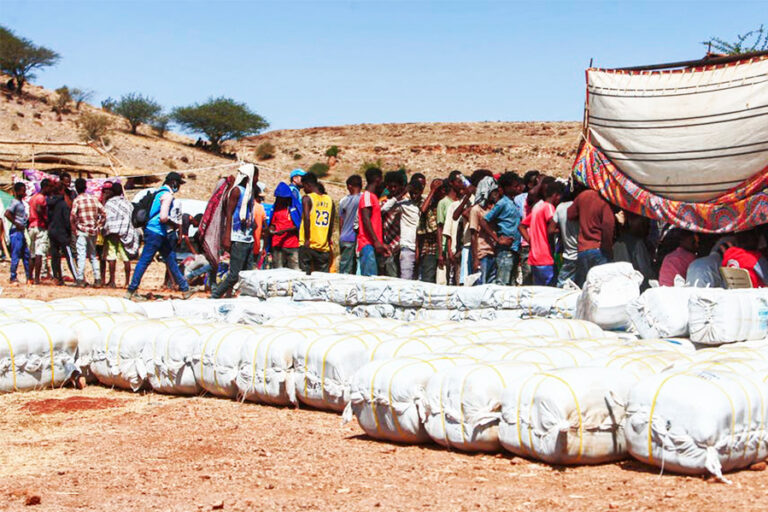
Internally Displaced Persons (IDPs) in Tigray region have surpassed the one million mark. The dire situation in the northern part of the country, Tigray region, remains concerning as the number of IDPs soars from day to day with conflict continuing in some parts of the region. The total population of Tigray region is estimated to stand at 5.5 million of which more than 1 million have been internally displaced by the current situation in the region.
“Violence and lack of assistance in the region especially in rural areas have driven displacement of people searching for safety and aid in the main towns across Tigray,” said Etenesh Negussie, communication head of the new interim government of the region.
“Up to this week, around 92,000 IDPs have entered the city of Mekelle,” highlighted Etenesh. In addition according to the Norwegian Refugee Council /NRC/, over 400,000 people fleeing intensifying conflict in western Tigray have recently arrived in Shire adding that 4.5 million people in Tigray region require humanitarian assistance.
As she said, there is a continues displacement of people from the western part of the region due to the tension between Amhara and Tigray ethnic groups, also the strain around Eritrea boarder and the unstopped conflict around the southern part of the region has aggravate the situation.
Even though it is becoming difficult to assist and support all the IDPs, it has been reported that people in the region are trying to reach towns where assistance is being delivered. Similarly, as Etenesh told Capital, the regional government is working to build camps for the internally displaced persons in the town of Mekelle.
Thousands of people, who have been sheltering in schools and universities and already living in extremely concerning conditions, are facing the prospect of relocation within one month due to back-to-school plans.
“Humanitarian partners are facing significant difficulties in identifying suitable alternative sites for displaced people and are stressing the urgent need to provide emergency shelter, water, sanitation and hygiene services, as well as supporting the management of settlements.
To date, nearly 62,000 refugees have been registered at the crossing points along the Sudan-Ethiopia border. To this end, humanitarian response efforts are focused on filling the existing gap in service delivery in the reception facilities.
It has been over four months since the law enforcement operation started in the Tigray region following the 4th of November 2020 attack on the Northern Command of Ethiopian National Defense Force (ENDF) by the Tigray Liberation Front.
After three weeks of military offense in Tigray region to enforce law and bring in the so called criminal group of Tigray Peoples Liberation Front /TPLF/ leaders on November 28, the government has announced the battle came to an end after taking Mekele, the capital city of the region, from the so called criminal group of TPLF.
It is to be recalled that the House of Federation had endorsed to establish an interim administration in Tigray Regional State following the defiant TPLF. The Interim Administration was established with the participation of independent and neutral scholars and political parties operating in Tigray.
Prime Minister Abiy, on the 3rd of March, announced that aid agencies can operate in the region by providing a notification to the Ministry of Peace. Following this significant development, organizations have begun notifying the Ministry and are working to urgently improve access to rural areas.
Following the transition to a flexible notification system for access, several organizations have deployed international staff to Tigray to scale up of the response.
Despite some progress in accessible areas, many people remain in hard-to-reach areas due to insecurity, logistical and administrative hurdles, where assistance is needed.
Tigray region IDPs exceed a million
Fueling programming skills whilst young

Created in 2017/18 by Nathan Damtew, an aspiring entrepreneur, B Blocky was an app developed to introduce kids to computer programming in a fun and interactive manner. It had a hundred levels each advanced when the learner gets a new skill. Yenetta Code was established in 2018/19.
Nathan believes computer code is the language of the future. He says it’s becoming just as crucial as reading and writing. He looks back at his own experience when he was first exposed to programming. He recalls that most of his classmates were learning about it for the first time. The university gave advanced courses so it was hard for the students to catch up. He never wanted to see another young person struggle with the same issues he did as a college student.
Yenetta Coding has taught more than 100 kids regularly at the center. The institution also throws events to introduce kids to coding and those events have had an outreach addressing more than 500 kids. The B Blocky app has been downloaded over 15,000 times around the world and anyone can find the app on googleplay.
The introductory part of coding isoften leant within 2-3 months. Yenetta uses pictorial representations for the lines of code used to solve problems, that way it could be easier for kids to learn. The kids are also taught to build games by coding them. They learn python, java and other programming languages. The classes run on Saturdays full day and also offers an after school program where the staff travel to schools and train the children. After the pandemic however, has forced the institute to give online classes as well.
The company now employs 10 with the team including a developer, content creator, and marketer. The company’s goal is to reach as many kids in the country and the continent. Nathan believes the biggest resource Africa has is its people and these people would be skilled because we’re moving into a digital era.
“It is important to build a digital economy with programmers. Ethiopia buys and imports softawares from foreign countries which isn’t too profitable in the long run. B Bloky was made to fit the platform of the growing mobile phone users and the company aims to reachg 18 million users by the next 5-10 years,” stated Nathan.
“The challenges that the institute has faced so far have been convincing parents to teach their kids things other than sports in their spare time,” he added elaborating that Yenetta as a whole urges the government to intergrate coding into the curriculum like other countries already have. Nathan adds that coding teaches kids life long skills like critical thinking, problem solving, and creativity.
MoF adjusts price on cement, rebar and ceramics
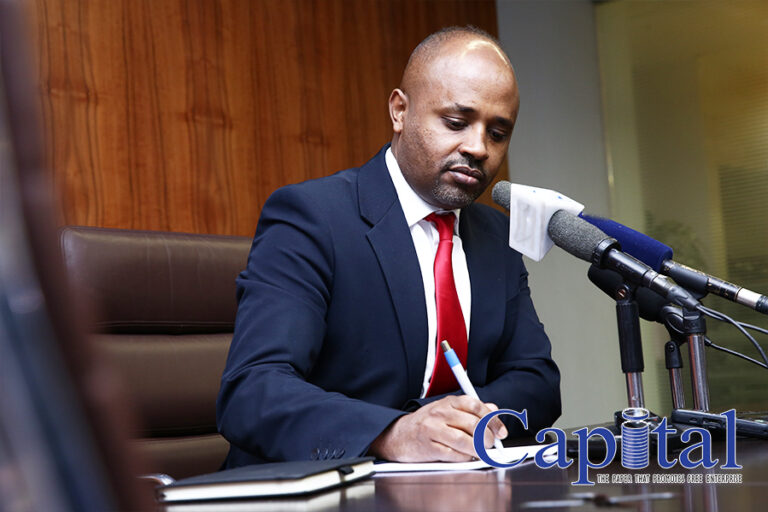
Ministry of Finance (MoF) has given a green light for a price adjustment on three construction commodities as per the request of the Ministry of Construction and Urban Development (MoCUD).
In a letter issued on March 5, 2021 and signed by Eyob Tekalegn, State Minister of Finance, MoF has given the adjustment of price on cement, rebar and ceramics due to the price escalation that was observed in the market.
MoF, which is responsible in controlling public procurement and in giving price adjustments on contracts, on its letter reminded that the concern informed by MoCUD on price escalation on construction material that affects the construction industry was received.
It added that under the public procurement directive of 2010, public offices shall adjust when price escalation transpires.
According to MoCUD’s price analysis volatility has been observed on the market of cement, rebar and ceramics, while some public offices did not mention about price adjustment on their contract or others who included the phrase on their contract are lagging to respond for the request of contractors to adjust the price on time which has become a major challenge for the construction industry.
As per the understanding of the problems that faces the industry and based on the directive that gives the right to adjust the price; on its letter MoF has given a permit to adjust the price on the stated three construction materials.
It explained that unless otherwise, the price escalation occurred on performance delay of contractors against their contract, the price adjustment shall be given under article 16/4 and 16/7/3 B.
According to the letter that Capital obtained, the copy has also ordered public offices that did not include the price adjustment on their contract to adjust the price since it was supposed to be mentioned on the contract agreement under the directive that was issued 11 years ago.
It has also advised the public office to give special attention for contractor administration to undertake required evaluation and control for the sake of mitigating the challenge on the construction industry in general and local contractors in particular.
It added that MoCUD and other relevant offices should control and provide technical support on the implementation of the adjustment.
About the price adjustment, the procurement directive article 16/4 J said that whether it is possible to make price adjustment in the course of the performance of the contract and the condition in which such price adjustment is made if it is allowed.
Article 16/7 B also added that provisions for the important terms of the contract such as time of delivery, packing, responsibility for transportation, price adjustment, payment, delivery and inspection, security and others as the case may be.
The same directive in article 5, sub-article 14 had also stated that certain price adjustments made in the process of procurement is in keeping with the procedure and the requirements of price adjustment set forth in article 16/14 of this directive.
Takaful insurance gains traction from insurers

More insurers have filed their application to the National Bank of Ethiopia (NBE) to be involved in Takaful service besides Global Insurance, which is the first to introduce the service. Similarly, a Global Takaful Forum has been held in Ethiopia.
Since the insurance business proclamation was amended in January 2020 and the directive for Takaful business in June, Global Insurance Company has become a pioneer in introducing the Takaful insurance service in the country that aims to address those who were excluded from the insurance sector.
According to Belay Tulu, Director of Insurance Supervision Directorate at NBE, at least two insurers have expressed their interest to commence the Takaful business as an alternative on a separate window.
He told Capital that the governing body has provided advice and support to those who demand to operate Takaful. “It needs more attention since it is different than other insurance business,” he added.
“We have preferred to confirm them to understand the business and help them in their preparation to commence the service prior to giving a license to the companies. As a result, we have provided support along the process,” Belay says, “we are working with them jointly to enhance capability for their operation.”
Fikru Tsegaye, acting CEO of Ethiopian Reinsurance, on his presentation about the Takaful business in Ethiopia at the forum held on Thursday 18 at Hyatt Regency said that Awash, Oromia and Nyala insurances have conducted a study to join the Takaful service.
Belay said that there is also interest to open a full-fledged Takaful insurance.
“An organizer of a full-fledge Takaful insurance company has approached NBE and we have consulted them, but they did not formally file for the undertaking of the formation of the company,” he reveled.
He said that sector capacity in the country and expertise including NBE is very limited that first requires growth. Such kind of forums and trainings is required to be facilitated to expand the service in the country and included those who are excluded because of their religion. “The takaful business will be instrumental since the conventional insurance still remains dormant in the country and will enhance significant contribution for the economy on the higher level,” the Insurance Supervision head underlined.
The Global Takaful Forum that also observed the re-takaful business was followed by experience sharing and trainings for two more days and was organized by Alhuda CIBE, a prominent consultant on the industry, Ethiopian Reinsurance and NBE.
Asseged Gebremedhin, Deputy CEO of Global Insurance Company, said that the global forum is crucial on sharing knowledge and experience from those who have huge global experience on takaful service.
He said that several experts from abroad have attended the forum that shall help uplift the Ethiopian takaful business. Asseged said that about 20 papers have been presented on the forum.
