Sunday, October 11, 2026
Home Blog Page 3136

A look back at Vincent Enyeama’s career

0

Born in 1982 in Aba, Vincent Enyeama grew up in the university city of Uyo, alongside his father (coach) and half-brother Aniekan (former Auxerre player). From a young age, he opted for the goalkeeper position, as a big fan of the legend Ewin Van Der sar. In the 2010s, the former Nigerian international was considered one of the great guardians of League 1.

His professional beginnings

Nigeria’s iconic former Super Eagles goalkeeper made his debut in football back home. Besides, his country nigeria has enough visitors on https://22bet.co.tz/ His first contract came very quickly, and this with the club of Ibom Star where he will impose himself as indisputable. He will score a goal in spite of his position. After this adventure, he bounced back to Enyimba where he will play for 4 years. This period at the top level will allow him to win his first selection with the national team of Nigeria where he was summoned for the 2002 World Cup. But he will only be the replacement of Ike Shorunmu. But in 2004, his career really started in selection and there, he will play a lot of matches with his nation, even in club situation. He will join Iwuanyanwu, the current Hertland Football Club, in 2005 with a total of 36 games on the season before flying to Israel.

His visit to Israel in Lille OSC

It is in Israel that Enyeama will have his first experience outside his country. He joined the Israeli club Bnei Yehudah FC where he will even play a continental cup, the UEFA Cup. In 2007, he will start a new adventure at Hapoël Tel-Aviv, a club well known in the championship. In this new club, he will play a total of 164 TCC matches in 4 years. He will have the chance to contest both the Europa League and the Champions League. In 2009-10, he will have an exceptional season, certainly the most important of his career.He played 47 club games and scored 9 goals, just incredible for a goalkeeper. In selection, it is a total of 14 selections.

After this magnificent season in 2010, he will hit the eye of several European clubs. But finally, he will engage with the LOSC, in Ligue 1. He became, after his arrival, the second guard of the club after Mickaël Landreau. Unhappy with his replacement position, he asked for a loan departure in Israel at the end of the 2011-2012 season. Thus he will engage with Maccabi Tel-Aviv, rival of his former club Hapoël Tel-Aviv. Returning to Lille after his loan, he became number 1 under the orders of René Girard, his new coach. This was during the 2013-2014 season.

Selected route

In the national team, Vincent Enyeama is the record holder for the number of selections with 101 capes to his credit, ex-æ quo with Joseph Yobo. After having failed at the 2004, 2006, 2008 and 2010 World Cup, he will finally win the prize with the Super Eagles in 2013. In particular, his three World Cup appearances (2002, 2010 and 2014).

In 2020, Vincent Enyeama joined the Iris Club de Croix as coach of the U16 (reserve team). But long before that, he had already announced the end of his professional career.

Awards

With Enyimba FC, Enyeama won the CAF Champions League in 2003 and 2004 and the CAF Supercup in 2004. In Israel, he won the champion in 2010, the Israel Cup in 2010 and 2011 under the colours of Hapoël Tel-Aviv. In 2013, but now with Maccabi Tel-Aviv, he won the Israeli championship once again. With Lille OSC, he won nothing, but was a finalist in the League Cup in 2016. With the Super Eagles of Nigeria, he will be crowned African champion in 2013.

Coming soon

0

CapitalCheck is a local multilingual fact-checking project based in Ethiopia, formed inside Capital’s newsroom, dedicated to verifying media contents from social to the mainstream. CapitalCheck works in collaboration with different media outlets to monitor media contents in English and four local languages (Amharic, Afaan Oromo, Tigrigna, and Somali)


Phase I of Africa CDC completes

0

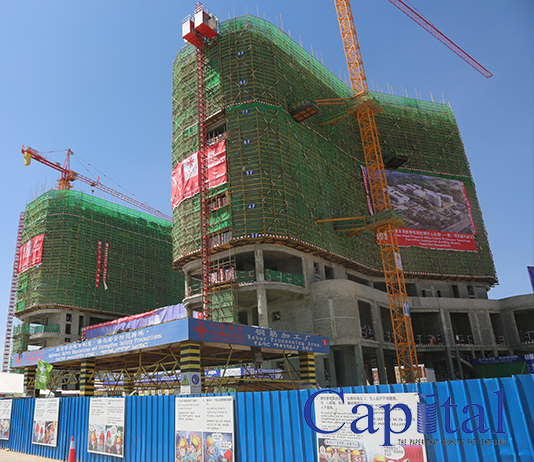
The Chinese aided African Union’s Center for Disease Control and Prevention (Africa CDC) headquarters building project commemorated it’s topping out ceremony at the project site on Friday November 26. The topping out ceremony marked the completion of the first phase of the project.
Construction of the headquarters began in December 2020 with the project completion scheduled in 24 months. The headquarters rest in an area of 40,000 square meters. After completion the facility will house laboratories, emergency operation center and offices among others.
Within a construction period of less than a year, 45 percent the project is completed consuming USD 20 million out of the total budget of USD 100 million. The project is fully funded by the government of China.
During the ceremony, head of China’s Mission to the African Union, Ambassador Liu Yuxi praised the partnership between China and the AU.
The implementation agreement on the Africa CDC HQs building project was signed in July 2020 between the AU Commission and the Ministry of Commerce of the People’s Republic of China.
The headquarters in Addis Ababa will be finalized by early 2023. Africa CDC has a plan of building additional five Regional Collaborating Centers in Egypt, Gabon, Kenya, Nigeria, and Zambia in the near future.
The Africa CDC was established in January 2016 by the 26th Ordinary Assembly of Heads of State and Government to improve coordination among health institutions among African Union member states in dealing with disease threats. African Union member states had first considered the idea of establishing a continent wide public health agency in 2013 at an AU Special Summit on HIV, Tuberculosis and Malaria in Abuja Nigeria. The idea was proposed by Ethiopia, then the Chair of the AU. The 2014 Ebola crisis accelerated the establishment of the Africa CDC, and also shaped perceptions of what its main purpose was to be and strengthened the importance of health emergency prevention and response. In July 2015, the African Union Ministers of Health meeting in Malabo had adopted the Statute of the Africa CDC, which called for fast-tracking the establishment of the institution. The agency was officially launched in January 2017.

ECX preps to floor aromatic gum, resins

0

The Ethiopian Commodity Exchange (ECX) that has been in modern trading facilitation for almost 13 years is on the process to embark the trading of aromatic gum and resins.
The exchange that is working to add more commodities on the electronic trading floor is now developing a contract for frankincense, myrrh and opopanax that are classified as aromatic gum. The floor has also planned to trade, gum Arabic, which is non-aromatic gum and resins.
According to the information Capital obtained from ECX, the trading floor has drafted the contract that was tabled on the panel of exports consultation for private and enterprises stakeholders and relevant public bodies like the Ministry of Agriculture.
During the discussion, relevant inputs were given to improve the draft contract document that considers grades and different measurements.
Further industry level consultation with stakeholders including suppliers and exporters is expected to be undertaken to introduce the trading at ECX.
The information indicated that ECX has targeted to commence the trading in this budget year, while it would depend on the preparation work.
Ethiopia is considered to have a long-established gums and resins sector, experienced in harvesting, grading, trading and exporting. The country is also considered as the widest range of endemic gums and resins in Africa, “and this represents an important commercial resource base for the country,” a Global Business Network Program document stated.
Different studies indicated that Ethiopia is one of the countries well endowed with various species of Acacia, Boswellia and Commiphora that are known to produce gum arabic, frankincense and myrrh, respectively.
Available estimates of the total area of oleo-gum resin bearing woodlands cover about 3.5 million hectares of land in the country, with over 35,000 to 114,000 metric tons of natural gum production potential. According to different study report, gum and resins production are playing significant economic role both at the local and national level today in Ethiopia, and their contribution is growing every year.
According to the Global Business Network Program document, the annual formal exports are around the 5,000 tonnes level.
A study that was conducted about a decade ago indicated that gum and resins is one of the forest export commodity that contributes over USD 30 million annually.
Frankincense, also known as Olibanum – these comprise sources from three different geographical zones, namely Tigray, Ogaden and Borena. The most commercially traded is from Tigray, Boswellia papyrifera, whilst the principal commercial species from the other main areas are Boswellia rivae and Boswellia neglecta. Myrrh and Opoponax – various species that are most likely endemic to Ethiopia, these include Commiphora myrrha as well as Commiphora guditti.
Ethiopia is one of the countries well endowed with various species of Acacia, Boswellia and Commiphora that are known to produce gum arabic, frankincense and myrrh, respectively. Available estimates of the total area of oleo-gum resin bearing woodlands cover about 3.5 million ha of land in the country, with over 30,000-33,000 metric tons of natural gum production potential. According to different study report, gum and resins production are playing significant economic role both at the local and national level today in Ethiopia, and their contribution is growing every year.
ECX which is at the heart of trading agricultural crop mainly trades; coffee, sesame seeds, soybean, white pea beans, green mung beans, speckled beans, red kidney beans and pigeon beans.
Recently the trading of four spices and vetch has been introduced to its electronic trading platform that started operation in 2008.