

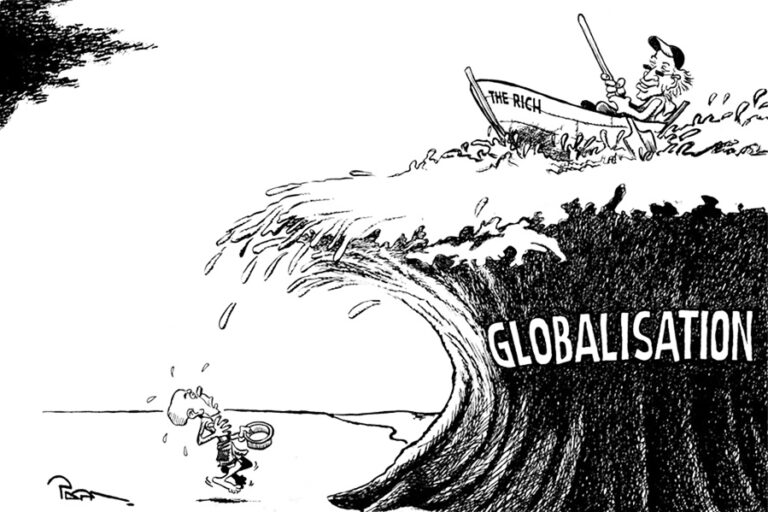
Globalization is not something that is entirely new. We can easily trace it back to the late fourteen hundred, if not earlier. The incorporation of the Americas (1492) into the then global trading system intensified world economic integration. Paradoxically, the resource of the Americas enlarged the scope of globalization, while at the same time ushering its physical limit (the last major frontier). Granted, in those days globalization was not a deeply entrenched phenomenon, both temporally and spatially, but nevertheless, there was extensive trade taking place between regions, including robust trade in human lives as well, slavery. What modernity/technology brought to the global economic system was/is; increased interconnectedness and depth of integration, mostly along the line/logic of capital. The other factor of production, namely labor, remained (relatively) immobile under the ascending globalization. In other words, labor’s usual free movement, relatively speaking, was/is gradually circumscribed by the burgeoning interstate system!
The prevailing complex global infrastructures (physical or otherwise) that were gradually built up with the explicit assumption of abundant/cheap energy and more (inexhaustible biosphere/resources) are currently undergoing severe constrictions. Without these infrastructures, the intense globalization that permeates global life today will unwind at ferocious speed, to the detriment of social peace and stability! As we have been saying all along, complex systems are precarious by nature, hence are vulnerable to the slightest perturbation from within and without. To keep a highly complex system going requires high level of maintenance (continuous energy input) that might not always be available, given the nature of our environment as well as our own very make up. Take the simple example of the Fukushima nuclear power accident. The plant was set up to generate energy for the unrelenting globalized economy of Japan. But human hubris and nature’s fury conspired to render the complex subsystem unworkable. The complex has become, unenviably, the worst nuclear power accident the world has ever seen, propaganda aside! What is even worse, collective techno humanity doesn’t seem to have a clue on how to stop or even mitigate the ongoing unmitigated disaster. As a result, plenty of high-level radiation is continuously entering the biosphere causing cancer, mutation, etc. on all life forms, while the long-term consequences remain unknowably unknown!
Surprisingly, globalization has also brought extreme polarization unseen in centuries past! A couple of hundreds years ago, the degree of inequality between the sheeple (human mass) in the core countries (say UK) and its counterpart in the periphery (like Sub-Saharan Africa) was only three to four folds. Today with all the material, social, technical, etc. achievements, polarization between individuals within a country as well as between nations is frighteningly stark. Measuring inequalities between individuals (using income), for example, say between the USA and Sub-Saharan Africa, one observes the following. A minimum wage earner makes about $25,000 in the US, while a top CEO can garner a salary of $25,000,000 (without adding other benefits), which works out to about a 1000 fold. In the rich countries (OECD) GDP/capita is about $39,000 while average GDP/capita in Sub-Saharan Africa is less than $1500, which translates to over twenty-five fold! Another major indictment of the prevailing polarizing globalization is, its rampant abuse of non-renewable resources. An ordinary meal on a dinner plate of a typical US household has travelled, on average, thousands of miles, utilizing all sorts of non-renewable resources, like fossil fuel, etc.
As we reach the various limits of the ecosystem, scaling back globalization will become imperative. In a nutshell, this is called ‘Localization’ and it entails, amongst other things, the followings. Food must be grown nearby and naturally, in as much as possible. Nonessential travel as well as the unnecessary transport of goods must be severely curtailed, if we are to reduce carbon footprint per capita. Even governance must be increasingly localized to help challenge the current suffocating preponderance of the greed infested transnational corporations. Social relations will also benefit from proximity, if parochialism is kept at bay by enlightening education (not indoctrination) and recollected virtues. Localization can also help recapture our long forgotten human scale, whose (almost complete) absence has encouraged mass psychosis across the board. One cannot talk about the important concept of chronic alienation from which modern wo(man) continues to suffer without giving due credence to the radical philosopher who mercilessly deciphered it at the time of its modern inception. Commodity production (production for exchange rather than for use), rigidly stratified societies, etc. are where alienation (helplessly becoming just a cog in the wheel) started to creep up, according to Karl Marx.
All the above will not come about without determined, principled and protracted struggle against those who perpetuate unsustainability, in all its forms. The prevailing order is out to get those who try to preserve sanity, gun control, environmental protection, etc.! To this end, the order systemically promotes individual as well as institutional (collective) stupidity via its myriad tentacles. Can anyone imagine mass shootings in schools/colleges/churches, etc. without guns?
GLOBALIZATION vs. LOCALIZATION
Blossoming education in Tiya
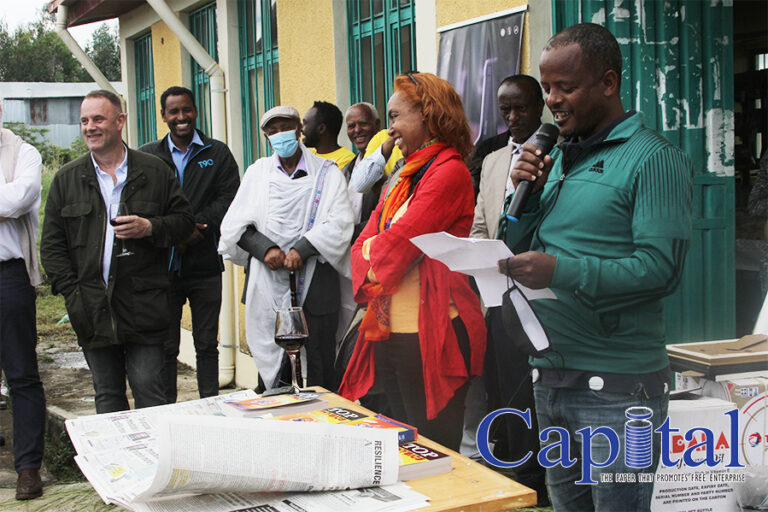
Awash Wine SC delivers close to 400 supplementary text books worth fifty thousand birr to Tiya secondary school located in the south region around the prehistoric area and UNESCO world heritage center of Tiya Stelae with the support and coordination of SMLH Ethiopia.
“As part of our corporate social responsibility Awash Wine has proudly handed over the support to the school,” said Girma Belay, Corporate Affairs Director of Awash Wine SC, adding, “Awash has been and will continue working with such kinds of community organizations to strengthen its support to the society.”
The event was attended by Ambassadors from Canada, Morocco, Australia, Greece, Poland, Norway, Portugal and EU ambassador to Ethiopia as well as head of the Sodo woreda education bureau, Aklilu Gembae, the school director and representatives from local community at the premises of the school.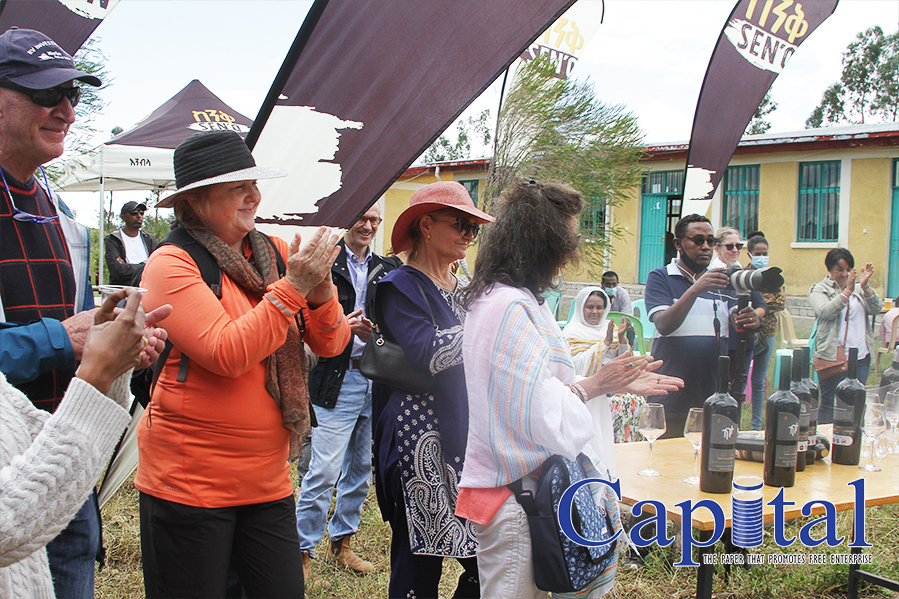
Beside, organizing the support SMLH Ethiopia has been supporting the school including financing the connection of the school with the public water system. The association of SMLH Ethiopia was formed in 2013 by the recipients of the French government’s award of the Legion of Honor and ‘Ordre National du Merite’ in recognition of eminent services rendered to their country and the strengthening of Franco-Ethiopian bilateral relations. SMLH-ONM Ethiopia brings together the decorated of these two French national orders living in Ethiopia, both French and Ethiopian nationals.
Since 2017 the section was joined by those honored with French ministerial awards, mainly academic awards in arts and literatures as well as agricultural merit, and maritime merit among others.
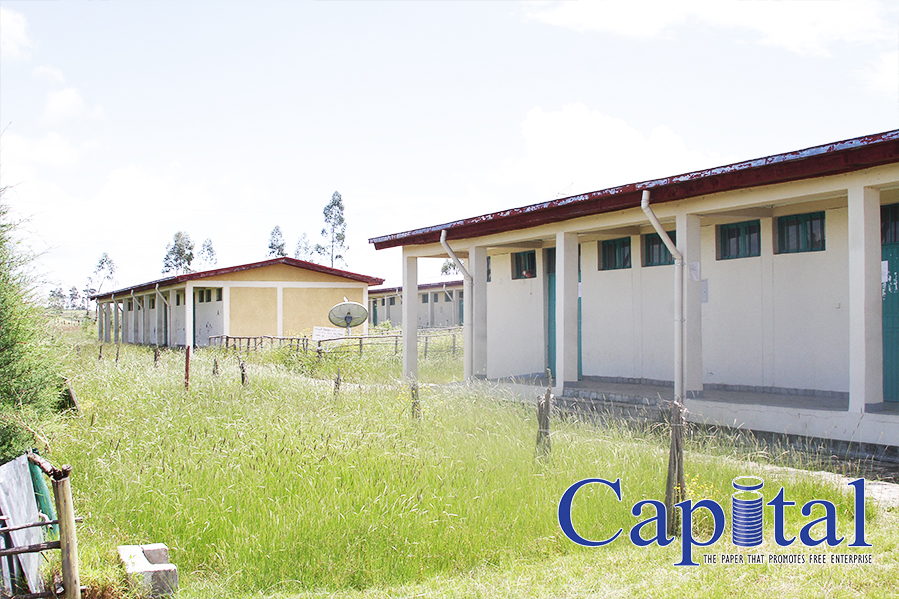
The school which was established 15 years ago starting at the kindergarten level with the support of French embassy and Turkish embassy, and later by JICA has now blossomed to a secondary school fully giving classes from 9th to 12 grade students.
“This visit to Tiya is intended to fulfill our duty of solidarity and mutual support which are values embodied in the Legion d’honneur,” said Teguest Yilma president of SMLH.
Favorable external environment to boost growth, IMF report indicates
The latest economic outlook of the International Monetary Fund (IMF) forecasts an improved external environment will support key exports and foreign direct investment and remittance inflows of Ethiopia.
Despite the 2020 outlook that was published in October 2020 projecting the country’s real GDP growth to be zero for 2021, improvements have been recorded which now stands at two percent.
“Ethiopia’s growth forecast for 2021 remains unchanged at 2.0 percent, with growth in 2022 facing headwinds from the slow pace of vaccination, a possible pickup in COVID-19 infections, and the Tigray conflict,” it said.
Meanwhile the forecast for 2022 did not give a numerical estimation on the latest report.
Similarly a year ago, the IMF had projected that the government debt shall stand at 58.5 percent of the GDP, however the latest report that was issued on Thursday October 21 forecasts it will stand at 57.1 percent over one percent lower than the preceding projection. Similar to GDP, IMF did not forecast the 2022 projections owing to an unusually high degree of uncertainty.
For the 2021 Ethiopia’s reserve was estimated to be 1.8 months of imports of goods and services. The reserve amount has declined from two months estimation for 2020. The country reserve amount was on its peak to 2.2 months in 2019 which in comparison was stated that it would be better to be at least three months similar to the global standard.
Most of sub Saharan African countries reserve has estimated to show reduction in the 2022.
On its outlook IMF stated that Sub-Saharan Africa is projected to grow by 3.7 percent in 2021 and 3.8 percent in 2022, “a welcome but relatively modest recovery, suggesting that divergence with the rest of the world will persist over the medium term.”
It said that the Sub-Saharan Africa’s economy is set to recover in 2021 – a marked improvement over the extraordinary contraction of 2020. This rebound is most welcome and primarily results from a favorable external environment, including a sharp improvement in trade and commodity prices. In addition, improved harvests have lifted agricultural production, “yet, the outlook remains highly uncertain as the recovery depends on the progress in the fight against COVID-19 and is vulnerable to disruptions in global activity and financial markets.”
“As sub-Saharan Africa navigates through a persistent pandemic with repeated waves of infection, a return to normal will be far from easy,” stressed Abebe Aemro Selassie, Director of the IMF’s African Department. In the absence of vaccines, lockdowns and other containment measures have been the only option for containing the virus.
At 3.7 percent this year, the recovery in sub-Saharan Africa will be the slowest in the world—as advanced markets grow by more than 5 percent, while other emerging markets and developing countries grow by more than 6 percent. This mismatch reflects sub-Saharan Africa’s slow vaccine rollout and stark differences in policy space.
Goh Betoch Bank officially opens its doors

Goh Betoch Bank SC, the first mortgage financial firm, is officially set to open its door as of tomorrow at its head quarter.
The mortgage bank that received its license from the financial sector supervisory body, National Bank of Ethiopia (NBE), in August is expected to be an alternative source of finance for housing scheme, which usually access less than 10 percent from the total fresh loans in the financial industry.
The information obtained from Goh indicated that the first branch of the bank will be opened on Africa Avenue, Abderuf Building around Japan Embassy starting from October 25 as the 21st bank.
The bank that is also expected to conduct other commercial banking services besides mortgage has targeted to expand its presence at the capital and other cities in the coming months.
At the official license handing over ceremony held mid-August Yinager Dessie, Governor of NBE, promised to back the operation of the first private mortgage bank with supportive policy direction since the operation of the bank is unique from the usual commercial banking activity.
At the ceremony Mulugeta Asmare, founding president of Goh, said that the bank is expected to see some policy changes from the regulatory body and the government in general to attain its target, which is also one of the government top economic development pillars that is mentioned on its ten year economic plan.
Couple months ago Getahun Nanam, Chairperson of Board of Directors of Goh and former Vice Governor of NBE, said that the bank has been in process for three years to realize the dream to become the first mortgage bank in the country.
He said that the housing financing scheme in Ethiopia is very poor despite the demand being very high making the housing issue a top priority.
Getahun cited a study that to ease the current accumulated housing demands, at least 1.2 million houses ought to be built as soon as possible, “besides that every year 100,000 houses have to be constructed to cover fresh demands.”
According to the veteran financial pundit, 70 percent of the existed houses in cities are under standard that actually need reconstruction.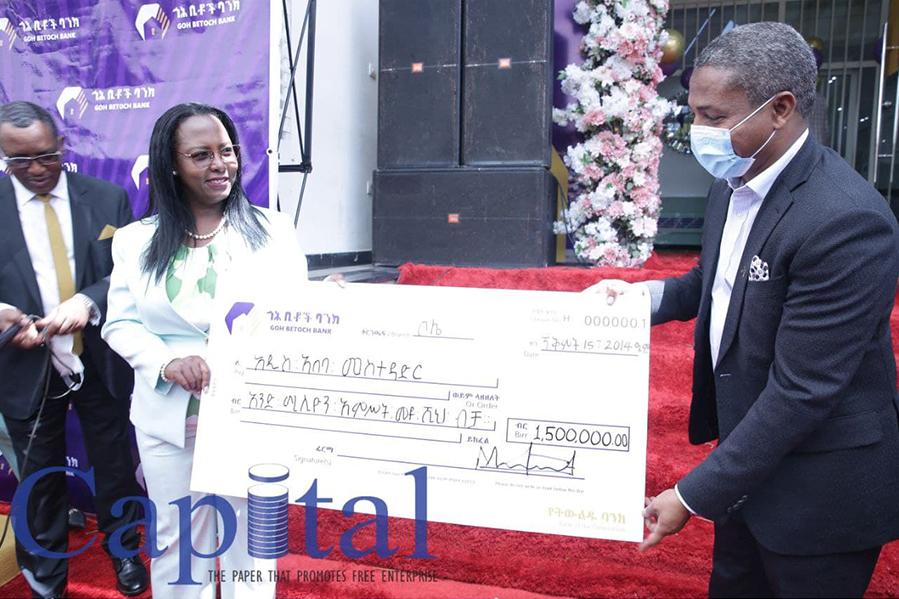
“Meanwhile this is the reality; the existed financial firms are not providing the required fund for the housing and construction sector. Due to that we are formed to fill the gap,” the Board of Directors Chair explained.
According to data from NBE the construction and housing sector has not benefited more than 10 percent of the total loans that banks provide.
“Currently, except the Development Bank of Ethiopia all banks have similar operation and with similar policy but when it comes to Goh, we are coming with different services that need different regulation and policy from the regulatory body,” Mulugeta elaborates, adding, “due to that starting from policy change we need support from NBE to amplify our operation.”
“We want to see preferential treatments on NBE policies like the composition on long term loans portfolio, which is now 20 percent of the total portion of loans and advances for commercial banks, and enable to be partner with foreign fund sources,” Mulugeta, who is well know by his role to register massive success at Bank of Abyssinia as a president, told Capital.
The policy change on the composition of loan portfolio would allow the bank to get huge amount of long term deposit and at the same time provide long term loans that are given for more than five years.
Goh has targeted that the majority share of loans portfolio would be long term.
“There are also opportunities that Goh shall work with international institutions to access and using idle funds to support our mortgage business, due to that on this side also NBE is expected to make consideration,” he explains, while he added that so far the bank would use the current environment for operation.
Mulugeta said that the bank also expects conducive policy environment and other segments of supports from Ministry of Urban Development and Construction and similar public offices in regions and cities to realize the housing solution in the country.
Yinager said that NBE will consider supports for such kind of specialized financial firms, “the country needs different specialized banks besides the existing commercial banking scheme.”
He said that currently, most of the existing banks are financing the commerce, while residential housing problem mainly in urban areas is very high that should be backed by a financing scheme.
Goh includes 6,658 shareholders. Its subscribed capital is 1.056 billion birr of which 521.5 million has been paid up.
Goh is the first after the Housing and Saving Bank (HSB) that was formed by the merger of Imperial Savings and Home Ownership Association and the Savings and Mortgage Corporation of Ethiopia mid 1970 during the Derg period. HSB was also reconstituted to Construction and Business Bank (CBB) in 1994 before it became defunct and merged under the state giant Commercial Bank of Ethiopia in 2016.
