

Ethiopian Football Federation is set to slash the number of foreign footballers in Premier League club’s squads next season while Super League and first division clubs are no longer permitted to enjoy imported footballers service. The hot issue of banning foreign goalkeepers in favor of home-grown talents has not yet reached to agreements among the league clubs.
The previous regulation that permits premier league clubs to register a maximum of five players in their squad and a field maximum of four in the starting line-up has now changed for clubs at the top tier since they are now to register only three foreign players. Champions Fasil Ketema, St George, Bahirdar and Hawassa were of the few with four foreign players while relegated side Adama Ketema and relegation survived Sidama Bunna were boasting five expatriates.
It is not only the number but their performance on the field was questionable for most of the foreign players. Some clubs had had regular benches while others hardly delivering better than the local boys. “Ethiopian Football could be flooded with mediocre and past their prime players from neighboring African nations whose level is lower than that of domestic footballers,” critics suggested.
Though no one including national technical director Sewnet Bishaw and former national coach Abraham T/Haimanot mentioned the implication of the influx of foreign players in the country’s football, the latest move of the Federation is considered historic and a would be spring board for the future young talents.
Although importing goalkeepers denies opportunities for real talents in the most vital position of football the federation took a chance of postponing the decision until after the clubs’ intention towards it. Some clubs notably champions Fasil is said to be hesitant to stand behind the decision ahead of the coming international fixtures.
Foreign players’ number in Premier League clubs slashed to three
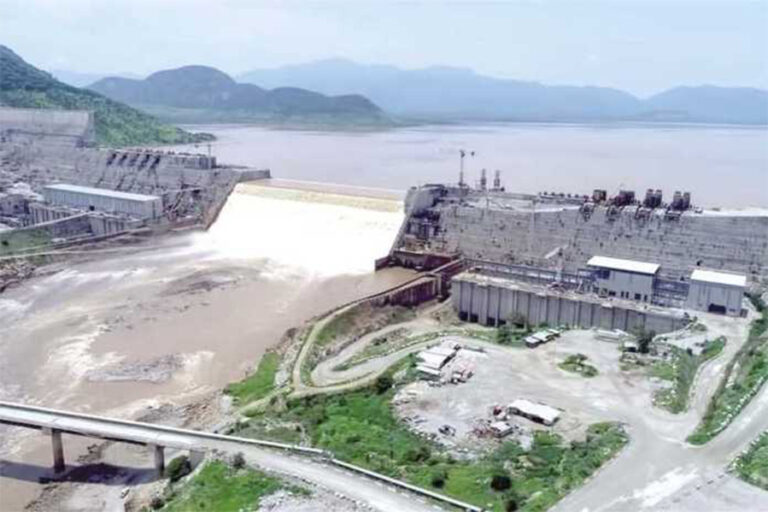
Ethiopia’s GERD Impounds Water
By Alemayehu Gessesse
The construction of Grand Ethiopian Renaissance Dam (GERD) along the Blue Nile River has been undergoing for over nine years. The ground breaking ceremony and commencement of construction was held on April 2, 2012 with initial plans to complete the project within five years. Due to a number of technical challenges and mismanagement by the then TPLF/EPRDF government, the project registered insurmountable cost and time overruns.
The project is a huge and complex undertaking and the first of its kind ever attempted by Ethiopia along the Nile basin. Not only is the size and technical complexity that makes the project unique but also the source of finance. The entire project cost of some USD 5+ billion is covered by Ethiopia with no loans from any external sources. This is too overwhelming a cost to a poor country like Ethiopia where there is no fossil fuel or any other dependable income. The main domestic sources are the government from its meagre coffers and contribution by Ethiopians.
The project is a hydroelectric dam able to store about 74 billion cubic meters of water. The stored water is continually released from the reservoir to turn the turbines which in turn underpin the generating sets. The initial plan was to generate 5,250 megawatts (MW) of electricity. Subsequent design modifications elevated the generation capacity to over 6,000 MW.
The economic, financial, social and environmental benefits accruing from this project is a game changer in Ethiopia’s overall development ambitions. Suffering from recurring drought and dehumanizing poverty, Ethiopia was and still is dependent on handouts from the developed world. There is a general consensus among the public and the government that the sad state of affairs shall drastically and reliably change sooner than later. Doing so requires meticulous planning followed by organizing the available resources in the best optimum way through a responsible leadership.
In the past three years, under the leadership of Prime Minister Abiy Ahmed, a number of large projects that were strangled from leadership incompetence and rampant corruption are rescued. Just to cite few examples, seven out of the ten sugar projects that were delayed for over eight years are completed. Koysha hydropower project with the capacity of 2,000MW along the Omo River gained traction from the abyss. Irrigation projects scattered along the country are also in good shape after a long slumber. Of all those projects, what towers most is rescuing GERD.
The project’s leading cause of problems from among others was the incorporation of a local company, the defunct Metals and Engineering Corporation (MetEC), as subcontractor for the electromechnical components. Having no practical previous experience, the company was a disaster pill to the project and a hindrance to the main (European) Contractor. The very reason of inviting the company as a subcontractor was perhaps a sinister design by former officials to siphon money from the project under the guise of ‘capacity building’. After thorough technical assessments, a decision was made by the government to detach the project from MetEC and dismantle any midcore installations installed by the latter. Everything started afresh and the progress is now remarkably well above 82% percent. In the rainy season of 2020, GERD was able to store some 4.9 billion cubic meters. In July/August of 2021, another 13.5 billion cubic meters is scheduled to be stored, increasing the storage to 25% of the total storage capacity. This is enough to turn two turbines whose combined electricity output is about 750MW.
Ethiopia, a country of some 115 million, more than 60% of the population is off grid. The main source of energy available to the rural people is biomass from trees and agricultural byproducts causing colossal air pollution and environmental degradation. Recent studies in Ethiopia have indicated that smoke from firewood and cow dung as a source of energy is one critical adverse factor of health affecting the eyes and respiratory systems. Replacing the hitherto source of energy from biomass to environmentally clean electric energy from the GERD improves the economic, social and environmental conditions.
The availability of electricity across rural areas greatly helps in expanding education and health infrastructure to the needy. Peasants and their children working on their agriculture fields can attend schools in the evenings. Mothers can give birth in hospitals and clinics where electrically run medical equipment including refrigerators for medicine are available. The electric power is a linchpin in attracting various investments particularly in the fields of manufacturing, services, mining, agriculture and many others. The power is instrumental for availing water and sanitation facilities to the wider public through pumping surface and subsurface water sources. Irrigation agriculture can increase in multiple folds enabling supply of food for the hungry. Excess energy can be exported to neighabouring countries who are suffering from similar electric power deficit. The annual estimated revenue of electric power export is estimated at around USD one billion. The hard currency serves as a catalyst in significantly enhancing the socio-economic conditions of the nation.
Despite of the many internal and external challenges, Ethiopians are rallying with the government for the successful completion of the project. The internal challenges were successfully handled by holding former corrupt officials accountable and trouncing TPLF and its affiliates in the battle field. Thanks to the commitment of the government and the support of Ethiopians, the finance keeps flowing. The internal hurdle is therefore substantially resolved in a decisive way. The external challenges (a subject of another article) are still existential but will soon ebb away. If Mother Nature allows enough water to shower in the in this rainy season, the dam is ready to impound the planned volume of water making possible the initial phase (750MW) of electricity generation to join the national grid as recently as September 2021. That will deservedly be a joyful moment for all Ethiopians in the new Ethiopian New Year.
Alemayehu Gessesse is a Practicing Civil Engineer from Ethiopia. He writes on civil engineering projects, hydro politics of the Nile and seldom in geopolitics of the Horn of Africa. He can be contacted at alemges2021@gmail.com.
Overview of Kazakhstan’s 30 years of independence celebration in Addis
By Maya Demissie
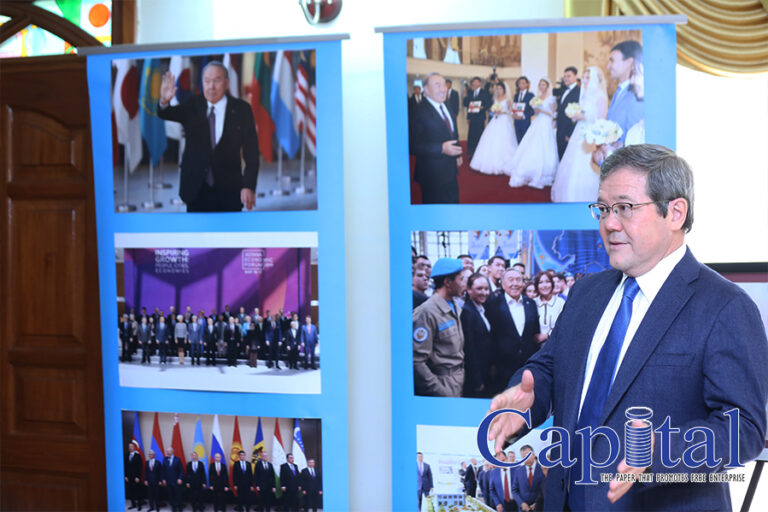
The Embassy of the Republic of Kazakhstan in Ethiopia held a seminar, “Cultural Heritage of Kazakhstan,” in honor of the 30th year of the nation’s independence on Thursday, July 08, 2021.
The seminar included an exhibition of Kazakhstani culture, politics, and monuments, the viewing of a documentary about Kazakhstani history, a presentation on the geography, architecture, and politics of the country, and performances by both Ethiopian and Kazakhstani musicians.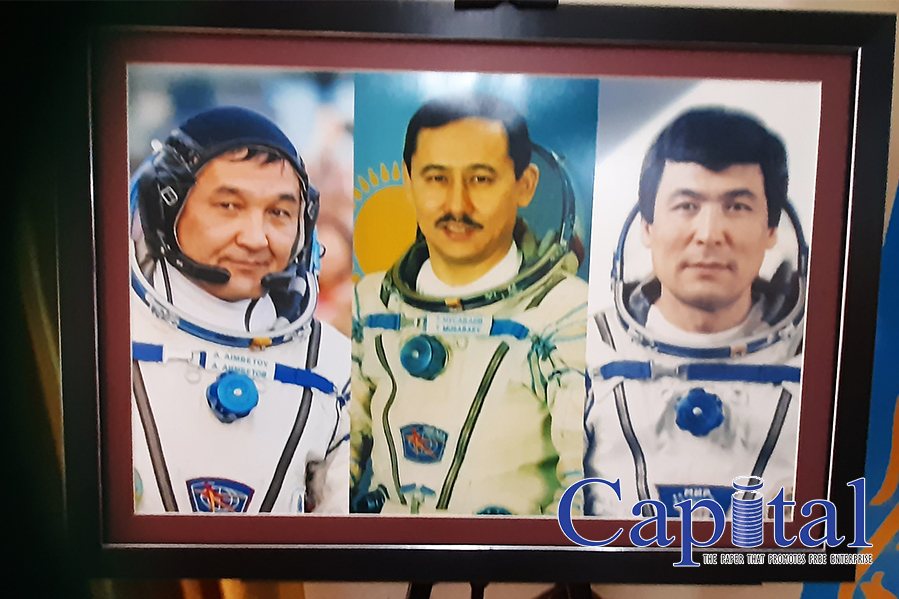
The focus of the seminar was on connecting the culture of Kazakhstan with the culture of Ethiopia. During the documentary and presentations, participants learned about Kazakhstan’s history. One organizer explained how Kazakhstani warriors used music to try and resolve disputes peacefully and avoid battle.
Participants also saw photos of Kazakhstani architecture, especially in the capital city of Nur-Sultan, including the Astana Opera, the president’s office or Ak-Orda, and the Palace of Peace and Reconciliation in Nur-Sultan.
The Embassy had a section in which participants were able to view and touch traditional Kazakhstani rugs, jewelry, cultural clothes, and decorations.
Similarly, the musical performances from both cultures worked towards that end. The Embassy invited Kazakhstani folk music singer Saule Duisenova to perform two songs with a dombra, a traditional instrument from Kazakhstan. A 6-man band then played Ethiopian music using traditional instruments such as an Ethiopian wood flute, African drums, and a masenqo.
The documentary also introduced participants to prominent figures in Kazakhstan’s past and present, from famous poets like Mukagali Makataev to musicians, wrestlers, educators, and independence-fighters.
The seminar also aimed to promote the vision of a peaceful Kazakhstan. Presenters described how Kazakhstan gave up its nuclear arsenal and has since supported the destruction of nuclear weapons to produce a world free of the threat of nuclear war.
The seminar also emphasized the religious and ethnic diversity of Kazakhstan, a trait it shares with Ethiopia, according to the presenters. Kazakhstan is home to over 130 different ethnic groups, as well as Jewish, Muslim, and Russian Orthodox Christian populations, according to the presentation.
Lastly, the seminar described the modern Kazakhstan, and how it aims to balance appreciation of its heritage and culture with the development and urbanization of the nation. Kazakhstan’s capital city, Nur-Sultan, was built from scratch, and holds both modern skyscrapers and traditional Kazakhstani architecture.
Coffee origins and culture explored in Museum of Islamic Art

Coffee, the universal pass time, is being explored in a new Museum of Islamic Art exhibition, from its origins in Ethiopia to its arrival in Israel.
By BARRY DAVIS
If your idea of a good cup of coffee is a throwaway receptacle brimming with some brown liquid, in all likelihood with a frothy topping, possibly sold by some global franchise or other, the “Coffee East and West” exhibition might help to redress that cheap and cheerful outlook.
The show, which will be unveiled at the Museum of Islamic Art on Thursday, July 15, under the devoted curatorship of Yahel Shefer, opens a window on a mesmerizing, rich and multifarious culture that has gained worldwide credence across the centuries.
So, where and when did our cup of joe come from? That, and much more, will be illuminated in the museum layout which follows five years of research and hunting down delightful and invaluable artifacts from all kinds of locations and cultures around the globe.
Many of us have probably been living with the misconception that coffee originates from South America. After all, isn’t Brazil synonymous with the household beverage?
Think again. It seems that Ethiopia was the first provider and exporter of coffee beans, initially to Yemen. That was back in the 15th century, and the new market player made significant inroads into this part of the world when the Ottoman Empire eventually embraced coffee as a popular drink and a desirable societal factor, and it gradually proliferated across the region, and subsequently into Europe. So, what has Shefer got lined up for us? The short answer is an abundance of artifacts and information, across a surprisingly broad sweep of areas.
Coffee, to my mind, is not just about the taste or the aroma. There is an alluring aesthetic hinterland to the drink which, I was to discover, embraces all manner of luxurious crockery, equipment and accessories.
(The Jerusalem Post)
