

Deputy President of Somali Regional State, Mustafa Omer along with high level officials has laid a cornerstone for the state-of-the-art public library to be built in Jigjiga town.
Deputy President of the region, on the occasion, said the library is the first in its kind in the region.
The total project cost of Birr 60 million will be covered by contributions from the public and budget from the regional government, Mustafa said.
Deputy President Mustafa further extended gratitude to those who started the initiative to build the state-of-the-art public library.
Somali Region Deputy President lays cornerstone for 60mln birr public library
Analyzing Africa
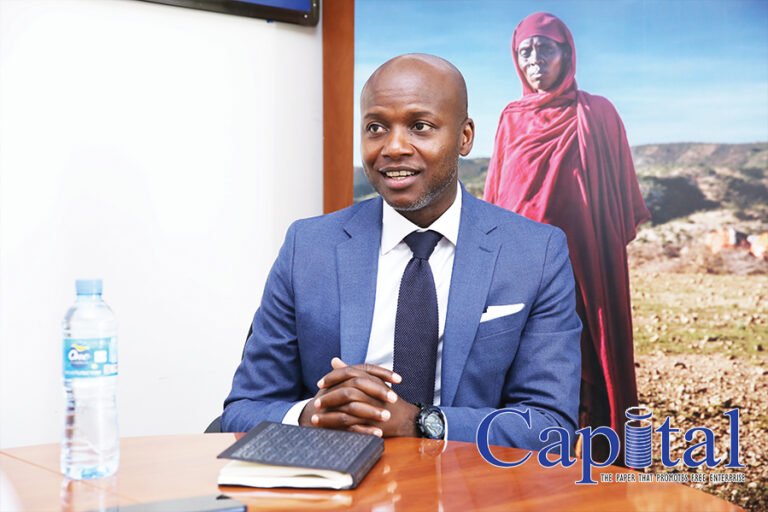
Fonteh Akum is the executive director of the Institute for Security Studies (ISS). He is the former head of the Lake Chad Basin programme in the Dakar office. He joined the ISS in 2017 as a senior researcher in the Peace and Security Research Programme in Pretoria, South Africa after which he moved to ISS Dakar as a senior researcher. Before joining the ISS he worked for the United States Department of Defense, the Council for the Development of Social Science Research in Africa, and the Africa Program of the United Nations University for Peace. Fonteh’s research covers violence, governance and human security in the Lake Chad Basin. He has a PhD in politics and international studies from the University of London’s School of Oriental and African Studies. He visited Ethiopia last week and met with different stakeholders to discuss ISS’ partnership. While here is Addis Ababa Capital sat down with his to discuss the works of ISS in Ethiopia and in Africa in general. Excerpts;
Capital: How does the Institute for Security Studies /ISS/ operate and what are your focuses?
Fonteh Akum: The Institute for Security Studies is pan-African non-governmental policy research organization which works in four main interconnected areas of intervention. Our evidence-based policy research feeds into the technical assistance to states, Regional Economic Communities as well as the African Union. The third area of work is capacity building and the fourth area of work is the convening of strategic and policy dialogue platforms. Here, we bring together actors who normally don’t get to interact among themselves on how to advance human security on the continent. So those axes of intervention will continue to undergird the implementation of the Institute’s 2021-2025 strategy which identifies six strategic outcome areas. These include delivering on African futures, gender equality, Africa in the world, governance peace and security, national and transnational crime and violence, as well as climate change and human security.
It is also worth noting that the ISS has offices in four locations across the continent. The headquarters were set up in Pretoria 30 years ago. Then followed the office here in Addis Ababa and Nairobi in 2004 and the office in Dakar, Senegal in 2010. We also have a satellite presence in Bamako to better cover the Sahel region.
Capital: what are your major engagements with the African Union?
Fonteh Akum: We have a number of engagements with the African Union. The ISS has a Memorandum of Understanding with the African Union, which frames and guides our engagements with the continental organisation. This allows us to provide timely research, critical analysis and technical support to the African Union on many thematic areas, upon request. In this context we get to sometimes help AU policymakers reflect on difficult questions with the goal of generating policy options for their consideration. The ISS also publishes the monthly Peace and Security Council (PSC) report which analyses issues on the AU Peace and Security Council agenda as well as important issues we feel should be prioritized for discussions. Recently we provided assistance in support of the AU’s work in the Sahel, for example through our Regional office for West Africa, the Sahel and the Lake Chad Basin. We also contributed to the AU’s work on elaborating of a framework on the management and resolution of local conflicts in the Sahel which is a preoccupation at the moment. Through the Training for Peace consortium which includes the African Center for the Constructive Resolution of Disputes based in Durban, South Africa and NUPI (the Norwegian Institute for International Affairs) we would provide technical assistance support to the AU’s Department for Political Affairs, Peace and Security.
Capital: The Sahel topic is hot issue, what’s your contribution to resolving these issues, Especially Chad’s president died this recently and there are certain consequences expected, what’s your contribution regarding solving that problems?
Fonteh Akum: Well, we strive for impact, first of all in clearly understanding what the dynamics and their root causes are. You would agree with me that the situation in chad at the moment remains fairly fluid. The fluid situation poses challenges in making hard policy decisions necessitating a focus on de-escalation, stabilization and transitions. Our researcher who is based in N’Djamena contributes to the analysis of a situation on the ground together with colleagues in Dakar and Addis Ababa to reach the requisite media and policy spaces. Secondly our long-term presence in the Lake Chad Basin, a program which I previously led has allowed us to actually build a strong network of analysts in the region. So, understanding the Chadian situation on one level requires grasping internal dynamics in Chad but also, on another level, understanding its implications for the broader region. Firstly, the Late President is the sitting head of the G5 Sahel coalition which includes Chad, Burkina Faso, Mauritania, Mali and Niger. It creates quite a problem when the president of a coalition which is actually fighting terrorists in the Sahel gets reportedly killed on the war front. Secondly, Chad is a key actor not only in the Sahel but against the Boko Haram insurgents in the Lake Chad Basin, thus Chad has remained sort of a lynchpin of relative stability against the current instability we’re seeing in Libya, from the Darfur region and in the Central African Republic. While stability is key, the transitional dynamics should also be prioritized. So from our perspective it’s about making sense of those dynamics in their right context, second level is to engage with a policymakers across national and regional organizations to advance an effective and credible resolution to the problem, and the third is to continue to make ourselves available to elucidate public opinion and what’s we’ve been doing on Chad over the past 3 days for example. We have been taking media interviews to explain what the implications are for the African continent and for Chad in particular.
Capital: Do you think that Chad’s situation could affect the horn of Africa?
Fonteh Akum: It could potentially affect the horn of Africa as geographically Chad’s sits right in the middle between the Sahel, the Lake Chad basin and the Horn of Africa. Additionally, there is a critical commonality – the issue of violent extremism affect some Horn of Africa countries as well as Chad. Chad has also plays an important role in the management of transnational security challenges such as exists on its border with the Darfur region of Sudan and, therefore, instability in Chad has a huge implication on the Horn of Africa as well. So it would be of essence to ensure a stable and peaceful transition and potentially a return to civilian rules as well and constitutional governance in Chad. And that would require quite a bit of negotiation between the military and the FACT (Front for Change and Concord in Chad) which has been moving in from the north of the country.
Capital: The policy briefs often provide concise analysis to inform current debates and decision making, what are some of the challenges your institution has faced with regards to transitioning from discussions to actual policy?
Fonteh Akum: It takes political will to go from discussions and briefs to policy. You could do the research you could bring the policy actors on board at the beginning which is something that we do because you’ve got to understand the mapping of the policy landscape to be able to advance requisite policies. The political will to actually move forward remains a key challenge, given the potential risks associated as well. The second key challenge is getting and sustaining committed coalition of state and non-state partners to actually move the chains from policy to programming for impact. Policy implement require human and material resources. And third relates to connecting different levels and scales of intervention. Often on the continent, problems that occur in one country have ramifications across national and regional borders, so getting to harmonize and synergize interventions from epicenters of issues and neighboring states is a challenge which we normally would face as well in moving from policy to practice and action.
Capital: ISS works in Ethiopia with the Ministry of Foreign Affairs and Ministry of Peace; can you explain what you are doing with these two ministry offices?
Fonteh Akum: True, ISS has been in Ethiopia since early 2000 and we have a robust Host Country Agreement with the Government of Ethiopia through the Ministry of Foreign Affairs. Since Addis is the diplomatic capital of Africa and hosts African Union, the location of ISS Regional Office in Horn and East Africa is strategic priority for us. From Addis, we work with various Horn of Africa governments on issues of regional and continental importance.
With regards to your question, understanding that we are applied policy research organization our work in Ethiopia provides analytical support, strategic collaboration and partnerships and technical assistance to both Ministry of Foreign Affairs and Ministry of Peace. We collaborate in organizing informative seminars, researches and capacity building workshops. You know that the vocation of diplomats is basically representing their country interests while engaging with other countries and cultures. Given ISS’ experience on specific thematic areas such as migration or peacebuilding; as well as with intergovernmental organisations such as the AU and the UN; and given that we have offices in different regions of the continent. We have developed a relationship with the diplomatic training institutes which allow us to support trainings to diplomats and specific issues that fit with the diplomatic training curriculum. These engages are aimed at bolstering regional integration, security and development through effective understanding of the different regional challenges. We cherish our partnership and collaboration with the Ministry of Foreign Affairs.
The Ministry of Peace is highly invested in national reconciliation, peacebuilding and conflict prevention initiatives, and of course to move towards national reconciliation it’s necessary to understand the fault lines which exist and the factors that drive tensions. We support and partner with the Ministry and associated Independent Commissions such as National Reconciliation Commission and Independent Identity and Boundaries Commission to conduct independent research which informs the Ministry of Peace and other agencies’ work by looking at what the causes and dynamics of tensions are, as well as the positioning of the different actors are to be able to accompany them as well through the process of national reconciliation and sustainable peacebuilding.
Capital: What is your view on Ethiopia’s recent conflict in the Tigray region?
Fonteh Akum: Well, the first thing is to underscore the human toll of the conflict in the Tigray region is really unfortunate. We are all sadden by the eruption of that violence and consequences of the same. I understand the government’s position in exercising its sovereignty and in engaging with political issues within the country that’s the first. I would withhold my personal view about the issue in the Tigray region since I don’t work in Ethiopia and the Tigray crisis particularly. However, in looking at the issues we’ve got to address both the root causes and the humanitarian consequences of the crisis to move towards the resolution. Institutionally we are more interested in a sustainable resolution of the crisis of Tigray region. As we argue in our various research and policy products, war is costly, and it is time for Africa to Silence the Guns through dialogue and mediation to resolve any difference.
Capital: How do you assist the horn of Africa in security wise?
Fonteh Akum: Well, first I would like to mention that since 2005, ISS has a partnership agreement with IGAD and we work very closely with a number of IGAD member states from issues related to conflict prevention, policy research to building national capacities for counter-terrorism among others. We undertake a number of research on peace and security dynamics in the Horn of Africa. Through one of our projects, ISS will soon launch a ground-breaking report on ‘the future of the Horn of Africa’ – a study that empirically forecast future scenarios for the region.
Moreover, I would say there are a number of tectonic shifts taking place in the horn of Africa in the moment. It would be useful to understand the drivers of these shifts which are not dramatically different from other regions on the continent. The COVID-19 pandemic might not affected Africa as hard as other continents but the economics, political, social impacts are likely going to be felt for at least the next five years. So there’s a confluence of factors here in the Horn – you’ve got to look at demographic, climate change, terrorism, livelihood, governance and electoral questions. These are all factors which are shaping the terrain of stability or instability in the horn of Africa. Understanding these imbricated dynamics, secondly identifying when, where and who are the best actors to be able to respond, as well as what their capacity is for effective action is crucial. Our ongoing research work on the future of the Horn of Africa will help develop various intervention scenarios for this part of the continent. Once it’s published in a couple of months will be more than happy to share as well with the research and policy community here.
Capital: Do you have anything to add?
Fonteh Akum: Well I would like to add that we are privileged to have be hosted by Ethiopia for over 2 decades now and we are more than delighted to continue working not only with and on Ethiopia. We hope generally that we can contribute to solutions that promote human security here and beyond.
Revenues Ministry collects over 212 Billion Birr
Ministry of Revenues said it has collected over 212 billion Birr during the last nine months of the current fiscal year.
The performance shows 15.95 percent increment when compared to the same period in the previous year, it was learned.
About 128.2 billion Birr of the collected money was generated from domestic tax, over 84.1 billion Birr and 166 million Birr from export tax and lottery, respectively.
The ministry noted that the performance can be described as good since the country is in a difficult period of insecurity and COVID-19 pandemic.
Residents of Somalia’s capital flee amid splits within security forces
Residents of the Somali capital Mogadishu fled neighbourhoods on Tuesday fearing renewed clashes between rival factions in the security forces, who have split in a dispute over an extension to the president’s term. Government forces also raided an independent radio station and confiscated equipment. Forces loyal to the opposition hold parts of the city and the two sides clashed over the weekend, raising fears that al Qaeda-linked al Shabaab insurgents could exploit a security vacuum as state forces turn on each other. read more Earlier this month, Somalia’s lower house of parliament voted to extend President Mohamed Abdullahi Mohamed’s four-year term in office but the Senate rejected the move, provoking the crisis.
