

As part of its celebration around International Women’s Month, Facebook announced the launch of ‘LeadHERs: Life Lessons From African Women’, a collection of beautifully inspired stories & life advice from 19 women who are breaking boundaries in fields such as media, entertainment, politics, education and business.
Available for free in digital and physical formats, the book provides inspirational real-life stories for future generations and young leaders. Each chapter focuses on a personal experience and life lesson around how these women have navigated their path to success, alongside the challenges they have had to overcome along the way. ‘LeadHERs: Life Lessons from African Women’ is aimed at encouraging, inspiring and guiding the reader – no matter the background, age or ambition.
‘LeadHERs: Life Lessons from African Women’ follows on from the successful 2020 launch of ‘Inspiring #Changemakers: Lessons from Life and Business’ in South Africa. This 2021 book is further brought to life through a series of beautifully illustrated artwork specially commissioned from four female artists from across the continent – Massira Keita from Côte d’Ivoire, Lulu Kitololo from Kenya, Karabo Poppy from South Africa, and Awele Emili from Nigeria.
With over 5,000 copies printed, the book will be provided for free to a number of Facebook’s local training partners including She Leads Africa, Fate Foundation, DigifyAfrica, Siyafunda, Smart Ecosystems for Women and cCHub. These will be distributed across 15 countries, including South Africa, Nigeria, Zambia, Zimbabwe, Liberia, Senegal and Kenya – in schools and to beneficiaries of training(s) offered by Facebook partners.
Nunu Ntshingila, Regional Director, Facebook Africa, said: “At Facebook we know that African women are at the helm of shaping the future of our promising continent – they are changemakers, mothers and CEOs. This book is a celebration of just some of the exceptional African women who in their own right are trail-blazers, motivating and inspiring people and advocating for good across Africa, and the world. We’re excited about their individual stories, inspired by challenges they’ve endured and how they’ve risen above these, and importantly how they’ve turned these into important life lessons to help inspire others.”
This March marks the three year anniversary of Facebook’s #SheMeansBusiness programme in Sub-Saharan Africa, an initiative designed to inspire, empower and train female entrepreneurs across the continent to build, grow and start their own businesses. As part of this, Facebook is launching a new training component on business resiliency through financial education in Nigeria, South Africa and Senegal, with the additional modules aimed at improving female business owners’ financial management skills, whilst addressing challenges that women entrepreneurs face, such as access to capital.
‘LeadHERs: Life Lessons From African Women’

Celebrating the Life and Literary Legend of Gash Abera Lemma

By Eyob Asfaw Gemechu
On 28 February 2021 HoHe awards showcased a webinar on the life and success of Gash Abera Lemma . The event was hosted through Gash Abera’s physical presence, the moderation of Yezina Worku and discussants of Associate Professor Zerihun Asfaw & Yeshaw Tesema. Down the line of the event his young compatriots cherished him ‘Gash’. Indeed it was one of the rare event in which HoHe awards engages in such a prestigious moment to celebrate success of an accomplished author in his presence before passing to eternal rest. To his credit, he himself often never mention other legendary authors such as Bealu Girma and Tsegaye Gembremedhin without referring them ‘ Gash’ to show reverence for sincere seniority .
His integrity and heart and hope on the youth is indisputable which many mature authors lacks it. Born in 1943 e.c in Fitche district and attending Kotebe teachers college, AAU and his career as a journalist chartered his contours of life and determined his eventual track record in literary works. Authorship, journalism, coordination, leadership of writers association has penned his life. At the moment, Abera is the sole member of Norwegian Authors association who yet engages to author in his vernacular language. Once he was also credited as a ‘priest of War zone’ cognizant of he wrote extensively on the war undertaken in the Northern era during the Dergue regime. The moderator-Yezina Worku applauded his recent award of certificate by Ethiopian Television for lifelong service within the sector of journalism.
Upon his commentary, Associate Professor Zerihun Asfaw remembers Abera’s intellectual humility back in his school days before some forty years. By then, Zerihun reminisces as Abera was an emerging author after publishing ‘Hiwot ena Mot’ ( to mean ‘Life and Death’). Zerihun remembers how it was tempting to teach an author. Perhaps, reportedly what Zerihun faced Abera’s throughout class undertakings totally negates his earlier timid about the perceived threat of Abera’s popularity. Indeed, Gash Abera produced several lifetime literary products which included ‘Shebet (1974 E.C.)’to mean ‘Grey hair’, ‘Mogedegnaw Newte (1976)’ to mean ‘The violent Newte’, ‘Yemaleda Sink’ (1980 e.c) to mean ‘morning breakfast’, and others.
His initial work with the genre of novella has reincarnated what was ceased for the moment after ‘Fikre Tolossa’s’, ‘Paulos Gnono’ and others. In its feature, he technically used hybrid forms of narration, both explanatory and plain narrative. In his characterization, Abera representatively characterizes both urban and rural folks through demonstrating for readers through making humour on how the later faces urban life. Interestingly, the characters also face strong agony of life. Notwithstanding with the character’s inability to cope with the urban life struggle the
In his turn, Yeshaw Tesema on the event shared his commentary to the audiences as he himself often used the poems in his class for literature students. In Yeshaw’s assessment, much of Abera’s poetry resembles more personification other than allegory. Perhaps, ‘Fendishaw’ to mean ‘Popecorn’ is one of the exceptions. In their resemblance, according to Yeshaw, much of the Gash Abera’s poems relents to lamentations other than humor.
Later on the proceedings of the webinar Abera, On his part, shared the rare impression which inspired how some of his literary works made to life. In one instance he recounts the personal encounter and inspiratory event which led him to author the poem named ‘Ferhat ( to mean ‘fear’). The poem was an epic poem with 20 lines of stanzas found on walls of every household. Originally, he commemorated an escaped armed soldier and personified social fear. By then he recorded the rampant popular uncertainty of the conflict affected Ethiopia. He asked the troop and the troop replied what justifies his retreat from his lost battle to his homeland. Within that day of impression, he gaze the poster picture in his office which eventually midwifed the poem ‘Ferhat’. Lastly, he shared his tale as how he audaciously done to publishing the poem- ‘Ferhat’ in the face of fierce threat of censorship.
In sum, Gash Abera proved to led his uninterrupted career in literature neither fiercely challenged by his engagement in journalism nor tempted by living in exile. His personality examined closest friends to prove his heart to share his experience and solicit debate on his works. For sure, the literary family wishes from heart long life for Gash Abera. Days are affront to harness Abera’s talent, productions and insights extensively. Good week!
The Italian Cultural Institute’s online screening
By Yohana Kassahun
The Italian Cultural Institute (Instituto Italiano di Cultura) of Addis Ababa held an online screening event of ‘The Confessions’ on Thursday, 04 March from 7 to 11 PM with English subtitles. Streamed by Home Sweet Cinema, the story follows a G8 meeting being held at a luxury hotel on the German coast. The world’s most powerful economists are gathered to enact important provisions that will deeply influence the world economy. One of the guests is a mysterious Italian monk, invited by Daniel Roche, the director of the International Monetary Fund. He wants the monk to receive his confession, that night, in secret. The next morning, Roche is found dead.
The thriller film is directed by Roberto Ando. The plot twist points toward larger questions at the film’s clotted center. The event encourages social distancing amidst the pandemic.
The Italian Institute of Culture in Addis Ababa is an official body of the Italian government, has as its aim the promotion of the Italian language and culture in Ethiopia through the organization of cultural events fostering the diffusion of ideas in the arts and sciences.
The Italian Institute of Culture in Addis Ababa offers the following services to both Ethiopians and the non Ethiopian public through: Italian language and culture courses held mainly by mother-tongue teachers with up to three annual examination sessions for attaining the diploma in Italian as a foreign language; a library with videos, DVDs and Italian newspapers and magazines which members of the Institute and students enrolled in a language course can use for consultation and borrowing of books and an information and documentation service on Italian cultural life.
The Institute collaborates with the local art and museum institutes, and European Union cultural organizations such as the British Council, the Goethe Institut, and the Alliance Française.
The genesis and current state of GERD
By Yohana Kassahun
By now, all Ethiopian citizens have heard about the Great Renaissance dam and the not only geopolitical significance it has but also the historical and economic relevance it has always had as well. “It’s our dam!” Being the echoing slogan for all Ethiopian social media fanatics for the past few months, it’s quite clear to anyone who has leaned an ear to realize how much this infrastructure means to our nation.
The significance of The Nile from a religious point of view has always been prominent. Gish Abay, or the Blue Nile source in Ethiopia, is seen as the direct outflow of the River Gihon from Paradise. The historical origin of the White Nile in Uganda, on the other hand, has a very different character. The water is not holy, but the waterfalls’ forces testify to the powers the river spirits possess. The Gish Abay spring in the Lake Tana region in Ethiopia is believed to be the Blue Nile source coming from Paradise. The holiness of Gish Abay has its origin in both Old and New Testament contexts. In Genesis, it is written:
A river watering the garden flowed from Eden; from there, it was separated into four headwaters. The first is the Pishon; it winds through the entire land of Havilah, where there is gold. The name of the second river is the Gihon; it winds through the whole land of Cush. The name of the third river is the Tigris; it runs along the east side of Asshur. And the fourth river is the Euphrates. (Genesis 2:11–14)
The River Nile is a history of salvation in Christianity. Moses and all the other Biblical figures like Abraham and Jacob drank of the Nile’s waters, including Jesus with his family. Among the Agows, it is called Gzeir, Geefa, Seir; the first of these names signifying God; it is also called Abba, or Ab, Father with sincere and genuine devotion, under these, or such like appellations, they pray to the Nile, or the spirit residing in that river.
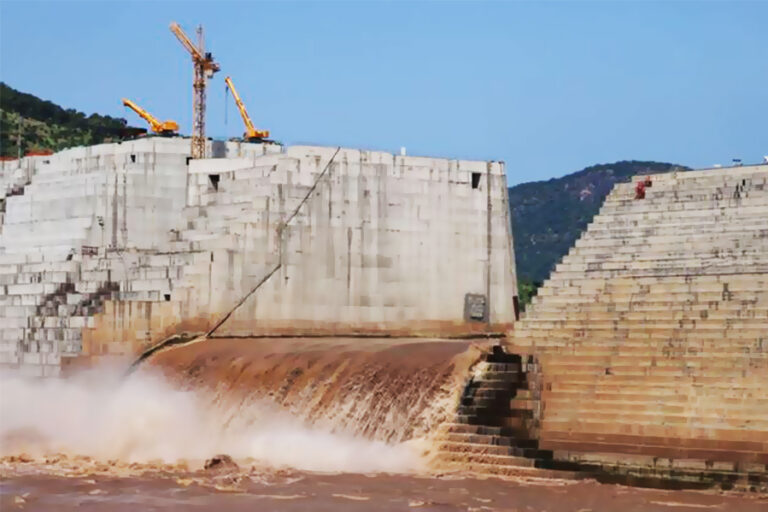
The dam is one way to harvest the powers of the Nile river. The main contractor is an Italian company. We build (formerly Salini Impregilo), which also served as the primary contractor for the Gilgel Gibe II, Gilgel Gibe III, and Tana Beles dams. Simegnew Bekele was GERD’s project manager from the start of construction in 2011 up to his death on 26 July 2018. The dam is expected to consume 10 million metric tons of concrete. The government has pledged to use only domestically produced concrete. In March 2012, Salini awarded the Italian firm Tratos Cavi SPA a contract to supply low- and high-voltage cable for the dam. Alstom will provide the eight 375 MW Francis turbines for the project’s first phase at the cost of €250 million. As of April 2013, nearly 32 percent of the project was complete. Diversion of the Blue Nile was completed on 28 May 2013 and marked by a ceremony the same day. By January 2016, the dam had 4 million cubic meters of concrete poured, and the installation of the first two turbines was imminent. The first power production of 750 MW was slated for sometime later that year.
The work was approximately 70% complete by October 2019. As of March 2020, the steelworks reached 35% complete; civil works are 87% complete while electro-mechanical works are 17% complete, to attain 71% construction complete. Egypt, Sudan, and Ethiopia agreed to delay filling the dam for a few weeks on 26 June 2020.
On 21 July 2020, Ethiopian prime minister, Abiy Ahmed, announced that the first filling of the dam had been completed. The early filling of the dam was attributed to the heavy rains. In his statement, Abiy stated that “We have completed the first dam filling without bothering and hurting anyone else. Now the dam is overflowing downstream”. The first year filling target was 4.9 billion cubic meters, while the dam can hold 74 billion cubic meters when completed.
The first phase of filling the reservoir began in July 2020, to a maximum depth of 70 meters (230 ft), utilizing a temporary sill. Further construction work is necessary before the dam can be filled to a level for electricity generation.
Ethiopian Minister of Water and Irrigation, Selchi Bakli, mentioned that the engineering work in constructing the dam reached 91%, while the total construction rate was 78.3% in February 2021.
Although the completion of the multi-billion dollar dam was set to finalize in five years since its launch in 2011, the time-frame, given the new developments, extended to 11 years. According to Ethiopia’s The Reporter newspaper, the dam has consumed 98 billion birrs ($3.5 billion) against its initial total budget of 80 billion birr. The latest we’ve heard about the dam is that the possible defects with the hydro-electrical plant’s equipment will postpone its completion to the end of 2022. For seven years, constant tripartite talks have been between top officials from Egypt, Sudan, and Ethiopia to reach an agreement on the period required for filling the Ethiopian reservoir. The two other states are concerned over its effect on their share of the Nile River. Through the last negotiations and empathy for the two downstream countries, Ethiopia extended the filling of the dam for 4 to 7 years, although it can be filled within three years as per the design. Scientists of the three countries have developed a stage-based filling mechanism which takes about 4 stages where the first stages have 2 steps, and in the second year, the dam will be filled up to 595 meters that constitutes dead storage volume. Ethiopia suggested that all the parties conclude the first agreement based on the first filling up to the full level and then continue negotiating on the difficult part; which is the operational one entangled with rules that are beyond GERD. This is where we have serious contention and still have not reached conclusion. The assertion that GERD is built for political purposes is fake. It is meant to transform the lives and livelihoods of the 110 million people in Ethiopia who have contributed each walk of their resources to build the dam.
The dam has social and political importance to Addis Ababa, given its expected immense generation of hydro-power that would help in the country’s power shortage and consequently having an impact on the education and health sectors. Besides, the completion of such a giant project is considered substantial political leverage for Ethiopia’s people.
