

The past few months I really struggled to motivate myself to write on anything. Just couldn’t make it! Corona, cricket, economic slowdown, inflation, famine, the Tigray war, elections, vaccine… did not help. By the way let me confirm that I am running for City Council of Addis Ababa. To be honest many say I have no idea what I am doing. But since I showed myself willing to go along with all the Arat Kilo aspirants I take full responsibility for my action.
So, dear readers, here I am trying to slowly come back and share with you my puny reflections. As always I like to write about what interests me most, so this time I’ll touch on politics and my mama.
We all know, like all things in nature, rulers age and crumble. Power corrupts them. Wealth weakens them. Over time, each generation becomes greedier and less competent. Check out the EPRDF Party and its reincarnated Prosperity Party. The later a reborn from the EPRDF ashes is like a Phoenix. The Phoenix is a bird with splendid colors in the Greek legend. Whenever it’s destroyed, it’s said to rise from its own ashes. According to legends it always returns to its initial state.
Here is a simple historical equivalence, the expression of the phrase “The king is dead. Long live the king”, which originated in the 1400s in France when young Charles, I believe, took over from his recently deceased papa, Charles VI. All could rest easy. Though he was a whole lot like the old dead guy, someone new was now in charge.
In the same way, the passing away of EPRDF gave way to its own reincarnation as Prosperity. Just check it out:
Prosperity uses the same offices, albeit with new colors and furniture.
Prosperity retained the same structures and advanced similar policies as the old one.
Prosperity is more feminine (I suppose this is about diversity).
Both EPRDF and Prosperity were fond of exercising brute force to accomplish limited aims.
The old and new parties settle old scores like earlier times.
When Prosperity began operating, it mostly used the same people from the old party; they had merely switched allegiance from EPRDF to Prosperity.
Prosperity uses all the resources and assets of the old party (I doubt if it [Prosperity] agreed to assume the liabilities of the old party?
Anyway, the old and now the reincarnated parties, have one major goal, shared among them, they all want to keep the “system” going… and use it to shove more and more status, wealth and power in their own direction.
The whole thing will surely end badly.
Now, to my mama, who is 94 and lived in her Bole house for over 40 years.
Last month my mama received a half page note from the Kifle Ketema administration to start preparing to vacate her property (some 40 owners were also concerned) for the “expansion” of government blocks and the building of a residential home for a top official. In the quest to build their empires, justify their existence and gain more power and control over land for which they paid not one red cent, they trample private civil liberty and violate common law justice, just like that.This is the second time my old lady is thrown out of her residential home in her 60 years as a resident of Addis. Each time rebuilding her life one step at a time; and now, at 94, she’s about to be thrown from her sweet home again and, most probably, die disoriented.
What will my mama and all her neighbors do?
What could they do? The responsible thing would be to take these self-righteous government thieves to court. But that would require hiring lawyers… and costs lots of money. One way or the other, the government would get the land. That’s the law.
But wait, who are the servants…
Isn’t the primary purpose of the new Prosperity administration – a capitalist by inclination – to protect natural rights. Isn’t the right of private property a fundamental right of a free society because it enables people to be truly free and independent of their government? My understanding is that such governments do not abuse their powers to take their citizens homes, businesses, or land. We have all seen that the use and abuse of government power is a slippery slope; the more power the government obtains, the more it tries to grab.
For many years my mama slept well at night knowing that no thief could appropriate her land in any arbitrary manner unless it was purchased at market value. “The government would make a fair offer to compensate your property”, the officials explained. That was the law. But we all know that officials have regularly cut unfair deals based on low-ball offers based on substandard estimates of property values, abusing the government’s extraordinary power to take properties from private citizens.
Alas, land or property titles mean nothing when governments can arbitrarily and forcefully use laws and ‘policy’ to disenfranchise property owners. At least the Derg dictators have the ‘integrity’ to nationalise assets and land by direct means – using guns and force – and openly at that. My mama and all the other mamas of Ethiopia who owned properties then, knew with certainty that the asset was lost and yet maintained the hope that one day it will be retrieved by force or by justice.
And we finally remind dear readers that it is neither homelessness… nor climate change… nor youth unemployment… nor Covid-19 that will crash Prosperity’s Ethiopia.
It’s unearned arrogance. And tribalism that causes conflict and violence, to be more precise.
The king is dead, long live the king.
New leaders. Same old story

Dashen Celebrates its 25 year dash in banking
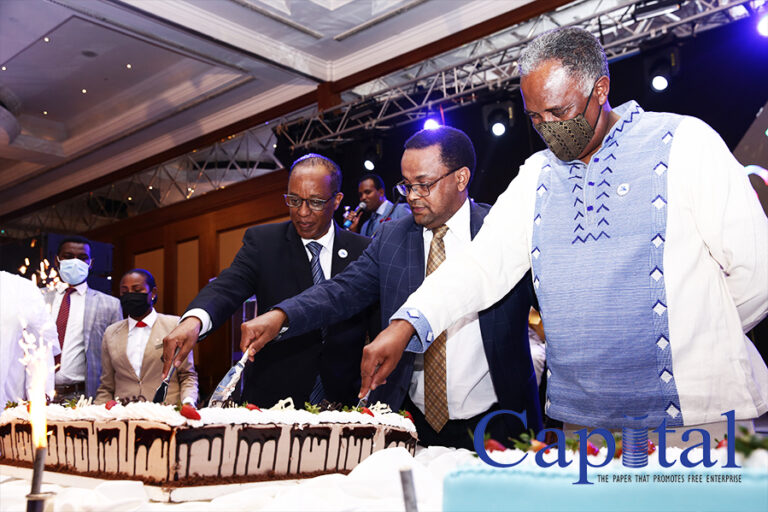
Dashen Bank, which is a pioneer on introducing new services on the sector expressed that it will celebrate its quarter of a century anniversary with different events in complement with introduction of new services in the banking sector.
The bank that is one of the first three private banks since free market was reintroduced in early 1990s has announced that it will have eventful months in the coming half year.
The company that opened its door as of January 1st 1996 said that it will celebrate the 25th anniversary by undertaking; panel discussions correlated with the financial sector, corporate social responsibility, recognizing the years with partners and staffs and introducing new services on the sector besides revitalizing the coming years with new energy.
The celebration started as of February 25 mid day in the ceremony held at the head quarter area and thanksgiving event ran through the afternoon at Sheraton with the presence of Yinager Dessie, Governor of National Bank of Ethiopia (NBE). On the same day the bank has provided free transport via 20 city buses for the capital city dwellers in relation to its anniversary celebrities.
From various celebration activities the bank has planned to engage on tree plantations in the coming rainy season at Ras Dashen Mountain, the highest peak in the country that the bank backed its name for its brand.
During the press conference held on Wednesday February 24, Asfaw Alemu, President of Dashen Bank, said that the bank has decided to establish a unique link with the mountain, due to that several programs including corporate social responsibility projects will be undertaken there every year.
He said that the bank will reaffirm its position on introducing new services for the sector.
Dashen was the pioneer in introducing ATM and debit card banking as well as international cards like Visa and MasterCard to the Ethiopian market.
Asfaw said that few have come up with new digital platform such as cobranded card that links Queens Supermarket and Addis Home Depot.
The digital platform enables smooth trading by settling any sales services done through the bank by the stated two retail companies that are under the Midroc Investment Group.
He said that the bank has been in the market as a pioneer in introducing edge cutting products and services on the market including mobile and internet banking that will continue with better upgrades with the new version.
“Within the coming six months we will introduce new services,” he says, “We will expand the co-branding card with other companies. New services related with remittance will be emplaced in the near future.”
“We are now engaged on a milestone investment to introduce massive products on technology bases,” Asfaw said, while he declined to give details.
The President has also commented on the financial intermediation which NBE allowed banks to access foreign currency as intermediary of hard currency for their customers in the country.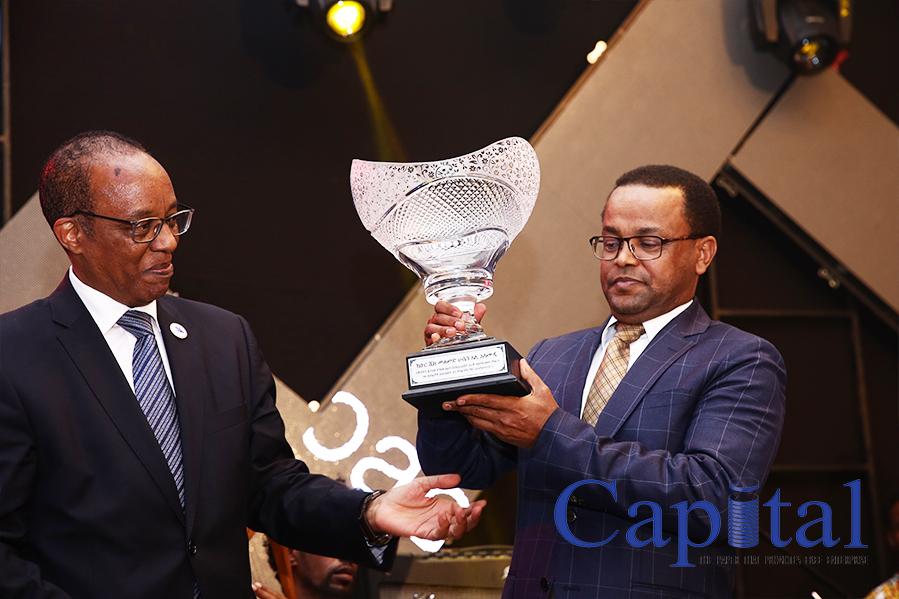
“The NBE directive has a target to ease the hard currency shortage of the country due to that we are assessing the opportunity but it is premature to give details,” he said.
The bank that was formed with 50 million birr authorized capital and ten branches at its inception now has 450 branches under 12 districts, 10 forex bureaus, 350 ATMs, and 2.5 million account holders. Its asset has expanded to 67 billion birr and its capital has reached 8.6 billion birr. It is also one of strongest banks in interest free banking business.
The bank in now in partnership with KPMG for a strategy formulation and implementation consultancy of its five year strategy plan and 10 year road map.
Under the plan, the bank envisions to be one of the best banks in Africa.
Amhara region bridges petroleum supply gap through new initiative

Amhara region has introduced an initiative to construct over 800 oil retail outlets and 100 operational and medium strategic deport in the coming one year on the aim to improve the poor petroleum supply in the region.
Berhanu Taemalew, head of Trade and Market Development Bureau of Amhara, said that the existed dealers’ stations are very far from the growing demand of fuel in the region.
He said that the region had conducted a study that indicates the growing demand of petroleum in the coming five and ten year period.
Currently, the demand is growing drastically in the region in relation with the growing number of vehicles mainly three wheeler cars that expanded in to remote areas in the region. In addition the expansion of household farmers’ irrigation scheme and the increasing access of transportation on all rural areas and other reasons have contributed to the demand.
As per the growing demand the regional administration has introduced an initiative to expand the access to fuel in all Woredas and towns in the region.
“We have tried identifying the growing sector potentials in the coming five and ten years in alignment with what the regional government shall contribute as its targets to meet the growth and expansion of the sectors infrastructure,” Berhanu told Capital.
He reminded that the sector in general is managed by the central government but the regional administration should play its part on the expansion of infrastructure in the region.
Berhanu expressed that the private sector will be responsible in building the deport stations under the initiative dealers’ stations. The set deports include operational deports and medium strategic deports that are lower than the strategic deport that the federal government bears the responsibility of control.
Currently, there are 202 retail outlets in the region, while the operational are 167 stations. According to the Bureau head, the region has 200 woredas and towns but the existing stations only covered 40 percent of the region. “This is supposed to be improved,” he highlighted.
“Based on the plan, the stations are expected to be expanded to 1,000 or additional 800 stations will be constructed. Up to 100 operational depots will be established under the strategy,” he added.
The Bureau head said that the sector is strictly controlled by the government since the private sector interest to invest on the sector is limited because the return on investment may take time.
“To boost the private sector involvement the regional government has taken an attractive initiative on access to investment land,” he says, adding that, “To attract investors, the region will provide plots with initial lease rate.”
So far 217 investors have secured land for station projects and 10 operational depots are under constructions.
The initiative has considered addressing all woredas and towns in the region. Under the new initiative major cities like Bahir Dar, Gonder and Dessie would have additional 10 stations while zone towns will have additional 6 stations. As for woreda capital cities and city administrations, at least four stations will be available.
“The establishment of stations and deports have its own discipline but we will closely follow it under the task force that has been formed by different stakeholders including the region’s Urban Development Housing and Construction Bureau and other offices from top to bottom to finalize projects on time,” he explained.
He said that the region will give attention to the supply of required materials for the construction. “We estimate that the stations including additional 583 from the 800 new retail outlets will be finalized within a year time,” he elaborated.
According to him, the next step will be focusing on the supply side which will involve close working relations with Ministry of Trade and Industry, which is responsible for controlling the sector including the supply of petroleum.
The number of oil stations in Ethiopia is very small compared with the population and area. According to latest information from Petroleum and Petroleum Products Supply and Distribution Regulatory Authority, the number of retail outlets in the country is about 1,100.
Compared with countries that have very small number of population and area like Egypt, Kenya and Uganda it is very small. The stations in Egypt are 3, 450, 1,842 in Kenya and 1,545 in Uganda.
Propagating sustainable business across boarders
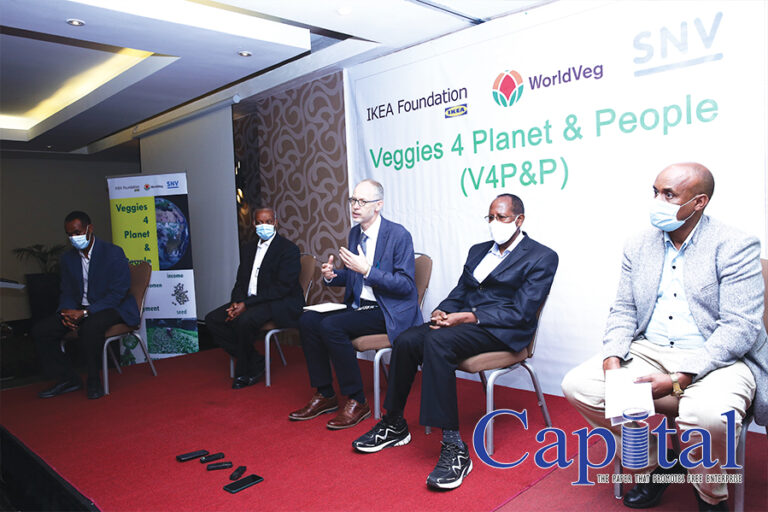
Veggies 4 Planet and People is funded by the IKEA Foundation to improve the income of youth and women through sustainable practices in the vegetable business. The project has been funded 6 million euros over 5 years in Ethiopia and Kenya. The program focuses on helping the women and youth farmers by linking them around big cities such as Addis Ababa, Nairobi and Kisumu. The project plans to connect the producers around urban cities, creating short linkages and supply chains to increase efficiency between growers and consumers; improve information flow; and boost trust between consumers and producers. Many consumers worry about the vegetables being grown with besmirched irrigated water or consuming pesticide residues that remain still after they’ve made their purchase. These fears deter the consumption of vegetables. The short supply chains allow consumers to know how their vegetables are grown and reassure them of their quality and safety.
The project targets 4000 youth and women in Ethiopia and Kenya with 1600 farmers in Ethiopia. The producers will be organized into what the project names “Vegetable Business Networks” which differ from the usual farmer groups as they consist of input suppliers, traders, processors, and retailers in a single network. There will be 80 of these networks in Ethiopia, organized as 1 or 2 networks per woreda. The project is targeting 9 million euros in increased profit annually.
The two major implementing partners currently involved in this project are the World Vegetable Center and SNV Netherlands Development Organization (SNV). The World Vegetable Center has overall coordination control of the program and will also be providing cutting-edge regenerative agricultural technologies in terms of integrated pest management, soil management, and water use. These technologies will also further serve to process and extend the shelf life of the vegetables. SNV’s main task is to fill the gaps in the value chain of the vegetable business networks. The pilot project has already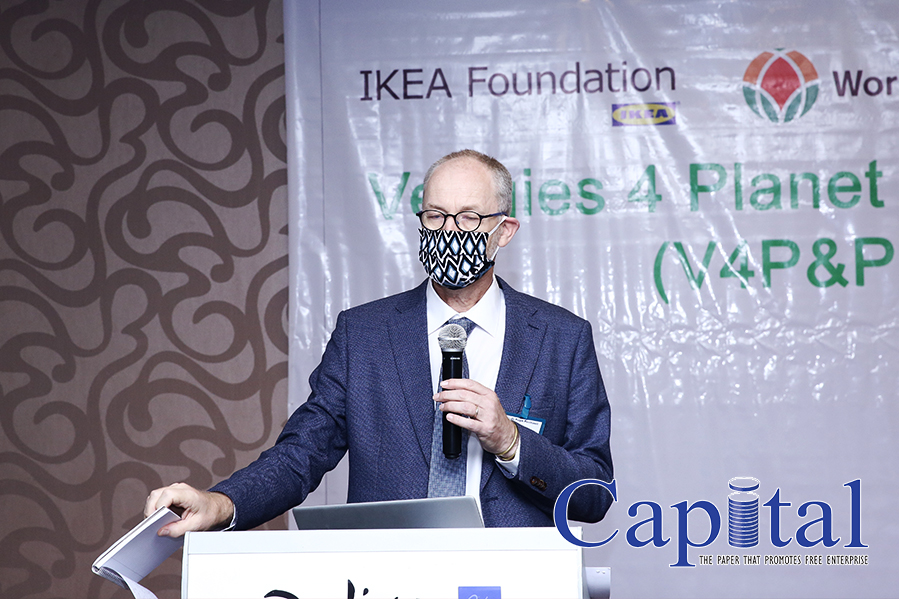 succeeded immensely leading to the donation of 20 more million euros by the Dutch government. SNV will also be focusing on building the vegetable business networks and their capacity. All the partners involved in this project have set out to help educate the farmers on how to use better technologies where the vegetable can be grown in safe and profitable ways.
The program perfectly aligns with current government policies with the appointment of a new state horticultural ministry which shows the government’s growing interest in the sector. Horticulture provides huge opportunities in export which in turn brings in foreign currency. It also immensely affects the local market for the better. The government is enabling the use of irrigation infrastructure and water sources closer to the vegetable farmers. These are challenges that the project needs addressing directly by the government and the government has not disappointed so far. Dereje Asamew,the representative on behalf of the Ministry of Agricultural Inputs and Output Marketing Sector, stated that the government has already created a road map concerning the horticultural sector for the next decade. The government is also planning to construct cold chain stores for the preservation of the product and to assimilate the produce with the agro-industry as a regular contributor. The other goal the government is putting its hopes on is the provision of various seeds for farmers through this project.
The project is planned to expand in the Shewa zone, Wolisso, Welmera and Ejera districts. These areas consist of farmers who have been trained and qualified by a previous initiative. The farmers have the basic skills of growing vegetables and the usage of sustainable agricultural practices. After the development of more improved technologies, the program is set to expand to other areas including the rift valley such as Batu (Zeway), Koka, and Hawassa. The project aims to break that cycle and show them alternative ways of growing vegetables using fewer pesticides and more sustainable substitutes.
The most common product is tomato processed into a paste or can be packed dried like red pepper. Leafy vegetables can similarly be dried and reconstituted by soaking in water or cooking. These methods are already practiced in Ethiopia in traditional ways and the project aims to adapt this and modernize the process. The project has recipes particularly prepared for vegetables that it plans to promote through social media and the aid of the Ministry of Health, Ministry of Education and Ministry of Agriculture.
This project aims on giving the youth jobs that are in their interests and aspirations which is quite a modern way of offering opportunities. Social media will be serving as the source of information so more farmers could learn continuously. The sustainability of the project not only depends on people’s sustainability but also on planet sustainability. Regenerative agriculture technologies will increase soil health through building organic matter. Pest and disease management without chemicals and using biopesticides and natural pesticides that are easily available and can be personally produced at low cost will ensure the longevity of the improved horticultural practices.
