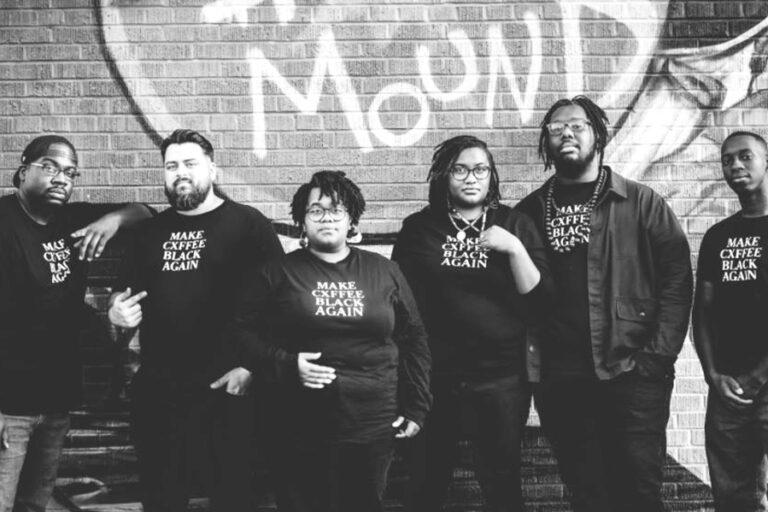
CxffeeBlack is a Memphis-based small business founded with Wakanda and Kendrick Lamar’s “To Pimp a Butterfly” in mind.
By Austa Somvichian-Clausen
When entrepreneur and rapper Bartholomew Jones’s interest in coffee first took root, he quickly began to realize something that would change the trajectory of both his life and future business: he was one of the only Black people in the coffee industry. So, Jones began to do some major research – digging into the history of coffee production and the reasons why his community was so vastly underrepresented there.
What he discovered was the colonization of the coffee bean, a crop whose modern use had originated in Ethiopia. He learned how Africans were then excluded from both the industry and the wealth it ultimately brought to its major players. Now, Jones is on a mission to change all that with one cup of CxffeeBlack at a time. The x in the company’s name, by the way, happens to represent that missing link in the coffee industry.
Upon founding CxffeeBlack at the end of 2018, Jones and his wife Renata Henderson have worked hard to bring bags of their fairly traded beans to the people of Memphis and beyond, and in the future they hope to bring more education and diverse ownership to the industry. We sat down to talk to him to learn about the true roots of the bean and how he plans to help make coffee Black again.
CxffeeBlack was founded to reclaim the Black history of coffee. Can you tell our readers a bit more about this? What should everyone know about the Black history of coffee?
Coffee was discovered in Ethiopia by an Oromo goat herder named Kaldi and, today, the Oromo people are one of the most disenfranchised people groups in Ethiopia. Coffee could have been a part of their generational wealth. Coffee started with Ethiopians, spread to Yemen, and was stolen by Dutch spies who unsuccessfully tried to grow it. They eventually obtained another seed by way of Sri Lanka, took it to Indonesia, colonized the country, and forced the Indonesian people to grow coffee on “coffee plantations” along with other cash crops.
The Dutch eventually give coffee as a gift to the French who then head to the Caribbean to grow it. They steal something else from Africa (the people) and enslave them to grow this in-demand product. Haiti, Trinidad, Jamaica, and other places were then growing coffee, producing around 60 percent of the world’s coffee until they gained their liberation. However, after they were liberated, France blackballed their economy, it tanked, and Black people were never able to profit.
Coffee is a 200 billion dollar industry – the most imbibed liquid after water, and even though it was stolen from Black people and Black people were stolen to produce it, Black people own only around one percent of the wealth from it.
How does the mission of CxffeeBlack play into its business model?
Coffee is essentially black gold. It’s the real life Vibranium. The narrative we hear from Killmonger in the Black Panther is what coffee really is. One of my friends at Portrait Coffee in Atlanta says that “coffee only grows where Black and Brown people do.” It makes sense for the Black community to engage in this good. It’s like hip hop-it was created by Black people, one of the most popular genres in the world (based on a recent survey) and we see that Black people are not always able to benefit and build wealth from it. Combining Black culture and coffee allows us to not only learn about the Black history of coffee, but to also use these cultural tools to reimagine a Black future in coffee.
We’re trying to be really intentional about honoring the Oromo people because their discovery doesn’t get enough credit, so right now we have coffee from the Guji region where they’re located. We’ve also partnered with Adarian Lherisson and Javae Coffee from Haiti. We’re also working on Afro-Brazilian and Colombian coffee. The crazy thing about Colombian coffee is that in Cauca, Colombia has a reputation for growing cocaine and a lot of the Black farmers are pressured to grow it too. One of the farmers we’re partnering is like “I don’t want to have to grow drugs to feed my family. I want my dignity back and to find people to partner with who want me to grow coffee.”
Black people around the world suffer no matter where we are. American poverty is different, but can be similar. So many Black people feel like they have to engage in illicit drug trade to feed their families, but we want to provide another option. We want to intentionally partner with our people around the world and use coffee as a means to lift us all out of poverty. Like I just got a sack from homie Gael who grew up in Burundi. He partners with groups across the diaspora and I’m excited to have that coffee available soon. My background is also in education and I taught kids in the hood. I gave them history, literature, and arts lessons as well as ran a hip hop club to encourage local rap artists. I now have a business that makes it powerfully tangible to see how the industry can lift them out of poverty.
How did you both come around to the idea of starting a coffee brand? What has the customer reaction been so far?
I went to college outside of Chicago and went to coffee shops to work on my education major, sociology minor, and my art as a rapper. Eventually, I got introduced to people in the third wave coffee space where they focus on highlighting the beverage itself, focusing on brew methods, water temperature, size of your grind, and freshness of the roast.
Learning about coffee coming from a specific place and the hard work the farmers put in helped me appreciate it. When I learned about coffee coming from Ethiopia, I originally thought it was French or Italian. French roast, Italian roast-those aren’t Black words. When
I learned it was colonized, I realized coffee’s whole identity was erased from it. How did we get the colonized version first?
As a teacher and rapper, my friends are teachers and rappers. I thought, “let me make coffee for my homies.” I remember when Kendrick Lamar’s “To Pimp a Butterfly” came out, I bought it on vinyl. It was a kind of controversial album at the time, so I invited my friends over to talk about it. I had whiskey and Ethiopian pour overs and told them to try it without cream and sugar. They were like “Whoa, what did you put in here!? It tastes like berries!” It was just that beautiful blackness. You don’t need that cream and sugar for it to be valuable – you just have to give it a chance. And that’s kind of the punchline for our brand and what we do. We just encourage people to give themselves, Black things, and God’s creations a chance.
My wife was the one to buy my first espresso machine. I grew up broke in Memphis and you don’t spend money on stuff that’s not essential. Like $20 for coffee? We’d get stuff and fix it up. Nothing’s wrong with the fix it up culture or Afro Engineering as my dad calls it, and I’m proud of it. But another of my friends Lachelle from Black Girl Black Coffee online says that Black people deserve luxury. We deserve to experience beautiful things as self-care. My wife decided to invest in me and gave me permission to buy more coffee stuff. I spent like nine bands on coffee stuff, which was way too much, but my wife saw something in me that she wanted to nourish. It turned into the business that allows us to pay our bills now. She’s the co-owner, does the graphic designing, runs HR, and she’s a total boss. And she just had a baby two weeks ago!
What do you hope to accomplish in this upcoming year?
My goal is to build direct trade relationships with farmers so we can build wealthy, profitable relationships. For the first year, I was driving to Atlanta and Nashville to get coffee from anyone I could. I was like let me hold the sack, Ima flip it-you know what I mean? We’re working with a brother from Burundi that exports his community’s coffee-which is not technically direct trade if you want to get into it-but it’s more direct than what we’ve been doing by working with a large white company who gets the coffee but we don’t know anyone who’s actually there. We want the profit from these relationships to go back into the farms instead of these big companies. The great thing about countries like Haiti and Colombia is that the countries are easier to get to than the ones in the horn of Africa. I want to go over there and be like “hey, I want my kids to meet your kids and your wife to meet my wife.” Those are the relationships I’d love to build.
Another goal is that I want our “Antigentrification Coffee Club” to be like a coffee education center in our community. We actually have the Kendrick Lamar album on vinyl in there because it’s a part of our origin story and we love single origin coffee. As we grow, we’ll have coffee training and have something like how the Black Panthers had charters. You’d come there for food, but you’d go to get educated and organize. That’s how we want to see coffee in our community. Our street is pretty trafficked and there’s a ton of people who walk to get to the bus or are experiencing homelessness, so they get to stop in for a free cup and get a chance to connect with Black baristas. We really want to build a community within the diaspora.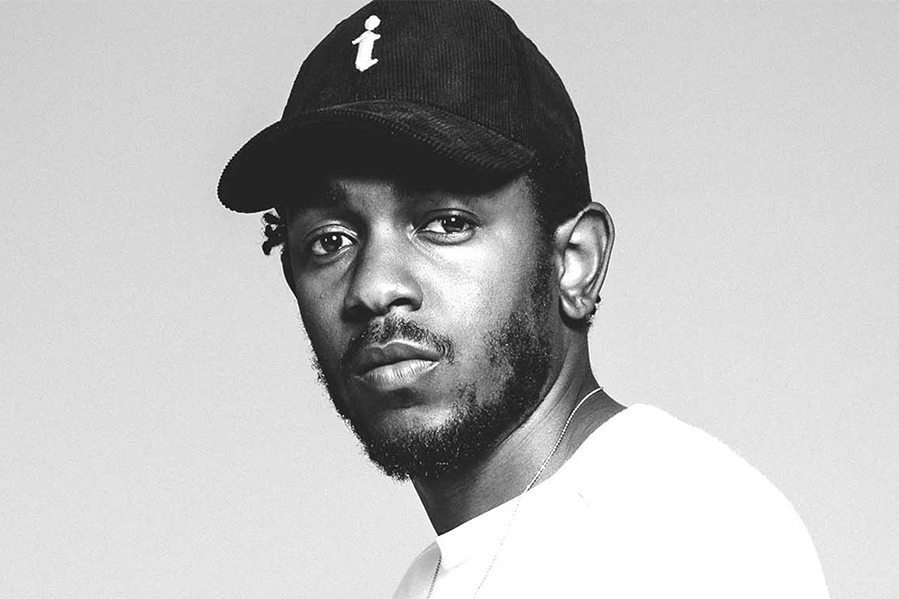
We have the CxffeeBlack podcast and we want to use that as a space to build tangible relationships with the neighborhood, between the City of Memphis, and our listeners worldwide in Black countries.
We also have the 1616 project which is the collaboration between white roasters of other cultures to create positive collaborations across the coffee culture instead of the colonizing ones in the past. Like, let’s break bread together and build something that gives dignity and is reciprocal to each party involved. The first one was with Onyx Coffee and we’ll begin doing others soon.
What do you think true equality would look like in the coffee industry? In the food and beverage industry as a whole?
I think it looks like ownership. My issue with conversations about Black people in coffee is that the conversation always starts with diversity. Which is okay, but there are two other areas. The first is diversity, which is Black people in white-owned spaces, and the second is ownership, which is Black people in Black-owned spaces. We never get to that part of the conversation because a lot of the diversity conversation is around microaggressions and white fragility. You run into many issues that come up when you’re a welcomed guest in a space as opposed to being an owner of that space. Ownership allows us to have more equity in the conversations.
A lot of people have asked “how do we get more Black people into coffee” and it’s like let them experience it from a cultural perspective as opposed to a, you know, “you really need this pour over” and “here are the notes,” perspective. Because we can get into it, I was heavily into it, but I’m a teacher too so I understand things have to be presented contextually. How does this live outside of business transactions? How does this live in someone’s grandma’s house? How does this live in art, churches, barbershops, and schools? And that’s something we’re heavy on.
Equality is black coffee being returned to Black people to do what they will with it. So, it’s living indigenously in Black families again. I feel like I see a world where rappers talk about their strain of coffee or pour over like they talk about their strain of weed. It’s not like Black people don’t appreciate being connoisseurs; the issue is that we’ve only seen coffee from a colonized perspective and not an Indigenous or Black perspective. We want to teach people about the history [of coffee], but we also believe that it can be a part of building a better future as well.
(The Hill)