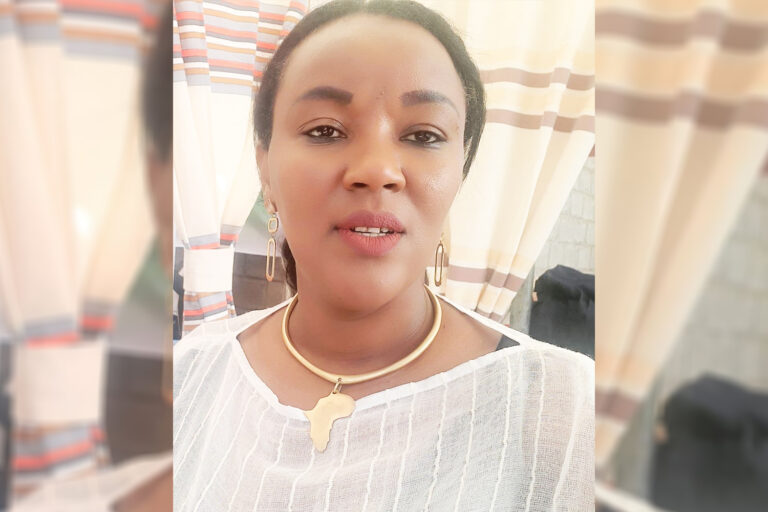
Melissa Simon-Hartman first experienced Carnival at the age of two in Trinidad and Tobago.
At the age of seven, she had her first experience as a masquerade at Notting Hill Carnival where she spent many Carnivals before sitting atop her father’s shoulder absorbing what has now become her life’s work.
Simon-Hartman is a British designer who creates wearable art and designs costume for individuals and bands for London’s annual Carnival.
Some of her designs will be featured in Beyonce’s Black is King visual album scheduled for exclusive release on Disney Plus on July 31.
Daughter of a Trinidadian mother and Ghanaian father, Simon-Hartman said she knew from early that costume design was something she wanted to do.
“Growing up in Carnival I was introduced to the creations of the true mas men of the day like Wayne Berkeley, Peter Minshall and Brian MacFarlane and was instantly taken with their artistry. They created theatre for the road, and I knew immediately that this is what I wanted to do,” she told Loop via email.
“For me, that is what makes Carnival so special. It is our form of theatre; a living, breathing performance that takes place on the roads of our community. It is an art form that expresses freedom and culture and I very much wanted to be part of it,” said Simon-Hartman who
She honed her skills with a mas camp called Elimu, who became her extended family after her father’s death. “From a young age I would shadow the head designer Meilin Sancho, she noticed my love for art and trusted me with her glitter work. I was encouraged to create my own designs not long after. Before I knew it, I was designing sections and entering the Gala competitions as a performer, each year winning an award in my category which gave a great sense of achievement.
“I took a lot of pride in my work and I am sure as a junior designer I annoyed some of the adults at the mas camp who volunteered their time to help me. I was a perfectionist. I appreciated the help but if the finish on the costumes were not right, I would spend all night redoing the work (laugh). The experience taught me self-discipline. Up to now I still have issues with fully relying on others to get a task done properly which can often be to my own detriment,” she said.
For the designer, costumes are more than just a pretty adornment to a perfect body. For her, it’s a chance to transform, to assume another persona. So emotionally attached was she to Carnival and what it represented that she spent a lot of her childhood in Carnival tabanca, shedding long tears for weeks when it was all over.
“I fell in love with having the opportunity to become someone else. From an early age, I would draw fantasy characters, it was my form of playing and escapism as an only child. Playing Monday mas offered the opportunity to be instantly transformed into something or someone else. Proudly parading in my costume amidst the admiring glares of spectators gave me a sense of empowerment and that has been infused into the costume work I do today as my clients often tell me they feel empowered as soon as they wear one of my pieces,” she said.
The main theme connecting all of her work is Africa. Celebrating her blackness and highlighting the richness of African culture is something she has always done through her art before ‘Black Lives Matter’ and ‘Supporting Black Businesses’ became a trend, she said.
“African history and folklore are such rich grounds for cultivating creativity that there is an endless bounty of inspiration. I firmly believe that it is our duty to explore our heritage and present it to the rest of the world so that they can see the beauty and art that comes from our culture, well to be completely honest see how EVERYTHING comes from our culture. Our history is amazing and did not start with slavery. Black artists have an opportunity to tell that story through their work. Designs take on a whole different aesthetic as artists discover more about the African experience.”
“Africa influences all my work. Regardless of the theme, there is always something that is connected aesthetically to African art. Classic movies I used to watch religiously with my mother, every Sunday also has an influence on my creations and the study of other cultures which is something that will continue throughout my creative journey,” she said.
When it comes to creating her costumes, Simon-Hartman loves to play with textures and fabrics. Confident in her vision, she does not follow the popular trends when it comes to her use of materials.
“I do not have a preference for any particular materials, I am addicted to texture and try to create my own textured fabrics through experimentation. Some have described me as anti-feathers which is not the case. I have used feathers in my work on the odd occasion but prefer to be more experimental with the treatment and placement of feathers rather than basing the costume design around what feathers will be used.
Although she has a carnival label called Legion Mas which emerged in 2017 as the first cosplay mas brand sponsored by MCM Comic Con, Simon-Hartman decided since 2019 to offer an exclusive service for individual mas players playing with different bands.
“Running a band takes a lot of time and commitment and a fully committed team, it is not something that I can deliver at present and prefer the creative freedom of designing and producing Individual mas for a specific clientele,” she explained.
Outside of the Carnival space, Simon-Hartman designs costumes for events and productions. Her work included appearances in Shanghai, on the WBFF competition stage, theatrical productions in Martinique, various music videos and on the red carpet for the London premiere of the movie, ‘I AM BOLT’ in 2016.
“I noticed that my work was attracting clients outside of the carnival community and acted upon it. My client base varies as I have made costumes for theatrical productions, music videos, dance competitions, fitness competitions and editorial shoots. What I enjoy most about this is the freedom and variety it offers,” she said.
“I love the opportunity to tell stories through my work and there are times when the stories are not pretty. Carnival clients want to look pretty, they love colour and sparkle so there are creative limitations with restricting my work to carnival only. There is nothing wrong with choosing to specialise solely in the carnival arts, but I am drawn to dark fantasy, folklore, and historical pieces so work within a broader landscape.”
As a nod to her Trini heritage, in 2015 she produced mas for Notting Hill Carnival that portrayed folklore characters like Papa Bois and La Diablesse and she has also produced costumes for a theatre production in Martinique based on the La Diablesse.
Her penchant for historical, fantasy pieces and especially her connection to Africa put her on the radar for Beyonce’s team.
Simon-Hartwell was contacted last year via Instagram about providing costumes for a project.
“I paused to read the message only to see that it was from Beyonce’s stylist, Zerina Akers asking if I would be interested. I mean . . . ‘HELLO’ (laugh). Obviously, without hesitation, I said ‘yes’. It is a moment I will never forget because last year was a very challenging year so the acknowledgment of my work from Beyonce’s creative team reassured me to keep pressing on despite the hurdles. Whether this opportunity leads to something else or not I shall remain grateful for that special moment.”
The Simon-Hartman London label consists of three categories: Couture, which is the high-end avant-garde pieces, Boutique, which offers handmade accessories and Urban, which is her new premium streetwear brand called A.F.I.A, the acronym for ‘AfroFuture Is Alive’ that will offer clothing and footwear.
Simon-Hartman worked with shoe manufacturers in Asia, Brazil, the UK and Italy when her label first started as a shoe brand years ago.
“This has equipped me with the experience of knowing what to look for in quality shoe production. The A.F.I.A. footwear will be handcrafted to order in Italy with a choice of leather and vegan leather fabrics. Many of the designs will be unisex.”
UK designer with Trini roots connects with Africa through her costumes
Abay The Prodigal Son of Ethiopia
By Etsubdink Sileshi
A parable I heard growing up is still warm and captivating to my heart. It is fetched from one of the scriptures (dear reader, hold on! I am not here to preach.) .This powerful parable is known as the story of the Prodigal Son .It goes as follows: A father has two sons. The younger son asks for inheritance from his father; and gets granted as per the request. Afterwards, this son goes to a distant place and engages in unspeakable wastefulness, extravagance, and adultery and dries up all the resources from his parents and ends up in destitute. Despite betraying his family, and bringing a disrespect to their house, he is welcomed back with stretched hands, joy and festivity. His older brother, who is loyal and hardworking becomes envious and refuses to join the welcome party. The father tells the older son: “you are ever with me, and all that I have is yours, but your younger brother was lost and now he is found.”
Blue Nile (Abay) is the Prodigal Son of Ethiopia (and Awash the older?).Since time immemorial it has flown without a drop of use to the thirsty dwellers by its bank. Enormous floods during the summer (June-September) erode a vast amount of fertile soil from the Highlands of Ethiopia and carry it downstream with which cotton and wheat are widely cultivated in Egypt and Sudan. The name Blue Nile or “Tikur Abay” in Amharic is a witness to the vast minerals the flood washes away from Ethiopia and turns the color of the water in to blue, blue black, and at times black depending on the severity of flooding and which course of the river we looking at. In Ethiopia, it neither hits the turbines of water mills, nor wets the draught -cracked lands it passes by. Millions of farmers, in the vicinity of Blue Nile still depend on food aid to survive. The circumstances at home and in the region combined used to hinder Ethiopia from developing its natural resources be it underground or the surface ones.
Abay, flows in deep canyons, cutting layers of Cenozoic era sediments, making it difficult to use for the livelihood of the people nearby. It simply flows while our mothers are suffering from shortage of fire wood and bearing the health consequences of the smokes which are toxic. Children cannot do their home works as most of them live in poorly lighted houses. Some are even exposed to asthma at a very young age from using oil lamps. Families starve because the mills don’t have energy to turn their turbines with. Cities suffer from recurrent tap water shortage as there is no electricity to pump up the ground water and drive it through the pipes. Hospital and other health facilities are subject to frequent interruption of electric supply -putting their patients (say in ICU) at a grave danger. The youth are unemployed for there is no energy for businesses to start with and run the machines. Many investments are on pending due to poor energy supply (recently, Amhara Mass Media reported that ,in the Amhara region alone, more than 352 new businesses were ready to start operation with all raw materials at hand if it were not for lack of electric infrastructure). Rail ways cannot operate due lack of electricity supply (remember the Wodia-Hara-Gebeya-Mekelle rail way project). The prodigal son, once it returns has a lot to accomplish to its family and their neighbors. A country with sufficient electric supply has long day lights. Days are productive; nights are safe. And life by far convenient. Energy tames the winter’s cold and the summer’s heat.
The Nile Basin (with Abay at the center) is the major basin in Ethiopia. It accounts for about 70 percent of Ethiopia’s annual runoff. An Ethiopia that is not properly harnessing this vital resource will not emerge out of poverty. Over the years Egypt and Sudan have built several dams, generated enormous electricity, planted and farmed using the water and fertile soil carried out by the prodigal son. These two countries have improved the lives and lively hoods of their respective citizens .Electricity and piped water coverage in Egypt is 100 percent, whereas, in Ethiopia 6 out of t10 people do not have access to electricity. And about forty percent of the people don’t have basic water supply. This is despite Ethiopia’s suitable topography for hydro-power generation potential and immense surface water resource. Now, Ethiopia is saying, “time to have clean drinking water! time have water for sanitation! Above all time to use my fair share and light up millions of houses left in darkness”. To be opposed to this basic human aspiration, and the dream of generations of Ethiopians for development is to live in some far distant era. Using her own resource within her boundary, yet taking in to account the real concerns of downstream countries, building GERD is morally fair, economically efficient, and environmentally friendly. Ultimately the Sudanese people and the Egyptian people will benefit from this be it via cheap supply of electricity, constant flow of water, reduction in flooding and over sedimentation damage. Besides, the location is GERD is less susceptible to evaporation which conserves a huge amount of water for the benefit of all riparian countries. Now, there is no disagreement about technical issues. Experts in the aforementioned countries have reiterated in one way or another the issue, now, is a political one. It is the politics, mainly from Egyptian side, that is trying its best to keep the unfair status quo-1959 agreement (which is now a thing of the past).
It is extremely disheartening to see some media personalities arguing by and mentioning past ‘agreements’ which Ethiopia was neither a part nor her interest represented. These ‘agreements’ are, mainly, by Egypt, for Egypt to Egypt. Take the 1959 ‘agreement’, it bestows veto power to Egypt, gives Sudan 18.5 billion cubic meters and 55.5 to Egypt. Ethiopia, on the other hand was to use zero cubic water; I repeat! ZERO cubic water while it contributes from 86-90 percent (depending on the season). Sometimes I wonder how someone in the 21st century entertains the possibilities of such “agreements”, let alone the practicability. I, for one, consider this inconceivable.
Before concluding my article, let me express my discontent with the economic sabotage and diplomatic com-pain so as to block funds from flowing to Ethiopia and redraw Ethiopia’s image as the bad boy of the Nile region. While the economic sabotage of foreign funds the could have been directed to Nile projects has been successful( thanks to citizens ,every penny is domestically collected, I ,myself ,started contributing when I was 12th grader,5 Birr), the “bad actor’ accusation cannot be further from the truth. Ethiopia has always conduced herself as a responsible actor in the global community. There is rich evidence for everyone to see. Since joining the League of Nation, Ethiopian leaders have advocated for collective world security and an orderly world. And as a founding member of the UN it has contributed a lot. Ethiopia contributed peace keepers to Korea, Congo, Liberia, Rwanda ,Burundi, Sudan, Somalia. Any positive stride, economic or otherwise in Ethiopia is a good news to the rest of at the world. The recent AU-lead talks on the GERD is a good move forward. I hope some positive outcomes will emerge very soon from these negotiations.
It is time to shake off the dust of old ideas and start seeing the entire region (basin)’s future as inter- wined. Development projects by one country should not be seen (intended) as a threat to the other. In matters that involve society and countries, no player solely gains by distorting the rules of the game to one’s short term monopolistic advantage. It is not in the interest of Ethiopia to hurt downstream countries. In the same fashion, it is not in the long term benefit of Egypt to stand on the way of Ethiopia’s development. Efficient utilization and equitable distribution of the Nile water is the only way forward. It is with such mutual understanding that hundreds of millions of people in the region will live a decent life in harmony and with utmost consideration for one another.
The prodigal son is back and is to stay here. He will serve his family as well as their neighbours.
The author has an MA in Economics .You can contact him via : etsubdink08@gmail.com
Beyond economics How Development Bank of Ethiopia plays its role in bringing balanced regional development and meet social responsibility?
By Atsebaha Abay
Beyond their economic roles, banks do play unique role in bringing balanced regional development and addressing social and environmental harms. This article tends to assess how the Ethiopian banks in general and DBE in particular perform their corporate social responsibilities.
Development Bank of Ethiopia (aka. DBE’s) mandate is derived from its policy objectives which again are drawn from the government’s national development policy and strategy. One of these mandates is providing development finance to sectors that have the highest sustainable development pay-out. These are clearly indicated in the GTP documents as priority sectors and national mega projects. Over the past decade and half, DBE’s contribution in attaining the double digit growth was visible.
DBE performs its business in a socially and environmentally responsible way. Taking the regional development and social responsibility factors, DBE’s contribution stood-out most in the financial industry of the country. The following can be mentioned as testaments of its regional and social commitment.
DBE provides long-term development finance to priority sectors that are identified by the national policy. While many banks of the country focus on profitability, return on equity, etc. and ignore the high risk sectors, DBE delivers long term finance to these sectors that are considered as critical in transforming the economy from agriculture based to industry.
Named as “Agricultural and Industrial Development (AID) Bank” for most of its 108 years in operation, DBE has been committed partner and prime financer of agricultural and rural based business enterprises. In connection to this, DBE has provided Birr 40.71 billion to agriculture, manufacturing as well as mining and energy sectors which is 19.3% of the aggregate loans and advances provided by the rest of the 17 banks operating in the country as of 2018/19 (Source: NBE and DBE 2018/19 Annual Reports). The loan was given to the priority sector investors at 11.5% lending rate against an average of 13.5% by the rest of the banks.
DBE works to bring balanced regional development. This is one of the governing policies of the bank. Unlike other banks who crowd their operations in Addis Ababa, only 4.4% (i.e., 4 out of 90) branches of DBE are located in the capital city. Taking the major banks operating in the country 20.9% of CBE’s branches, 42.1% of Awash Int’l, 36.7% of Dashen, 41.2% of Abyssinian, 37.8% of Wegagen, 41.5% of United, 53.5% of Nib and 41.8% of Birhan Bank Branches are concentrated in Addis Ababa leaving the 95% of the population with little access to financial services. Indeed, DBE not only opens bank branches in these regions but also works with regional, zonal and woreda level bureaus of industry and investment offices to recruit new borrowers. Further, beyond bringing its branches near to the needy rural projects, 90% of the loans and advances delivered by DBE over the past decade was made to regions’ based investments.
Financial inclusion of the MSMEs: Financial inclusion is one of the crucial dimensions of DBE’s business and the bank uses this as an opportunity to ensure access to financial services to those vulnerable and economically weaker groups of the society as well as addresses the financial needs of the missed middle group (i.e., the SMEs/ Small & Medium Enterprises). In this category, DBE works with 21 MFIs (Micro Finance Institutions) that operate throughout the country. Under its RUFIP (Rural Financial Intermediation Project) and SMEFP (Ethiopia SME Finance Project) credit windows, DBE contributes to the growth of rural financial services and reaches out to the rural poor and cooperatives who are engaged in micro and SME businesses. In these credit lines, DBE together with the international development partners provided Birr 2.4 billion (as of March 31st 2020) through the MFIs to be disbursed to the micro and SMEs at only 8% interest rate.
Introducing new financial products to the Ethiopian market: DBE is keen to modernize the Ethiopian financial market through among others providing diversified financial products. Unlike the other commercial banks that provide traditional banking products, i.e., receiving deposit and providing short term loans, DBE has introduced new financial products such as lease financing. Through the lease financing window, DBE provided a total of Birr 5.35 billion to SMEs that operate throughout the country as of March 31st 2020.
Environmental protection: DBE joins hands with international development partners in initiating environmental management and renewable energy development funds namely MDRE & EEPs (Market Development for Renewable Energy and Energy Efficient Products) and REF (Rural Electrification Managed Fund). In this window, DBE has been working with 13 MFIs and has disbursed Birr 586.6 million as of May 31st 2020. In addition, DBE has also played a laudable work in mobilizing domestic savings and harnessing national efforts for the country’s brand dam “the GERD”. So far, DBE has contributed an aggregate of Birr 12.4 billion (including through the sales of bonds, employees’ contribution and donation) to the dam. By doing all these, the bank has greatly contributed to improve the rural people’s welfare and realize the climate Resilient Green Energy (CRGE) strategy of the country.
Women economic empowerment: DBE with its international development partners such as the World Bank, UK Aid and Enterprises Partner (EP) is implementing a women entrepreneurs Development Program (WEDP) starting 2012. In this credit line alone, DBE has been working with 12 MFIs and has disbursed Birr 3.2 billion to 15,250 women entrepreneurs operating throughout the country. Therefore, apart from its responsibility of finical inclusion, DBE has been playing its role in developing women owned businesses and build their competitiveness.
Combating Covid-19 and its negative consequences on the economy: In the context of the ongoing combat against Covid-19, DBE has developed an inclusive strategy to fight against the pandemic. In this regard, DBE has contributed Birr 5.0 million to the national taskforce and also developed the Covid-19 response strategy which costs it Birr 290 million to support its clients. Further, the bank has established a client friendly complaint delivery mechanism and together with its clients have developed a strategy of mutually acceptable and workable loan repayment plan.
Creating new jobs, earning foreign currency and boosting government revenue: Unlike the commercial banks who provide short term loans for working capital, DBE specializes in providing long term loans to finance new projects and thus its role in creating new jobs is tremendous. This year alone the bank (through its borrower clients) has targeted to create 15,765 new jobs, generate Birr 2.76 billion US$ of foreign currency and boost government revenue by 426.75 million in the form of taxes. All these have been achieved without compromising its financial efficiency. Last year, (i.e., in 2018/19) DBE has accrued Birr 2.94 billion profit before tax and this year it targeted to earn Birr 3.41 billion.
All being so, the bank has faced with some challenges. Admittedly, some employees lack ethical integrity and have tried to erode the hard earned reputation of the bank and its image. Also, some social activists who associate themselves with some political elements have tried to tarnish the reputation of this national pride. Despite the promising improvements that have been achieved this year, high level of NPLs (Non Performing Loans) has been another challenge of the bank. This year, the bank has managed to reduce the NPL by 5% points in just 9 months, i.e., from 38.6% in June 2019 to 33.6% by March 31 2020.
All in all, the bank’s role in bringing balanced regional development and meet its social responsibilities are laudable by all standards and these have been possible with the 2,360 committed and hardworking employees of the staff and its management.
In conclusion, Ethiopia has no CSR (Corporate Social Responsibility) standard/ guideline for the financial institutions. In many regions and countries of the world including USA, EU and Asia, CRS has been used as an instrument for business enterprises to positively impact to societal welfare and their environment. In Ethiopia, NBE’s Licensing and Banks’ Supervision guideline has some elements of CRS but it lacks a full dimension and indices.
Currently, many of the banks contribute to social development (mainly in the form of charity) and disclose this in their annual reports. However, it is not uniform and above all is not mandatory. These banks do not even have written guideline on how to and how much to contribute annually. Therefore, it is time for NBE (or other relevant institutions such as the Ethiopian Bankers Association/ EBA) to develop CRS guideline with its indices and monitoring framework. Beyond developing a guideline, NBE or EBA will have to ensure that each bank integrates the CSR to its core business. Once the guideline is mainstreamed, NBE or EBA can periodically evaluate the banks’ social development performances, rank the bank and declare it to the public.
Atsebaha Abay holds BA degree in Business Management and Diploma in general agriculture both from Jimma University and is now attending MBA degree in Financial Services at Addis Ababa University. He served DBE for the last 29 years at different positions and regions: 19 years in Oromia, 6 years in Tigray and 4 years at the headquarters. 29 years back he joined the bank as loan technician and was promoted to different expert positions. In his managerial position, he was first promoted to a team manager in the North Region District then as manager of Mekelle branch. Later he was raised to manage Adama District and currently serving as Director of CRMD III. (atsebahaabay@gmail.com)
Bereket Sisay
Name: Bereket Sisay
Education: TVET
Company name: Et-Ahatod innovative works
Title: Founder
Founded in: 2019
What it does: Different kinds of innovations
HQ: Addis Ababa
Number of employees: 9
Startup Capital: 1 birr
Current capital: Growing
Reason for starting the business: To have an income
Biggest perk of ownership: Having your own original products
Biggest challenge: Scarcity of inputs
Plan: Building strong innovative company
First career: Electrician
Most interested in meeting: Kitaw Ejigu
Most admired person: Kitaw Ejigu
Stress reducer: Reading
Favorite past time: Watching movies
Favorite book: Dertogada
Favorite destination: NASA, Houston
Favorite Automobile: None