

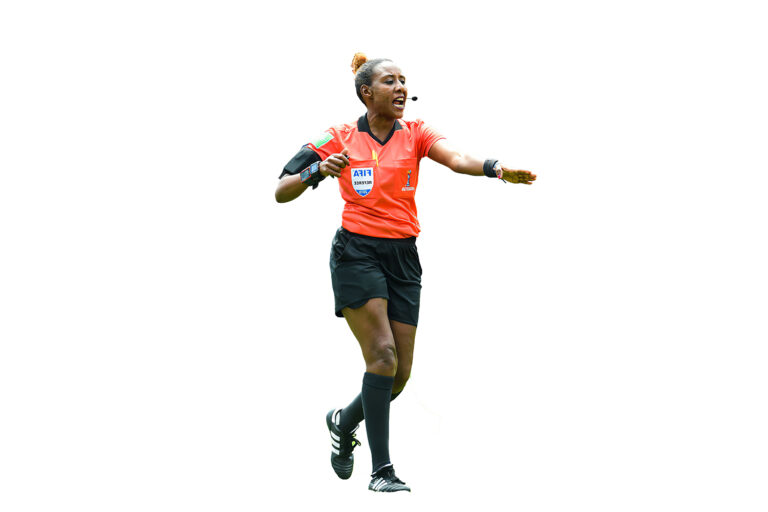
Ethiopian Lidya Tafesse will be the first African female referee to officiate a senior men’s match at the continental level (CHAN). She is the only woman in the continent of 19 center referees who will enforce the Laws of the Game in the 2020 African Nations Championship in Cameroon. Lidya officiated the FIFA Women’s World Cup and the Africa Women Cup of Nations in the past.
Lidya will be leading assistant referees Mimisen Iyorhe of Nigeria, Bernadhar Kwimbria of Malawi and Atezambong Fomop Carine of Cameroon to the scheduled CHAn 2020. According to reports, the referees will be in Younde from 9th to 10th January 2021 for fitness tests and refresher courses. This is the first time a team of female referees including eight from Ethiopia that features in the senior’s men’s CAF tournament.
Lidya who dreamt of being an Ethiopian Premier League referee, had achieved way past that fate officiating the African Cup tournament. Soccer fans who engage in Betway Zambia betting can predict whether Lydia will officiate a particular Ethiopian game.
Lidya has enforced the Laws of the Game in the Africa Cup of Nations for four consecutive years. She was the referee in the semi-final match between South Africa and Nigeria. Also, the Ethiopian Football Federation voted Lidya as the best referee for three years in the women’s and men’s Premier League.
Lidya is committed to her career. She likes promoting fairness in football games. Like other African sports legends, Lidya started from the bottom before she became an international referee. She has faced many challenges in her career. The Ethiopian referee is a role model for many girls. FIFA gave her some costly sports equipment for free but she gave them to underprivileged senior referees. Betway allows African sports enthusiasts to wager on local and foreign leagues.
Ethiopia’s Lidya makes African Nations Championship History
Uganda won Cecafa u-17 crown, Ethiopia third
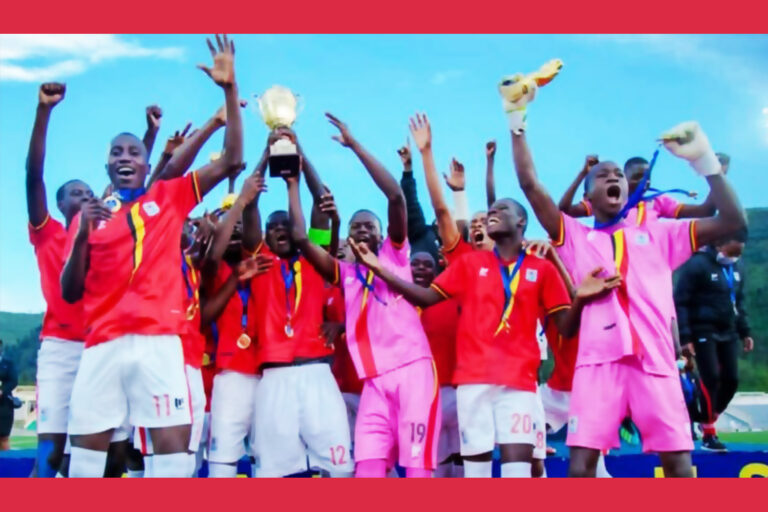
Cecafa U-17 defending champions Uganda crushed first timer Tanzania to 3-1 victory while, Ethiopia defeated Djibouti 5-2 to finish third in the annual competition. Champion Uganda and runner up Tanzania book a place in the continent’s cup final
The champions scored their goals through Ivan Irinimbazi, Travis Mutyaba, and Ibrahim Juma while Vincent Mulema scored into his net for the Serengeti Boys’ goal.
The Cubs scored their first goal in the 63rd minute from Irinimbabazi’s header followed by the second ten minutes later through MMutyaba. The Serengeti Boys then conceded a penalty in stoppage time from which skipper Ibrahim Juma converted for the third.
The Cubs have now managed to retain title and they will be playing in the Africa Cup of Nations in Morocco in 2021. Despite losing the final, Tanzania has also qualified for the biennial competition.
In the meantime Enderias Berhanu’s Ethiopian side finished third after 5-2 victory over Djibouti. A 3-0 defeat to Uganda followed by a 2-2 draw with Kenya, after a regular time 1-1 draw then 4-3 penalty shootout defeat to Tanzania, Ethiopia finished in style crushing Djibouti to 5-2 victory. Considering Djibouti’s resilience against ultimate champions Uganda, the big win is something to celebrate for the side that returned home with bronze medal.
Not only the trophy but all the tournament’s individual honors went to Uganda. Six goals in four matches including a hat trick over Kenya, Oscar Mawa stood top scorer of the tournament while Travis Mutayaba and Henry Mwabe named Most Valuable Player and Best Goalie of the tourney.
Age test (MRI) common trait between Nigeria & Ethiopia
An embarrassing age-related moment for Nigerian football, 40 out of the 60 boys penciled down as part of the Golden Eaglets contingent to prosecute the Under-17 African Cup of Nations (AFCON) qualifiers in Benin Republic failed the mandatory Magnetic Resonance Imaging (MRI) age test.
Coming just three weeks to the qualifiers, this means the coaching crew will have to race against the clock to pick a squad qualified enough to represent the country at the West African Football Union (WAFU) Group B qualifiers billed to kick-off on Tuesday, January 5.
Out of the 20 players who passed the tests, only five of them are part of the main squad and just two of the five are included in Coach Fatai Amoo’s preferred starting lineup for the competition. Most of the players the coach banked on did not scale through. (Compare with Ethiopia only five out of thirty-five). Surprisingly, among those affected were players from the National U16 team, some of whom were featured at an invitational tournament in Japan last year. As a consequence, they will vacate the team’s hotel in Abuja and head home with dashed hopes and dreams. These age-cheating incidents are worsened by the desperation of parents and agents to get their youngsters into the national team at this level of the game.
To prevent further embarrassments that might warrant the disqualification of the entire team by CAF, the Nigeria Football Federation (NFF) has pegged Grades 1- 4 as the benchmark for the age test to ensure registered players stop being disqualified.
Nigeria’s Golden Eaglets, just like their Under-20 Flying Eagles counterparts, are drawn in Group B of the U17 qualifiers along with rivals Ghana and Cote d’Ivoire.
The hard Brexit
The agreement reached under maximum pressure by the EU and the United Kingdom (UK) during the night of December 7th 2017 is full of ambiguity and hypocrisy. The main, though not insignificant, merit is to avoid the premature interruption of the Brexit negotiations, as well as to offer the main protagonists peaceful year-end celebrations. According to Paul Goldschmidt, the former Director, EU Commission and Member of the Advisory Board of Stand Up for Europe outlined, indeed, on the basis of this agreement, it appears that the UK must choose between one among the following four options:
The first one is negotiating the withdrawal of its notification under Art. 50 and retain full membership of the Union. The delivery of the withdrawal notice dated March 29, 2017, initiated an irreversible process of two years leading inexorably to the departure of the UK from the EU. This process can, however, be modulated under the terms of two agreements covering respectively the “divorce” and the “future relationship” between the parties; both need the unanimous approval of the Council and a majority vote of the European Parliament.
The second one is to leave the EU but retain membership of the Custom’s Union and the Single Market. This option is in contradiction with the previous undertakings of Theresa May. While it is in line with the commitments of the “divorce” agreement, it implies the subordination of the UK to the rules of the EU (rule-taker), the inability to negotiate separate trade deals with third parties, etc. Such restrictions should be welcomed by Ulster, Scotland, and Wales because the reversion of other EU powers would mainly benefit the British Government and Westminster.
The third option is to negotiate a Free Trade Agreement (CETA model). This option implies instituting border controls either at all external borders of the UK or between Ulster and the remainder of the UK. It is not possible to guarantee simultaneously the territorial integrity of the UK market including Ulster and the indivisibility of the market on the Irish island. Regardless, any FTA cannot confer on the UK the same privileges as those enjoyed by members of the Customs Union and of the Single Market.
According to Paul Goldschmidt, the fourth option is leaving the EU without any agreement (WTO model). Leaving the EU without an agreement covering the future relationship would be detrimental to both parties and carries with it the risk of judicial procedures which would jeopardize any harmonious future cooperation. It should be evident that this option is particularly dangerous in the current instable geopolitical climate which should, on the contrary, underscore the mutual benefits of a European continent speaking with a single voice in order to provide joint security and prosperity to its citizens.
Regarding the hard Brexit, Nicola Sturgeon, the SNP (Scottish National Party) leader, has promised to publish draft legislation for a second independence referendum before the upcoming election to the Scottish Parliament on May 6, 2021. Nicola Sturgeon hopes that Brexit, which goes against the will of the 62.0% majority in Scotland that voted to remain part of the EU in June 2016, will reverse the result of the 2014 Scottish Independence referendum. At the time, a 55.3% majority voted to stay in the UK.
Kallum Pickering, Senior Economist at Berenberg Bank in London stated that following a major shift in the polls that started shortly after Boris Johnson and the Conservatives won the landslide victory at the UK election on December 12, 2019, the most recent five opinion polls give support for Scottish independence a seven-point lead, with average support running around 49%. On that basis, one cannot rule out that Scotland could leave the UK in the coming years, even though such pro-independence polls seem to have a habit of narrowing in the run-up to referendum day.
However, actually getting there is hard for two reasons. First, not only are around 8% of Scottish voters still undecided. More significantly, with no guarantee that the second independence vote could end in a majority vote for leaving the UK, the SNP may well ride the wave of pro-independence sentiment to boost its support ahead of the Scottish election. Kallum Pickering noted that this would likely imply that the SNP would stop short of pushing hard for a second independence vote once in power at the national level, unless referendum polls shifted even further in their favor on a sustained basis. The SNP also has to think hard about what it wishes for. After all, a second failed attempt to go for Scottish independence would put the question to bed for a generation and partly undermine the case for voting for the SNP in the future.
Second, Scotland still needs the approval of UK parliament to hold a second referendum, unless a future devolution of powers to national governments from the UK parliament in Westminster allowed national parliaments to pass such legislation. Such legislation seems unlikely as long as the Conservatives are in power. While a landslide victory at the upcoming Scottish Parliament election scheduled for May 2021 could strengthen the hand of the SNP, a second referendum is unlikely ahead of the 2024 UK general election.
Tom Clifford, an Irish journalist based in Beijing stressed that in view of news that the UK´s prime minister Boris Johnson plans unilateral shifts that upend the Withdrawal Agreement with the EU, one has to wonder whether this is a Trump-style negotiating strategy on the part of the UK government. The idea to up the ante seems to be based in the hope that the EU will blink as the clock ticks down or a conscious approach by the UK to undermine the ongoing negotiations on the future relationship (and settle for the hardest possible exit from the EU single market) instead of reaching for a compromise is unclear.
As Denis MacShane, the former UK’s Minister for Europe noted, it seems odd, to say the least, that the UK could be about to undermine its commitments to Ireland with upcoming legislation after the UK had taken steps in recent months to prepare Northern Ireland’s border for exit day. It suggests the UK is trying to increase the pressure to get a deal more to its liking rather than going for a hard exit. Either way, the strategy does not raise the chance of a good outcome. With the costs of a hard exit falling disproportionately on the UK, the strategy could harm the UK more than the much bigger EU. For the UK and the EU to find compromises on the sticking points, level playing field, governance and fisheries, both sides must work to build trust. The UK’s actions are doing the opposite.
