

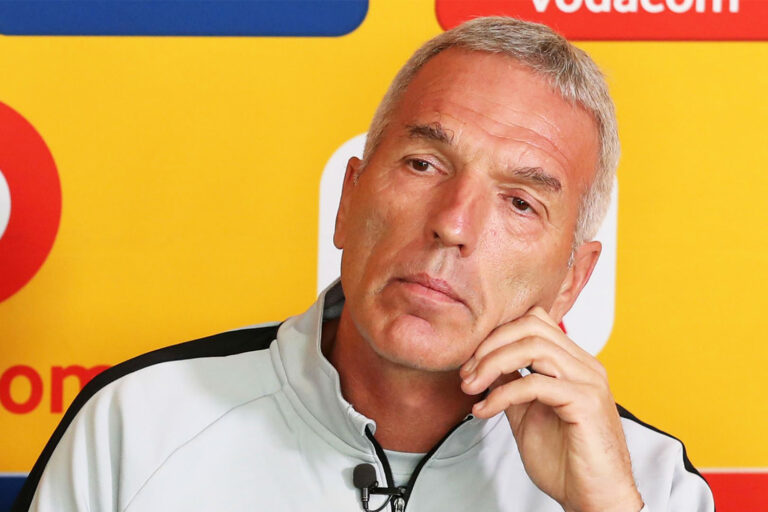
Notorious for wandering around different clubs that is 23 teams in three decades, German Coach Ernest Middendrop did what he did best with other side that is abandoning St George in less than a months’ time. He left the club flat footed just four weeks in to his three years contract. Physical trainer Mahir Davids takes over at the vacant hot seat as interim Coach.
Just three weeks at the club’s preseason camp at Yedenekachew Tessema Acadamy: forty-five kms from the capital, Middendrop took the players as well the club officials announcing his sudden change of mind on grounds of security.
Though Board Chairman Abnet G/Meskel boasted they have finally found the right boss to steer back his side to former glory day, the German simply walked out of his three years contract without much explanation.
Although he paid a two months’ salary for the contract breach, St George is suspended in the air five weeks from the start of the new season.
Of course the South African Mahir Davids who joined the team as assistant to Middendorp took over as interim Coach until a new appointment. Nevertheless the team’s dream of returning to the championship after three disappointing seasons appeared to face a difficult setback. What is more bizarre is that of the Germans decision to let the players have a seven days break just three weeks into their preseason preparation camp at the club youth academy at Debrezeit 45km from the Capital.
Despite the club’s claim that they parted sides after mutual agreement to pay his two month salary as penalty for breaching the contract, insiders disclosed he was unhappy with the club’s setup including players’ selection and interference of the administration.
Having a long history of switching clubs and his loyalty in question, critics suggested earlier that the 61 year-old German was not the right professional to help St George back to the championship title. “Middendorp’s record shows he is not someone to be trusted for lasting commitment. I wonder why they signed him after all,” one critic remarked.
St George is the only club in the country to appoint a foreign Coach for the new season.
German Coach Middendorp abandoned St George in mid air
CAF President Ahmed banned for five years
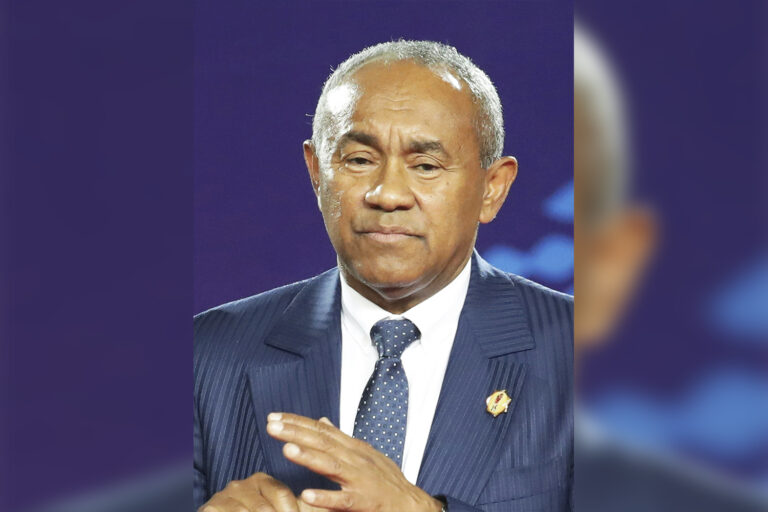
The head of African football, Ahmad Ahmad, has been banned from football for five years by Fifa following an ethics investigation by world football’s governing body.
Ahmad Ahmad, from Madagascar, was found guilty of breaching his duty of loyalty, offering and accepting gifts and other benefits, misappropriation of funds and of abusing his position by the adjudicatory chamber of Fifa’s independent ethics committee. In addition to the ban, he was fined 200,000 Swiss francs (£164,000).
Ahmad was elected CAF president in March 2017, and last month submitted his candidacy to serve a second term in office, with elections due to take place next year.
Fifa had “sanctioned him with a ban from all football-related activity (administrative, sports or any other) at both national and international level for five years,” it said.
Former CAF general secretary Amr Fahmy, who died this year from cancer, had been dismissed after he made corruption allegations against Ahmad last year in a document sent to Fifa.
The document, sent on 31 March 2019 by Fahmy to a Fifa investigations committee, accused Ahmad of ordering his secretary-general to pay $20,000 (£15,000) bribes into accounts of African football association presidents. They included Cape Verde and Tanzania.
The document also accused Ahmad of costing CAF an extra $830,000 (£621,000) by ordering equipment via a French intermediary company called Tactical Steel. The company denied any wrongdoing and said it had won the contract on merit.
Furthermore, it accused him of harassing four female CAF staff, whom it did not name; violating statutes to increase Moroccan representation within the organization; and overspending more than $400,000 (£300,000) of CAF money on cars in Egypt and Madagascar, where a satellite office has been set up for him.
Senior CAF officials, speaking on condition of anonymity at the time of his dismissal, said Fahmy was fired in reprisal for compiling the document with the allegations against Ahmad.
Ethiopian Letesenbet in the forefront to win Athlete of the Year Award

World Athletics announced five finalists for the Female World Athlete of the Year 2020. In spite of the many challenges presented by the global Covid-19 pandemic this year, the five athletes, who represent five countries and four area associations, have excelled, producing brilliant performances across a range of athletics disciplines in 2020.
The finalists are: Letesenbet Gidey, Ethiopia: Gidey set a world record of 14:06.62 over 5000m. She was second in the 5000m at the Wanda Diamond League meeting in Monaco.
Sifan Hassan, Netherlands: Hassan set a world record of 18,930m in the one hour run. She set a European record of 29:36.67 over 10,000m, the fourth-fastest performance in history. Peres Jepchirchir, Kenya: The Kenyan athlete won the world half-marathon title. She twice broke the world half-marathon record for a women-only race (1:05:34 and 1:05:16).
Yulimar Rojas, Venezuela: Rojas remained undefeated in four triple jump competitions indoors and outdoors. She broke the world indoor triple jump record with 15.43m. Elaine Thompson-Herah, Jamaica: The Jamaican remained undefeated in seven 100m races. She ran a world-leading 10.85 over 100m.
The male and female World Athletes of the Year will be announced live at the World Athletics Awards 2020 to be staged as a virtual event on December 5.
Big Tobacco wants African nations to do its bidding

There was a time when tobacco companies could market their deadly and addictive products with cartoon characters, svelte women and handsome Cowboys. Decades later, with growing evidence and public awareness of the harms of tobacco use, such unscrupulous advertising has been outlawed in many countries. Now, there is increasing evidence that the purveyors of cigarettes and other tobacco and nicotine products look hungrily at Africa, a region ripe for expanding demand for their products. The continent has low tobacco use compared to other continents. It has a growing, youthful population, fewer regulations and, importantly, increased disposable income. For Big Tobacco, Africa could be the goose that lays golden eggs for decades to come.
The only barrier to the industry’s ambitions is governments implementing strong policies to deter tobacco use and protect health, so the industry works to influence and, ultimately, undermine those policy decisions. This problem came into sharp focus with the recent release of the Global Tobacco Industry Interference Index, 2020 compiled by the Global Center for Good Governance in Tobacco Control from civil society reports, and published by STOP, a global tobacco industry watchdog. The Index looks at Big Tobacco’s efforts to sway policymakers around the world and evaluates governments’ progress, or lack of progress, in protecting policy. Nine of the 57 nations reviewed are in Africa.
From Nigeria and Ethiopia to South Africa and Uganda, the Index is a wake-up call to big tobacco’s tactics. This is an industry that often needles and cajoles African governments to get what it wants, while also sweet-talking policymakers through disingenuous corporate social responsibility initiatives. The goal is the same: to change policies, delay or weaken tobacco control laws, and to win lucrative financial incentives. The methods are insidious, and the examples are plentiful.
The tobacco industry embeds itself anywhere in the government where it can gain an advantage. In Nigeria, for example, the industry sits in the standard-setting organization for tobacco products while in Ethiopia, the National Tobacco Enterprise (NTE) is allowed to comment on tobacco control laws before they are passed. Japan Tobacco International, one of the world’s largest tobacco companies that is active in at least seven African nations, bought a controlling share of the NTE.
Likewise, the industry uses corporate donations and unnecessary interactions to establish cozy relationships with non-health government bodies. In 2019, Zambia’s Finance Minister officiated the opening of a new BAT factory, while in Sudan, the former President and the Minister of Industry were involved in a tobacco industry-sponsored scholarship program. More recently in Kenya, British American Tobacco (BAT) donated 300,000 liters of sanitizer to government agencies around the same time the government listed tobacco as an “essential product” during the COVID-19 pandemic. These activities provide positive media coverage for companies that sell deadly products.
In many cases cited in the Global Tobacco Index 2020, Big Tobacco’s interference has stalled or derailed tobacco control policies, while tax incentives flow freely. In 2019, there were no tax increases on tobacco in Ethiopia and Tanzania. The Global Index is based on detailed country reports. South Africa’s country report notes that interference led the South Africa Revenue Service to extend the deadline for the country’s proposed Track and Trace system, that would help to reduce illicit tobacco. The tender has since been cancelled. Civil society also records attempts to influence policy that were ultimately unsuccessful: Uganda’s country report notes that BAT Uganda pressed upon the Minister of Trade to modify one of the region’s strongest tobacco control regulations. After the research for Nigeria was completed and amidst a global pandemic, civil society witnessed Philip Morris International using media interviews to request tax and regulatory breaks for its heated tobacco products, even though these products are not duly proven to be safer than cigarettes.
The message throughout this research is clear. The industry will use every tactic at its disposal to grow sales in Africa. The profits from this growth will flow back to wealthy transnational tobacco companies, while Africans are left to pay the price of tobacco’s harm.
The Index also highlights a strategic roadmap to halt the harm in Africa. Article 5.3 of the World Health Organization’s (WHO) Framework Convention on Tobacco Control calls on governments to safeguard public health policies from industry influence and these efforts must cover the whole of government. In a positive example, Uganda rose to rank in the top three nations globally for acting to prevent industry interference and passed one of the region’s most stringent tobacco control laws in the face of heavy tobacco industry pressure.
There is a lot of hope for Africa. We can stop the tobacco epidemic before it gains a bigger, deadlier foothold, as it did in Europe, Asia and the Americas, if governments act now to stop Big Tobacco’s interference. It will require vigilance, transparency, and the demonstrated will of policymakers to push back the industry. It is time to put the African people and tobacco control policies before the tobacco industry’s vested interests.
Leonce Dieudonné Sessou is Executive Secretary of the African Tobacco Control Alliance (ATCA)
