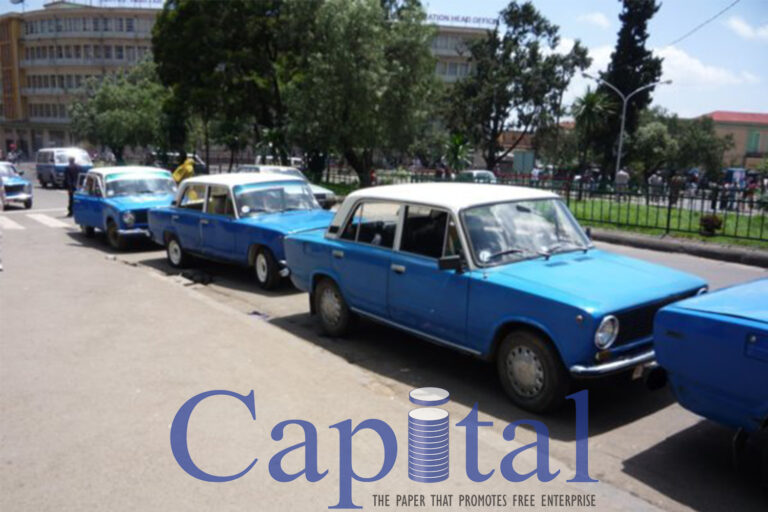
The city administration has begun its action to change the old blue taxis to modernize the transportation in the city. The administration is negotiating with the owners of the old taxis to change them with the new latest taxis and electric taxis.
“The authority has planned to bring 10,000 cabs with 10 billion birr and the city administration will facilitate the finance by a loan secured from the Commercial Bank of Ethiopia” said Meare Mekonnen, deputy director at Addis Ababa Road & Transport Bureau (AARTB).
The authority starts negotiating with the bank to get a loan of 10 billion birr to finance the plan and the bank has given them a positive answer to give the loan, however if the commercial bank loan negotiation failed the authority has set a second option to get a loan from Addis Credit and Saving Institution.
There are tens of thousands of blue taxis registered and known to the Addis Ababa Road & Transport Bureau, of which around 8,097 blue taxi drivers have been registered within the last couple of months to change their old cars. The authority will buy the old cars from the owners and will sell the new taxis to them with long term loan payment with low interest rate.
The city administration believes the reform is needed and will only make the job hassle-free and convenient for both the driver and passengers. The city administration was beginning to recognize the old taxis were no-longer safe or convenient. They appear old and are not reflective of the government’s agenda to change the image of the city.
To many, the old blue taxis represent a battered image of the city as stuck in the past instead of one attempting to transition to a modern and fresher city. The newly imported taxis will be compatible on the often brutal and crowded streets of Addis Ababa, comfortable, safe and their use of technology.
Compared to the vehicles that were used to serve as taxis back in the late 1970s and early 1980s, the blue and white mini bus taxis are the longest in service. Even if their replacement is nearing with the recent announcement of the government’s intention to gradually replace them.
The blue old taxi industry is facing its biggest business challenge to date since the coming of yellow modern taxis which are upgraded with technologies. The reforms that are taking place currently are expected to change this. However according to some taxi drivers in the city, they fear that the city administration will ask them much money than their income.
Action to oust old blue taxis
Ethiopia lifts tax on semi-finished leather export

With the aim of boosting the production and export earnings, the country has decided to lift the tax on semi-processed leather exports, the Ministry of Trade and Industry announced.
The government made the decision because the tax imposed on export of semi-finished leather goods some years ago has seriously affected the tanneries and exporters, according to Teka Gebreyesus, State Minister of Trade and Industry who briefed reporters on Wednesday. He stated that as the tax imposed on the sector was huge and identified as the main factor for the country’s failure to increase the foreign currency earnings from the leather industry, the government has decided to lift the tax on export of pickles, white-blue and crest leather products.
As of this week all exporters of semi-finished leather are exempted from tax, according to Teka, who mentioned the starting of execution of the new proclamation 61/2012. It is stated that about 80 percent of skins and hides traders in Ethiopia has left the industry because they are discouraged by the tax. As a result, out of the total of 17 tanneries in Ethiopia five were closed and the remaining have been producing below their capacity. The tax has also discouraged foreign investors from investing in the untapped leather processing and export of Ethiopia.
It is also indicated that though Ethiopia has a huge potential for leather and leather goods products as the country is the leading in the number of cattle, no foreign direct investment was registered over the last seven years. With the aim of utilizing the potential of the sector, now the government is working to establish Leather City Park in Modjo town in Oromia region.
A practitioner in the sector blames the little attention given by the government from power supply to financial provision and limited supply of hard currency.
“The finance provided by the government doesn’t show the real commitment of the government as the industry needs attention with regards to access to finance in order to encourage the industry” said Yared Alemayehu, Manager of Waliya Tannery.
The recent move of the Ministry of Finance in waving the 150 percent tax on semi-finished leather, which had disabled the industry, is taken as the major outcome in the industry.