

The United Nations Economic Commission for Africa (ECA) has launched a first-of-its-kind continental tool that offers a unique view of price variations in African countries, regional economic communities and at continental level.
During the virtual launch on 11 August 2020, ECA Executive Secretary, Vera Songwe, noted that the role of national statistics offices and national revenue authorities in ensuring that this platform has timely, accurate & up-to-date data will be crucial.
She cautioned that the “lack of price data to enable us monitor, analyse and manage economies through informed policy decisions has often led to civil unrests” because when prices of things like food, oil, and energy go up, “people take to the streets.”
The initiative intends, therefore, to bring the prices and exchange rates of all African countries into one platform that’s readily accessible to citizens, decision makers and other stakeholders. The platform will involve monthly, quarterly and annual analyses of inflation.
The launch was chaired by Ghana’s Vice President, Mahamudu Bawumia, who applauded ECA for the initiative, stating “this one-stop-shop for finding data” will go a long way to “increase ECA’s relevance in Africa.”
“We need data on price movements to gauge how changes in consumer prices alone may be affecting the trends in income distribution, poverty levels and inequalities, including especially among those who live on retirement incomes,” said Bawumia.
He pointed out that “as we open the doors to continental free trade, price level data will enable across-country comparisons and understanding of regional markets and the competitiveness of producers across Africa.”
ECA launches Price Watch Centre for Africa
Secondary Education should prepare young people for work, says new report
The Mastercard Foundation released a new report, Secondary Education in Africa: Preparing Youth for the Future of Work. Report findings indicate that changes in the nature of work are placing a premium on skills that help young people be adaptable, resilient, and creative problem solvers. Secondary education that provides relevant skills to young workers will help improve productivity, particularly in the informal sector, and will play an important role in driving long-term economic growth and reducing poverty in Africa.
“Digitization, automation, and technological advancements are already changing the nature of work in Africa. Young people must enter the workforce from secondary education equipped with the right skills. So, strategic investments into secondary education can be a big part of ensuring young people and their countries emerge from the other side of COVID-19 stronger and more inclusive,” said Mastercard Foundation President and CEO Reeta Roy, as she welcomed audiences to the Secondary Education in Africa Virtual Summit held earlier today to discuss the report findings.
Across the continent, the youth population is growing and is expected to reach 456 million by 2050. This growth, along with improvements in the number of young people enrolling in, and completing, primary education is increasing the demand for secondary education. Enrolment is expected to double by 2030, representing an additional 46 million students at the secondary level over the next 10 years. This in turn requires an expansion in the education workforce. Over the next 10 years, an additional 10.8 million teachers will be needed. Ensuring high-quality teachers are in classrooms is one of the most strategic investments a country can make to enable all students to develop the skills they will need for work and as citizens of a global world.
Chinese Government Donates COVID-19 Prevention Items to the Office of the First Lady of Ethiopia
Tan Jian, the Chinese Ambassador to Ethiopia, on behalf of Prof. Peng Liyuan, wife of the Chinese President Xi Jinping, handed over COVID-19 prevention items including facial masks and infrared thermometers to the office of the First Lady of Ethiopia in a bid to help the host country’s effort to combat the pandemic.
Amb. Tan expressed appreciation of the solidarity and support to the Chinese people given by many African countries, particularly Ethiopia, at the most difficult time when China was hit the hardest by the COVID-19. He noted that as a token of friendship between the Chinese people and their African brothers and sisters, the Chinese government has decided to donate medical supplies to help mothers, children and young people through the Office of the First Lady.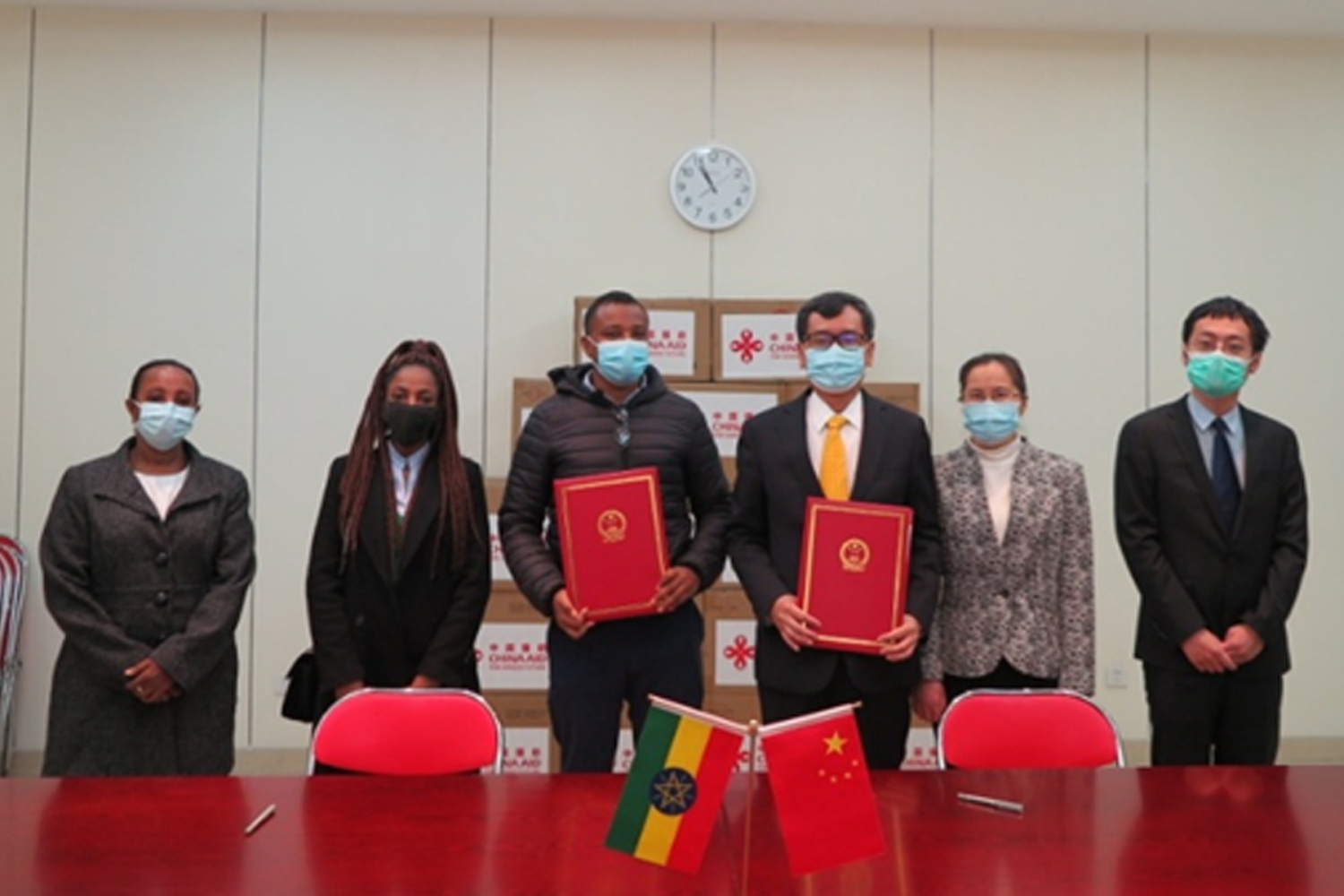
Muluken Fenta, Director of Ethiopia’s First Lady Office, expressed thanks for the generous donation by the Chinese government. “As the first country to successfully control the spread of the pandemic, China sets an exemplary role of standing together with Africa to combat the COVID-19 virus and has made great contribution to the prevention and control of the pandemic in Ethiopia,” he said during the ceremony.
It is learnt that earlier this year, Madame Antoinette Sassou, the First Lady of the Republic of Congo, President of the Organization of African First Ladies for Development(OAFLAD), wrote a letter to Prof. Peng Liyuan on behalf of the OAFLAD and asked for China’s attention to mothers and children and young people in Africa.
Prof. Peng, accompanied President Xi on his first visit to Africa as Chinese President in March 2013, has carried out a lot of cooperation with OAFLAD since then under the framework of FOCAC.
OAFLAD is an organization where First Ladies of Africa seek to leverage their unique position to promote African women and youth empowerment.
Japan International Cooperation Agency (JICA)
DEADLINE EXTENDED TO AUGUST 26, 2020!
Title: Inviting Startups for the NINJA Business Plan Competition in response to COVID-19
Main
Japan International Cooperation Agency (JICA) Ethiopia Office, Federal Small and Medium Manufacturing Industrial Promotion Authority (FeSMMIPA) and Federal Urban Job Creation and Food Security Agency (FUJCFSA) have announced the launch of the NINJA Business Plan Competition for businesses emerging during the COVID-19 outbreak. NINJA is short for Next Innovation with Japan; the project was launched this year.
The NINJA Business Plan Competition will target startups and organizations from 19 African countries. The application is open for startups/organizations in all sectors with a specific focus on emerging businesses in COVID-19-related fields including, but not limited to:
- Health: Online healthcare support; disease-testing solutions; medical data sharing and privacy protection solutions; distribution of drugs and medical equipment; IoT, including 3D printers, in the medical field
- Disaster management: Geo-tracking during disasters; emergency information dissemination
- Business services: Support for remote workers; efficient management/operation of online events
- Education sector: Remote learning support
- Food and agriculture: Efficient food/commodity distribution technology
- Finance: Contactless transactions/payment; lending/insurance services to SMEs and individuals
- Logistics: delivery service, urban mobility management
- Other: Substituting imported goods with local innovative technology
WHO CAN APPLY (Applicants must meet all criteria 1-4)
- Organisations with their head office or a branch in one of the target countries.
- Profit/non-profit organisations registered as an independent legal entity. Proposals from individuals will not be considered.
- Companies with a very strong management team of at least 2 people.
- Businesses that have an innovative product(s) or service(s) in response or adaptable to the Pandemic and post-pandemic society OR have a feasible business plan to create prototypes (MVP).
THE PRIZE
- Winners from each country will be given a chance to sign a work contract with JICA for their innovation(s).
- Winners will be eligible for equity/debt-free sum of up to USD 30,000 by JICA for covering costs associated with the proposed activities including, 1) remuneration of staffs, 2) other expenses, and 3) indirect local tax.
- Winners may also get the opportunity to travel to Japan for further investments and business partnerships sponsored by JICA.
SELECTION CRITERIA
- The proposal should introduce some level of innovation in terms of a business model, a new product or service that can be more actively used, and/or profitability in the current and post COVID-19 era.
- Proposals should be as commercially-oriented as possible.
- JICA may establish an evaluation board with outside evaluators experts under strict confidentiality to evaluate proposals.
- Each country will have 8 to 10 finalists out of which up to 5 winners will be selected.
- Winners from each country will participate in the grand finale
- TARGET COUNTRIES
- Angola, Burkina Faso, Botswana, Cameroon, Côte d’Ivoire, Egypt, Ethiopia, Ghana, Kenya, Madagascar, Mauritius, Nigeria, Rwanda, Senegal, South Africa, Tanzania, Tunisia, Uganda and Zambia.
SCHEDULE
- Extended application deadline for Ethiopia (due to absence of internet access during the launch of this competition): August 26, 2020 (First-come, first-reviewed base)
- Interview of selected startups: Early September 2020
- Final selection: September 2020
Note: JICA will request the startups invited to be interviewed online to submit additional documents/a pitch deck if necessary.
IMPORTANT THINGS TO NOTE
- When applying, each company is to submit a business plan with the Key Performance Indicators (KPIs) that can be achieved within about 6 months.
- Before the contract, JICA will examine the details of the proposed activity and the validity of the budget (each expense item) and JICA may request the additional documents to determine the detailed activity in the contract.
- After the contract is signed, startups/organizations must submit monthly reports about the KPIs to JICA. (The duration of the contract will be about 6 months.)
- JICA will make payments based on the progress of the proposed activities and the submission of the progress reports and/or the expense report with receipt.
- The payment schedule will be determined by JICA, and in principle, no advance payment at the commencement of the contract.
To apply for the NINJA Business Plan Competition, please go to https://forms.gle/8E5RQuchUsU5P8Jt7 or go to the JICA Ethiopia Facebook page: https://www.facebook.com/jicaethiopia or use this QR code to access the application form
For any queries about the competition, please get in touch with us at the following email address: edgps@jica.go.jp
