On paper, Ethiopia is having an extraordinary run. The International Monetary Fund’s April 2026 Regional Economic Outlook put Ethiopia’s projected 2026 real GDP growth at 9.2 percent, the highest of any large economy in Sub-Saharan Africa, more than double the regional average of 4.3 percent, and ahead of every other economy the Fund tracks on the continent except tiny, war-recovering South Sudan. Three years after a civil war that displaced millions and after a sovereign default that took nearly six years to unwind, that is a striking reversal.
But sit with two other numbers. Ethiopia’s headline inflation rate accelerated to 15.3 percent in July 2026, its fourth consecutive monthly increase and the highest reading since January 2025. And on the World Bank’s own reckoning, the share of Ethiopians living below the $3-a-day poverty line is estimated to have risen to roughly 43 percent in 2025, up from 33 percent in 2016.
Put differently: an economy that the IMF says is expanding faster than almost anywhere else in the world is simultaneously seeing inflation reaccelerate and poverty rise. That combination is the real subject of this article. It is not a story about collapse; the evidence does not support that word and using it would be an exaggeration. It is a story about whether headline growth is a reliable signal of Ethiopia becoming a stronger, more resilient economy, or whether it is concealing fragility that a growth number alone cannot show.
What the growth number actually says — and doesn’t say
The 9.2 percent figure comes from the IMF’s April 2026 Regional Economic Outlook for Sub-Saharan Africa, and it has since been repeated widely in financial and general media. It’s worth noting immediately that forecasts for Ethiopia are not fully consistent across sources: the IMF’s own country page and Article IV-linked material, alongside the UNDP’s Ethiopia economic profile, cite a somewhat lower, GDP growth figure closer to 7.1–7.2 percent for 2026, and consensus trackers such as Focus Economics have cited a range of roughly 7.1–7.3 percent. Ethiopia’s own Ministry of Finance has at various points pointed to an even more optimistic target near 8.9 percent. These are not necessarily contradictions, different vintages of IMF forecasts, different program documents, and government projections routinely diverge by a percentage point or more, but the spread itself (7.1 to 9.2 percent) is a reminder that even the “headline” growth figure is really a band of estimates, not a single hard fact, and it should be read that way rather than quoted as settled truth.
There is a further, more structural reason for caution, and it is one that independent economists, not just critics, raise: Ethiopia’s national accounts are still built on a 2015/16 base year, a decade old, which the Ministry of Planning and Development has itself acknowledged is overdue for updating. Ethiopia’s authorities have announced plans to rebase GDP to a 2024/25 base year by around September 2026, partly under a “statistical sovereignty” initiative. Rebasing exercises (Nigeria’s 2014 and 2025 rebasing are a well-known regional precedent) frequently produce large, mechanical revisions to GDP levels and can also alter measured growth rates, simply by better capturing the size of services, the informal economy, and sectors that have grown since the base year was set. The World Bank has separately noted, in a country document, that “limitations are particularly noticeable in the estimation of expenditure components” in Ethiopia’s GDP data. None of this means the 9-percent-plus figure is fabricated. But it does mean the number carries wider uncertainty bands than a comparable figure from a country with modern, high-frequency national accounts, a point a well-informed economist reviewing Ethiopia’s data would insist be made explicit rather than glossed over.
What is more solid is the composition of growth. The IMF and independent trackers agree that growth in 2025–26 has been broad-based rather than reliant on a single commodity: mining (notably gold), construction, manufacturing and agriculture have all contributed, which several analysts argue makes the expansion structurally more durable than in economies leaning on one export. That is a genuine point in Ethiopia’s favour and distinguishes its story from, say, a pure gold- or oil-price windfall.
The other half of the picture: prices are accelerating again
Ethiopia’s disinflation story through late 2025 was real and worth taking seriously. Annual CPI inflation, which had been above 30 percent in 2022–2023, fell to single digits by December 2025 (9.7 percent), a genuine policy achievement that Prime Minister Abiy Ahmed’s government has credited to subsidy targeting, income adjustments and supply-chain reforms, alongside the National Bank of Ethiopia’s tight 15 percent policy rate.
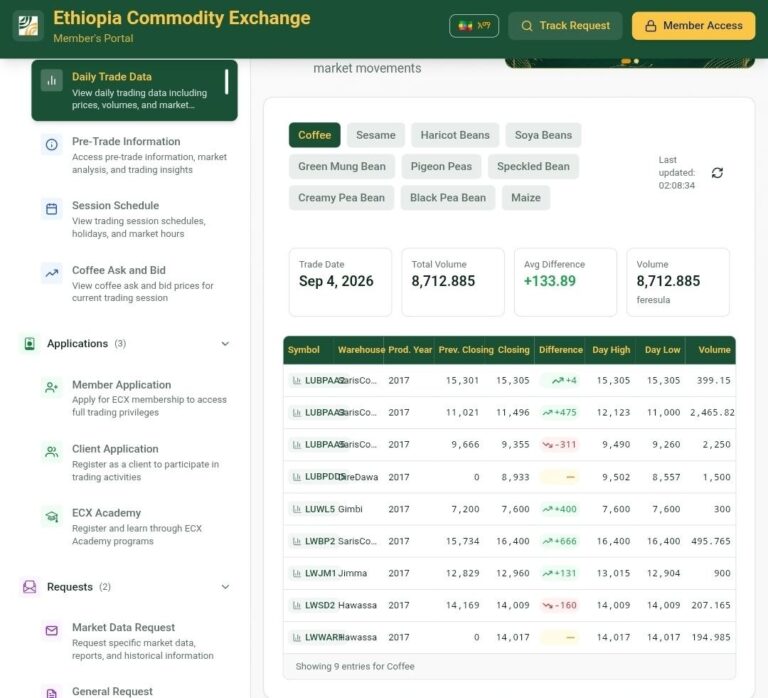
That disinflation has now reversed. According to Ethiopia’s Statistical Service, annual inflation rose for four straight months through mid-2026, 13.4 percent in May, 13.9 percent in June, and 15.3 percent in July, the highest since January 2025. Non-food inflation jumped particularly sharply, to 14.8 percent in July from 12.2 percent in June, while food inflation reached 15.7 percent, driven by outsized increases in sugar (nearly 40 percent year-on-year), coffee and other staples. Ethiopia recorded the largest inflation increase of any of the ten major African economies tracked in the first half of 2026.
The proximate trigger, according to the IMF and multiple financial outlets, is external: the war in the Middle East disrupted fuel and fertiliser shipments and pushed global energy prices higher, and Addis Ababa responded to the resulting supply shock by raising domestic petrol prices by roughly 35 percent over a matter of weeks in spring 2026, a decision that fed directly into transport fares and food prices. The IMF’s July 2026 review explicitly frames the war as “a significant external shock” that disrupted trade and caused “temporary fuel shortages and sharp increases in the price of imported fuel and fertilizer,” while judging that the impact on output and inflation had, at that point, been “modest.”
It is worth flagging a genuine and unresolved dispute here rather than picking a side. The government’s official inflation figures, the ones cited above, put 2025/26 inflation in a 9–15 percent range depending on the month. A March 2026 commentary circulated by independent Ethiopian economists and monetary analysts argued that Ethiopia’s “underlying” inflation rate may be closer to 30 percent, roughly three times the official estimate, a claim tied to broader scepticism about the reliability of official statistics generally. This is an assertion from independent commentators, not a verified alternative index, and no comparable independent CPI series (of the kind a group like Johns Hopkins-Cato’s “Troubled Currencies Project” or similar produces for countries such as Venezuela or Zimbabwe) was found to corroborate the 30 percent figure specifically for Ethiopia in 2026. Readers should treat it as a contested claim rather than an established fact, but its existence, from analysts who are not simply reflexively hostile to the government, is itself informative about how much confidence outside observers place in the official CPI.
The currency: liberalized, but still not settled
Ethiopia’s July 2024 exchange-rate reform, a roughly 30 percent devaluation and a shift toward a market-determined birr, undertaken as an IMF program condition — was the single largest structural change underpinning the current reform narrative. Two years on, the currency is still adjusting, and not smoothly.
As of late August 2026, the official/commercial-bank rate for the birr was trading in the neighbourhood of 155–163 to the US dollar, while the parallel (informal) market rate was running well above that, reported at roughly 174–180 birr per dollar in various accounts through August, implying a persistent gap of somewhere between 10 and 20 percent depending on the source and week. The IMF’s own July 2026 review put the average spread at around 11 percent as of May, an improvement from wider gaps earlier, attributing the narrowing partly to a more active central-bank FX auction system. Independent market reporting (Bloomberg, cited via regional outlets) suggested the gap was wider again by mid-August, with some banks bidding as low as 163 birr per dollar at a 12 August auction against a parallel rate near 180 — and Citigroup’s Africa economist was quoted forecasting the birr could weaken to 185–195 per dollar by year-end, though he expected the authorities to try to prevent it crossing 200.
The persistence of a double-digit parallel-market premium two years after a “market-based” reform is itself a data point worth taking seriously: it suggests dollar demand still substantially outstrips the supply the formal banking system can offer, a classic symptom of an economy where foreign-exchange scarcity, rather than having been resolved, has merely been repriced and partially formalized. The National Bank of Ethiopia has reportedly absorbed foreign-exchange losses estimated at about $2.6 billion since the reform, according to audited financial statements reported by Addis Standard and The EastAfrican, a cost of defending the currency that is separate from, and additional to, ordinary reserve depletion.
On reserves, the picture is one of gradual, IMF-monitored improvement from a very low base rather than either crisis or comfort. The IMF’s fifth ECF review (completed July 2026) projected gross international reserves reaching about $5.9 billion by the end of Ethiopia’s 2025/26 fiscal year, providing import cover of a little over two months, up from roughly 0.7 months two years earlier, but still thin by conventional benchmarks, which generally regard three months of import cover as a minimum comfort threshold. The Fund projects that cover only reaches roughly 3.5–3.8 months by 2030/31, several years away. In other words: real progress, from a genuinely dangerous starting point, but not yet a robust buffer.
Debt: a restructuring finally nearing completion, not a debt crisis resolved
This is the area where there has been the most unambiguous, verifiable progress in 2026 — and it deserves to be reported as such.
Ethiopia defaulted on its sole, $1 billion Eurobond in December 2023 after missing a coupon payment, having already requested treatment under the G20’s Common Framework in January 2021. What followed was one of the framework’s slowest and most contested cases: an agreement in principle with the Official Creditor Committee (OCC, co-chaired by France and China) was reached in March 2025 and formalized in a Memorandum of Understanding that July; a preliminary bondholder deal announced in January 2026 was then rejected by the OCC for failing the framework’s “Comparability of Treatment” test; renegotiation followed, with talks collapsing again in May before a new agreement in principle was reached with bondholders on 29 June 2026. On 21 August 2026, the OCC’s co-chairs formally confirmed that this deal was consistent with Comparability of Treatment, clearing the way for implementation. Under the terms reported by Reuters and regional outlets, Ethiopia will exchange the defaulted bond for a new three-year, $880 million instrument carrying a 6.15 percent coupon, maturing July 2029, alongside payment in full of roughly $99.4 million in missed coupons and a modest consent fee — reporting describes this as roughly a 12–15 percent face-value haircut for bondholders, alongside a warrant tied to Ethiopia’s future market access. Ethiopia’s government has set an October 2026 target to finalize the remaining commercial-creditor agreements, which make up roughly a tenth of total external debt.
This is genuinely significant: Ethiopia is the last country still working through the Common Framework since its 2021 launch, and its case has been widely described (including by Foreign Policy) as a test of whether the mechanism can function at all. Completion would restore a path back to international capital markets that has been closed for years.
It would be a mistake, however, to read debt-restructuring completion as debt-sustainability achieved. The IMF’s own Debt Sustainability Analysis, published alongside the fourth ECF review in early 2026, shows the present-value of public debt-to-GDP ratio rising to about 44 percent in 2026/27 under a combined contingent-liabilities stress scenario, remaining above safer thresholds until roughly 2029/30. External public and publicly guaranteed debt jumped from 15.7 percent of GDP to 31.7 percent of GDP in a single year (2023/24 to 2024/25) — a jump the IMF attributes mainly to currency depreciation following the FX reform rather than new borrowing, which is a useful and important distinction, but one that also illustrates how mechanically sensitive Ethiopia’s debt ratios are to further birr weakness. Separately, independent commentary (an economic-analysis piece published on the pan-African outlet Africa Is a Country in July 2026) put debt service at “roughly 24 percent of the national budget” — a claim from an opinion/analysis source rather than an official IMF or Ministry of Finance figure, and one this article could not independently verify against a primary document, but plausible enough, given the scale of restructuring underway, to be worth flagging as a serious claimed fiscal constraint rather than dismissing it.
The IMF’s own framing, in its July 2026 press release, is measured rather than triumphalist: it describes “strong macroeconomic performance to date” that “has created resilience,” while explicitly warning that “debt vulnerabilities remained significant” and that the Middle East war represents “a substantial external shock.” That is closer to the honest state of play than either “debt crisis resolved” or “debt crisis unresolved” would be on its own.
Growth, poverty, and the transmission problem
This is arguably the sharpest tension in the whole picture, and it is documented by the World Bank rather than by critics with an axe to grind. The World Bank’s poverty-and-equity assessment for Ethiopia projected the poverty rate (measured at the $3-a-day, 2021 PPP line) rising to 43 percent in 2025, up from 33 percent in 2016 and 39 percent in 2021 — a reversal of roughly two decades of poverty reduction. The Bank attributes this to a combination of factors: the COVID-19 pandemic, the Tigray conflict, drought, a slowdown in growth in the early 2020s, and high inflation, which it notes hit urban households (who buy most of their food) harder than rural households (many of whom are net food sellers, though largely disconnected from off-farm income opportunities). The Bank itself projects poverty may only begin to decline gradually from 2026, and only “assuming peace and stability return” — a conditional forecast, not a promise.
Separately, Ethiopian development economists quoted in domestic reporting (The Reporter, via its magazine coverage) have pointed to structural features compounding the growth-poverty gap: what one economist termed “premature deindustrialization,” continuing insecurity in parts of the country limiting the free movement of goods and labour, and climate shocks. Youth unemployment is estimated near 27 percent in early 2026 according to Trading Economics data cited in regional coverage, with commentators describing a pattern of “jobless growth” in which capital-intensive sectors such as construction and mining expand output without proportionately absorbing the roughly two million young Ethiopians entering the labour force each year.
This is the empirical core of the “growth versus resilience” question this article set out to investigate, and it is where the evidence most clearly supports genuine concern rather than either alarmism or complacency. GDP growth measures the expansion of aggregate output; it does not, by construction, measure how that output is distributed, whether real wages are keeping pace with inflation, or whether job creation matches the size of the labour force. Ethiopia’s own numbers, a rising poverty rate concurrent with strong reported GDP growth, are consistent with a “transmission problem”: growth concentrated in capital-intensive, often geographically or sectorally narrow activity (large infrastructure projects, mining, gold, an urban construction boom) that has not yet broadly lifted household incomes, particularly for the roughly three-quarters of Ethiopians who live in rural areas and, per the World Bank’s 2021 human-capital data cited in its own report, face very low rates of primary-education completion and persistently high rates of child stunting.
It’s worth being precise about what this does not establish. It does not establish that the GDP growth figures are fictitious, nor that Ethiopia is undergoing “economic collapse”, inflation, while elevated, is roughly half its 2022 peak; reserves and exports are improving from a genuinely dangerous 2023 starting point; the debt default is close to being resolved through an internationally recognized process; and independent institutions (the IMF, World Bank, AfDB) continue to describe Ethiopia’s trajectory as one of gradual, hard-won stabilization rather than deterioration. What the evidence does establish is a real and currently unresolved gap between top-line output growth and household-level living standards — precisely the distinction the World Bank itself draws when it writes that “growth alone cannot end poverty unless it is broad-based and stable.”
So: growing, or getting stronger?
Weighing all of this, a fair summary looks something like this:
What the evidence supports.
Ethiopia’s economy is genuinely expanding, probably somewhere in a 7–9 percent range depending on which vintage of estimate is used, and that growth is reasonably diversified across mining, manufacturing, construction and agriculture rather than dependent on one commodity. A years-long, complicated sovereign-debt restructuring, the hardest test case yet of the G20 Common Framework, appears close to completion on genuinely improved terms relative to Ethiopia’s 2023 default. Foreign reserves, exports and government revenue have all improved from very low, dangerous 2023 levels, according to the IMF’s own repeated program reviews. Disinflation from over 30 percent in 2022 to single digits by December 2025 was real, even if partial and now reversing.
What the evidence also supports, and what growth alone does not capture.
Inflation has reaccelerated sharply through mid-2026, driven substantially by an external shock (the Middle East war) but amplified by domestic fuel-price pass-through. The birr, two years after being “liberalized,” still trades with a persistent double-digit gap against its informal-market rate, evidence that foreign-exchange scarcity has not been fully resolved. Foreign reserves, while improving, remain thin by international benchmarks. Public debt ratios remain vulnerable to further currency depreciation and contingent liabilities, even as the restructuring nears completion. And most importantly, by the World Bank’s own reckoning, poverty has risen, not fallen, over the past decade, even as GDP has grown — a pattern that should trouble anyone treating the growth rate as a proxy for how ordinary Ethiopians are actually faring.
Growth and resilience are not the same thing, and neither is stable. An economy can grow while its currency stays fragile, its inflation stays volatile, and its poorest households fall further behind — and that, on the balance of evidence assembled from the IMF, World Bank, G20 creditor process documents, and independent Ethiopian and international analysts, is closer to where Ethiopia stands in August 2026 than either a triumphant “Africa’s fastest-growing economy” narrative or a “collapse” narrative would suggest. The more useful question, going forward, is not whether the growth number for 2026 lands nearer 7 percent or 9 percent. It’s whether the reforms now largely complete on paper — currency liberalization, debt restructuring, fiscal consolidation — translate, in the next two or three years, into a currency that trades near one rate rather than two, reserves that comfortably clear import-cover benchmarks, and a poverty rate that finally turns back downward. Ethiopia’s own data suggests that transition has not yet happened. Whether it does is the real test of whether this is a growth story or a resilience story.