Thursday, April 2, 2026
Home Blog Page 860

Médecins sans frontières (MSF) raises alarm over cuts to food rations for Sudanese refugees in Eastern Chad

0

As the civil war in Sudan continues to rage and drive people out of the country, humanitarian needs, including access to enough food, remain critical in refugee camps in eastern Chad, which has received over half a million refugees since the outbreak of the war in April 2023.

In Aboutengue, one of the camps, nearly 44,500 Sudanese refugees—the majority of whom are women and children—are facing severe cuts to food rations and poor living conditions due to a lack of adequate shelter.

“Life here is tragic compared to Sudan [prior to the war],” says Jimiya, who arrived in Aboutengue with her family in July 2023. “At first, we were given enough food, but now the rations have decreased. Recently, we only got sorghum and oil, which are hard to cook without fresh ingredients. We don’t have enough to sustain our family, especially the children.”

Since February the primary humanitarian agency responsible for food aid has progressively reduced the rations. Uncertainty about future funding has led to significant supply disruptions and delays, according to the agency.

“We are paying close attention to these recurrent shortages in food distributions,” says Danielle Borges, Emergency Coordinator for MSF in East Chad. “It would be devastating if the gaps in this humanitarian response were creating an additional food crisis in these camps.”

The geographical isolation of Aboutengue camp, located in a remote area with very few livelihood opportunities, makes refugees even more dependent on this inadequate food assistance. Without sufficient food or financial support, women have to walk deep into surrounding forests to collect firewood, which is one of the few available ways to earn money.

However, this comes with serious risks. “Sometimes, when we’re in the forest, some people threaten us, saying we’re not allowed to collect wood,” says Aziza. a Sudanese refugee, a mother of seven children, who has been in the camp since July of last year. “Some of us have even been beaten.”

A bundle of dry branches sells for the equivalent of 1 to 3 euros in the informal markets that have sprung up around the camp. The lack of resources and food means that the refugees have no choice but to continue collecting firewood in order to survive.

“One of the few livelihood opportunities that exist for women in Aboutengue camp involves collecting firewood in the surrounding forests and selling it for a handful of pounds due to the lack of sufficient food supply and financial support,” says Atsuhiko Ochiai, MSF Project Coordinator. “This activity puts the women at risk of violence, but it has become so vital for them that they have no other choice. Unfortunately, stories of women being assaulted in the forest continue.”

Decreasing food portions could lead to rising malnutrition, particularly among children. “In Aboutengue camp, MSF is treating hundreds of children each month for moderate and severe acute malnutrition,” warns Borges. “We’re concerned this situation could worsen if the food shortages continue.”

In Metché, two hours from Adré, the situation is similarly alarming. Many refugees are now surviving on just one meal a day. While in recent months food distributions have taken place both in Metché and the nearby camps of Alacha and Arkoum, refugees receive low number of calories per portion.

The inpatient therapeutic feeding center (ITFC) at MSF Metché hospital is the busiest ward, with an increase from January to August in the number of children with severe acute malnutrition with complications arriving from Alacha and Arkoum camps: 11 children in Metché have faced relapses after being discharged just between early August and September.

There is an urgent need for increased nutritional support and logistical solutions to prevent further deterioration. The refugees’ plight is compounded by the lack of sustained and planned funding for the humanitarian response. “The prevailing feeling is that this crisis is being neglected by major donors,” says Borges. “Without immediate and substantial support, we risk seeing an even greater humanitarian disaster unfold in this region.”

“We are grateful for the help we’ve received from the NGOs,” says Jimiya, “but we need enough food, proper shelter, and work opportunities to live with dignity, like we used to.”

For over a year, MSF has been providing essential medical care, water, and sanitation support to refugees in Aboutengue camp, including treating malnutrition and distributing basic supplies like soap, mosquito nets, and jerrycans. Despite being relocated to this camp 14 months ago, around 14,000 refugees still lack proper shelter and continue to live in makeshift structures under extremely harsh conditions.

Distributed by APO Group on behalf of Médecins sans frontières (MSF).
Uganda: Speaker calls for increased citizen participation in budget processes

0

The Speaker of Parliament, Anita Among, has urged the African Network of Parliamentary Budget Offices to foster increased citizens participation in budget processes. 

Speaker Among made the remarks in a speech read on her behalf by Parliamentary Commissioner Hon Solomon Silwany during the 7th Annual African Network of Parliamentary Budget Offices (An-PBO) Conference, at the Munyonyo Commonwealth Resort on Monday, 16 September 2024.

Citizen involvement and participation, said Among, engenders transparency and accountability in governance and budgeting.  

“Parliament of Uganda’s Budget office has developed capacity to monitor government programmes through topical studies, but this can be further enhanced during the consideration of the annual budget estimates through citizen participation, like in the case of Zimbabwe that holds a pre-budget conference incorporating citizens’ views,” she said. 

Among said budget officers need adequate financial and technical support to deliver on their mandate.

“Parliamentary budget offices must be equipped with tools and knowledge to provide our Parliaments with the best possible advice on emerging issues. This can be achieved through capacity building to ensure a robust and well-functioning Parliamentary Institution. Investing in the capacity of Parliament through training, resources and support mechanisms is also crucial,” Among said.

She hailed as timely the theme, ‘Role of PBOs in African Parliaments’ Fiscal Oversights: Contribution to the African Development Agenda 2063′, and said it reflects the evolving challenges and opportunities in the line of work of parliamentary budget offices.

Speaker Among was also named patron of the African Network of Parliamentary Budget Offices. 

The Deputy Clerk (Parliamentary Affairs), Ms Rose Ikiror, said the Uganda Parliament Budget Office has been instrumental in supporting the appropriation and oversight functions of Parliament.

“The work that your offices do across Africa is critical in ensuring that our parliaments serve as effective checks and balances on the Executive, thereby safeguarding the interests of our citizens,” she said. 

She added that the conference will serve as a vital platform for collaboration, knowledge sharing and capacity building, and such forums will avail learning from the experience and best practices of participating countries.

The Chairperson of the African Network of Parliamentary Budget Offices, Dr. Dumisani Jantjies, observed that the budget offices feed into the role of the legislature and support the work of MPs in handling fiscal policy, and as such, they should be accorded more support to deliver more effectively.

The Director of the Parliament of Uganda Budget Office, Mr Sulaiman Kiggundu, said the AN-PBO conference will amplify the importance of the collective role in public finance management, where parliament budget offices appear in unique positions to support fiscal legislative processes.

“This conference is not just about sharing knowledge but also building a collaborative network where we can continue to support each other. The partnerships we foster here will strengthen our collective capacity to respond to the fiscal challenges of today and tomorrow,” Kiggundu added.

The week-long AN-PBO conference will feature discussions on topical issues including the complimentary role of parliamentary budget offices in achieving policy outcomes, and building capacity for sound financial management in African institutions.

Distributed by APO Group on behalf of Parliament of the Republic of Uganda.

Uganda: Parliament Sacco posts Shs9.6 billion in growth

0

The Speaker of Parliament, Anita Among, has hailed the Uganda Parliamentary Sacco for its continuous expansion following a Shs 9.6 billion growth in 2024, which is a 15 percent increase from last year’s Shs8.3 billion. 

In a speech read on her behalf by the Minister of State for Trade, Industry and Cooperatives, Hon Frederick Ngobi, Speaker Among said the Sacco’s growth is a welcome development, as it shields MPs and staff from predatory financial institutions with exorbitant interest rates and harsh terms. 

“I am cognizant of the importance of this Sacco to its members. It is in the interest of the leadership of Parliament that this Sacco becomes the first and last resort for affordable and readily available capital for its members, instead of relying on exorbitant and exploitative loan sharks on the street,” said Among, during the Sacco’s 20th Annual General Meeting held at Parliament on Friday, 13 September 2024. 

The Speaker also reported the impending success of efforts to have the Sacco compensated for its 100 acres of land in Mityana, which was compulsorily acquired by the Ministry of Defence and Veteran Affairs under the Land Acquisition Act Cap 235.   

“I know that despite the success achieved there have been challenges, in relation to compensation for land comprised of plot 21, 25, 26 and plot 107 which was compulsorily acquired by UPDF in October 2022. Both administrative and political efforts are being put in place to ensure that through relevant government bodies this compensation is fulfilled,” said Among.

She urged the Sacco management to be innovative in developing new products and efficient delivery mechanism such as timely dispatch of loans, favorable savings, loan conditions and acceptance of online deposits.

Minister Ngobi on his part noted that he was aware of the challenges Saccos are facing due to multiple and uncoordinated regulatory bodies, proposing that there should be a single regulator.

The Chairperson of the Sacco Board, Hon Robert Migadde (NRM, Buvuma Islands County), said he plans to introduce an amendment in the near future to put right the regulation of Saccos which he said have fallen into confusion due to over regulation. 

“Bank of Uganda requires us to file with them, so does the Ministry of Tourism, Trade and Industry and the Uganda Retirement Benefits Regulatory Authority. Saccos are wondering where to go, with time we hope to come with an amendment such that we streamline the Sacco movement,” he said. 

He informed members that a court ruling on whether the earnings from Sacco business should be taxed was concluded and that currently both members’ savings and earnings from investments are tax exempt. 

As a result, Migadde said a total of Shs 514 million which was meant to be remitted to the Uganda Revenue Authority (URA) has been paid back to members.

The Chief Executive Officer of the Sacco, Mr Methods Mureebe, said the investments in unit trusts and earnings from fixed interests throughout the financial year were the game changers for the aforementioned 15 percent increase in gross income.

Mr Mureebe added that the institution is celebrating growth in total assets from Shs 67.4 billion in 2023 to Shs 75.9 billion in the 2024 financial year representing 13 percent increase.

Mr Mureebe also reported a 36 per cent increase in the number of savers. 

“Regarding interest we pay to you on your Sacco savings, the previous year we paid Shs 3.4 billion, for 2024 we paid Shs 4.7 billion to savers, which was due to big increase in members savings,” Mureebe said.

The leadership recognized outstanding contributors who they said make their work seamless.

MP Robert Kasolo (NRM, Iki-Iki Country) emerged the best borrower, and was recognized for paying back loans promptly. 

The Minister of Lands, Housing and Urban Planning, Hon. Judith Nabakooba was awarded the best shareholder while MP Fredrick Angura (NRM, Tororo County South) Angura was honored as the best saver. 

Distributed by APO Group on behalf of Parliament of the Republic of Uganda.

On Ethiopian New Year, “Meskel Flower” Is a Love Letter to Our Culture

0

By Ruhama Wolle
Every September 11—as the rains retreat and the earth drinks its final drops—the golden petals of the Meskel flower are blooming across Ethiopia. They blanket the highlands in yellow brilliance, a living tapestry that signals the dawn of a new year: Enkutatash, the Ethiopian New Year. While the world waits for the cold grip of winter to mark the start of its calendar, Ethiopia steps into 2017, holding onto a unique timeline rooted in its own heritage. In a world hurtling toward 2025, Ethiopia stands anchored in its own rhythm, a subtle reminder that time moves differently here, steeped in the kind of history and culture that refuses to be rushed.
This isn’t just another New Year. It’s a reclamation. A renaissance. As Ghana’s ‘Year of Return’ turned the eyes of the African diaspora back to the continent, Ethiopia has quietly been sparking its own cultural revival, one that transcends tourism. It is a deep reconnection with roots, an affirmation that despite conflict and struggle, this ancient land is not only surviving—it is thriving.
Ethiopia has always set the stage for global influence—starting with Lucy, the oldest human ancestor, who marked the very beginning of humanity. One of the only African nations that was never colonized, as Ethiopia remained unbroken, the world took notice. The red, yellow, and green of its flag didn’t just represent a nation; they became the symbol for independence movements across the globe.
From the bold, vegan-friendly flavors of its cuisine, now staples in cities like L.A., Brooklyn, and Seattle, to the coffee that fuels the world, Ethiopia’s roots run deep in the global fabric. Ethiopian jazz has already left its mark on funk and hip-hop, but today it’s the youth who are turning up the volume and pushing boundaries. They’re not just remixing the past, they’re carving out a future that embraces tradition while boldly redefining it.
From music and fashion to film, visual art, poetry, and even nightlife, a creative renaissance is sweeping across Ethiopia. And this generation? They’re not waiting for permission to step onto the world stage, they’re storming it with the same unapologetic pride their ancestors used to. I’ve witnessed this cultural resurgence firsthand, spending time in Ethiopia, right in the heart of its revolution. Yes, the country’s been through political turmoil, with bloodshed and unrest marking untold stories—but amidst the chaos, millennials, Gen Zers, and even Gen Alpha are rising up, making sure their voices are heard. It’s a renaissance you can’t ignore.
Take a look at the Habesha-American experience today, and you’ll see a movement that’s shaking things up. Platforms like Motherland Sounds and 2591 Worldwide are spotlighting East African culture, while Herrana Addisu’s film The River, produced by the powerhouse duo Qene Films in Addis, shows that Ethiopia’s creative voice is making waves. KITFO is gearing up to host the first Ethiopian film festival in Los Angeles, and Pristine Marketing Group is throwing massive concerts in Addis, blending Afrobeat stars with local Ethiopian talent. Meanwhile, WorldAfrika is redefining the African party scene across the States, and poets like Debbie Alamrew are dropping spoken word albums. Musicians like Abel (The Weekend), Mereba, Kelela, Aminé, and Berhana? They’re taking Ethiopian talent global.
From the kid who invented a skin cancer-detecting soap and earned Time’s ‘Kid of the Year’ to Ethiopia’s marathon champion dominating the 2024 Olympics, this generation is making its mark in every arena. Actors like Ruth Negga and Arsema Thomas, chefs like Marcus Samuelsson and Fariyal Abdullahi, and initiatives like One Love Community Fridge, tackling food insecurity and malnutrition, show just how deep this cultural renaissance runs. Add to that a thriving art scene—from the fine art circles of Addis Fine Art to celebrated visual artists in the Habesha community—and it’s clear this moment is huge. Social platforms like SelamCentral and Habesha Networks are keeping the community connected, sharing stories and celebrating joy. Whether it’s in WhatsApp group chats or on the streets of Addis, this community is shouting, loud and proud, “We’re here, and we’ve got each other’s backs.” This collective experience is rooted in pride, connection, and only growing stronger.
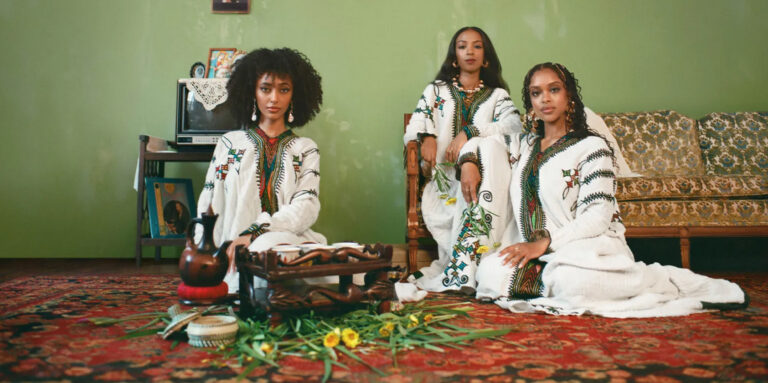
This is what sparked the birth of Meskel Flower—a visual love letter to Ethiopia, an homage to our traditions, and a reclamation of our stories.
When I began this project, I wasn’t just hoping to photograph women in traditional Habesha kemis—a handwoven, white cotton dress with it’s intricate tibeb embroidery, worn for holidays, weddings, and religious ceremonies. I was capturing the essence of a culture long overlooked in the editorial landscape. Scroll through social media, search through photo archives, and you’ll find beautiful representations of African fashion, art, and celebration—but very little of Ethiopia. There’s a void, a silence where our stories should be. And I wanted to break it, to ensure that the next generation of young Ethiopian girls sees themselves represented in the world’s visual lexicon.
The inspiration behind Meskel Flower comes from Afewerk Tekle’s iconic painting of the same name, an image that has always spoken to me as an Ethiopian woman. His depiction of a woman holding the bright Adey Abeba flower—the symbol of hope, renewal, and unity—has always felt like our Mona Lisa. There’s something timeless and quietly powerful in the way she holds herself, in the flower’s golden simplicity. It’s a reminder of our strength, our beauty, and our ability to flourish no matter the circumstances. That’s why we’ve done it so subtly—because we move with humility. Our strength has never needed to shout. It’s always been in the quiet power of our resilience, our ability to thrive with grace, even when the world wasn’t watching.
To me, this project was never just about fashion. It was about creating a moment that would last beyond the click of a shutter or the turn of a page. I wanted Meskel Flower to stand as a visual testament to the complexity and elegance of Ethiopian women—a tribute to the mothers, aunts and grandmothers who carried our culture forward through their hands, their voices, and their unshakable pride.
Every image, every stitch in the traditional garments, every prop in our recreated Ethiopian living room—each detail is a love letter to who we are. The crocheted table coverings, the old-school TV, the framed family photos—they all speak to the shared memories of Ethiopian homes around the world. It’s more than nostalgia; it’s a grounding, a reminder that wherever we are, we carry home with us. The braided hair, the laughter, the coffee ceremony that brings everyone together—they are echoes of our past, folded neatly into the future we are building.
As we celebrate Enkutatash, Ethiopia’s renaissance isn’t just happening on its own soil—it’s radiating outward. Our music, our art, our fashion—they’re not whispers anymore. They’re loud, they’re bold, and they demand to be seen. This is our moment to rise, to claim our space in the global cultural landscape, and to do so unapologetically.
Meskel Flower is my contribution to that rise. It’s a piece of history, a snapshot of the present, and a vision for the future. Because, like the Meskel flower itself, we bloom with resilience, year after year, unbowed by the storms that come. And as the world wakes up to Ethiopia’s brilliance, one thing is certain: we are just getting started.
