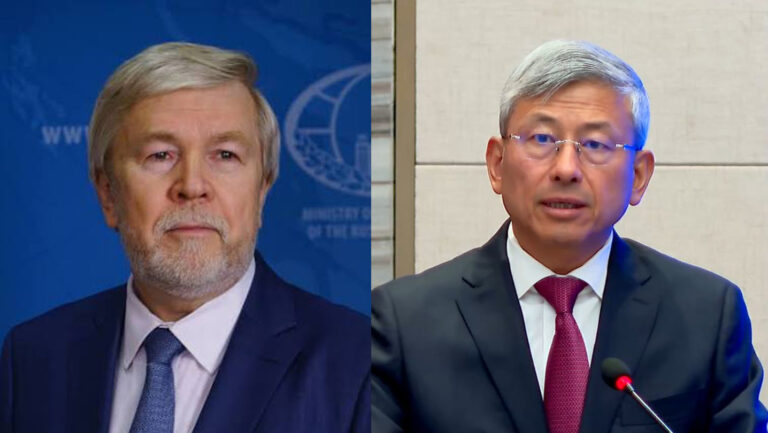
By Evgeny Terekhin and Chen Hai
This year marks the 30th anniversary of signing the Joint Russian-Chinese Declaration and the 25th anniversary of the Treaty of Good-Neighborliness, Friendship, and Cooperation between the Russian Federation and the People’s Republic of China. These documents formed a foundation for an equal and trusting partnership between our countries in the 21st century and ensured its strategic character for decades to come.
Today, our interstate dialogue continues to be based on fundamental principles, foremost among them being peaceful coexistence, respect for sovereignty and territorial integrity, non-interference in each other’s internal affairs, equality, and mutually beneficial cooperation. We respect the right of every nation to choose its own social system and path of development, as well as to preserve its cultural and historical identity and traditional moral values.
As President of the Russian Federation Vladimir Putin has stated: “Today, Russia and China are friends not against anyone; we are not fighting anyone. We are fighting only for our interests and our development. We are ready to cooperate with all our partners throughout the world.” His words are corroborated by the assessment of the President of the People’s Republic of China Xi Jinping, who noted that “the stability and certainty of China-Russia relations are particularly valuable in a changing and turbulent international situation.””
The special nature of the Russian-Chinese partnership at the present stage was reaffirmed during the Russian leader’s visit to Beijing on 19–20 May 2026. The visit produced a substantial package of documents, including the Joint Statement on strengthening the Comprehensive Strategic Partnership and Strategic Cooperation and on Deepening Relations of Good-Neighborliness, Friendship, and Cooperation, as well as the Joint Declaration on multipolarity and a new model of international relations.
The success of our chosen course is demonstrated by the achievements in Russian-Chinese trade and economic cooperation, which has shown resilience and progress despite adverse external factors. For the third consecutive year, bilateral trade has exceeded $200 billion. This year, it reached a new record, rising by 26 % by August to $159 billion. This figure includes a 29.5 % increase in Chinese exports to Russia, which amounted to $73 billion, and a 24% increase in Russian exports to China, reaching $86 billion. Such a growth enables us to set new ambitious targets, including the achievement of the next milestone of $300 billion ahead of the previously established 2030 deadline. At the same time, significant progress has been made in shifting bilateral settlements to national currencies: in 2025, more than 90% of trade between Russia and China was conducted in roubles and yuan.
We will continue to develop joint projects in accordance with long-term strategic documents, above all the Plan to Promote the Key Elements of Russian-Chinese Economic Cooperation until 2030, across a broad range of established areas, including energy, industry, outer space, agriculture, transport and logistics. At the same time, new prospects are opening up for linking our respective national achievements in innovative fields such as information and communication technologies and artificial intelligence.
Cultural, sporting, youth and tourism exchanges are also expanding. The introduction of a visa-free regime has made a substantial contribution to the growth of professional and business contacts. The launch of the Cross Years of Russia-China Cooperation in Education will undoubtedly provide an additional impetus to inter-university cooperation and collaboration in the training of specialists in high-technology fields.
In addition to close interstate relations, Moscow and Beijing maintain similar positions on the majority of key issues on the international agenda. As permanent members of the United Nations Security Council, they successfully coordinate approaches and demonstrate a shared commitment to the purposes and principles of the UN Charter. We can state with confidence that, amid growing turbulence in world affairs – behind which stand a number of states unwilling to abandon the logic of neocolonial thinking and claiming to exceptionalism – it is precisely the Russian-Chinese partnership that continues to underpin the stability of the contemporary system of international relations.
Our countries have consciously rejected the transformation of their interstate cooperation into a bloc, which would inevitably lead to confrontation in the spirit of the Cold War with Western powers claiming the role of a global hegemon. To any impartial observer, it is clear that Russian-Chinese cooperation is not directed against third countries. This approach fully corresponds to global trends pointing to an evolutionary transition towards a polycentric world order.
In contrast to the militaristic attitudes of certain international actors, Russia and China are at the forefront of establishing new types of international organizations based on new mechanisms of global governance and the formation of a fairer architecture of international relations – one that takes into account the growing role and needs of the countries of the Global South. This applies above all to BRICS, the Shanghai Cooperation Organization and the G20.
Within the BRICS, our countries serve as political and institutional pillars of the grouping. Through the efforts of Russia and China, what initially functioned primarily as a “forum for dialogue” has evolved into an effective mechanism for implementing concrete initiatives – from settlements in national currencies, new payment systems and financial cooperation to joint research programs and technological projects. At the 2024 BRICS Summit in Kazan, Russia, as the chair, promoted three priorities: politics and security, economy and finance and humanitarian ties. China supplemented these priorities with cooperation in innovation, green energy, trade and logistics. The resulting synergy has enriched
the BRICS cooperation with new practical instruments, including centers for cooperation in special economic zones and industrial competencies. China will take over the BRICS presidency in 2027. Through the joint efforts of all member states, the BRICS mechanism will continue to grow and strengthen.
The accession, on 1 January 2024, of one of Africa’s key countries – Ethiopia – was an important milestone in the institutional strengthening of the BRICS. Russia and China consistently support Addis Ababa’s integration into their multilateral formats and key mechanisms, with a view to bringing political dialogue and economic and financial cooperation to a new level. We believe that Ethiopia’s participation in BRICS will help advance its most important priorities in such areas as trade and economic cooperation, infrastructure and agricultural development, environmental protection, energy, healthcare and others.
At the same time, Moscow and Beijing cannot but be concerned by the persistent attempts of certain global actors to pursue outdated policies aimed at expanding military and political blocs, thereby undermining strategic stability in the Asia-Pacific region and throughout the world. Moscow and Beijing advocate strengthening equal and indivisible security, adherence to the principles of mutual respect, and rejection of policies based on coercion and pressure.
Russia and China have every reason to hold this position. Our peoples possess a strong historical memory, shaped in large part by the enormous sacrifices they made during the Second World War. We will commemorate its end 81st anniversary on September 3. The Chinese People’s War of Resistance Against Japanese Aggression was an important part of the World Anti-Fascist War. With huge national sacrifice, the Chinese people made major contributions to saving human civilization and safeguarding world peace. After bringing the Great Patriotic War to an end in Berlin and before it had even recovered from the devastation inflicted upon it, the Soviet Union immediately rendered assistance to the fraternal Chinese people by committing all available forces to the defeat of Japan’s Kwantung Army.
The Russian and Chinese peoples continue to preserve in their hearts the memory of the tens of millions of Soviet and Chinese citizens who were killed and tortured by German Nazis and Japanese militarists. Their sacrifice, however, was not in vain. They paid for the freedom of our countries with their blood, and we remember them with gratitude.
It is also well known that hundreds of thousands of Ethiopian citizens lost their lives during the treacherous Italian invasion of 1935–1941. Some fell on the battlefields with weapons in their hands; others perished in concentration camps or as a result of punitive operations, hunger and deprivation. Yet, like the Soviet and Chinese peoples, the Ethiopian people were not broken. They emerged from that terrible war victorious – the first people to free themselves from the yoke of fascist occupation – once again defending their sovereignty and statehood, just as they had done half a century earlier at the Battle of Adwa.
The common contribution of our peoples to victory over global evil during the Second World War made possible the creation of a new world order and the United Nations, which for 80 years have helped to prevent the outbreak of a new global catastrophe – one which flames could consume all humanity. That is why we unswervingly uphold the postwar international order and the authority of international law, unite the Global South, and steer the reform of the global governance system in the right direction.. We can withstand these efforts only through joint action.
The experience accumulated by Russia and China convincingly demonstrates that, while pursuing their respective sovereign national interests, our countries continue to be united by the ideas of good-neighbourliness and friendship, underpinned by consistently developing and mutually beneficial political, trade and economic cooperation and a shared vision of a multipolar world order. This community of views enables our peoples to look confidently towards the future.
Evgeny Terekhin is ambassador of the Russian Federation and Chen Hai is the ambassador of People’s Republic of China to the Federal Democratic Republic of Ethiopia