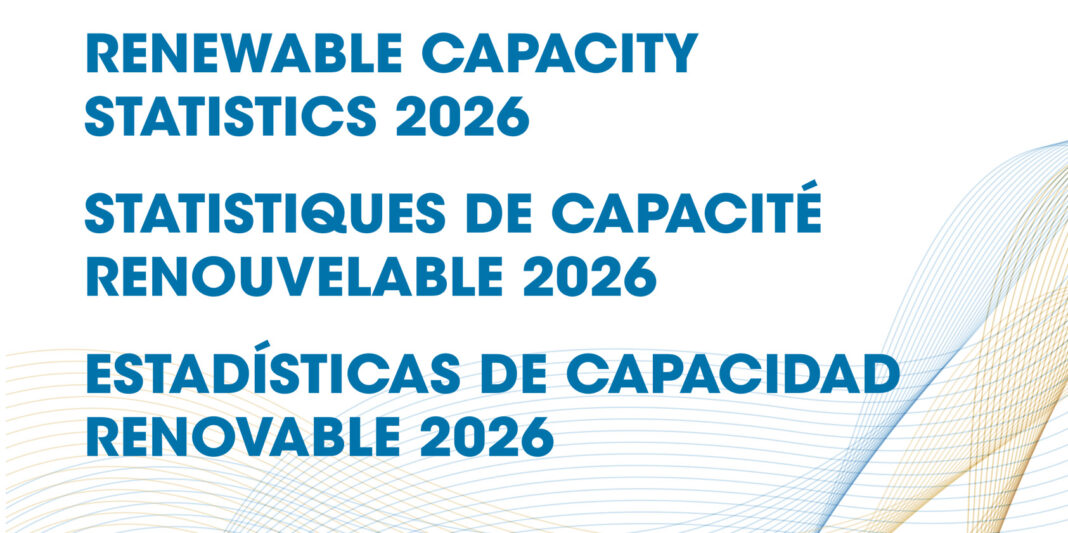
Ethiopia is emerging as one of Africa’s main renewable energy markets, helping drive the continent’s highest annual capacity increase in 2025, according to the International Renewable Energy Agency’s latest Renewable Capacity Statistics 2026. The report says Africa’s renewable power capacity rose sharply last year, with Ethiopia among the countries leading that expansion alongside South Africa and Egypt.
The IRENA report says renewable energy continued to dominate new global power additions in 2025, with Africa recording its strongest annual increase to date. It notes that while solar and wind power accounted for most new capacity worldwide, Africa’s overall growth was still far below the pace seen in China, the United States and the European Union.
For Ethiopia, the finding reinforces the country’s growing role in the clean energy transition. The report does not break out Ethiopia’s exact capacity in the summary, but it identifies the country as one of the main contributors to Africa’s record renewable energy expansion in 2025.
IRENA said renewables accounted for 46 percent of global installed power capacity at the end of 2025 and 74 percent of new global power additions during the year. The agency said the trend reflects the economic competitiveness of renewable power, but warned that much faster growth is still needed to make clean electricity the world’s dominant source.
The report also said Africa’s renewable capacity reached a new high in 2025, driven by Ethiopia, South Africa and Egypt, while the Middle East also saw strong growth led by Saudi Arabia. It said the growth shows the widening spread of renewable investment outside traditional markets, even though global deployment remains uneven.
For Ethiopia, the momentum could support broader energy security goals, including grid expansion, industrial power supply and rural electrification. The country has long relied on hydropower, but the IRENA data suggests it is increasingly part of a wider renewable energy mix that also includes solar and wind.
IRENA said the global transition still faces major planning and grid-flexibility challenges, particularly as renewable energy approaches a larger share of total generation capacity. The agency added that the next phase will require stronger policies, better infrastructure and more distributed generation if the world is to move toward a just and sustainable energy future.