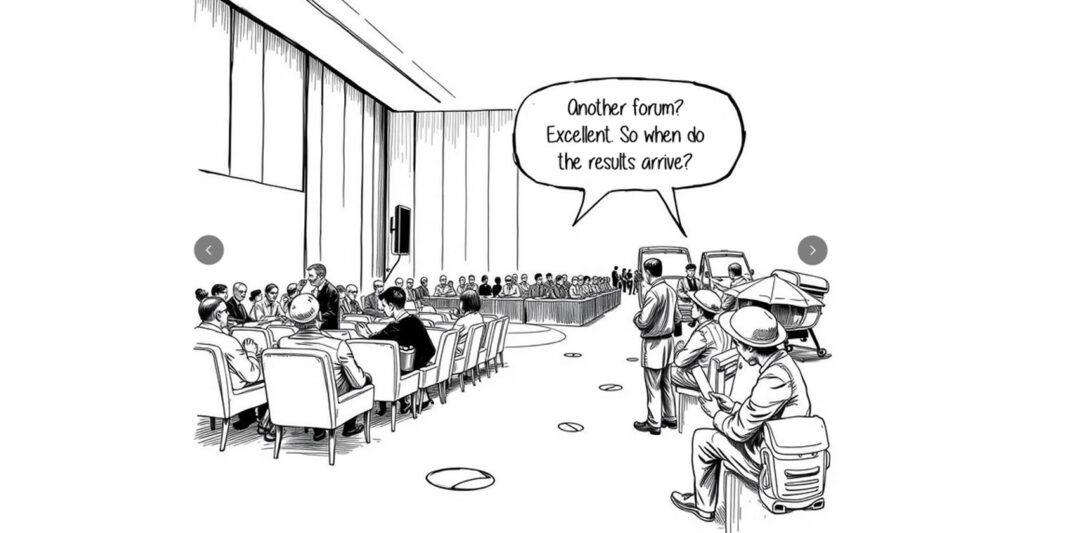
Africa does not suffer from a shortage of summits, forums, conferences or high-level gatherings. It suffers from a shortage of implementation. Every year, leaders, experts, diplomats and business executives fly from one polished venue to another, announce ambitious partnerships, pose for photographs and issue communiqués that promise transformation. Yet for ordinary Africans, too many of these meetings produce little more than expensive speeches and recycled commitments.
That is why the continent should ask a hard question: what exactly are these inaugural forums changing? In many cases, the answer is disappointing. They create visibility for a few organizers, networking opportunities for a select group of attendees and media headlines that quickly fade. They rarely fix broken roads, expand electricity access, lower food prices, create jobs or improve public services. Africa cannot afford to keep confusing activity with progress.
This is not an argument against dialogue. Africa certainly needs spaces where governments, private sector actors, civil society and development partners can exchange ideas. But the current culture of endless convening has become excessive. Too often, the same themes are repeated with new branding and a fresh venue, while the underlying problems remain unchanged. Food insecurity, debt distress, unemployment, weak industrial capacity, poor health systems and collapsing infrastructure do not disappear because people attend a forum on them.
The real issue is opportunity cost. Every dollar spent on lavish conferences is a dollar not spent on a classroom, clinic, irrigation system, local factory or community program. African governments and institutions must remember that public money is scarce and public trust is even scarcer. Citizens judge leaders not by how many panels they host, but by whether life becomes more affordable, more secure and more dignified. A forum that ends without measurable results is not a contribution to development; it is a distraction from it.
There is also a deeper political problem. In many African capitals, forums are used as substitutes for policy. Leaders gather to discuss agriculture, energy, digital finance, climate resilience or regional integration, then return home without changing budgets, laws or institutions. This creates the illusion of seriousness without the burden of delivery. The continent does not need more declarations of intent. It needs functioning institutions, disciplined execution and a willingness to measure success in concrete outcomes.
African people are increasingly aware of this gap. They do not need more speeches about empowerment while unemployment remains high. They do not need more summits about food security while farmers lack fertilizers, storage and access to markets. They do not need more elite conversations on climate action while communities continue to face droughts, floods and displacement without support. What people need most is practical progress in the areas that shape daily life: jobs, education, health care, housing, transport, energy and security.
This does not mean Africa should isolate itself from international dialogue. On the contrary, the continent needs stronger cooperation, better coordination and smarter partnerships. But those partnerships should be judged by their results, not by their ceremonial value. A modest working meeting that produces a loan guarantee, a trade corridor, a regulatory reform or a new production facility is far more useful than a grand summit that ends with applause and no follow-through.
There is also a cultural issue in how some forums are organized. The staging often matters more than the substance. Imported speakers, luxury hotels, executive dinners and glossy brochures may create an impression of importance, but they do little for the people who finance the continent through taxes, labor and sacrifice. African institutions should adopt a stricter standard: if a forum cannot demonstrate a clear problem it will solve, a timeline for action and a mechanism for accountability, then it should not happen.
The continent’s priorities are not mysterious. African people want affordable food, decent incomes, reliable electricity, better schools, functional hospitals, safe transport, digital access and peace. They want governments that can manage public finances responsibly and businesses that can grow without endless obstacles. They want regional trade to move faster, borders to be more efficient and domestic production to replace import dependence. These are the real forums that matter — the ones happening in farms, markets, workshops, classrooms and households every day.
Some will argue that forums help attract investment. That may be true in limited cases, but investment follows confidence, and confidence follows results. Investors do not commit capital because a continent hosts a stylish conference. They invest when they see policy stability, credible institutions, infrastructure, market access and a reasonable chance of return. If forums are not helping build those conditions, then they are not advancing investment in any meaningful sense.
Africa should therefore be selective. Convene less, implement more. Reduce the number of ceremonial gatherings and increase the number of delivery-focused working sessions. Put the savings into programs that people can see and feel. Measure every forum by one question: what will change after this meeting that would not have changed otherwise?
That question would clear away a great deal of noise. It would force seriousness. And it would remind leaders that development is not performed on a stage. It is built through disciplined choices, hard work and accountability.
Africa does not need another round of expensive promises. It needs results.