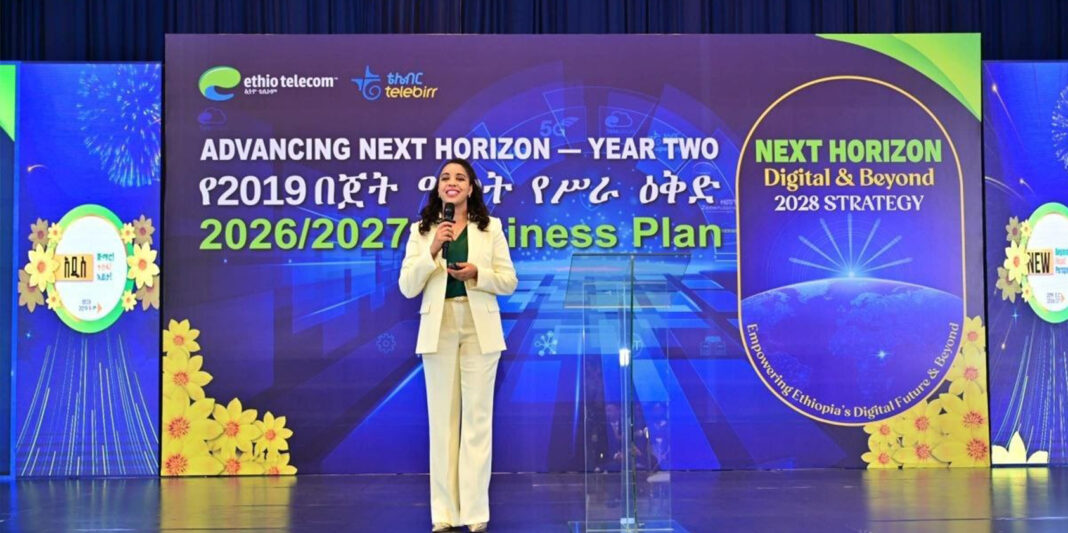
Ethio Telecom has unveiled an ambitious business plan for the 2026/27 fiscal year, targeting 295 billion birr in revenue and allocating 8.1 billion birr to the National Disaster Risk Response Fund as part of its broader contribution to national development and social protection.
The state-owned telecommunications operator said the revenue target represents a 36.7 percent year-on-year increase, or an additional 79.2 billion birr over the previous fiscal period. The announcement marks the second year of implementation of the company’s “Next Horizon: Digital & Beyond 2028” strategy, which aims to expand services beyond traditional connectivity.
CEO Frehiwot Tamiru told reporters that “Beyond Connectivity” services — including digital financial services, e-commerce and enterprise solutions — are expected to generate 77.45 billion birr, accounting for more than 26 percent of total revenue. The company has set an EBITDA target of 154.4 billion birr, representing a 52 percent margin, and a projected net profit margin of 22 percent.
Beyond its core operations, Ethio Telecom outlined a wide-ranging fiscal contribution to the state. Backed by revenue growth, job creation and strategic investments, the company estimates its total direct and indirect tax contributions will reach 83.8 billion birr. This includes corporate income tax, value-added tax, employment taxes, withholding taxes and customs duties.
The operator also anticipates disbursing 43.1 billion birr in dividends to the government. Combined with the 8.1 billion birr allocation to the disaster fund, these payments represent a significant capital injection into the national treasury to support infrastructure and broader development priorities.
The 8.1 billion birr contribution is a direct implementation of Council of Ministers Regulation No. 576/2025, which came into effect in November 2025. The regulation requires telecom operators to remit a 5 percent levy on all airtime and data sales to the National Disaster Risk Response Fund.
The levy forms part of a wider “home-grown resilience strategy” that draws on 17 revenue streams across multiple sectors. These include a 1 percent charge on bank loans, a 1 percent levy on insurance premiums and a 1 birr-per-litre surcharge on fuel. The initiative is designed to create a sustainable domestic financing mechanism for disaster response and reduce Ethiopia’s reliance on external aid, particularly following disruptions such as the suspension of USAID disbursements.
To support exponential growth in data consumption, Ethio Telecom said it will undertake major network upgrades during the coming year. The company plans to expand total mobile network capacity from 115.1 million to 135.7 million subscribers. Its 4G footprint will be significantly enlarged, with 5,417 new sites to be added and population coverage rising from 82 percent to 95 percent.
Frehiwot also highlighted the expected performance of telebirr, the company’s mobile money platform. The user base is projected to grow by 11.7 percent to reach 67.69 million customers. Active user transactions are expected to reach 4.99 billion, with transaction values climbing to 7.4 trillion birr.
The report further sets aggressive targets for telebirr’s ancillary services. Microcredit is projected to grow by 69.6 percent to 35.4 billion birr, while digital savings are expected to rise to 26.42 billion birr. The e-commerce marketplace ZemenGebeya aims for a gross merchandise value of 1.4 billion birr, a 279 percent increase that signals rapid expansion in Ethiopia’s digital commerce ecosystem.