The Ethiopian Deposit Insurance Fund (EDIF), the statutory body established to protect retail depositors and bolster financial stability across the banking and microfinance sectors, is weighing a fundamental reform in how it assesses member contributions. Fund officials are exploring a transition from the current flat annual rate of 0.3 percent to a dynamic “target fund” model that factors in the specific risk profiles and liabilities of individual financial institutions.
The proposal comes as the fund accumulates tens of billions of birr in reserves while navigating yield compression on government securities, notably a sharp drop in Treasury bill (T-bill) yields alongside limited domestic investment outlets.
Currently, 31 commercial banks and 44 microfinance institutions operating in Ethiopia pay an annual premium of 0.3 percent calculated on their average total deposits.
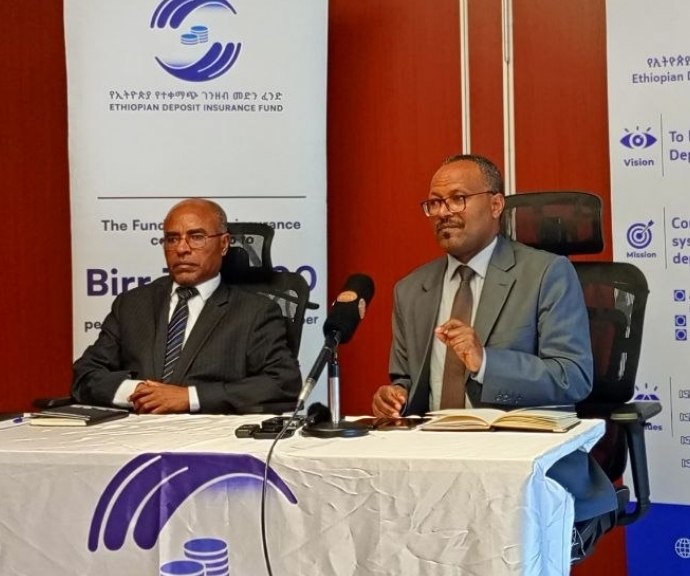
“Since the EDIF began operations in 2023, member institutions have been required to pay an annual contribution of 0.3 percent of their average total deposits, alongside an initial contribution paid upon joining,” said Merga Wakweya, Director of Operations at the EDIF. He noted that the 0.3 percent rate was drawn from international benchmarks to build a financial safety net quickly.
However, fund leadership argues that a more sophisticated methodology is needed over the long term, moving away from a flat rate toward an actuarially determined target size.
“Right now, we simply calculate and collect 0.3 percent of the existing deposit pool,” Merga explained. “Our long-term objective is to transition to a structured, scientifically modeled target fund approach.”
Under the proposed model, the EDIF would establish a specific target reserve ratio relative to the banking sector’s aggregate insured liabilities. Once the reserve reaches the determined threshold, the fund could pause collections, issue pro-rata rebates, or adjust premiums based on institutional risk ratings.
A central operational challenge facing the fund is the sharp drop in T-bill yields. When the fund commenced operations, government securities offered returns of up to 18 percent, generating robust revenue on reserves. Yields have since decreased substantially.
Data from the National Bank of Ethiopia (NBE) shows that weighted-average yields on government securities fell from 15.59 percent in September 2025 to 5.79 percent in September 2026.
Results from the central bank auction held on September 2, 2026, reflected high market liquidity, with total bids reaching 74.18 billion birr against an offering of 43 billion birr, compared to 44.11 billion birr in bids recorded during the September 2025 auction. The downward trend across 28-day, 91-day, 182-day, and 364-day tenors has directly reduced the fund’s investment income.
“Where do we place the funds we continuously collect from institutions?” Merga noted. “We invest primarily in Treasury bills, effectively lending to the government. With yields dropping to roughly 6.87 percent, fund revenue is directly affected.”
Despite lower yields, fund leadership reiterated that investment decisions strictly prioritize safety and liquidity over aggressive returns.
Beyond T-bills, the fund holds roughly 2.36 billion birr collected from interest-free and Mudarabah deposits in accounts with the Commercial Bank of Ethiopia (CBE). Officials acknowledged that holding significant reserves directly within commercial banks is a temporary arrangement, as deposit insurers generally avoid redepositing funds into institutions they insure to prevent circular exposure.
To diversify its holdings, the fund is actively tracking the development of Sukuk (sharia-compliant securities) in Ethiopia, which could offer alternative fixed-income vehicles for its interest-free reserves.
Despite macroeconomic adjustments, the EDIF’s financial standing remains solid, with accumulated reserve balances reaching 45.57 billion birr by late 2026. The fund currently guarantees deposits up to 100,000 birr per depositor per institution, covering the vast majority of retail accounts.
The fund recently initiated its first statutory payout process following the liquidation of a microfinance institution whose operating license was revoked by the central bank. Beneficiary verifications and disbursements are underway for affected depositors in Addis Ababa and the Dilla area.
Under prevailing regulations, insured payouts must be executed within 90 days of a declared institutional failure, while depositors retain the legal right to claim entitlements for up to five years.
To enhance public understanding, the EDIF is drafting directives requiring commercial banks and microfinance institutions to actively disclose deposit insurance coverage in their customer communications and savings campaigns.
Established under Council of Ministers Regulation No. 482/2021, the Ethiopian Deposit Insurance Fund operates under the regulatory oversight of the National Bank of Ethiopia, with its Board of Directors chaired by the NBE Governor.