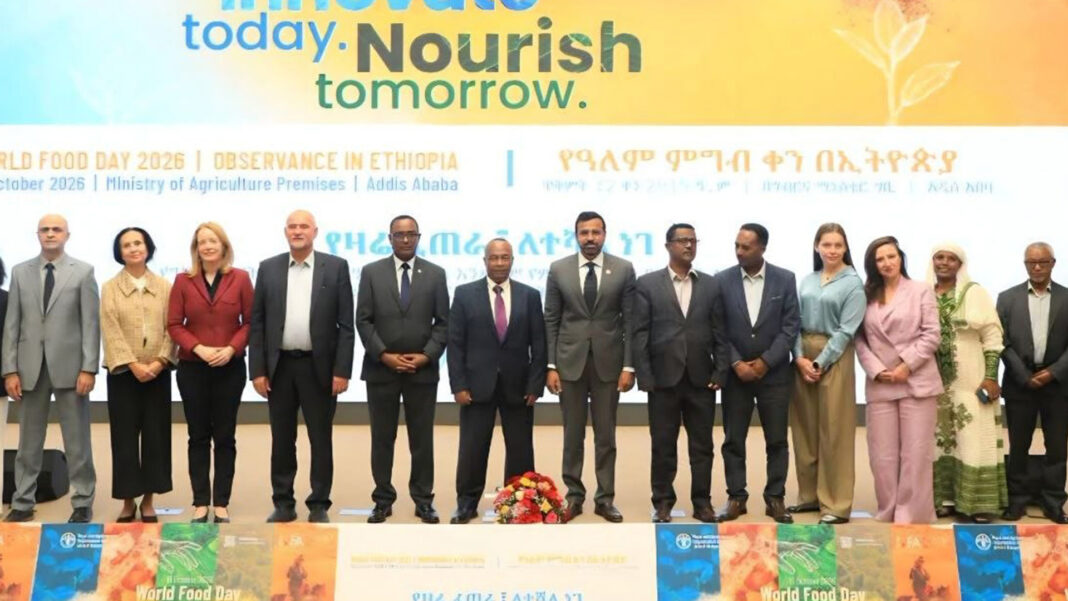
Ethiopia’s efforts to expand wheat production and strengthen food security are facing a new challenge as El Niño-related weather risks threaten harvests and livelihoods, with humanitarian agencies warning that vulnerable communities need early support.
More than 163 woredas have been identified as vulnerable to El Niño, with 114 woredas, home to an estimated 9.3 million people, designated for anticipatory action by the Ethiopia Disaster Risk Management Commission.
Of these, 84 woredas in Afar, Amhara, Somali and Tigray regions have been classified as Priority Levels 1 and 2, based on the severity of risks and the need for assistance.
Speaking at the 2026 World Food Day celebration in Addis Ababa, held under the theme “Innovate Today, Nourish Tomorrow,” Zlatan Milišić, the World Food Programme’s (WFP) Representative and Country Director for Ethiopia, said the country had experienced dry conditions for several months, raising concerns about agricultural production.
“Generally, a poor harvest is expected, certainly a worse harvest than over the last several years,” Milišić said.
He said the WFP was working with the Ethiopian government and other partners to prepare for and respond to the potential effects of El Niño. These efforts include early-warning messages, financial assistance to help communities prepare, and support for areas facing humanitarian needs.
According to Milišić, the impact is particularly visible in Amhara, Tigray and Afar, where the government and its partners are focusing their response.
The WFP is supporting up to two million people in Ethiopia, depending on seasonal needs, while also investing in resilience measures designed to help communities withstand future shocks.
The warnings come as Ethiopia seeks to build on gains in agricultural production and reduce its vulnerability to food shortages.
Figures indicate that the area under wheat cultivation increased from 20,000 hectares in 2020 to 3.78 million hectares in 2025/26, while reported annual production reached 318.4 million quintals.
These figures reflect the scale of the country’s agricultural ambitions. However, increased production alone may not protect farmers and pastoralists from weather-related disruptions.
The effects of drought or irregular rainfall can extend beyond crop yields to household incomes, livestock, food availability and access to markets.
Dr. Workicho Jateno, Assistant FAO Representative for Programmes in Ethiopia, said climate change, land degradation, water scarcity, biodiversity loss, economic volatility, conflict and displacement were placing interconnected pressures on the country’s agri-food system.
He called for stronger use of scientific evidence, digital technology, traditional knowledge and locally developed solutions to improve agricultural resilience.
“Better risk information must lead to timely action that protects lives and livelihoods,” Jateno said, stressing the importance of linking early-warning systems with financing and preparedness measures.
He also highlighted opportunities to strengthen climate services, irrigation, improved seeds, sustainable soil management and agricultural planning.
However, he said technology alone would not transform food systems without accessible services, capable institutions, skilled workers and adequate financing.
The Ministry of Agriculture is also relying on social-protection and livelihood programmes to help vulnerable households withstand food-security shocks.
Sentayehu Demissie, Head of the Ministry’s Food Security Coordination Office, told Capital that the Rural Productive Safety Net Programme was supporting eight million people vulnerable to poverty and various hazards across 10 regions and one city administration.
She said the programme was designed not only to address the effects of El Niño but also to tackle broader food-security challenges by helping households improve productivity and move towards self-reliance.
Activities include support for land development, vocational training, income-generating activities, savings and agricultural production.
According to figures provided by the ministry, more than 862,000 beneficiaries received comprehensive training through the Family Livelihood Improvement Programme, with women accounting for 48 per cent of participants.
More than 857,000 beneficiaries accumulated savings totalling 1.2 billion birr, while 862,252 received one-time cash assistance.
The programme also supplied water-harvesting technologies to beneficiaries, including water pumps, and distributed urea fertiliser to support agricultural production.
The ministry reported that these interventions enabled the production of 720,000 quintals of crops, vegetables and fruits.
Sentayehu said the programme’s broader objective was to link immediate assistance with longer-term livelihood development, helping households move beyond subsistence activities towards more productive and sustainable sources of income.
Dr. Mandefro Nigussie, Chief Executive Officer of the Agricultural Transformation Institute, said Ethiopia was investing in irrigation, mechanisation, improved agricultural markets and more resilient rural economies.
He stressed that agricultural transformation requires better coordination across production, processing, distribution and consumption, alongside investment in climate-smart practices and digital agriculture.
As the country responds to disasters such as El Niño, the effectiveness of these measures will depend on how quickly support reaches vulnerable communities and whether longer-term investments can protect farmers and pastoralists against future shocks.