Africa’s promise of deeper integration is being slowed by weak mobility links, outdated transport networks and persistent barriers to the movement of people, goods and services, according to a new report, Africa on the Move.
The report, released ahead of the Africa Forward Summit in Nairobi, says the continent cannot move forward without major improvements in connectivity, both “soft” mobility, such as visas, labor mobility and trade rules, and “hard” infrastructure, including roads, railways, aviation and digital networks. It argues that stronger mobility would accelerate the African Continental Free Trade Area, support regular migration within Africa and help unlock the continent’s economic potential.
The study says Africa’s internal connectivity remains heavily shaped by an old export model built around moving raw commodities out of the continent rather than linking African economies to one another. As a result, travel within Africa is often slower, more expensive and less direct than comparable journeys in other regions. Roads are frequently discontinuous, railways remain fragmented and underused, and air travel, though growing, is still costly and mostly outbound.
The report notes that only four countries — Mali, Niger, Rwanda and São Tomé and Príncipe — have ratified the African Union’s Free Movement of Persons Protocol, while only 28 percent of African citizens do not need a visa to travel to another African country. It says the limited recognition of educational and professional qualifications also makes it harder for Africans to study, work or move across borders.
Trade in goods and services faces similar obstacles. Beyond customs duties, exporters must deal with non-tariff barriers such as sanitary and phytosanitary rules, labeling requirements and packaging standards. The report says these measures, together with limited currency convertibility, create hidden costs that weaken intra-African commerce. It estimates the continent loses about 5 billion US dollars a year to currency conversion costs alone.
The report highlights the potential gains if the AfCFTA is fully implemented. It says intra-African trade could rise to 53 percent from about 18 percent of current African trade, the manufacturing sector could expand by 1 trillion US dollars, income gains could reach 470 billion US dollars and 14 million jobs could be created by 2035.
Transport infrastructure remains a major constraint. The report says roads are still the main mode of transport on the continent, but are often unsafe and discontinuous. Rail networks face low interoperability, old systems and limited access to seaports, while at least 13 countries, home to around 17 percent of Africa’s population, still lack direct rail access to seaports. Air transport is improving but remains expensive and geared more toward international than intra-African travel.
The report also points to the importance of continental and external investment in infrastructure. It cites the EU’s Global Gateway as a major effort to improve connectivity through strategic corridors, while also noting China’s continued role in African infrastructure, though often in support of outward-oriented trade flows.
At the same time, the document argues that mobility is not only about trade and transport, but also about people. Most African migrants remain within the continent, with 72.4 percent of sub-Saharan African migrants living elsewhere in Africa. The report says this reflects the reality that Africa is not a continent of mass exodus, but one where mobility is shaped by economic opportunity, regional tensions and uneven access to visas.
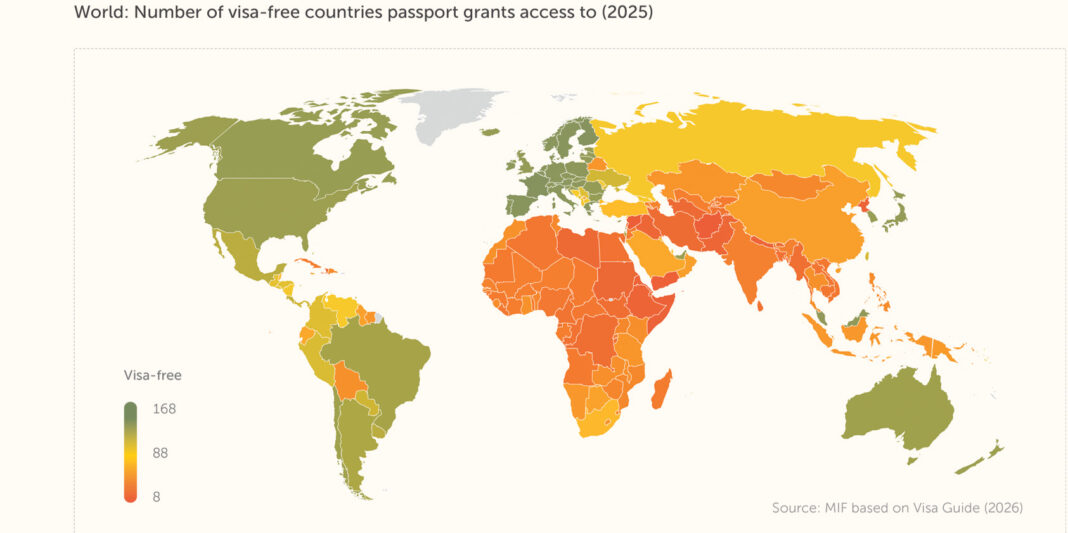
Passport restrictions remain a major barrier. The report says Africa has the weakest passport strength in the world and that 21 African countries grant visa-free access to fewer than 30 countries globally. It also notes that rejected Schengen visa applications cost African citizens about 60 million euros every year on average, with more than 706,000 applications rejected across the continent in 2024.
The report concludes that Africa’s mobility and connectivity gaps are not just technical problems but strategic ones. It says that improving movement across the continent would strengthen regional integration, expand employment opportunities for Africa’s growing youth population and improve the continent’s sovereignty and economic autonomy.