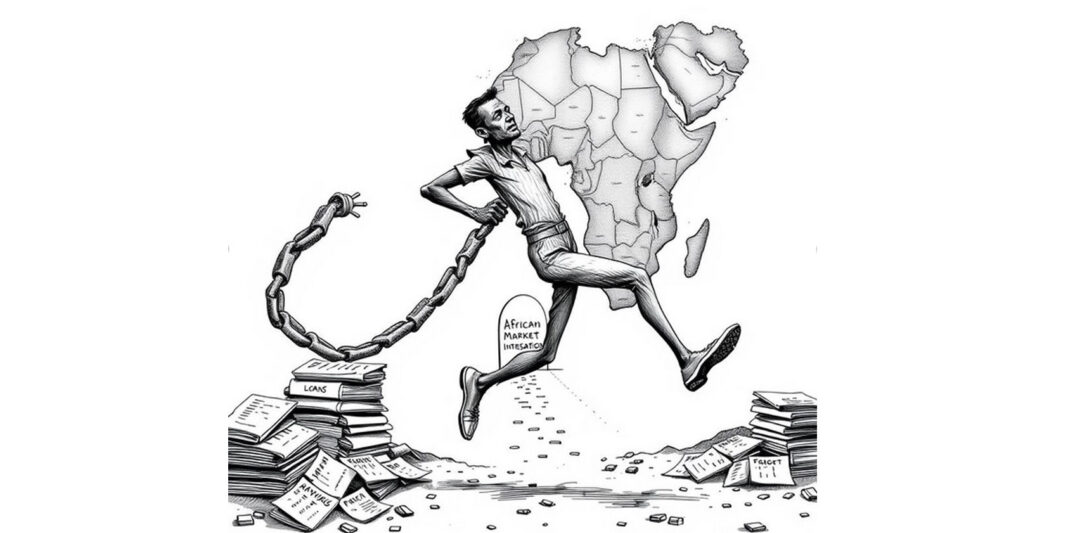
Africa’s debt crisis will not be solved by borrowing alone, nor by waiting for rescue from outside the continent. The more durable answer is to grow the continent’s own markets, strengthen production, and expand intra-African trade so that African economies can generate more of the revenue they need at home.
For decades, many African countries have relied on external financing to cover budget gaps, fund infrastructure, and stabilize currencies. That model has left governments vulnerable to exchange-rate shocks, rising global interest rates, and sudden changes in investor sentiment. When debt service rises, social spending, development programs, and public investment are usually the first to suffer. The result is a cycle in which countries borrow to survive, then borrow again to repay the last round.
Breaking that cycle requires a shift in strategy. Africa must stop treating itself mainly as a collection of small national markets and start behaving like one large economic space. The African Continental Free Trade Area is the clearest path toward that goal. If it is implemented seriously, it can create scale, deepen industrialization, and keep more value within the continent. But trade agreements alone are not enough. Governments must remove the practical barriers that still make it easier to trade with Europe, Asia, or the Gulf than with a neighboring African country.
The first barrier is infrastructure. Goods cannot move cheaply across Africa if roads are poor, rail links are weak, ports are congested, and border posts remain slow and unpredictable. A trader in Kigali should not face more difficulty shipping to Nairobi than to Rotterdam. The same applies to a manufacturer in Accra trying to sell in Abidjan or a farmer in Ethiopia trying to access regional markets. Better logistics is not a luxury; it is the foundation of trade-led growth.
The second barrier is regulation. African businesses still face a patchwork of customs rules, product standards, permit systems, and payment procedures. These frictions raise costs and discourage cross-border commerce. Governments should harmonize standards, simplify customs procedures, and digitize clearance systems so that goods can move faster and more transparently. Regional trade should not depend on political speeches; it should depend on predictable systems that firms can trust.
The third barrier is finance. African trade needs African money. One reason intra-African trade remains underdeveloped is that many transactions are still settled in foreign currencies, exposing firms to exchange-rate risk and higher costs. Regional payment systems, local-currency settlement arrangements, and stronger correspondent banking links can reduce those burdens. If an importer in Uganda can pay a supplier in Tanzania more easily in regional currency, trade becomes simpler and cheaper. That is how markets deepen.
Africa also needs to build more regional value chains. Too many countries export raw materials and import finished goods at a premium. That pattern drains foreign exchange and leaves economies exposed to price swings. Instead, countries should specialize within the continent: one producing inputs, another processing them, another assembling finished goods, and others providing logistics and services. This is how trade becomes a ladder out of debt rather than another reason to borrow.
At the same time, governments must support small and medium-sized enterprises, which are the backbone of any meaningful regional trade system. Large firms can navigate high compliance costs and distant markets, but smaller businesses often cannot. If Africa wants trade to reduce debt pressure, SMEs need access to trade finance, market information, insurance, and export support. Without them, intra-African trade will remain a policy slogan rather than an economic engine.
There is also a political dimension. African leaders must resist the temptation to measure success by how much external financing they attract. The better measure is how much domestic wealth they mobilize and how much regional trade they enable. A continent that consumes what it produces, processes more of what it exports, and circulates capital within its own markets will be less dependent on lenders and more resilient in a volatile world.
Debt will not disappear overnight. Many countries will still need external financing for some time. But the terms of dependence can change. If Africa trades more with itself, it will earn more in local value, build more industrial capacity, and reduce the foreign exchange drain that makes debt so dangerous. Intra-African trade is not just a commercial agenda. It is a debt strategy, a development strategy, and a sovereignty strategy.
The continent’s future will not be secured by borrowing its way forward. It will be secured by building an economy that can stand on its own feet, with African goods, African markets, and African confidence at the center.