
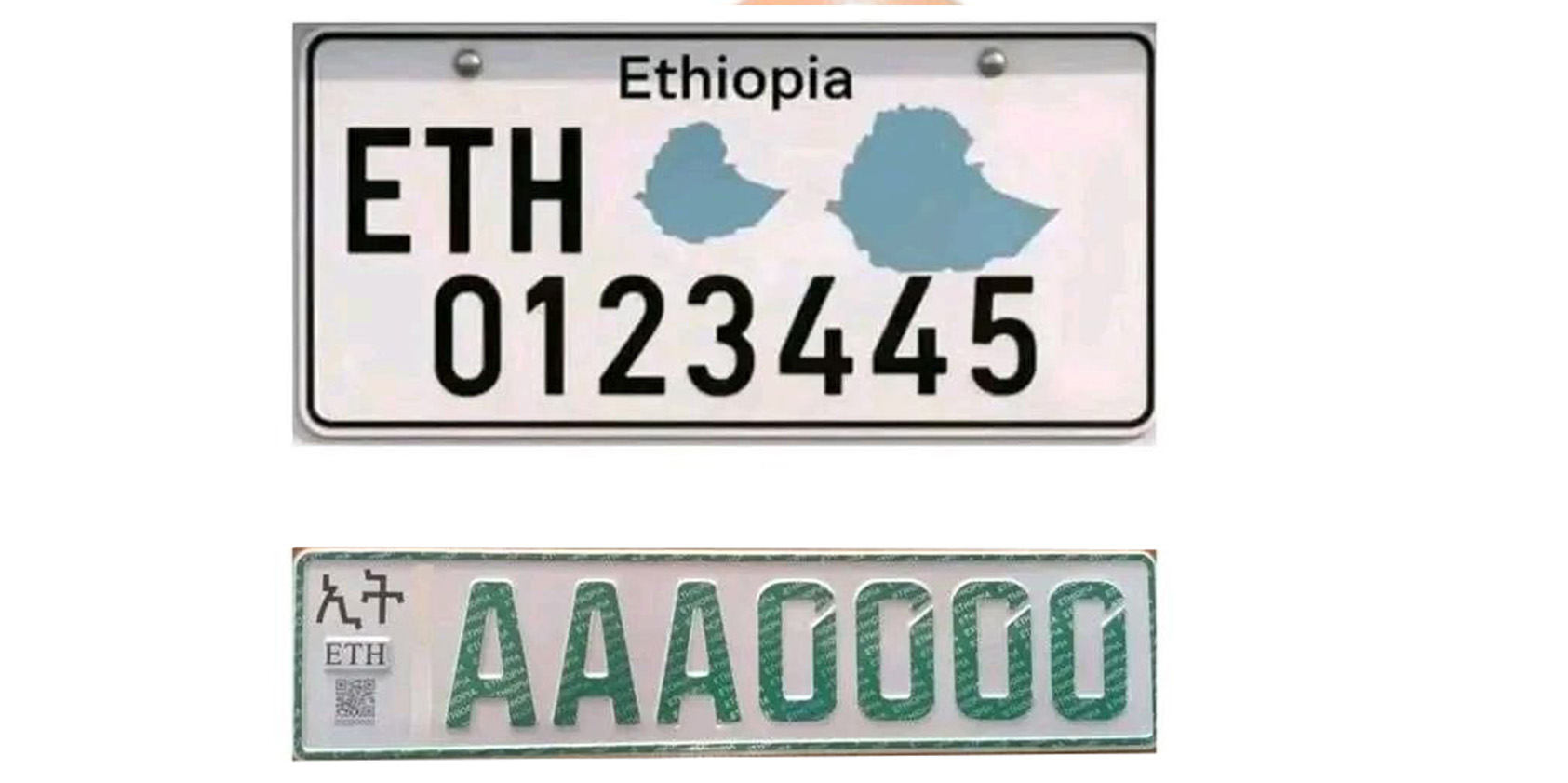
The Ethiopian government has officially announced that the Public Service Transport Service Enterprise will fully take over responsibility for manufacturing and distributing the country’s newly unveiled digital vehicle license plates. This transfer of responsibility will take place once the current international supply contract is completed and the system moves from its initial implementation phase into regular operation.
The announcement was made during the official launch of the country’s first standardized national vehicle identification system, which meets international standards.
According to Zegeye Belayneh, Director-General of the Addis Ababa City Driver and Vehicle Licensing and Control Authority, the new system will fully replace the old license plate system currently in use, which suffers from numerous flaws.
Transport authorities explained that although the initial rollout followed an international framework — involving the large-scale manufacturing of 4 million modern plates by a specialized company in China due to a lack of immediate domestic production capacity — the long-term strategy calls for complete national control. To ensure economic sustainability, the government-backed Public Service Transport Service Enterprise has been officially mandated to handle all subsequent manufacturing and logistics operations.
Zegeye explained that the conventional plates currently in use suffer from structural flaws: they degrade quickly, lack uniformity, are prone to physical damage and are highly susceptible to forgery and illegal duplication. Officials emphasized that such counterfeit plate activity has repeatedly endangered public safety and security while enabling illicit operations.
However, following the license plate reform, the release of the new price list — which covers both front and rear plates and includes Value Added Tax (VAT) — has sparked intense opposition and concern among vehicle owners and service providers. Critics argue that the newly released tariff represents a major price increase compared with previous plate issuance costs, imposing a heavy economic burden that overshadows the benefits of the lifetime smart license plates.
According to the official tariff list, the price for private, commercial, diplomatic and aid organization vehicles running on fuel is set at 56,000 Birr, while those running on electricity or gas are priced at 44,500 Birr. For cross-border freight transport vehicles, the fee is 28,500 Birr for fuel-powered vehicles and 15,200 Birr for electric or gas-powered vehicles. Public taxis are charged 11,700 Birr for fuel-powered vehicles and 9,400 Birr for electric or gas vehicles. For buses, government vehicles, vehicles for persons with disabilities and bajajs, the cost is 9,400 Birr for fuel-powered vehicles and 7,100 Birr for electric or gas vehicles. Motorcycles are priced at 4,700 Birr for fuel-powered models and 3,550 Birr for electric or gas models.
Even as public criticism grows, economic analysts say the government’s pricing strategy sends a clear signal to the automotive market and represents a strategic move to accelerate the transition away from fossil fuels. By offering discounts of up to 46 percent for electric and gas-powered vehicles, policymakers are using the price gap to encourage consumers to adopt electric vehicles.
Nevertheless, public taxi drivers and transport associations have warned that the added cost could trigger inflation, affecting public transport fares and logistics expenses. During a recent press conference, the authority did not provide a detailed response to the pricing concerns.
Officials also said that, to manage the large volume of demand without overloading administrative channels, the government has introduced a strict phased implementation plan beginning with a pilot program across 11 key branches in Addis Ababa. The first phase targets newly registered vehicles. More than 1,000 major construction companies, commercial enterprises and transport organizations — some managing fleets of hundreds of vehicles — are already registered and waiting to receive the new plates.
Before the rollout, the authority acknowledged that minor delays were caused by structural adjustments to the system and technological upgrades. As a result, the ministry said transitioning existing vehicles, categorized under Code 1, 2, 3 and so on, into the new system is expected to take three to six months.