Ethiopian Electric Power (EEP) is advancing plans to establish a competitive, stock-market-style system for cross-border electricity trading as the country seeks to mobilise an estimated USD 40 billion for its rapidly expanding energy sector.
The proposal is tied to the Eastern Africa Power Pool (EAPP), a regional initiative intended to enable member states to trade electricity through a structured day-ahead market. But the initiative remains stalled by governance disagreements, technical bottlenecks and diplomatic tensions over the location and control of the market operator.
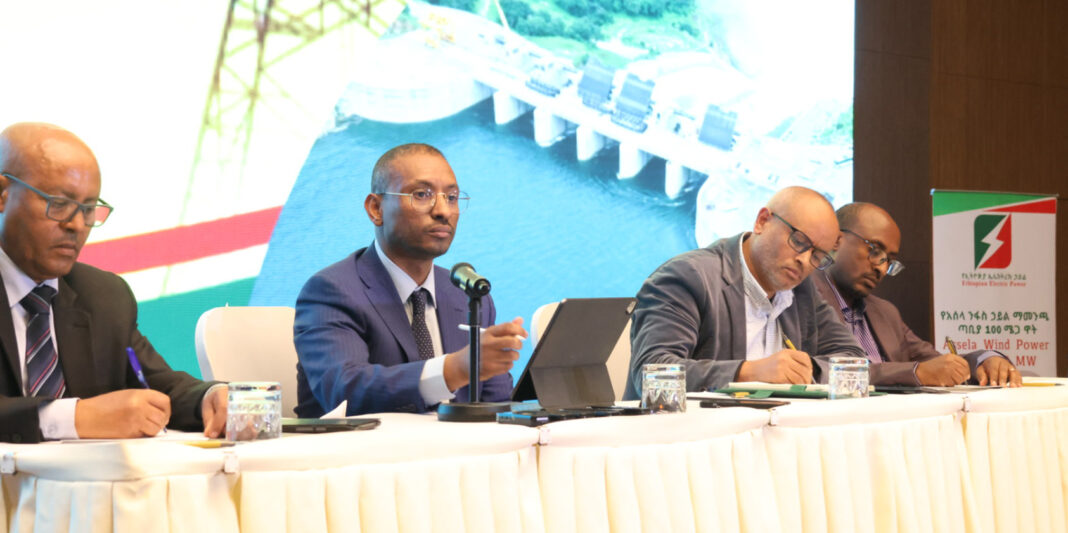
EEP Chief Executive Officer Ashebir Balcha said the transition to a market-based framework remains necessary despite the uncertainty surrounding the regional market’s launch.
“The Eastern Africa Power Pool market has not yet properly started; we are currently in a dispute,” Ashebir said. “Over the past years, there has been a fierce struggle—and it continues—over efforts to move the market away from the market operator within the pool to another country.”
The Eastern Africa Power Pool includes Ethiopia, Kenya, Tanzania, Uganda, Sudan, South Sudan, Egypt, the Democratic Republic of the Congo, Rwanda, Burundi, Djibouti, Somalia and Libya. It was established to promote the efficient use of power resources, strengthen regional energy security and facilitate cross-border electricity trade.
Although the EAPP has tested its Day-Ahead Market (DAM) platform and finalised standardised grid-connection codes, the market has yet to begin formal trading. According to EEP, a major point of disagreement is a proposal to relocate the market operator from its current administrative home—an initiative Ethiopia has strongly opposed.
Ethiopia recently assumed the chairmanship of the EAPP Coordinating Committee and has called for the prompt implementation of the DAM system. At the 37th Extraordinary Meeting of the EAPP Coordinating Committee in Addis Ababa, State Minister of Energy Sultan Wali urged members to operationalise the platform to prevent further economic losses and missed opportunities across the region.
The governance dispute is not the only barrier. Physical infrastructure remains a major constraint, particularly along the Ethiopia–Kenya–Tanzania interconnection.
Ashebir said existing transmission networks are not yet capable of carrying the high volumes of electricity needed for an active regional market. Congestion in Kenya’s domestic grid, he said, has limited transmission through the Ethiopia–Kenya corridor to less than 500 megawatts.
Without major upgrades to national transmission systems and cross-border interconnectors, the region’s ambition to create a functioning electricity market will remain limited. Recent work on the Zambia–Tanzania interconnector is also expected to create a critical link between the Southern African Power Pool and the Eastern Africa Power Pool, which have not previously traded directly.
The need for reform is being driven by the scale of Ethiopia’s domestic energy requirements. According to EEP, the Ethiopian Electric Utility requires more than USD 20 billion for transmission, distribution and customer-access expansion, while EEP requires about twice that amount for generation and related infrastructure.
Together, the investment need is estimated at USD 40 billion—far beyond what the federal government can finance alone.
To close the gap, the government is accelerating private-sector participation through independent power producers, public-private partnerships and decentralised renewable-energy solutions. The Public-Private Partnership Directorate has identified 36 projects open to private investors, covering hydropower, solar, wind and geothermal energy.
Ethiopia has revised its National Energy Policy to create a more favourable framework for private investment in power generation, transmission and renewable energy. The policy is intended to help meet rising demand, improve resilience, expand regional electricity exports and support electric mobility.
The government is also seeking to expand electricity access. Ethiopian Electric Utility connected 664,505 additional households during the fiscal year ending July 2026, taking its customer base above 5.88 million. However, rural access remains far below urban levels, underscoring the scale of the remaining challenge.
In addition to large hydropower projects and regional transmission infrastructure, officials are increasingly promoting decentralised generation, particularly rooftop solar and mini-grid systems.
Ashebir said consumers should eventually be enabled to generate solar electricity and sell surplus power back to the national grid. The so-called “prosumer” model would allow households, businesses and industrial users to become both electricity consumers and producers, easing pressure on centralised generation and transmission networks.
The approach would represent a significant shift for an electricity system traditionally dominated by large state-led hydropower projects. The country is now seeking to diversify its energy mix through solar, wind and geothermal resources while retaining hydropower as the central source of generation.
Four solar projects recently inaugurated in West Hararghe are expected to benefit more than 5,276 households and public institutions in communities located far from the national grid. The projects were financed through a World Bank-supported programme and form part of a wider plan to build rural solar mini-grids.
The Corbetti Geothermal Project is also moving forward through private-sector participation. Its initial phase is expected to develop a 50-megawatt geothermal plant, followed by a second 100-megawatt phase.
Under the revised policy framework, private developers will be allowed to generate power, develop dedicated transmission infrastructure and use the national grid to supply domestic industries or export electricity to neighbouring countries.
Such reforms reflect Ethiopia’s ambition to become a regional renewable-energy hub. The country’s large hydropower base, expanding solar and wind resources, and location at the centre of the Horn of Africa give it a potential advantage in cross-border electricity trade.
Yet the plan depends on resolving the EAPP’s governance impasse, upgrading transmission capacity and securing finance for major new infrastructure.