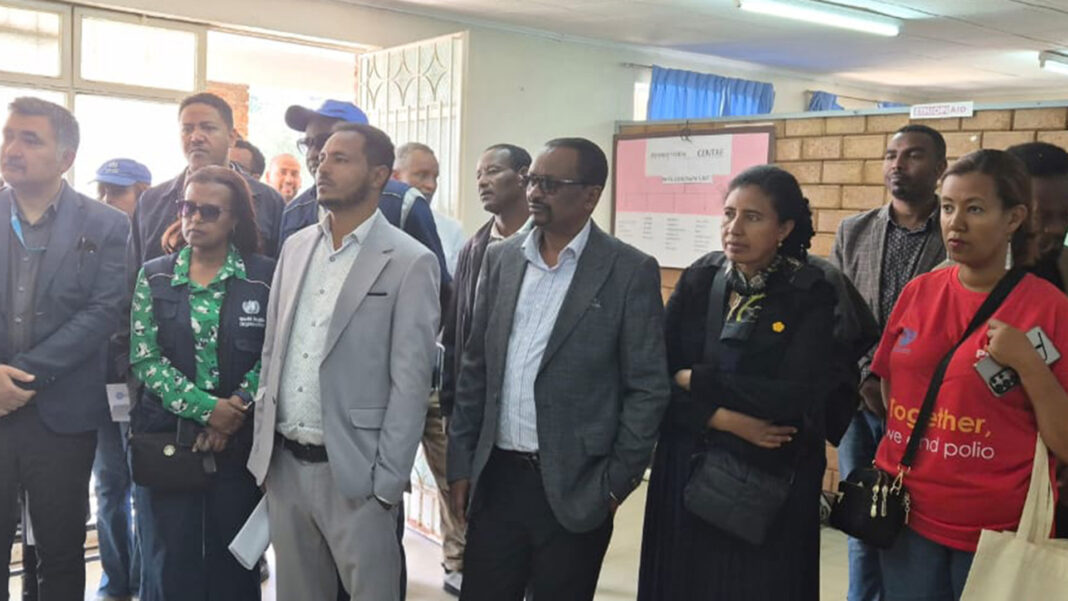
Ethiopia is marking World Polio Day with renewed efforts to sustain its polio-free status, strengthen disease surveillance and reach children who remain unvaccinated or under-vaccinated.
The commemoration, held on October 24 under the global theme “One Day, One Focus: Ending Polio for Good,” brought together the Ministry of Health, the Ethiopian Public Health Institute (EPHI), the World Health Organization (WHO), UNICEF, Rotary International and other Global Polio Eradication Initiative (GPEI) partners.
The local slogan for the day was “Protect Every Child: Close Immunity Gaps, Sustain Polio-Free Status through Community Action.”
Ethiopia has made major progress against polio. The country interrupted indigenous wild poliovirus transmission in 2001, reported its last imported wild poliovirus case in 2014, and was certified free of wild poliovirus in 2017.
The WHO African Region, comprising 47 member states, was declared free of wild poliovirus on August 25, 2020.
However, health authorities say the risk has not disappeared. Ethiopia continues to face outbreaks of circulating variant poliovirus type 1 (cVDPV1).
According to the joint statement issued by GPEI partners, 11 cases were reported in 2026. Five were recorded in Gambella Region, four in West Shoa Zone of Oromia Region, and two in Gofa and Gardule zones of South Ethiopia Region.
In response to the outbreak in Gambella, the Ethiopian Public Health Institute and the Ministry of Health, working with WHO and UNICEF and with funding support from GPEI, conducted two rounds of subnational vaccination campaigns.
The campaigns used nOPV2 vaccine in Gambella, neighbouring Benishangul-Gumuz and two zones of Oromia. More than 11.3 million children under five were reached, with administrative coverage reported at almost 100 per cent.
The campaigns were integrated with other lifesaving services, including catch-up vaccinations for zero-dose and under-vaccinated children.
The country is now preparing a further outbreak response targeting 11,348,548 children under five and under 10 years of age across 629 woredas and 68 zones in five regions: Addis Ababa, Central Ethiopia, Oromia, South Ethiopia and Southwest Ethiopia.
The first round is scheduled for November 20–23, 2026, while the second round will take place from December 18–21, 2026.
Health partners stressed that vaccination alone is not enough to end polio. Because many people infected with poliovirus do not show symptoms, the virus can spread silently even when no paralytic cases are reported.
Strong surveillance is therefore essential to detect transmission early and guide rapid responses.
Ethiopia is being urged to strengthen acute flaccid paralysis (AFP) surveillance, environmental surveillance and laboratory networks, particularly in border and cross-border areas where the risk of virus movement remains high.
The commemoration also highlighted the need to reach zero-dose and under-vaccinated children, especially in hard-to-reach, conflict-affected and pastoralist communities.
Organisers said community engagement is central to sustaining immunisation gains. The campaign emphasised partnerships with religious leaders, women’s groups, youth forums and local influencers to build trust and counter misinformation.
Women frontline health workers are also being supported to lead house-to-house efforts and overcome cultural and mobility barriers that can prevent mothers from accessing vaccination services.
As part of the commemoration, officials and partners visited the Polio Survivors Rehabilitation Centre in Menagesha, Sheger City. The programme included remarks from health authorities and partners, a testimony from a polio survivor and a panel discussion on the way forward.
GPEI partners commended the government, regional health bureaus and community leaders for their response to recent outbreaks. They also recognised the contributions of WHO, UNICEF, Gavi, Rotary International, the Gates Foundation and other immunisation partners.
Partners reaffirmed their commitment to supporting Ethiopia to maintain high immunity levels and strengthen community-based systems so that no child is left unprotected.
As Ethiopia marks the ninth anniversary of its certification as wild polio-free, health authorities and partners say the priority is clear: sustain high vaccination coverage, strengthen surveillance and ensure every child is reached.