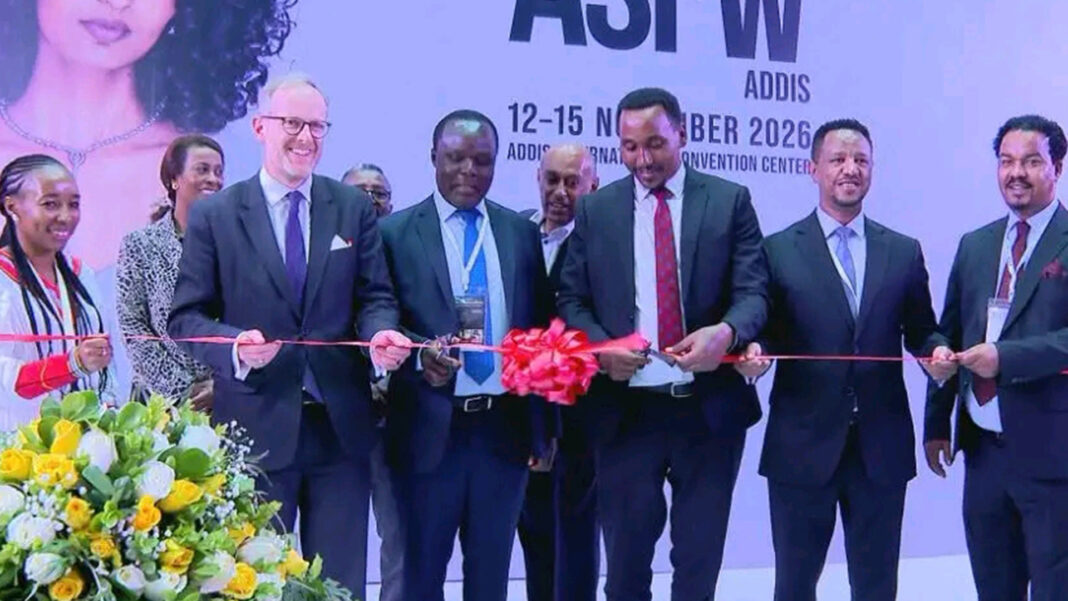
Ethiopia is seeking investment to expand domestic processing and finished-goods production in its textile, garment and leather industries, as manufacturers and international buyers gather in Addis Ababa for the 12th African Sourcing and Fashion Week (ASFW).
The four-day exhibition opened on Thursday, November 12, at the Addis International Convention Center, bringing together more than 250 exhibitors. Organisers expect over 6,000 trade visitors and buyers from more than 70 countries.
Speaking at the opening, State Minister of Industry Dagato Kumbe said Ethiopia aims to move beyond basic manufacturing towards an integrated and internationally competitive textile, garment and leather industry.
He identified the country’s natural resources, industrial infrastructure, geographical location and young workforce as advantages for export-oriented manufacturing.
The government’s ambition, he said, is to strengthen the textile and garment value chain from cotton production through spinning, weaving, knitting, dyeing and finishing to garment manufacturing and Ethiopian fashion brands.
Achieving that goal would require stronger local production capacity, better product quality, greater efficiency and compliance with international standards, he added.
Dagato said Ethiopia also needs to make better use of its livestock resources by shifting from exports of raw hides, skins and semi-processed leather towards finished leather goods and footwear.
He highlighted the planned Mojo Leather City Industrial Park as an initiative intended to attract domestic and foreign investment, introduce modern technologies and expand leather manufacturing capacity.
“Ethiopia is open for business,” he said, inviting leather manufacturers, footwear producers, international brands and technology providers to participate in the country’s industrial development.
Fesseha Yitagesu, chief executive of the Industrial Parks Development Corporation (IPDC), said the corporation had established 14 special economic zones over the past decade, attracting more than 300 domestic and foreign investors and creating over 100,000 jobs.
He said IPDC provides industrial land, ready-to-use factories, shared infrastructure and other services to support manufacturers.
Exhibitions such as ASFW, he added, allow designers to meet manufacturers, buyers to identify suppliers and investors to assess production opportunities.
However, Fesseha said the event’s success should be judged by the partnerships, factory visits, buyer connections and orders it generates—not simply the products on display.
Goshu Negash, president of the Ethiopian Textile and Garment Manufacturers Association, said Africa’s position in global textile and clothing exports remains limited despite its contribution to cotton production.
African countries account for approximately eight per cent of global raw cotton production but less than five per cent of international textile and clothing exports, he said.
Goshu attributed the gap partly to underdeveloped value chains, infrastructure constraints and insufficient policy support. He called for clearer regulatory frameworks and stronger implementation to help manufacturers compete internationally.
The exhibition is also providing a platform for cooperation between African designers and international leather suppliers.
Sarah Gillespie, agricultural counsellor at the U.S. Embassy in Ethiopia, said the U.S. Department of Agriculture is working with the Leather and Hide Council of America to support emerging African designers and encourage the use of quality leather materials.
She said the partnership aims to connect American hides and leather suppliers with African manufacturers and designers producing finished goods for domestic, regional and international markets.
According to Gillespie, the United States exports approximately US$700 million in hides and skins globally, but less than US$1 million goes to Africa.
The partnership would also support training, knowledge exchange and access to materials, helping designers develop innovative products capable of competing internationally, she said.
For Ethiopian manufacturers, the exhibition offers an opportunity to turn investment interest and buyer introductions into production partnerships and export orders, alongside the government’s push to retain more value within the country’s manufacturing industries.