Saturday, November 21, 2026
Home Blog Page 1081

Ethiopia envisions a bright future for E-Commerce with Alibaba partnership

0

Ethiopia is poised to transform its e-commerce landscape following a landmark agreement with Alibaba, the global e-commerce giant. The deal aims to address the growing challenges in the country’s digital shopping sector and enhance accessibility for consumers and local businesses.

AliExpress, Alibaba’s online shopping platform, has partnered with Echlion Group, a Canadian-Ethiopian company, to facilitate online shopping in Ethiopia. This collaboration is expected to revolutionize the digital marketplace by providing new opportunities for both consumers and local businesses while integrating Ethiopian products into the international trade arena.

According to reports from Capital, the agreement allows traders importing goods from abroad to view and place orders at a newly opened showcase in Addis Ababa, eliminating the need for international travel. The facility, which is the second AliExpress product demonstration center in Africa, is designed to accommodate Ethiopian consumers and businesses seamlessly.

Echlion Group is actively involved in logistics, agriculture, manufacturing, and e-commerce sectors, striving to modernize electronic marketing in Ethiopia. The opening of this state-of-the-art center represents a significant step toward enhancing the e-commerce ecosystem in the country.

The partnership is anticipated to not only improve access to international products but also stimulate local economic growth by fostering entrepreneurship and creating jobs. As Ethiopia continues to embrace digital solutions, this collaboration with Alibaba marks a pivotal moment in the country’s journey toward a robust e-commerce industry.

With this initiative, stakeholders hope to harness the potential of e-commerce to drive economic development and improve consumer experiences across Ethiopia.
Awash Insurance Reaffirms Market Leadership with Strong Performance in 2023/24

0

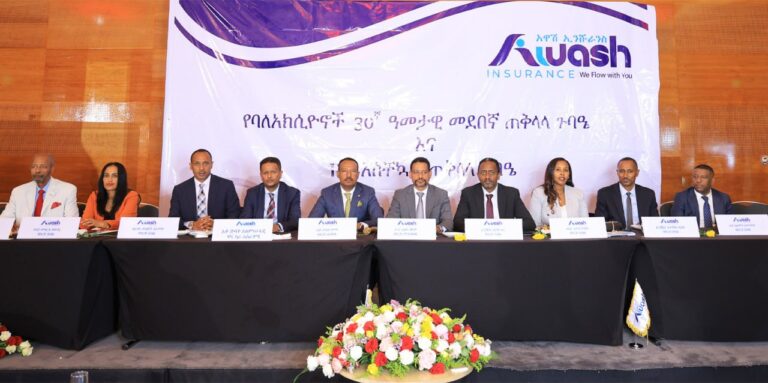
Awash Insurance has successfully reconfirmed its position as the market leader among private insurance companies in Ethiopia, despite facing various challenges throughout the year. The company reported a remarkable gross premium revenue of over 3.1 billion birr for the 2023/24 financial year, solidifying its status in the competitive insurance landscape.

Having entered the insurance sector three decades ago, Awash Insurance has consistently demonstrated resilience. In the non-life insurance segment, the company led the market significantly among 17 private insurers, while in the life insurance sector, it collected 443.7 million birr in premium revenue, surpassing all 18 companies operating in Ethiopia.

In its latest report, Awash Insurance highlighted that it made substantial investments exceeding 387.9 million birr across various companies, increasing its total equity capital to 1.25 billion birr. As of June 30, 2024, the company’s total assets reached over 7.7 billion birr.

The company also owns multiple properties, including a G+16 operational building and several other structures in strategic locations. Furthermore, groundwork has been completed for a new headquarters building featuring four basements and 35 floors.

During the fiscal year, Awash Insurance announced over 1 billion birr in compensation payments across all sectors and recorded a pre-tax profit of more than 902.6 million birr. The company expanded its operations by opening three additional branches, bringing its total to 70 branch and liaison offices and creating new jobs for 114 individuals. This growth increased the total number of regular employees to 756.

From its inception with just 456 founding investors, Awash Insurance has seen its investor base grow to 2,035 as of June 30, 2024. This impressive growth reflects the company’s commitment to excellence and leadership in Ethiopia’s insurance industry as it continues to navigate challenges and seize opportunities for expansion.

Ahadu Bank to discuss mergers at upcoming general assembly

0

Ahadu Bank would be the first to bring up the merger and acquisition topic at the general assembly, which is scheduled for next week. According to the National Bank of Ethiopia (NBE), the merger case would be resolved by legislation.

Despite the unsuitable site, the bank, which started operations in July 2022, reported that it ended the previous fiscal year with favorable results.

Ahadu has taken the initiative to explore the possibilities in response to the government’s heavy push for Ethiopian banks to merge in order to create a small number of powerful financial enterprises.

According to Anteneh Sebsibe, the chairperson of the board of directors of one of Ethiopia’s newest banks, his bank has engaged an overseas consulting firm to investigate potential mergers.

Anteneh, a former top executive of a large bank, stated that he does not agree with the prevailing views that some experts encourage bank mergers in general.

“While it is comparative reasoning, it may not be the case that we have numerous banks. Certain small banks will have a distinct primary business,” he informed Capital.

However, Ahadu has engaged a consultant to find out where it is, how and where it should go, and what the possibilities are in response to the rising recommendation that banks be consolidated.

The preliminary research that will be presented at the next general assembly has been completed by the consultant.

He asserts that “shareholders should be psychologically prepared about the future of the bank” and that “I think we are the pioneers to discuss the issue openly with shareholders.”

The opinions of shareholders will be useful in conducting further research to ascertain the bank’s future.

Anteneh stated that the firm had extensive experience with comparable issues worldwide, notwithstanding his refusal to reveal the identity of the foreign consultant.

According to the board chair, “the second phase, which is the in-depth study, will be launched this year as per further recommendations that will be given by the general assembly.”

He did, however, assert with confidence that his bank would be able to satisfy the required paid-up capital within the time limit that NBE, the central bank, had established.

Anteneh said that newly established financial firms are impacted by the central bank policy that restricts new lending.

“We concluded the fiscal year that ended in June with encouraging results and profit, despite the market’s unsuitability,” he said.

The law that is being prepared would address the merger and acquisition issue, NBE Governor Mamo Esmelealem Mihretu told Capital.

He said the law will be issued very soon, but he would not provide specifics.

Regarding the financial sector’s anticipated openness at the start of the upcoming year, the Prime Minister and other government officials have on several occasions urged banks to unite in order to create a small number of powerful institutions.

Unilever to reduce workforce amid profit concerns

0

British-Dutch multinational Unilever, a leading player in the consumer goods sector, has announced plans to reduce its workforce starting next month as part of a strategy to maximize profits. The company, which operates in over 190 countries including Ethiopia, currently employs more than 128,000 people globally.

The decision to downsize comes in response to declining profits and an oversaturated employee base. Unilever has been a prominent provider of food, home, and personal care products in Ethiopia since 2015. Sources indicate that the company had signaled its intention to cut staff six months ago, with the reductions set to take effect in December 2024.

This workforce reduction is not limited to Ethiopia; it is part of a broader initiative that will impact employees worldwide. In Ethiopia, the company plans to streamline operations by reducing the number of employees in each administrative unit to one or two.

While Unilever aims to offer discounts on its products both locally and internationally, it is expected that the cuts will have a more significant impact on lower-paid workers. Employees are reportedly exploring alternative options amid the impending changes.

Unilever has been in operation for over 120 years and produces more than 400 well-known brands, including Signal, Lifebuoy, OMO, Sunlight, Knorr, Geisha, and Lux. In Ethiopia, the company markets more than 20 products.

Recently, Unilever sold its Russian operations to a local manufacturing group following pressure from campaigners who argued that the company’s presence in Russia supported the ongoing conflict in Ukraine.

In its latest financial report for the third quarter of 2024, Unilever recorded sales of approximately 15.2 billion euros, a decline from about 16 billion euros in the previous quarter. As it navigates these challenges, Unilever’s workforce reduction reflects ongoing efforts to enhance profitability and adapt to changing market conditions.