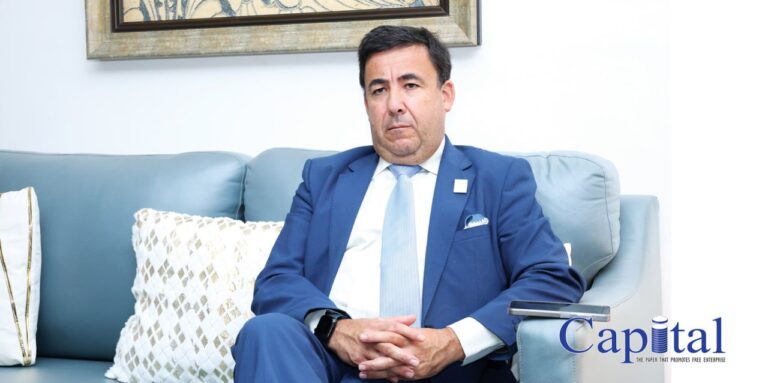
Nuno Samopio, Secretary of State for Foreign Affairs and Cooperation of Portugal, shared insights on the historical significance of Portugal’s relationship with Africa and its evolving diplomatic efforts. As Portugal continues to strengthen ties with African nations, particularly those in the Portuguese-speaking community, Samopio emphasized the importance of cultural events and collaborative initiatives aimed at fostering mutual understanding and addressing shared challenges.
During the conversation, he discussed key areas of collaboration outlined in a Memorandum of Understanding with the Economic Commission for Africa, focusing on the blue economy and climate action. Samopio highlighted Portugal’s commitment to supporting African nations through innovative financing mechanisms and capacity-building programs, particularly in maritime governance and environmental sustainability.
As the dialogue unfolded, Samopio also touched on the role of education in enhancing cultural exchanges, including the establishment of a Portuguese language lectureship at Addis Ababa University. He articulated Portugal’s vision of being a bridge between Europe and Africa, advocating for a more inclusive approach to international relations that recognizes Africa’s potential and contributions to global governance.
This interview offers a comprehensive look at Portugal’s strategic initiatives in Africa and its commitment to fostering partnerships that empower African nations while addressing pressing global issues. Excerpts;
Capital: What do you see as the historical significance of Portugal’s relationship with Africa, and how does it shape current diplomatic efforts?
Nuno Samopio: We have very close relations with Africa, especially with the Portuguese-speaking countries, but also with all African development, and to have this truly be a cooperation, with your solutions for your problems as well. So that’s our view; we are a member of the European Union, we are a European country, but we are, most of all, bridge builders. We always want the dialogue between peoples, the dialogue between seas, the dialogue between continents. And this is our approach with the relations with Africa.

Capital: How do cultural events, like the restoration of Afework Tekle’s stained-glass mural, serve to strengthen Portugal’s ties with African nations?
Samopio: You know, art is a universal language. And it’s such a privilege to be here to celebrate this inauguration of Africa Hall. Most of all, to participate in the celebration of Portuguese contribution through this piece of art that symbolizes the past, the present, and the future of Africa. We have this view that in cultural events, art, and cultural dialogue, it’s one of the most beautiful ways to strengthen dialogue between peoples.
So it’s very symbolic, and it’s very emotive to be here, and I think we can build a lot on a cultural approach.
Capital: Could you elaborate on the key areas of collaboration outlined in the MoU with the Economic Commission for Africa, particularly concerning the blue economy?
Samopio: Yes, as you know, Portugal is a maritime country. And we have always been trying to be on the front line on ocean issues, on ocean governance, ocean preservation, and also the blue economy.
So this is one of the areas that we want to strengthen and develop with the United Nations Economic Commission for Africa. We have already achieved concrete results. I can tell you that we will now finance a position in the UN ECA for an expert in the blue economy.
And that’s very important because this is a concrete area; it’s an area where we Portuguese have expertise, and we want to develop this area with Africa. Perhaps much of our future is in the reaches of the oceans. And so it’s important to work on the economy.
Capital: How does Portugal plan to assist Portuguese-speaking countries in Africa in achieving regional integration within the framework of the blue economy?
Samopio: We have this very close and respectful relationship with the Portuguese-speaking countries. We respect their sovereignty, but we have this very close relationship. So we cooperate in many areas, and we have some important projects already in blue economy and ocean preservation. Last week in Lisbon, for instance, we had a capacity-building program on ocean governance and the blue economy, a fellowship given by the Portuguese government for participants from Portuguese-speaking countries but also from other countries in Africa.
So we are together; we are together in the language, but we are always looking to the future and also to the ocean and the blue economy. I will raise the follow-up questions.

Capital: What types of training modules will be offered to Portuguese-speaking countries as part of the collaboration on the blue economy and maritime economy?
Samopio: So we have these capacity building programs. We are also helping these countries to join the BBNJ Treaty, which is the Treaty of High Oceans to preserve the high seas. So we are providing all the capacity in terms of law and governance, but we also have projects in fisheries; we also have projects in maritime security and defense. So we are involved in all the dimensions of the blue economy and maritime oceans. We have cooperation and projects with the Portuguese-speaking countries.
Capital: How does Portugal intend to support African nations in their climate action initiatives, and what role will innovative financing play in this regard?
Samopio: Climate change is one of the biggest challenges of our times. The African continent is suffering from climate change. So we are working on multiple platforms to fight climate change. We have a very specific tool to work with other countries to help and to address this issue. This tool is a debt swap tool. For instance, we are starting to work with Cabo Verde; we are swapping debt for financing to an environmental fund. We convert it into funds for fighting climate change and for renewable energies. We are proposing this new paradigm to the United Nations. Next year in Spain, we will have a very big conference on how to finance development.
We are also working not only with the United Nations but also with the G20 and the African Union to use this example of debt swap to convert debt into environmental funds as a new paradigm. At the same time, we are helping to finance developing countries, while also building capacity to respond to all the climate challenges. There are many challenges. Fighting climate change is essential. You see the high angle of sea levels. You see the need to make this transition, this green transition from oil to renewable energies. You need financing to do that. So, at the same time, it’s a win-win paradigm, because you have lower costs in importing oil, and you have more environmentally friendly energies. In the end, you will create better living conditions for people and for nature.
Capital: Can you discuss the implications of the planned Portuguese language lectureship at Addis Ababa University for educational and cultural exchange?
Samopio: Portuguese is the fourth most spoken language in the world. We are almost 300 million people speaking Portuguese; that’s very impressive. We must think of Portuguese as a tool for work, a means to study, a means to conduct research, and, of course, always a way to dialogue between people. Here in Addis Ababa, this morning I signed a protocol with Addis Ababa University, which is one of the most distinguished universities in Addis Ababa. We have this lectureship in Portuguese language with a cultural center.
So that’s one of the ways to promote and disseminate Portuguese. We also offer fellowships for students from Ethiopia who go to Portugal. That’s another way to do it. This morning, I had a meeting with the Minister of Education, and he told me, “Please, I want to ask you something. If you can provide fellowships, it is important for us to have people from Ethiopia learning Portuguese and going to your country.”
It’s very good to hear that people have this will of learning Portuguese. This is a big stimulus to the Portuguese government. We will do more in the promotion, the teaching, and the dissemination of the Portuguese language.
Capital: How does Portugal envision its role as a European leader in the ocean economy facilitating partnerships within Africa?
Samopio: As a European Union member state, we try to do in the blue economy what we try to do in all dimensions to be a bridge builder between Europe and Africa. And I can tell you, I feel that Europe can do much more for Africa. But sometimes, perhaps there is a gap in communication. Because if you look at the numbers, all European cooperation in all fields is perhaps higher than people sometimes think and higher than the cooperation of other countries. So we will work together with our European fellows to promote the blue economy in Africa and all the other dimensions.
Capital: What specific outcomes do you hope to achieve through your meetings with Ethiopian counterparts and representatives of the African Union?
Samopio: We are working to strengthen our relations. We are always working to dialogue and to be bridge builders. It’s our role in the world. We feel that’s our mission. But it’s also our duty as the Portuguese government to do that, and at the same time, we have to walk the talk. As I told you, we have some concrete achievements and delivers that I give you the example: this contribution of Portugal to the preservation of this piece of art that is very symbolic at the African Hall and the Portuguese sponsorship of this expert on the blue economy at the African Union, the protocol with the University of Addis Ababa, our perspective with the Ministry of Education of Ethiopia to strengthen and to increase our relations in the teaching of Portuguese, but also in other dimensions, such as cultural heritage preservation.
So we have already some concrete, very concrete achievements. We have a very dynamic embassy here, but we also have a lot to do in the future. So these are the seeds of future work, and we feel that the potential is very big, and I have hope that we can develop more and more in the coming years.
Capital: What is Portugal’s long-term vision for its relationship with Africa, particularly in light of evolving global dynamics?
Samopio: We have this multilateral vision of the world. And for instance, now Portugal is campaigning to be a member of the Security Council of the United Nations. And we defend that Africa must have two positions in the UN Security Council. So we feel that the world is changing, and institutions must follow the air of the times. They must follow these geopolitical, demographic, and social dynamics of the world. So we think that our view is that Africa is a great continent. It’s great in territory, but it’s also great in potential and its contribution to humanity. So Africa must be part of the decision-making processes of world governance. That’s the way we see it, and we are advocating that in the UN system and in the multilateral system.
Capital: You mentioned a new paradigm in Portugal-Africa relations. Could you elaborate on what this entails and how it will differ from past approaches?
Samopio: So we advocate that we must have African solutions for African problems. And to cooperate, we have to work together to impose what we think is good for development. No, it’s to work together to see what is really important, what can really make the difference in people’s lives. And you can do it in several dimensions. In very small but big projects of cooperation. Yesterday I visited a shelter, a girls’ and women’s shelter for survivors of gender violence. That’s a small but, at the same time, a big contribution of the Portuguese cooperation. That’s one dimension. To work together, to build, to help people feel secure and to give hope to people, to fight insecurity, to fight poverty. That’s one dimension.
But there are other dimensions. We must look at the economic potential. And we must bring Portuguese and European companies to believe in working in Africa and to build these long-standing relations. To have long-standing relations of cooperation must be win-win relations. It must be; you cannot just, you can no longer have a donor-receiver relationship. You must have a commercial, in the good sense of the word, a commercial economic relation that makes win-win, that creates employers in Africa so that the companies that come from other countries see their investments rewarded, so that’s the way we see it.
Capital: How will Portugal ensure regular political dialogue with African nations, and what mechanisms are in place to facilitate this dialogue?
Samopio: We have several mechanisms. You mentioned that we have the CPLP (Community of Portuguese Language Countries). That’s one mechanism, and we are very united. We have the UN; we have all the UN system mechanisms that’s also very important.
But of course, we have this African Union and European Union mechanism. So that’s why we, Portugal, advocate that the summit between the African Union and the European Union must take place as soon as possible. That’s a very important mechanism of dialogue between two very large continental organizations. And, of course, we have always, that’s why she is my advisor, we have always political consultations between countries, and we already have two with Ethiopia, for instance. We are working on having a third political consultation as soon as possible, and we have very good bilateral relations, so there are these diplomatic channels that we must preserve and cultivate.
Capital: In what ways do you think cultural diplomacy can contribute to improved political and economic ties between Portugal and Africa?
Samopio: Yes, cultural linkage always promotes dialogue, always promotes friendship, always promotes comprehension, and that’s one of the ways to achieve peace. Most of all, cultural cooperation promotes mutual comprehension and dialogue, and that’s a way to promote peace. And when you have peace and you have these friendly relations, you can have commercial transactions, you can have economic development, and you can have trust when you have this cultural cooperation.
By building cultural cooperation, you are building trust between peoples, between states, and between companies, and that brings economic development to convey to African nations about Portugal’s commitment to mutual cooperation.
Capital: As you wrap up your visit, what message do you wish to convey to African nations about Portugal’s commitment to mutual cooperation?
Samopio: The goal of strengthening relations with African countries. And we think that the dialogue between civilizations is very, very important. For instance, next month in Lisbon, Portugal, we will have the UN Islands of Civilizations big conference. It’s all about dialogue between civilizations. So we hope that European countries, Western countries, Portugal, and African countries can join together in dialogue and mutual global cooperation.
Capital: What are your expectations for future engagements with Africa, and how do you see Portugal adapting to the changing landscape of international relations on the continent?
Samopio: The future of Africa is quite a challenge. You know, at present, we have these big threats and challenges: wars, poverty, climate issues— a little bit all over the continent. And you have this growing youth population that is looking for the future, looking for employment, looking for hope. So it’s not easy because reality talks.
But at the same time, you must look to the potential. We must have hope. You must see this youth as a strength, as a demographic strength and a sign of the whole dynamic and power of Africa.
So you can have potential, economic potential. We see already good examples from over the continent in digital transition, in fighting poverty, in reinventing ways this continent can find a new paradigm for development, and that’s my hope. That’s my hope. And Portugal will look to the world at the same time with the eyes of reality. Yes, there are a few geopolitical challenges; yes, there are lots of dramatic situations to solve. But we will not raise our arms; we will not raise our hands. We will keep belief in hope, and most of all, we will keep belief that dialogue is always the way to live in this multipolar world. We must have dialogue to achieve peace and development.