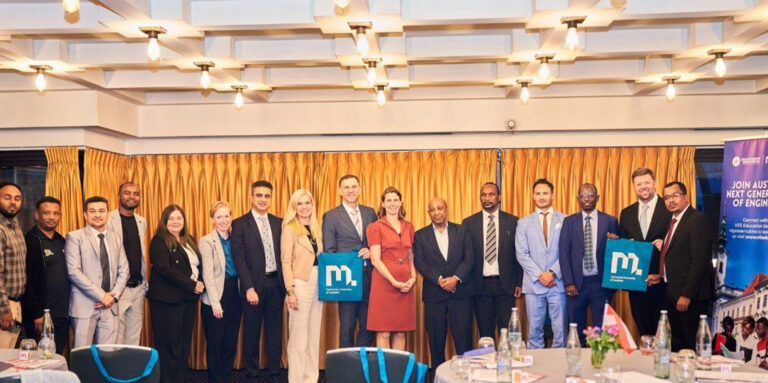
To strengthen bilateral relations and foster sustainable development, the Republic of Austria has unveiled a new public-private partnership that facilitates scholarships and exchange opportunities for students studying engineering and technology.
Implemented under the framework of the “Focus Africa” strategy, this initiative enables talented students from Ethiopia and various African countries to access high-quality education at Montanuniversität Leoben (the Technical University of Leoben) in Austria. Speaking at a recent event in Addis Ababa, the Austrian Ambassador to Ethiopia, Simone Knapp, stated:”This new initiative launched at Montanuniversität Leoben is a significant step toward linking Africa’s emerging talents with Austria’s expertise in science, engineering, and sustainable technology. It celebrates and strengthens our long-standing academic and institutional partnerships.”
This public-private partnership aims to support Austrian-African mobility for skilled engineering and technology students. The Ambassador explained that the strategy is not a one-size-fits-all approach, but rather a mechanism for Austrian ministries, institutions, and private companies to strengthen cooperation beyond Europe and its other traditional partners.
The program is specifically tailored for students enrolled in accredited colleges in Ethiopia and other African countries. Under this agreement, qualified Ethiopian and African engineering and technology graduates can pursue full-degree studies in Austria through strategic pathways established by the “Focus Africa” initiative.This partnership particularly takes into account Ethiopia’s rapid development in the mining and natural resources sector. Minister of Education, Berhanu Nega, emphasized that developing domestic human resource skills is crucial to managing this growth.
“Two years ago, our overall mineral exports were low, but last year they grew to nearly $5 billion,” Berhanu said. Despite the sector’s significant growth, he pointed out a shortage of local human capital to manage these resources efficiently, adding, “We cannot grow the mining sector by remaining perennially dependent on foreign experts.”
To address this gap, the government is establishing mining and petrochemical institutes at universities like Bule Hora. The partnership with Montanuniversität Leoben is expected to accelerate this capacity-building process by granting Ethiopian students access to advanced Master’s degree programs, research opportunities, and industry-aligned practical skills.
Thomas Prohaska, Vice-Rector of Montanuniversität Leoben, added “Building on the strong momentum generated by the Austrian-Ethiopian Symposium on Sustainable Mining and Circular Engineering, and following recent high-level discussions, we are proud to develop ‘Focus Africa’ as a long-term platform for cooperation. Together with our partners, we aim to bridge education, research, industry, and skill development, creating tangible opportunities for students and institutions in Ethiopia and Africa.”
Susanne Feiel and Clemens Weihs, lead of the “Focus Africa” initiative, further explained that the project transforms their international educational approach. It does not just create new opportunities and strategically support talented Ethiopian and African students to pursue higher education in Austria; it also directly links their education with industry, ensuring quick post-graduation employment opportunities.
Berhanu Nega called on partners to break away from traditional bureaucratic red tape and move rapidly, describing the partnership as a “win-win” relationship shaping the future of both countries. “The timing is right; we must launch this educational framework right now,” the Minister said, emphasizing that sluggish development projects are obsolete. He further suggested that European educational institutions should actively promote the high quality and affordability of their systems, positioning Austria as a compelling alternative for African students who might otherwise look exclusively to the United States.