

Huawei Ethiopia has provided Ethiopian Communications Authority (ECA) with a three-day cyber security training, with Huawei’s top cyber security experts leading the training.
The Ethiopian Communications Authority Director General, Balcha Reba, attended the opening of the training and in his opening remarks appreciated and acknowledged Huawei’s efforts into building a digital Ethiopia. “A security issue is not something provided by an external body to us, it is a system and a strategy we have to develop internally. It is not only a tactical or technological input; it is also policy and strategy as well. So, all the leaders as well as the vendors, the industry all together needs to work on accountability,” remarked the communications authority head.
He also added that when discussing cyber technology, it is important to understand the; who, how, and what. He underlined that it is a must to understand who the hackers are that affect our systems by stealing data, how viruses work, and which components of our software and systems must function effectively to safeguard our systems. “Therefore, such trainings are beneficial in learning more about cyber security issues and acting accordingly,” Balcha stated.
CEO of Huawei Ethiopia, Chen Mingliang, expressed his gratitude and respect to the Ethiopian Communications Authority for the efforts made to coordinate and to build a better-connected Ethiopia and for the endeavors that makes Ethiopia to enter the 5G era.He also emphasized that we live in a highly interconnected world, where the physical and digital worlds are increasingly converging, and the network boundaries are blurring.
Cyber security and privacy protection are increasingly important. And Huawei has established 7 cyber security transparency centers around the world, including 2 global centers located in Brussels and Dongguan (China), with 3,000 employees working full-time on cyber security Research and Development (R&D). Each year, and about 5% of its R&D budget are spent on cyber security and privacy protection related to R&D. By the end of 2020, Huawei held more than 100,000 active patents across over 40,000 families, among which 2,963 are related to cyber security and privacy protection.
The training covered global cyber security challenges and analysis, introduction to cyber security governance standards, introduction to Huawei’s end-to-end cyber security assurance system, 5G security technologies based on 5G security considerations, and a virtual tour exhibition in the Cyber Security and Privacy Protection Transparency Exhibition Hall.
The public relations director of Huawei Ethiopia, Ye Liming, during the final day session, said “With the knowledge you learnt these days, I believe that all of you will put what you learnt into practice and be devoted into digital Ethiopia building.”
The training took place from July 25 to July 27, 2022 and was attended by 20 experts.
Clients in outrage over railway tariff
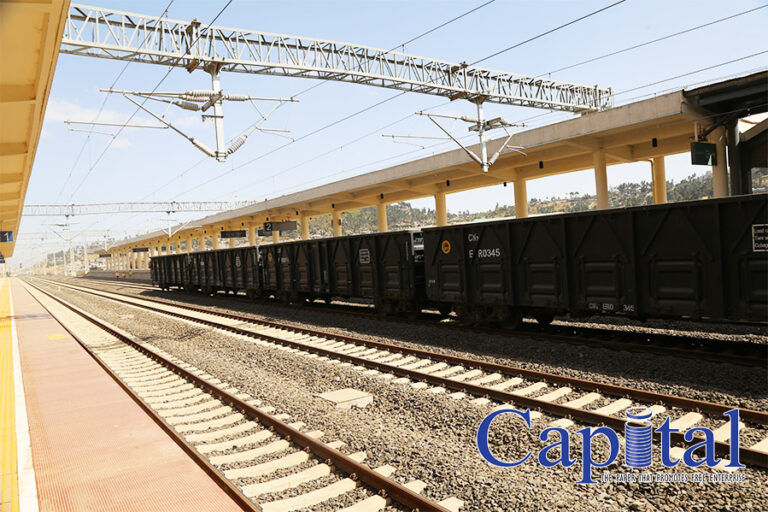
Clients who have a freight service contract with Ethio Djibouti Railway SC (EDR) are in outcry over the company’s imposition of a new tariff prior to the deadline they had signed for their consignment. On the flip side, the logistics firm has dismissed the claim.
On the notification letter via email, EDR disclosed that it has revised the consignment tariff as of August 1.
According to the contract amendment that EDR sent to its clients, the new tariff has an increment of over 16,000 birr per container and unlike the past the new rates are in USD.
An exporter that Capital spoke to explained that he has a contract rate with the firm with his set duration yet to be complete, and with the new rates kicking in, he expressed his worry, stating, “it will affect my export since I am running the business as per the existing logistics expense that I agreed with EDR.”
Another exporter who signed a six-month contract agreement with EDR and has so far used the first three months, explained that the rate he had agreed upon was 24,960 birr from Indode Terminal and 22, 512 birr from Mojo for a forty feet container, “I have an active contract that does not mention any price revision but they have revised the rate to USD 744 for a forty feet container that shall be loaded from Indode.”
Both exporters have similarly argued that the contract agreement they signed was not inclusive of any tariff revision.
They expressed that the service that EDR provides is seamlessly perfect and incomparable with truck operations, while such sudden rate revisions will erode and diminish the trust with the service provider, they opined.
They also reminded that the logistics sector is crucial for trade and competitiveness in the global market.
The revised contract that was sent by Teshome Eshete, Chief Operation Officer (COO) of EDR, said that the price of container transportation from Indode railway freight yard to SGTD container railway freight yard shall be USD744 per 40ft container and USD 753 per two TEU containers.
“If the client makes payment in Ethiopian Birr, the exchange rate from USD to ETB shall be the prevailing exchange rate of Commercial Bank of Ethiopia at the date of payment,” it added.
Teshome said that the railway company has neither revised the price nor increased it, “from the inception as per our operation the rate is stated on USD, but we have been giving a price at lower exchange rates that was converted years back, which is against the latest official exchange rate.”
“Issuing the daily rate is the mandate of the National Bank of Ethiopia, because of that the relevant government body ordered us to use the proper exchange rate rather than using our own rate,” he explained.
“Revising the rate is the responsibility of shareholders; we don’t have a right to put new price,” the COO told Capital.
He reminded that the rate that was mentioned on foreign currency was set in 2017 when the Ethio Djibouti Electric Railway system commenced service, “we are saying that the dollar rate was not properly exchanged that is now corrected.”
The COO added that the operation cost is growing due to different reasons including the price hike on petroleum that EDR is using for shunting, which is a process to transfer cargos at loading/unloading sites that are not connected with electricity.
“As far as my knowledge, only one person has complained regarding the latest payment change on foreign currency,” he added.
He argued that the railway consignment rate is still very fair compared with the road transport.
“The road transport for two TEUs is in minimum 120,000 birr that is about 80,000 birr at the railway transport. We have a minimum of 40 percent lower rate than road transports,” he elaborated.
He added that the rate is also lower compared with regional markets, “compared to Kenya, we have at least 15 percent lesser pricing.”
EDR has over 800 customers, who use the line to transport their cargos.
In the ended budget year, EDR said that even thought there is constrain on global cargo schemes it stated that it accomplished the budget year with the best performance in terms of lifting cargos on time and other operations.
Institutionalization of corporate legal service continues to thrive
In the context of a new law enabling the registration and licensing of law firms, a new firm, Aman & Partners LLP is yet another corporate legal service provider that has completed its registration as a de jure law firm obtaining its license from the Ministry of Justice. First founded by Aman Assefa, a reputed corporate lawyer with over two decades of experience, the new firm is established based on a partnership agreement signed between four advocates: Aman Assefa, Bahakal Abate, Ermias Ayalew and Micael Sehul bolstering a combined experience of more than 70 years in the legal profession.
The firm is currently advising on major foreign direct investments in their legal needs across various sectors and industries including telecommunications, infrastructure, healthcare, manufacturing, textile, beverage, fin-tech, media, data protection, acquisitions, corporate governance and many others. In the practice of corporate and commercial law for over two decades, the firm currently employs 20 staff members in total who hold diverse specializations in various fields of law from reputed universities in the USA, UK, Germany, Switzerland, Netherlands, South Africa and Australia.
Having worked and practiced together in a de-facto partnership since 2017, the team at Aman Assefa & Associates Law Office have had a strong and dependable working relationship and a synergy that is reflected in the recently announced legal awards by IFLR, a law firm rating institution, that awarded the team to be the winner in the “National Firm of the Year” category.
It is also remembered that Bowmans, a reputed Pan-African law firm, had signed an alliance agreement with the founders of Aman & Partners LLP back in 2019. A statement shared by Richard Harney, Senior Partner and founder of the Bowmans Kenya team celebrated the new development by saying “we congratulate the whole team at Aman & Partners LLP on this timely transition into a full-fledged law firm. At Bowmans, we continue to be optimist about the potential of Ethiopia as a vibrant and burgeoning market and are very happy that our alliance partners in Ethiopia are taking this historical step in institutionalizing their high-end corporate legal service in the market.”
Aman who was appointed as the first Managing Partner for Aman & Partners LLP said,“ I am thrilled to witness this historic transition and even more so in anticipation of what our strong and tested track record would mean in continuing to provide increased quality of service to clients and realizing our dream, which was, and still is, establishing a firm that will outlive the founders.” Aman stated this in light of the law which allows establishment of law firms which will help formalize and ensure the continuity of legal partnerships and institutionalization of legal service delivery in Ethiopia.
It is to be recalled that one of the biggest challenges to the legal industry has been lack of appropriate legal framework to institutionalize and guarantee the continuity of legal service to clients. It is not so long ago that the late Teshome Gebremariam’s law office had to close its doors due to the sudden passing away of its founder; alas at a time when law firms did not have the opportunity to institutionalize and register under the relevant legislation at the time.
Since the enactment of the new law, it is recalled that firms such as Habesha Advocates LLP and Mihrteab & Getu Advocates have also been incorporated. In a joint statement from Aman & Partners LLP, the team has emphasized that they will “continue to elevate the standard of legal service delivery in Ethiopia through thought leadership and ensuring dependable and tailored legal service to investors and businesses in Ethiopia.”
BASF bridges gaps
A year ago, BASF, a German multinational chemical company and the largest chemical producer in the world, through its blossoming business stated that the first seeds produced at BASF’s state-of-the-art production facility in Ethiopia entered the global vegetable seed markets. The facility built offered an ideal year-round production conditions for sweet pepper, tomato and cucumber and was BASF’s first high-tech greenhouse complex in Africa.
Following a similar culture of easing business for the Ethiopian market and the region, BASF has opened a Djibouti base, which is very beneficial to its customers in the region, more so Ethiopia. Capital’s Editor-In-Chief, Groum Abate, caught up with Gift Mbaya, Business Lead and General Manager BASF Trade Representative Office, for insights on what this new endeavor means to the firm’s customers. Excerpts;
Capital: You recently set up an office in Djibouti. How has that helped your business with the Ethiopian Market?
Gift Mbaya: Setting up a base in Djibouti has been very beneficial for our Ethiopian market. It has given more access to our customers to get our products, thus helping to bridge the gap between BASF Europe and Ethiopia. Furthermore, the office that has been set up takes ownership and responsibility for the full customer order import and export management process into Ethiopia.
The Djibouti office offers seamless transactions where prior to that, customers had found it difficult in terms of the length of time it took to provide supply as well as availability and access to products.
Currently, the office in Djibouti is responsible to manage the customer order export process from the Djibouti Port, in and out of the Free Trade Zone at efficient, timely and satisfaction levels. In addition, it manages and coordinates all activities for inbound/outbound and logistics operations for Ethiopia.
At the end of the day, this whole project came to fruition in order to make it easy for customers to do business with BASF.
Capital: How in particular does it make it easier for the Ethiopian customers?
Gift Mbaya: For customers who are buying products from Europe usually takes a longer time to get to Ethiopia. Thus, BASF Djibouti will buy from BASF Europe and bring the product to Djibouti. Thus Ethiopian customers can get their products at a quicker and easier way, without going through the traditional longer route.
Capital: Are you going to assist customers on opening up LCs to access your product? If so, how are you going to do that?
Gift Mbaya: We will assist them in terms of the paperwork. But the issue of raising LC between Ethiopia and Europe or Ethiopia and Djibouti will remain the same.
Capital: How would you evaluate the current foreign exchange shortage with regards to its effect to your business?
Gift Mbaya: Because of the foreign currency shortages our customers are not buying as much products as they can. This might not be due to unavailability of the product but rather shortage of currency which can control the purchasing power.
And as BASF Djibouti, we are here to assist, for example, customers who used to buy full container loads from Europe, but have seen sudden decrease owing to foreign currency shortage struggles. Such customers stand to benefit since through Djibouti they can buy little product loads at the various different frequency that they require.
This will also enhance the cash flow of the customers since you won’t be put at a point of spending all the eggs in one basket, and since the quantities are purchased in birr, saving on your cash can mean customers can use the cash for their factories for future longevity.
Capital: How do you assess business in Ethiopia? Is there potential for growth?
Gift Mbaya: Ethiopia is the place to be and as far as BASF is concerned business is thriving with room for potential growth. Our field of business enables industrialization, which the government of Ethiopia is advocating and promoting.
In recent weeks stories have been published showing that Government wants to increase its efforts in industrialization; in addition to wanting to increase wheat production by over 70%; to which we can participate in. To this end, we want to participate in helping our farmers grow more so as to make Ethiopia self-sufficient.
With the increasing population of Ethiopia, the market is therefore for all of us to grow and if we map that to the manufacturing industry stance, we notice that they equally want to grow, thus the potential growth of business is limitless. We see manufacturers wanting to grow and improve their production, and we can partner with them in such through capacity building and working in partnership in areas of mutual interest.
Capital: How is BASF’s seed business progressing?
Gift Mbaya: The seed business, which we’ve been part of from four years back is an investment that is doing well. We have a production facility now, where we are growing seeds of peppers, cucumbers, tomatoes. This can be noted as a visible investment which brings innovation into the country, to which the country then benefits because of the export to Europe and ultimately to global distribution reach. Overall, the project is reeling in positive results.
Capital: Do you have any other new projects?
Gift Mbaya: Not at the moment, but we’re expanding our product ranges. BASF is one potential of 85 different business units globally. And right now in Ethiopia we’re dealing with about 12 or 13 of those. We want to expand that because we are interacting with a lot of customers who have expressed interest in our products.
So as we find new business opportunities for them, we want to expand our base. Right now we are into agriculture, pharmaceuticals, home and personal care business, leather business, polyurethanes for shoes, furniture, mattresses and pillows, human nutrition, and vitamins. To this regard we often say we are creating chemistry for a sustainable future.
Capital: Can you tell us about the kids’ Lab program?
Gift Mbaya: With the belief that students today can become innovators and leaders of tomorrow, BASF established Kids’ Lab in Germany in 1997 with the aim to nurture children’s interest in chemistry; and to help young generation recognize how chemistry around us can help protect the environment and create a sustainable future.
The BASF Kids’ Lab program is an interactive, fun and free chemistry education program designed for kids aged 6 to 12 years to discover the world of chemistry through simple and safe experiments. This program has been brought to more than 30 countries across the globe.
Here in Ethiopia we have gathered these kids in schools such as the German school where other schools are invited to be part of this initiative. To show them real life scientific works we take them to our customers who interact with them and give them inspiration through showcasing their various projects to build excitement in their ambitious hearts.
Within the program, we schedule two to three hours to create excitement around chemistry and lab works to spark their interest, so when they resume normal classes they can aspire to be scientists of tomorrow.
This program will continue to expand across Africa in order to propel and inspire innovations and harbor scientists of tomorrow.
Capital: Do you have plans on expanding to public schools?
Gift Mbaya: Working through the German school, our program is open to both public and private schools and we often do that by inviting students as well as staff from neighboring schools.
In order to conduct such activities in public schools, authorization is needed. To this end, we have been in talks with the Ministry of Education so as to provide these opportunities to a wider range of schools.
Capital: Is there anything you want to add?
Gift Mbaya: I think it’s a great time to be part of the business scene in Ethiopia, owing to the country’s commitment to expand and grow its various sectors. As BASF we see incredible potential in this country and we look forward to partnering and playing pivotal roles in improving the country in our own way. We also look forward to spearhead innovations through our work as well as continue to inspire the future generation.
