

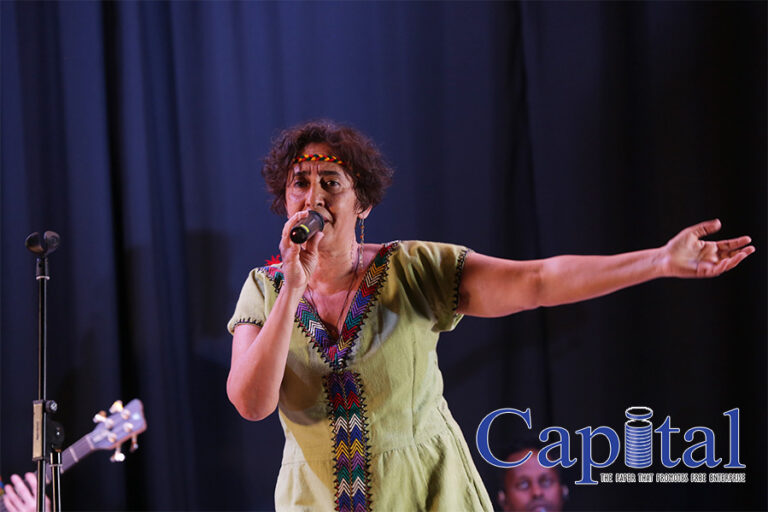
Singer Gabriella Ghermandi and her italo-ethiopian ensemble “Atse Tewodros Project” host their “Set Nat Concert” on Tuesday April 19, 2022 at the Italian cultural institute, Addis Ababa.
The show combined both Ethiopian and Italian languages, with traditional Ethiopian instruments being mixed with modern ones, to make an incredible mix of sounds.
An evocative musical journey led by the writer and performer Gabriella Ghermandi, and her group of creatives set the stage alight providing a dialogue between historical memory and the future. The band which comprises four traditional musicians and three jazz / afrofunky musicians give life to unique captivating sounds vocalized by the melodious voice Gabriella Ghermandi.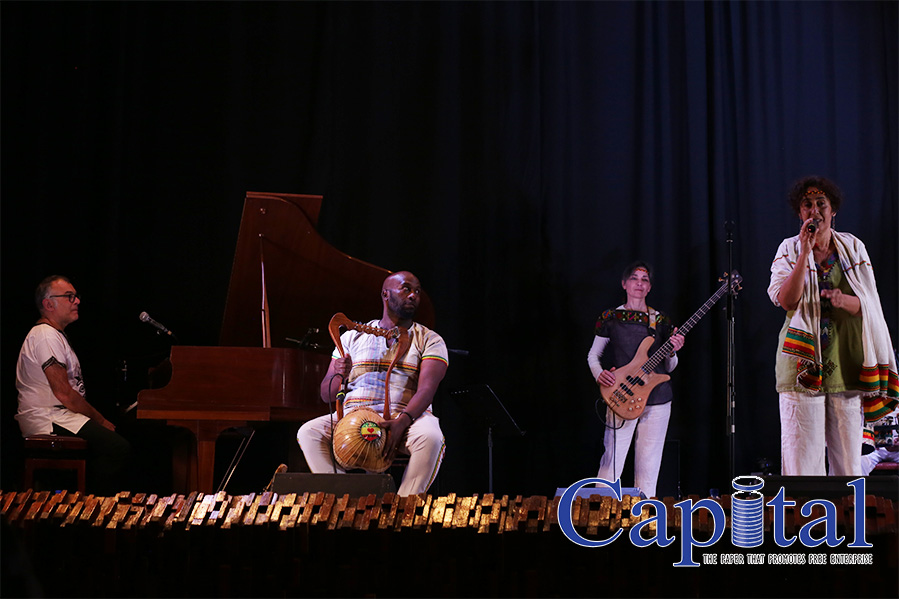
Gabriella Ghermandi, a singer, performer, novelist and short-story writer was born in Addis Ababa in 1965 to an Italian father and Ethiopian mother, and raised in Ethiopia. In 1979, a year after her father’s death, Ghermandi moved permanently to Italy.
In April 2007 her first novel, Regina di fiori e di perle, was published by Donzelli Editore, and the English translation, Queen of Flowers and Pearls, came out with Indiana University Press in 2015.
In 2010, in an effort to bring together Italian and Ethiopian musicians as a way of fostering mutual dialogue and artistic creation, she created the Atse Tewodros Project. This project got its start in Addis Ababa and is named after one of the great emperors in Ethiopian history, Atse Tewodros II.
Set Nat Concert comes alive at the Italian cultural institute
59th Venice Biennale One Stop Guide To Artists Curators And Pavilions-Artlyst
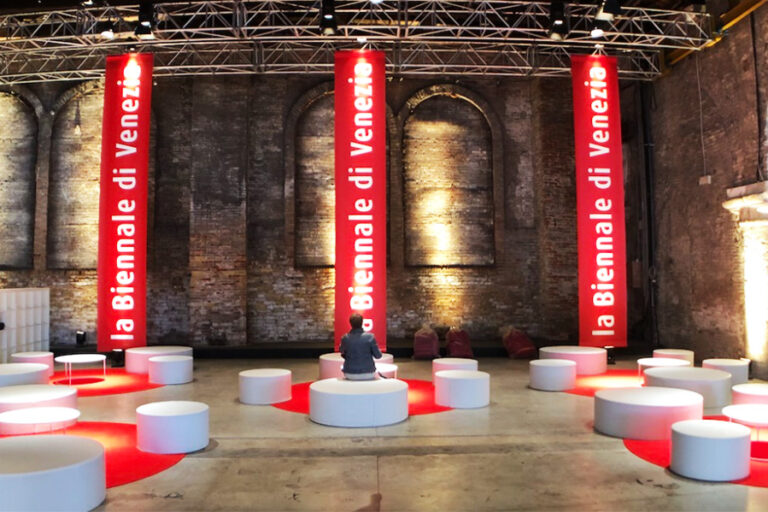
The 59th International Art Exhibition of La Biennale di Venezia, titled ‘The Milk of Dreams’, will open to the public from Saturday April 23 to Sunday November 27, 2022, at the Giardini and the Arsenale; it will be curated by Cecilia Alemani and organised by La Biennale di Venezia chaired by Roberto Cicutto. The Pre-opening took place on April 20, 21 and 22; the Awards Ceremony and Inauguration was held on 23 April 2022.
The latest details about the key participants of the 59th International Art Exhibition. The Venice Biennale, the oldest art biennial, is back after being delayed a year due to the pandemic—and it is seemingly as jam-packed with artists as ever. To help you get your head around who is showing where, we have brought together all the national pavilions and artists that have been announced so far.
The Milk of Dreams takes its title from a book by Leonora Carrington (1917–2011) in which the Surrealist artist describes a magical world where life is constantly re-envisioned through the prism of the imagination. It is a world where everyone can change, be transformed, become something or someone else; a world set free, brimming with possibilities. But it is also the allegory of a century that imposed intolerable pressure on the very definition of the self, forcing Carrington into a life of exile: locked up in mental hospitals, an eternal object of fascination and desire, yet also a figure of startling power and mystery, always fleeing the strictures of a fixed, coherent identity. When asked about her birth, Carrington would say she was the product of her mother’s encounter with a machine, suggesting the same bizarre union of human, animal, and mechanical that marks much of her work.
The exhibition The Milk of Dreams takes Leonora Carrington’s otherworldly creatures, along with other figures of transformation, as companions on an imaginary journey through the metamorphoses of bodies and definitions of the human.
This exhibition is grounded in many conversations with artists held in the last few years. The questions that kept emerging from these dialogues seem to capture this moment in history when the very survival of the species is threatened, but also to sum up many other inquiries that pervade the sciences, arts, and myths of our time. How is the definition of the human changing? What constitutes life, and what differentiates plant and animal, human and non-human? What are our responsibilities towards the planet, other people, and other life forms? And what would life look like without us?
These are some of the guiding questions for this edition of the Biennale Arte, which focuses on three thematic areas in particular: the representation of bodies and their metamorphoses; the relationship between individuals and technologies; the connection between bodies and the Earth.
Many contemporary artists are imagining a posthuman condition that challenges the modern Western vision of the human being − and especially the presumed universal ideal of the white, male “Man of Reason” − as fixed centre of the universe and measure of all things. In its place, artists propose new alliances between species, and worlds inhabited by porous, hybrid, manifold beings that are not unlike Carrington’s extraordinary creatures. Under the increasingly invasive pressure of technology, the boundaries between bodies and objects have been utterly transformed, bringing about profound mutations that remap subjectivities, hierarchies, and anatomies.
Today, the world seems dramatically split between technological optimism − which promises that the human body can be endlessly perfected through science − and the dread of a complete takeover by machines via automation and artificial intelligence. This rift has widened during the Covid-19 pandemic, which has forced us even further apart and caged much of human interaction behind the screens of electronic devices.
The pressure of technology, the heightening of social tensions, the outbreak of the pandemic, and the looming threat of environmental disaster remind us every day that as mortal bodies, we are neither invincible nor self-sufficient, but rather part of a symbiotic web of interdependencies that bind us to each other, to other species, and to the planet as a whole.
In this climate, many artists envision the end of anthropocentrism, celebrating a new communion with the non-human, with the animal world, and with the Earth; they cultivate a sense of kinship between species and between the organic and inorganic, the animate and inanimate. Others react to the dissolution of supposedly universal systems, rediscovering localised forms of knowledge and new politics of identity. Still others practice what feminist theorist and activist Silvia Federici calls the “re-enchantment of the world”, mingling indigenous traditions with personal mythologies in much the same way as Leonora Carrington.
EESA raises more than $4,000 for Cairo elementary school that serves Eritrean refugees
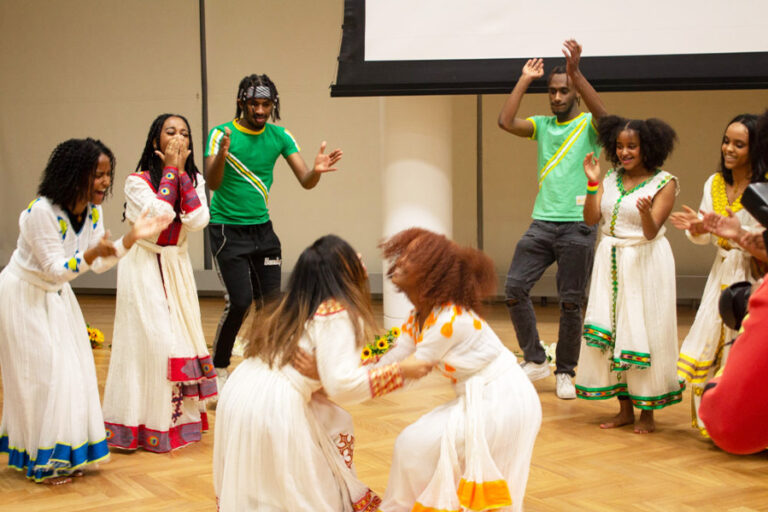
The GW Ethiopian-Eritrean Students Association raised more than $4,000 in donations for an elementary school in Cairo, Egypt serving a refugee population at a banquet fundraiser late last month.
The banquet, held in the Grand Ballroom of the University Student Center, was EESA’s ninth annual benefit dinner and the largest dinner of the organization’s history, EESA leaders said. The money raised from the banquet this year went to help Bana Eritean Elementary School purchase supplies and pay teachers’ salaries.
Senior Nedine Ahmed, the president of EESA, said the organization’s executive board knew they wanted to donate to an Eritrean cause this year and came into contact with the school through the American Team for Displaced Eritreans, a public charity that assists Eritrean refugees and asylum seekers in the United States and around the world. She said the school teaches first- through sixth-graders about their Eritrean language and culture as well as brings their parents together with community events to support Eritrean refugees in Cairo.
Ahmed said the school needs money and assistance to sustain and upkeep the building so they can continue to serve the more than 150 students in the area and can expand to bring in more students.
”The money itself is going to supply school supplies that’s helping them with paying the teacher, just helping them – that’s the main two things,” she said. “Just helping sustain a school because it is already built, it’s just in its second stages of trying to bring more people to school.”
Egypt hosted more than 270,000 refugees and registered asylum seekers as of 2021, the majority from Syria, Sudan, South Sudan, Eritrea, Ethiopia, Yemen and Somalia. UN Refugee Agency data showed more than 20,000 Eritrean refugees were living in Egypt as of 2021.
The benefit dinner included an array of cultural foods, a silent art auction, a fashion show highlighting different cultural pieces from a number of Ethiopian and Eritrean tribes and music and dance performances from EESA members, all of which helped raise funds for the school.
“Spreading word about the tickets, I feel like I was surprisingly shocked that that wasn’t one of the main challenges,” she said. “People really came out, and people really supported us during this.”
She said the main sources of fundraising from the event came from ticket sales, proceeds from the silent art auction and donations. She said EESA also raised money through fundraisers with South Block and Roti in Foggy Bottom, separate events that donated a portion of money made on food to EESA who sent the money to the Bana school.
Kidist Cheru, EESA’s social media chair, said she was thrilled with the number of people who attended the event. She said she thinks this year’s benefit dinner, with more than 150 guests, was the largest dinner EESA has ever hosted.
“It’s open to everybody,” she said. “We also invited family members. The thing is with Ethiopian and Eritrean outside of Africa, the GW population is one of the most populated areas, so we just went around and just asked.”
A promotional video for the benefit dinner filmed by Ahmed that showed the members of the EESA dance team gathering and getting prepared for the banquet gained more than 13,000 views after it was placed in the Student Life GW newsletter.
Cheru said attendees took to posting photos and videos from the event on social media platforms like Instagram and Snapchat throughout the night leading a steady stream of people to show up to buy tickets at the door.
She said the EESA chapters at the University of Maryland and Howard, Georgetown, American and George Mason universities were also invited, and each of their respective executive boards were offered three free tickets, which cost $15 for GW students and $20 for all non-students.
“I think what was really the big thing that I’m outside of our personal marketing, basically at the event, people the entire night were posting it on Instagram, Snapchat, etc., etc.,” she said. “So the entire night we had people coming by, there wasn’t a single point in the event where someone wasn’t buying a ticket to come in.”
EESA Vice President Hanan Kadir said the organization used social media to get in touch with various artists who were willing to donate work for the silent auction portion of the banquet.
Kadir said so many extra people came to the fundraiser that more chairs were needed to accommodate the larger-than-expected crowd.
“We did not expect a lot of people to come to our event,” she said. “We expected about 100 people but a lot of people showed up so we didn’t have enough chairs for people to sit on, and we have to go around and find chairs.”
(The GW Hatchet)
Let’s pray the ‘Cold War’ between America and Russia doesn’t turn hot

The Cold War, a term coined 75 years ago, is still here – and it’s better than what seems to be the only alternative
By Robert Bridge
In April 1947, the term ‘Cold War’ was uttered for the first time to describe the geopolitical rift between the US and the Soviet Union.
The confrontation supposedly ended with the fall of the USSR. But did the cessation of tensions happen only in our imagination?
While Washington and Moscow made invincible allies in the battle against Nazi Germany, the two ideological foes could no longer conceal their mutual enmity when World War II came to a close in 1945. Then, a severe chill swept the planet for nearly half a century that many feared would end in nuclear disaster.
Seventy-five years ago this month, Bertrand Baruch, the American financier and statesman, coined the term ‘Cold War’ to describe this protracted standoff. Speaking before a delegation of US lawmakers, Baruch, foreshadowing the Red Scare of the McCarthy years, told his audience: “Let us not be deceived, we are today in the midst of a cold war. Our enemies are to be found abroad and at home. Let us never forget this: Our unrest is the heart of their success.”
Historians tend to agree that the Cold War began in 1947 with the so-called Truman Doctrine, a program of ‘containment’ against America’s arch enemy as recommended by the US diplomat George Kennan, until December 26, 1991, when the Soviet Union gave up the ghost. Others argue that it actually began as early as 1945 when Washington dropped atomic bombs on the Japanese cities of Hiroshima and Nagasaki in the final days of World War II.
That dreadful act, which took Moscow and the world by surprise, compelled Joseph Stalin to ramp up the Soviet nuclear program. On August 29, 1949, Moscow tested its first nuclear weapon, thereby achieving strategic balance with the US.
For millions of people around the world, this was the start of the real Cold War, a veritable nightmare out of Dr. Strangelove that saw two nuclear-armed camps locked in an ideological battle over their preferred -isms. In the US, as in the USSR, schoolchildren regularly participated in emergency drills (cowering under wooden desks apparently protected one from radiation) in preparation for the totally unthinkable.
Perhaps the closest the world has ever come to a full-scale nuclear war was during the 1962 Cuban Missile Crisis (called the ‘Caribbean Crisis’ in Russia), which saw US President John F. Kennedy and Soviet leader Nikita Khrushchev take nerve-wracking steps to walk away from a standoff without losing face that involved removing American ballistic missiles from Turkey and Soviet missiles from Cuba.
Fast forward 30 years and the USSR was relegated to the history books. What remains questionable, however, is whether the Cold War joined it there, or are we merely living through a continuation of those dark times?
After the fall of the Soviet Union, Russia faced the monumental challenge of transitioning from a command-and-control economy to a market one. At this point, Russians and Americans put aside their past animosities (personified by the jovial relationship between Bill Clinton and Boris Yeltsin) as Western advisers arrived on the scene to help reform the economy. The fruits of those efforts have been hotly disputed ever since.
Employing the so-called “shock therapy” techniques of IMF-sponsored liberalization, Russia gave up price controls and state subsidies while offering a “loan for shares” scheme for privatizing previously public-owned assets. The end result was, among other disasters, massive inflation, unemployment, endemic poverty, the rise of an oligarchic class and an unprecedented surge in the death rate, which at least one study blamed on the reckless rate of liberalization. Needless to say, this first instance of post-Soviet cooperation between Russia and America did not represent a promising start. Nor would things get better.
The pivotal moment in modern US-Russia relations came following the terrorist attacks of September 11, 2001. Despite Vladimir Putin being the first global leader to telephone US President George W. Bush and offer Russia’s unconditional support, Washington returned the gesture in a way that Moscow would not soon forget. Just a few short months later December 13, 2001, Bush gave formal notice that the US would be withdrawing from the Anti-Ballistic Missile (ABM) Treaty. Signed by Moscow and Washington in 1972, the ABM treaty maintained strategic parity – and more importantly, peace – between the nuclear powers, a type of balancing act that has been described as ‘mutually assured destruction’.
What did the US proceed to do shortly after walking away from the 30-year-old treaty? It went ahead with plans to bolt down a sophisticated anti-ballistic missile system in Poland, a mere stone’s throw from the Russian border. To which they deployed soldiers this year.
“The U.S. Navy recently moved sailors aboard its newest base, a strategic installation in northern Poland that will support NATO’s European missile defense system,” Stars & Stripes reported in January. “Citing operational security, the Navy would not say how many personnel were assigned to the base or provide … details about the installation’s size or structure.”
Last year, Mikhail Khodarenok, a retired Russian colonel, discussed in an RT op-ed what this system means for Russia and European security.
“The development of the Aegis Ashore complex in Poland worries Russia,” Khodarenok wrote. “Here is the problem. The Mark 41 launching system can be quickly adjusted, and the SM-3 would be replaced with Tomahawk land attack cruise missiles.”
What is Russia supposed to do in this situation, when such a transformation of the land-based Aegis system in Poland could pose a very real threat to its national security,” he asked.
Nobody should think, however, that Moscow has not been busy finding ways to respond to the US and NATO efforts at building anti-ballistic systems in Eastern Europe. In fact, Moscow immediately got to work on ways to overcome the US anti-missile systems once Washington pulled out of the ABM Treaty. Those efforts paid off in ways that the US may not have anticipated.
In 2018, Putin delivered a rather unorthodox State of the Nation speech in which he announced the creation of hypersonic missiles that travel so fast that “missile defense systems are useless against them, absolutely pointless,” he said.
“No, nobody really wanted to talk to us about the core of the problem [US anti-missile systems in Eastern Europe], and nobody wanted to listen to us,” the Russian leader stated defiantly. “So listen now.”
Moscow’s concern over the strategic military architecture being constructed in its ‘near abroad’ is no secret. Back in 2007, Putin delivered a speech to the Munich Security Conference in which he emphasized that for Russia, NATO expansion “represents a serious provocation that reduces the level of mutual trust.” He went on to ask the rhetorical question: “against whom is this expansion intended?”
At this point, many more pages could be written on other areas of US-Russian relations that demonstrate the two nuclear superpowers may have survived the Soviet times, each in their own way, but the vestiges of the Cold War continue to live on. From unproven accusations that Russia interfered in the 2016 US presidential election to Washington’s unconcealed displeasure over Russia’s decision to intervene in the Syrian civil war against Islamic State, tensions between the US and Russia are reverting back to Cold War levels, and then some.
And now, with hostilities in Ukraine threatening to spill over into something beyond control, it may be a good time to pray that it remains a Cold War and doesn’t turn hot.
Robert Bridge is an American writer and journalist. He is the author of ‘Midnight in the American Empire,’ How Corporations and Their Political Servants are Destroying the American Dream.
