Wednesday, October 14, 2026
Home Blog Page 3038

The mystery of what happens when we die: solved

0

New research suggests the point we’ve traditionally called “death” might have been a few seconds too early

By Chris Sweeney

One of the questions everyone wants the answer to may have been solved by accident. A groundbreaking study offers hard new evidence that, at the moment we shuffle off this mortal coil, our life really does flash before our eyes, challenging the very understanding of the time at which death actually occurs.
Dr Ajmal Zemmar, a neurosurgeon at the University of Louisville, in the US, stumbled across something so deep, it throws doubt over when a person truly dies. He was treating an 87-year-old patient, who had a bleed between the brain and skull. Although Zemmar removed the clot, the patient began having seizures, so an electroencephalogram (EEG) was attached to record his brain activity. This was all routine.
“The thing that changed the standard was this: while the EEG was recording, the patient suffered a cardiac arrest and died. So, now, all of a sudden, we have the first-ever recording from life to death in the human brain,” Zemmar told RT.
To the layperson it might not sound that profound, but there are a few reasons such activity has never been recorded before. First, it’s impossible to know when someone will die in order to be ready to measure it. And, second, the accepted way to measure life is by recording a heartbeat – that is, the activity of the heart, rather than the brain.
“What we do as standard is record EKG [electrocardiogram] activity. When we have a patient in the ICU, we don’t, as standard, record EEG,” explained Zemmar. “So, one thing our study might open up for discussion is this: is it worthwhile considering recording EEG? When do we die – is it when the heart stops beating or when the brain stops reacting?”
Zemmar and his colleague Professor Raul Vicente Zafra of the University of Tartu, in Estonia, and their team recently published a paper titled ‘Enhanced Interplay of Neuronal Coherence and Coupling in the Dying Human Brain’. By analysing the readings, they saw a spike in brain activity after ‘death’.
“There’s a frequency called the gamma band, which is electrical activity in your brain going up and down 40 or 50 times per second … And we saw that, after cardiac arrest, the power of this rhythm increased,” said Vicente. “We also saw the power increase in this same frequency range when someone was engaged in activities like memorising a list of words, for example.”
Based on the data the researchers collated, the idea of our life flashing before our eyes at great speed when we die is a serious possibility. Such oscillations occur for a full 30 seconds before death, if we have the misfortune to suffer a cardiac arrest.
In Zemmar’s view, a previous paper offers further confirmation of this theory: “In a study in rats that was done nine years ago by colleagues in the United States, they saw very similar findings around the time of death in those that had no injury and had a clean, healthy brain. In these rats, they were observing very similar findings to what we’re seeing in the human brain.”
Zemmar’s and Vicente’s team kept their research on ice as they analysed their findings, but now they’ve published it and are posing some very big questions.
“One of the things we would like to open up for discussion is this: if, when we say the patient ‘died’, we refer to the time when their heart stopped, is that correct? Because, if their brain keeps going, are they really dead? ” Zemmar speculated. “We would rather say, in this case, that, after the heart stopped pumping blood, we recorded 30 seconds of activity in the brain. To us, the patient was not yet dead, by definition.”
As testament to how big these findings could be, the study has garnered global interest. But It’s been hard work for Zemmar and Vicente to ensure their study is as robust as possible.
“We’ve been working on this data set for quite some time that’s something people don’t realise so it’s very nice now to get the rewards and the attention, and see them being interested. All this analysis takes time and it’s been the work of months, if not years,” explained Vicente.
The neuroscientists do appreciate, however, that they have data from only one patient and that the extreme nature of collecting similar data means it’s unlikely their research will be repeated on a mass scale.
“We have one case, and one is better than none. We’ve waited for quite some time to go out with this, hoping there would be more people coming along to give us more cases, but there simply aren’t any,” Zemmar said.
Some might still be wondering why they can’t just repeat their research. “The difficulty is we would have to speak with families and say, ‘In the last moments, would you be OK with us doing an experiment?’ Even if families would agree to this, you can’t predict death,” explained Zemmar. “So, when the patient dies and you keep them artificially alive with machines and put on electrodes, I don’t know how much true brain activity you would capture and how much would be the brain saying goodbye and the heart artificially working.”
He and Vicente hope that, by releasing their data, they will prompt other scientists with relevant research to share it with them so further conclusions can be drawn in what is surely one of the most defining scientific studies in history, calling into question the very idea of death.
“There is no scientific evidence that the patient would really have died when the heart stopped beating, if you just look at the pure data we have. It might be a few seconds later, maybe in some other patients it’s a few seconds less or more. I don’t know. But it’s fair to say, maybe what we declared as death was a few seconds too early,” said Zemmar.
It could be different for each individual. Is it 20 seconds? 45 seconds? 90 seconds?
Speaking to RT via Zoom, both men were beaming and clearly proud their work is receiving so much positive attention. It could also cap an incredible rise for Zemmar, who, as a refugee, fled Afghanistan aged six with his parents, arriving in Berlin just three days before the wall came down in 1989. He was raised there before pursuing a career in neuroscience internationally.
“The moment we saw similar findings to what they had seen in the rat study… those are the moments you live for as a scientist. It’s like when a soccer player wins the World Cup. It was one of the most unforgettable moments we’ve ever had,” he said.
Of course, what happens when we die is not only a scientific question, but a spiritual one. Ironically, this study might actually be of more use to the living than the dead. “I’ve received messages from friends and patients who recently lost a family member,” said Zemmar. “They said the idea that their loved one might have been having a flashback of the nicest moments of the life that they’d experienced together gave them calm at the moment they had to say goodbye.”

Chris Sweeney is an author and columnist who has written for newspapers such as The Times, Daily Express, The Sun and the Daily Record, along with several international-selling magazines.

Basketball Africa League announces roster of broadcast partners for expanded 2022 season tipping off tomorrow

0

Tickets for Sahara Conference Games and Fan Zone Experience in Dakar from March 5-15 On Sale Now at NBA.com/BAL
2022 BAL Season Will Reach Fans in 215 Countries and Territories in 14 Languages Through Free-to-Air and Paid TV Broadcast Partnerships with Canal+, ESPN, NBA TV, Tencent Sports, TSN, American Forces Network and Voice of America; All 38 BAL Games Will Livestream on the NBA App, ; Season Opener Will Feature Senegal’s Dakar Université Club (DUC) Taking on Guinea’s Seydou Legacy Athlétique Club (S.L.A.C) at the Dakar Arena.
The Basketball Africa League (BAL) announced its roster of broadcast partners for the 2022 BAL season, which tipped off yesterday, Saturday, March 5 at the Dakar Arena in Dakar, Senegal, and will include stops in Cairo, Egypt and Kigali, Rwanda. The second BAL season will reach fans in 215 countries and territories in 14 languages through free-to-air and paid TV broadcast partnerships with Canal+, ESPN, NBA TV, Tencent Sports, TSN, American Forces Network (AFN) and Voice of America (VOA), and livestreaming on the NBA App.
In the season opener, Senegal’s Dakar Université Club (DUC) will take on Guinea’s Seydou Legacy Athlétique Club (S.L.A.C), the event will be broadcasted on Canal+, ESPNews and TSN in the first of 38 games taking place across three cities over the next three months. The second BAL Finals will be held Saturday, May 28.
Tickets for the Sahara Conference games and BAL Fan Zone experience at the Dakar Arena from March 5-15 are on sale now at various retail points across Dakar. The first BAL Fan Zone will feature a DJ, live musical performances, concession stands, and merchandise sales, opportunities to meet NBA and basketball legends, and more.
“The BAL is back with an impressive group of world-class broadcast distribution partners for our expanded second season,” said BAL President Amadou Gallo Fall. “As the competition intensifies and travels to more cities in Africa, we are excited that BAL games will reach more fans across Africa and the world on devices and platforms they use most through our partners and the official BAL website.”
Below please find complete details about the 2022 BAL season’s global broadcast distribution:
For the second consecutive year, Canal+ and ESPN will air every BAL game across Francophone and Anglophone countries and territories in sub-Saharan Africa. Canal+ will also produce and distribute original programming about the league, including an eight-episode magazine show “BAL Action” set to premiere March 5.
VOA will broadcast 31 games across its extensive radio network in Africa, including select games in English, French, Portuguese, Kinyarwanda and Wolof. New this year, VOA and the BAL will collaborate on additional programming including weekly podcasts from Dakar, Cairo and Kigali beginning March 4 that will air across VOA and BAL online platforms.
Select free-to-air channels across Africa will air BAL games throughout the season.
In the U.S., the opening game and Finals will air on ESPNews, with all the remaining games available on ESPN+.
ESPN will air the opening game and Finals in select countries in Asia-Pacific, the Caribbean and Latin America, and all BAL games will air on ESPN’s digital platforms in the same regions.
BAL games and programming will be available in Canada on TSN and in China on Tencent Sports.
AFN, which is distributed to U.S. military bases and ships at sea in 167 countries and territories, will air select games live and on delay throughout the season.
NBA TV will broadcast all 38 games live or on delay in the U.S. and around the world.
The 12 BAL teams, which represent 12 African countries and include defending BAL Champion Zamalek (Egypt), have been divided into two conferences – the Sahara Conference and the Nile Conference. Each conference will play a 15-game group phase during which each team will face the five other teams in its conference once. The Sahara Conference group phase will take place at the Dakar Arena from March 5-15, while the Nile Conference group phase will take place at Hassan Mostafa Indoor Sports Complex in Cairo from April 9-19. The top four teams from each conference will qualify for the BAL Playoffs, which will feature a single-elimination tournament and Finals at Kigali Arena from May 21-28.
New Fortress Energy (NFE), Rwanda Development Board (RDB), NIKE, Jordan Brand and Wilson will return as BAL Foundational Partners. The league’s roster of world-class marketing partners also includes Flutterwave and Hennessy.

Diredawa, Wolkite booted down Zemariam and Paulos to Youth team

0

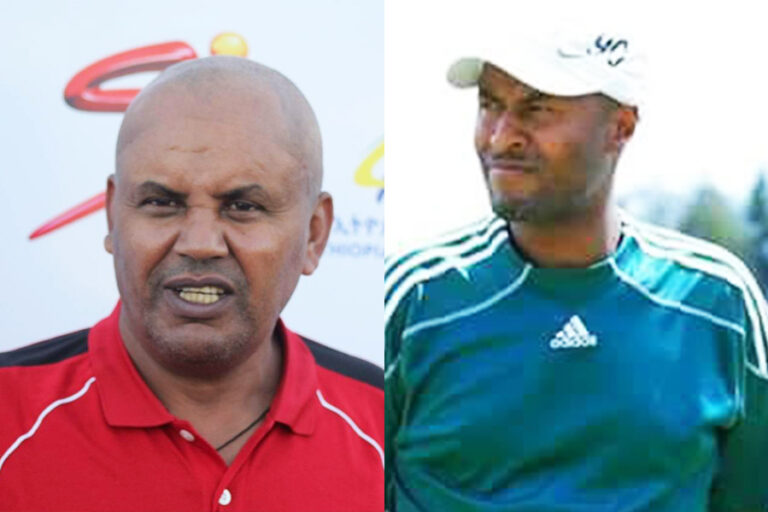
A new phenomena appeared to develop from Ethiopian Premier league clubs that is relegating Head Coaches into Youth team coaches. Wolkite Ketema’s Paulos Getachew Is the latest victim of such precedence receiving a frustrating letter to take over the youth coach duty until the end of his contract.
The first to be handed such harsh letter was Diredawa’s head coach Zemariam W/Giorgis who was booted out of the senior team hot seat following poor results.
According to unofficial sources Zemariam was requested to submit a resignation letter so that never to claim any payments for the remaining contract. “The club has no option but to slap him with such strong letter undermining his professional stature,” stated an official from the club who chose to be anonymous.
Former Harar Brewery Coach who had been Technical Director with Diredawa is the one who replaced Zemariam.
Weeks later Wolkite Ketema handed the same kind of letter sending down one of the premier league senior coaches Paulos Getachew aka Mango to the youth side.
Paulos who boasted building a miraculous squad spearheaded by former Ethiopian international Getaneh Kebede failed to deliver his promises thus sacked even before the end of the league season first round. “I have nothing to say for I am rather surprised with the development. Everyone knows I was fully committed to the club’s success,” Paulos said to reporters.
In the meantime Wolkite appointed former national U-20 and Debub Police coach Temesgen Dana for undisclosed duration.
Currently 9th In the table with 20 points just six points above the relegation zone, Wolkite is expected to name a regular head coach before the start of the second round in the final weeks of March.

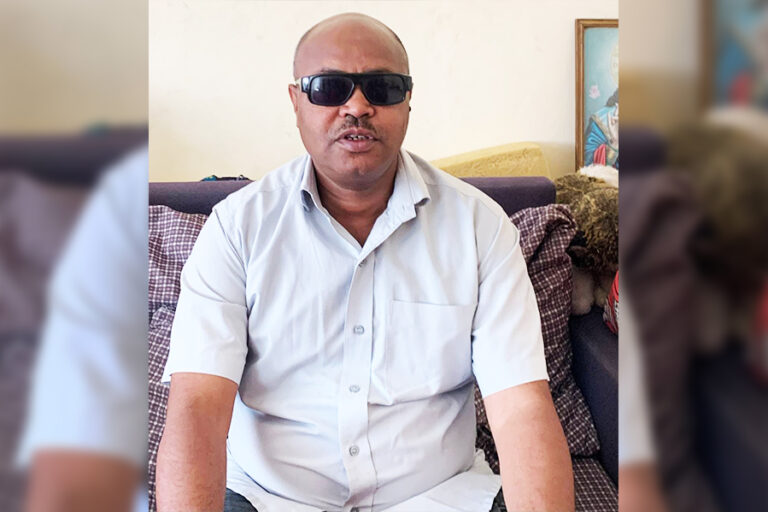
Daniel Kebede

0

Name: Daniel Kebede

Education: Diploma

Company name: Blind Chef

Title: Owner

Founded in: 2021

What it does: Provides catering service for different occasions

HQ: Addis Ababa, 22 ‘Mazoria’

Number of employees: Depends on the occasion /no permanent employee/

Startup Capital: 1 birr

Current Capital: Growing

Reasons for starting the business: My vast catering experience in the sector

Biggest perk of ownership: Staying strong during hard times

Biggest strength: Being Blind

Biggest challenging: Community awareness on disability

Plan: To open a big catering company

First career: Chef

Most interested in meeting: No one

Most admired person: Yetnebersh Nigussie

Stress reducer: Staying in silence

Favourite past time: Time spent with my family

Favourite book: Fikir Eskemekaber

Favourite destination: Dire Dawa

Favourite automobile: None