Commercial Bank of Ethiopia (CBE) inaugurates the nation’s tallest headquarter today in conjunction with celebrating its 80 year-diamond anniversary with the presence of the bank’s president, board members and higher government officials.
The new headquarter which has taken 5 years and 11 months to complete is said to be the tallest skyscraper in east Africa and the third tallest in Africa.
The new headquarter which was built at a cost of 303.5 million USD, china state construction engineering corporation took the construction of the building.
The bank is also known for its huge 31.4 million customer base with a huge asset pegged 1.1 trillion birr.
CBE was established in 1942, with only two branches which have now heaped to a mammoth 1,795 branches making it one of the largest bank in east Africa.
The building has 53 stories, 13 commercial floors, 11 floors for conference center. The headquarter area for public access includes exhibition area, cafeteria, sighting area, meeting halls, shopping mall, cinema, gymnasium, spa, children entertainment, restaurant and game areas, among others including parking area which has capacity to handle more than 2000 cars at a time.
CBE inaugurates east Africa’s tallest HQ
ESLSE’s hesitance to offer indicative prices delays sugar bid
The Ethiopian Sugar Corporation’s (ESC) international tender to procure 200 thousand metric tons of sugar has faced extensions owing to the failure of offering an indicative rate by the Ethiopian Shipping and Logistics Services Enterprise (ESLSE).
The state owned corporation had issued an international competitive tender on January 4 to purchase 200,000 metric tons of plantation white cane sugar, to which the deadline date for the bid was slated for Thursday February 10. However, the timeline is set to face delays owing to the state owned logistics enterprise’s failure to provide its offer to transport the cargo to the country.
As a result the bid opening date has been postponed to February 16.
Weyo Roba, CEO of ESC, whilst addressing the issue explained that the logistics giant was unable to offer its rate due to price issues which have shown high volatility at the global stage of late. He further stated that the corporation has requested a formal response from ESLSE to table its reasons for not offering an indicative price during the timeline.
“At this point I can not give any specific reason for the case since the enterprise’s response is crucial,” Weyo said, adding, “if they could not offer their rate prior to the up coming bid opening, we may put the case to the higher body to get amicable solutions.”
He told Capital that as a public enterprise the shipment is supposed to be handled by ESLSE, “due to that we have to wait for the solution.”
Regarding shipment price volatility that has been observed in the global market, Weyo reminded that in the previous similar bid which was conducted in the past budget year, ESLSE had offered its rate and within that space the international logistics price shot by 300 percent prior to transporting the cargo.
“Such kind of concern is the reason for ESLSE’s reservation. It is not a big issue and I hope we will solve the problem mutually,” the CEO explained.
Wondwossen Kassa (Chief), Deputy CEO for Shipping Sector at ESLSE, on his part said that the enterprise hesitated to offer its rate for different reasons, “initially the offer was expected to be given for ESC rather than biding companies.”
“If we give the rate for companies they would do their calculation and manipulation and submit their CFR and FOB price, which will not make us competitive,” he explained.
“Certain parameters including shipment period, shipment port, and quantity shall be specifically mentioned to offer the required and actual rate,” he added.
He told Capital that companies just asked general rates for different loading ports, “in this case we shall give indicative price that could not be put for completion and would not benefit the logistics enterprise.”
“These are our reasons for hesitating to offer the rate in this latest sugar bid,” he firmly stated.
“This is our stand. But the case shall be resolved as per the government direction,” he explained.
He recommended that the process must be carried out in such a way that bidding companies offer their price on CFR and FOB. Similarly, ESC ought to request ESLSE to offer its rate as per the parameters mentioned above.
He confirmed that the corporation asked for clarification to which ESLSE will provide its response soon.
The country annually imports up to 350,000 metric tons to address the gap. ESC is targeted to produce 413, 000 metric tons in the current budget year.
Weyo said that in the budget year the corporation planned to supply about 720,000 metric tons of sugar for consumption.
The sugar demand has been growing from time to time and it is estimated that the country’s annual sugar demand stands at 1.2 million metric tons. Thus the remaining gap is covered by other importers who have special permit from the government and those who have Franco-Valuta privileges.
Newly amended regulation harmonizes with regional vehicle overload control
The recently amended ‘vehicle axle unit load limits regulation’ is stated to harmonize the country’s truck loading standard with the regional’s tripartite agreement, Vehicle Load Management Agreement (VLMA) signed by regional parties.
Although the amended regulation being not fully public as of yet, experts in the sector explain that the new law will threshold the permissible maximum combination mass to 58 tons. Similarly, despite the exact sum of fines not being disclosed, penalties have been put in place for those that will abuse the new law.
It is to be recalled that the Council of Ministers ratified different regulations in different sectors, of which the amendment of the long awaited ‘vehicle axle unit load limits regulation’ was atop of the agenda.
Experts in the transport sector said that the new regulation which replaces the 1990 regulation, will be harmonious to the Tripartite – Common Market for Eastern and Southern Africa (COMESA), Southern African Development Community (SADC) and East African Community (EAC) – standardized vehicle and axle/axle unit load limits agreement which Ethiopia is a part of.
On its announcement, the cabinet stated that the regulation is developed on the consideration of the increment in the number of vehicles and their loading capacity. Cabinet disclosed that the regulation shall curb the infrastructure damage, and protect the road pavement as well as aid in ensuring road safety.
Despite the cabinet announcement not mentioning the tripartite agreement for its amendment experts said that the new regulation has taken into account the regional cooperation which mainly targets to boost the trans-border movement and economic enhancement.
Experts said that the new regulation has considered the regional cooperation which is also part of the African Continental Free Trade Area.
A weight limit is being imposed to control overloading and to make sure, for example, that trucks don’t cross bridges with lower carrying capacity than what the truck is holding.
Experts said the amended regulation will improve the axle load control and impose penalties from the regulatory government body against those who abuse the nation’s transportation laws.
They said that over the past three decades the situation has improved, including the standard of vehicles, roads and technology as a result the law had to be revised and updated.
According to experts, the former regulation did not specifically mention the penalty for over loading, and the process to fine those involved against the law is very lengthy.
“Regarding the fine the amount may vary but it is very insignificant compared with the damage that may occur when overloading trucks,” experts explained as they demonstrated their expectation from the change that the fines will bring.
The new regulation shall have mandates over a tridem axle load limit which replaces the 1990 regulation that was signed by then Deputy Prime Minister, Hailu Yimenu.
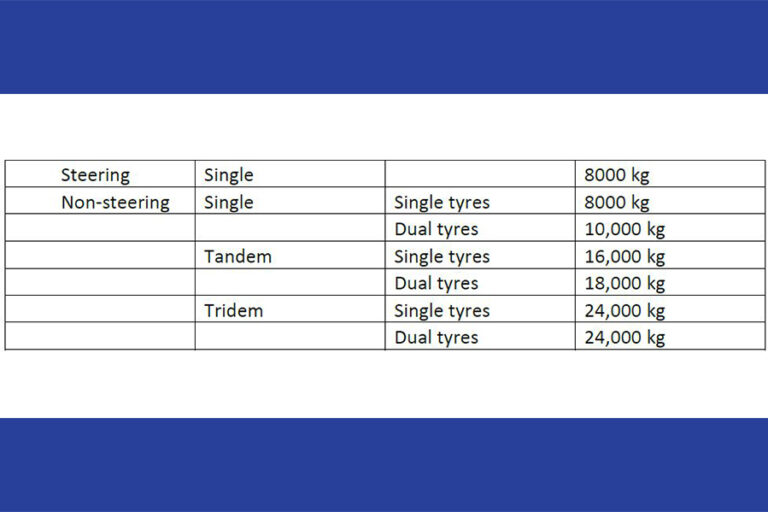
In the 1990 Council of Ministers’ regulation article 4 sub article C, the steering axle of a vehicle was stated to not carry a gross load in excess of 8 tons which experts expected the new law will house the same being that the standard is similar to the VLMA.
The former regulation amended the 1962 law which stated that the rear axle of a vehicle equipped with dual tyres shall not carry a gross load in excess of 10 tons.
Sub article D stated that the gross weight with of a tandem axles vehicle shall not exceed 17 tons, where the distance between the axels are not more than 1,300 mm.
Experts said that based on the tripartite agreement of the new regulation is supposed to reduce the 17 tons to 16 tons.
Experts specify that the latest study conducted by the Ethiopian Roads Administration (ERA) indicates that the distance between the tandem axles does not have a significant change in the loading capacity due to that the reduction shall have a benefit for infrastructure safety.
The expected change from the new regulation also mandates tridem axles loading capacity to a maximum cap of 24 tons.
A tridem axle is the international standard that every country is currently using.
The previous law did not mention the total weight, while the current one limits truck weight to 58 tons which was also stated on the tripartite VLMA.
It is to be recalled that Lee International Consultants, an international firm, conducted the study and changed the regulation, which led to the adoption of the sub-continental agreement of COMESA that Ethiopia signed.
Over loading is one of the major causes for damaging roads before their life expectancy and often has an economic impact down the road. Currently, ERA is working to curb the challenge and the new regulation is said to be of great boost to combating the issue.