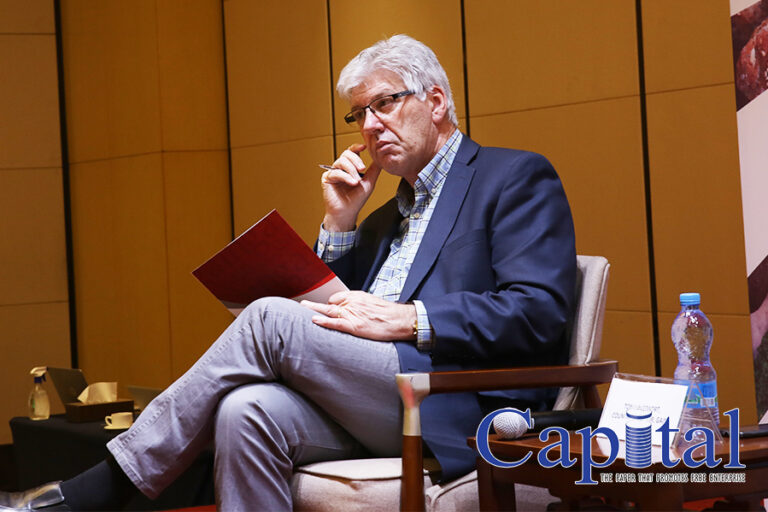
Ton Haverkort has 40 years’ work experience in the development sector and has extensive experience in leadership positions. Ton has spent a large part of his career working in different roles for SNV – a non-profit international development organisation established in the Netherlands – mostly in Ethiopia and Kenya.
He then joined Global Alliance for Improved Nutrition (GAIN) from the Catholic Organization for Relief and Development Aid (Cordaid), where he was Head of Mission and Regional Programme Coordinator for Ethiopia, Kenya and Uganda. Ton used to write a weekly article for Capital Ethiopia on “Doing Business in Ethiopia” for 20 years. Ton as he recently retired talked to Capital about his life in Ethiopia. Excerpts;
Capital: When did you come to Ethiopia and why?
Ton Haverkort: I began my career in development cooperation in 1979 and I was assigned to Ethiopia in 1988. My assignment was to set up a school of physiotherapy at the Prosthetics & Orthotics Centre behind Paulos Hospital. While I enjoyed my work in this sector, I really wanted to move into management of development support programs. I was employed by SNV, Netherlands Development Organization and I was fortunate to work with several Country Directors, who encouraged me to continue studies in that direction. SNV’s policy at the time also included a trajectory to develop technical experts into Program Managers and Country Directors. I then got the opportunity to become Program Officer in Ethiopia for a few years, before I was assigned SNV Country Director in Kenya. A little less than four years later, I was transferred back to Ethiopia as SNV was looking for somebody who knew the country already well to replace the departing Country Director. So, I returned to Ethiopia with my family in 2001 and I was Country Director for SNV until 2004. SNV then went through a major reorganization and it was time for me to leave the organization. But as a family we did not want to leave Ethiopia. My wife Tigist had set up a growing business, Ethiopian Reflection, which required her full attention and I decided to take on consultancy assignments, which I really enjoyed. One year later I picked up a consultancy assignment with CORDAID to develop a Drought Cycle Management Program, which over the years grew into a Community Managed Disaster Risk Reduction Program. I was hired as regional Program Coordinator to manage projects in Ethiopia, Kenya and Uganda, duty station Addis Abeba. This allowed us to continue to stay in the country. Meanwhile our children continued their secondary education at Sandford International School to IB level and Ethiopian Reflection became a front running company, in designing and producing a new generation of Ethiopian souvenirs and gift items, focusing mainly on engraved glasses, tableware and mugs, but also added wallets and T-shirts to its products.
I remained Regional Program Coordinator with CORDAID until 2017, when another reorganization happened, and I also felt it was time for me to look for a new focus in my work. I found that focus with GAIN, the Global Alliance for Improved Nutrition, and I became their Country Director for Ethiopia in 2018. I found this to be the icing on the cake of my career, with a great mission and the focus I was looking for. After fours years however I found that the time had come for me to retire.
Over the years, our business expanded and Tigist had set up the “KitesNest Luxury Apartments” as well “The Canteen” restaurant.
And so, here we still are in Ethiopia and Addis Abeba, minding our business, while I will try and kickstart some consultancy activities again. This time though, I want to bring young professionals on board of my team and give them the opportunity to make their first steps in their career.
Capital: Tell us about your experience in Ethiopia and your various ventures.
Ton Haverkort: The work I was able to do in Ethiopia and the East Africa region, allowed me to travel to many remote areas and communities. I count myself blessed to have been able to see so much of the beautiful, vast and diverse country sides and meet with so many people of different cultures and livelihoods. Perhaps I have learned more from them than they did from me. Their resilience, hospitality and generosity have always impressed and inspired me. In spite of all the challenges that come their way, in terms of droughts, floods, environmental degradation, etc. I have found communities to be resilient, and supportive to each other. Projects to support their resilience will only be successful though, if the communities are fully engaged in the design and implementation of activities. Ownership is key.
Capital: Tell us a little about your work with International NGOs like SNV, CORDAID and GAIN.
Ton Haverkort: International organizations like SNV, CORDAID and GAIN are genuine development partners, which hold ownership by beneficiaries and sustainability as primary conditions for success in development. Likewise, we see ourselves as development partners and try and make a contribution to the development agenda of the country. This is another essential point of departure for successful partnership. Ethiopia has good policies in terms of development and growth. The struggle lies in the effective implementation and that is where we can come in. The Integrated Rural Development Programs with SNV and the Community Managed Disaster Risk Reduction projects with CORDAID are good examples of partnership with communities and the Governments that serve them. GAIN on the other hand also works a lot with Private Sector Partners and from a comprehensive Food Systems perspective, realizing that business is key in all food value chain steps. And from a Food System perspective, we are able to identify challenges to make nutritious food more available and affordable, including infrastructure, financial services, extension services, inputs, food safety, packaging, transportation, etc. GAIN and other development partners were able to work with Government last year to prepare for the Food System Summit, make commitments and lay out a road map to end malnutrition. This process was co-convened by the Minister of Health and the Minister of Agriculture and coordinated by the Agriculture Transformation Agency. The foundation was laid indeed to tackle malnutrition from multiple perspectives and the role of International NGOs and development partners is to find their way to effectively provide their support.
Capital: How did you start writing for Capital Newspaper? What was the focus of your writing?
Ton Haverkort: As I mentioned earlier, after I left SNV in 2004, I began consultancy services. I noticed there was a need also to provide management support to the private sector and business owners. I knew Capital Newspaper to be a newspaper for the private sector and proposed to write a weekly column “Doing Business in Ethiopia”. Teguest Yilma, editor in chief, who had interviewed me earlier in my capacity as SNV Country Director, welcomed the idea and invited me to send in a few sample articles, which I did. She approved the articles which resulted in a weekly column for 15 years. The focus was to provide management support to business owners in the context of Ethiopia. Observing challenges that business owners face, I began to describe real life examples, analyze the particular issue, and suggest options for improvement. From a principal point of view, I did not write blue-print management articles, but I tried to look at issues and solutions in the Ethiopian context. I also described situations from my own experiences in the country and as member of the Ethiopian business community, looking for ways to do business in this country in a more effective way. I considered myself part of the problem and wanted to be part of the solution.
Capital: What challenges did you have to overcome at the beginning of your journey?
Ton Haverkort: There have always been challenges and there will always be challenges. They are numerous and diverse. There are cultural differences in management and leadership for example. It is not anybody’s place to say which is a better way. It is important to realize there are differences and to know what these differences are and why they exist. Next is to find out how to deal with these differences and decide what to give and take to meet somewhere in the middle. Learning how to deal with cultural differences makes our lives richer indeed. Not being able to deal with them will make us miserable, irritable and bitter, wasting a lot of negative energy.
There are multiple other challenges of course, like consistent or rather inconsistent supply of services, including water, electricity, and telecommunications, infrastructure, the road conditions, etc. The growth in terms of population and urbanization is too fast for services to keep up. Frequent interruptions in water and electricity cause damages to business and add to production costs. I have the feeling that the service providers and authorities do not fully understand or appreciate the negative impact for business and the challenges faced by business owners. Meanwhile they are expected to fulfill their obligations without fail.
Capital: What is next?
Ton Haverkort: As I mentioned, I will kickstart my consultancy services again in the development and business sectors. And I want to give the opportunity for fresh graduates to make a first step in their career by including them in my teams and coach them on the way. I have seen how difficult it is for young professional to find employment and I hope to be able to help some on their way. I also intend to organize a monthly “Mingle” evening in our restaurant “The Canteen” for professionals to meet informally and network. Building relationships is one of the most effective ways to further develop as a person or business.
I may also pick up writing articles again and share my views about doing business in Ethiopia and make a contribution to doing business in Ethiopia more effectively.