

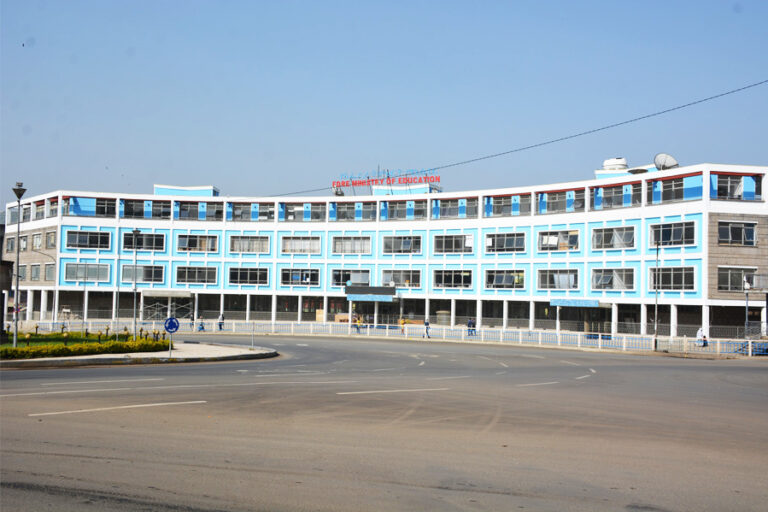
Ministry of Education tables a draft for education proclamation to the Council of Ministers, which is a first of its kind.
Despite public institutions financed by the federal government being established by the regulation of the Council of Ministers, the education ministry had no regulation or law enacted by the state which meant Ethiopia did not have an education proclamation.
“The absence of the proclamation has been blockading the ministry to expand its way and enhance quality of education, as well as issue directives,” Muluken Nigatu /PHD/ Director general of education quality assurance at the ministry stated.
Muluken further explained that the proclamation will help to guide the ministry to create an appropriate legal framework and autonomy that complies with the requirements of the state law and other federal minimum quality standards, which sets specific rights and duties of the Ministry of Education.
Passing due processes, the draft has been tabled to the Council of Ministers, and as he disclosed the proclamation is expected to be ratified within two months.
In related news, on Monday January 3, 2022, the House of Peoples Representatives’ Standing Committee on Public Expenditure, Administration and Regulatory Affairs discussed with the Ministry of Education on the licensing and supervision and qualification of private primary and secondary schools and performance report of private schools in Addis Ababa for the fiscal year 2020/21.
As the report shows, the sample take from both private and international schools shows that there is no teacher who takes professional qualification assessments. Moreover, there is no guideline for enrolment and licensing requirements for international and community schools, as well as directive to establish an educational institution and licensing in addition to renewal of private primary and secondary schools.
During the discussion, the Standing Committee advised the ministry to change ‘Licensing and Supervision of Private Educational Institutions No. 206’, which was approved by the Council of Ministers starting from1994/95, which has not been amended and made up-to-date.
Commenting on the issues, Muluken said the ministry is preparing a qualification frame work.
Also regarding on the quality of general education, Education Minister Berhanu Nega (Professor) said there are more than 47,000 schools in Ethiopia, adding that 90 percent of the schools in the country are underdeveloped.
According to Berhanu, there is a basic education problem in Ethiopia and as the Ministry of Education highlights, less than 20 percent of teachers in the country have passed the qualification assessment, while less than 90 percent of schools over the nation do not meet standards which is set by the ministry.
Education ministry tables its first proclamation draft
Renowned diplomat, Kassa Kebede laid to rest

The body of prominent diplomat and former senior government official Kassa Kebede (Amb) was laid to rest on stately funeral service on January 5 at the Holy Trinity Cathedral.
Kassa, the former Ethiopian Ambassador to Geneva and who served as expert on diplomacy, and peace and security for different global organizations reportedly died few days ago in the US where he resided till the age of 79.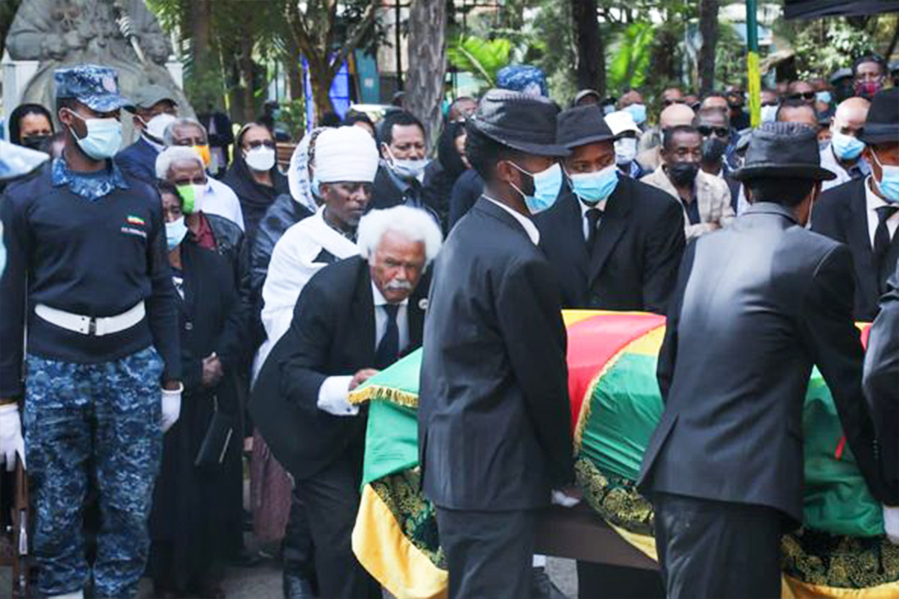
Ministry of Foreign Affairs stated that on the official service, High-level government officials including Mehreteab Mulugeta (Amb), Chief of Cabinet of the Office of the Foreign Minister, and other representatives from the Ministry of Foreign Affairs of Ethiopia were in attendance at the funeral.
Kassa, who served Ethiopia in different capacity in the emperor and Derg era, is well know in related with Operation Solomon, the campaign to move Ethiopian Jews to Israel.
Kassa was one of the influential figures during Mengistu Hailemariam’s time.
Provision expense dwindles Wegagen Bank’s profits

The provision expense of Wegagen Bank triple slashing the profit by 82 percent for the financial year that ended in June 2021.
The bank that disclosed the 2020/21 financial year report a week ago, stated that its total expense surged by 44 percent in the stated period.
In the 2019/20 financial year the bank’s total expense was 3.3 billion birr which ballooned to 4.8 billion birr in the financial year that ended on June 30, 2021.
According to the annual report, although the provision expense took 18 percent of the total expense of the 2020/21 financial year it has contributed to increase in the total expense significantly.
The report stated that the provision expense increased by 307 percent compared with the preceding year due to the non performing loans (NPL) rate showing increment in the year.
A year ago the share of provision expense for doubtful loans and advances was only 6 percent of the total expenses which went on to stretch to 18 percent in the past financial year.
In the reported year, the bank was forced to hold 864 million birr as provision expense due the NPL while but a year ago this amount was 231 million birr.
From the total expense, the salary and benefit took the lion share followed closely by interest expense and general expense with 31 percent, 30 percent and 20 percent respectively.
In the financial year ended on June 30, 2020, it is worth recalling that the interest expense stood at the top taking 37 percent share from the total expense amount.
According to Abdishu Hussien, Chairperson of the Board of Directors of Wegagen Bank, the provision expense increment has significantly affected the bank’s profit in the reported period.
In the year, the bank managed to secure 193.1 million birr in profit before tax which is a huge chop of 82 percent when compared with 1.07 billion birr in the preceding year.
Abdishu said that NPL mainly occurred in relation to the conflict in northern part of the country. He said that the bank was unable to collect loans provided for customers in the stated conflict area.
In the year the bank totally secured five billion birr in revenue which increased by 13 percent in comparison with 4.4 billion birr of the 2019/20 financial year.
Similarly, the deposit mobilization has shown a five percent increment to stand at 31.5 billion birr.
According to the annual report, the total outstanding loans and advances increased by 15 percent to reach 27.3 billion birr.
At the end of the reported year, the total asset of the bank has reached almost 40 billion birr with four percent growth on year to year basis.
At the reported period, the paid up capital of Wegagen increased by 400 million birr to reach at 3.3 billion birr. In the year Wegagen’s profit after tax has stood at 126.7 million birr showing significant shrinkage from 832 million birr on June 30, 2020.
African Mosaique unveils event to support women, children and victims
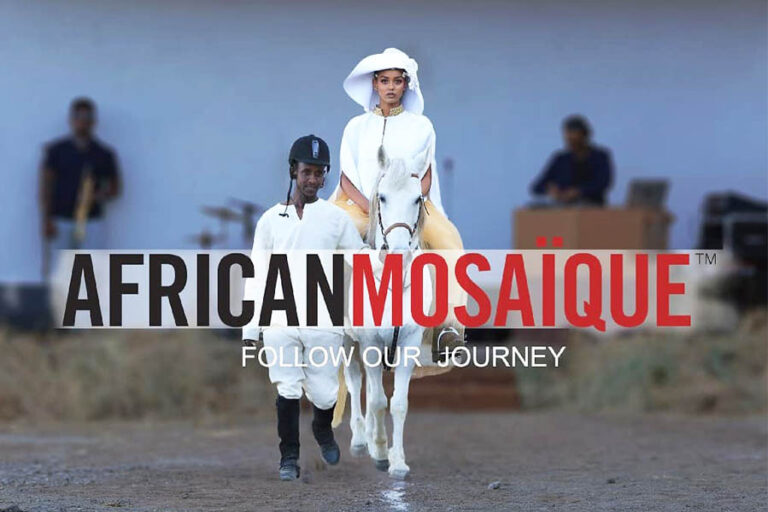
Aimed to both fundraise and provide support for Women and Children causes through Eyezon.com, the African Mosaique has organized an event dubbed “ Made In Ethiopia Pop-up series wrap-up event” which is to take place on January 14, 2022, at its design center and manufacturing hub, in Legetafo.
“This fundraising event aims to attract visiting and local guests, especially the diaspora community that has arrived for the great Ethiopian Homecoming challenge, as well as the business and international community, government officials, the diplomatic community, designers, and the press,” the statement of African Mosaique read. Moreover, all proceeds including the entrance fee of 500 birr will be donated to support Women and Children causes through Eyezon.com. The event will follow the proper COVID-19 protocols to protect the safety of guests and participants.
The one day event will feature 10 leading and emerging designers who will showcase their product at the fashion show and over 20 creatives who will participate in the Pop-Up. Guests will have a chance to meet and hear inspiring stories from the creatives as well as shop. Moreover, some of Ethiopia’s creative designers, and interior design installations from leading furniture designers, and display of art works from different artisans and designers will be showcased.
The African Mosaique PLC, is primarily a high-end-fashion and clothing production enterprise, and an export-oriented company with operations from Legetafo. The company also provides mentorship and collaborates with up-and-coming young designers and entrepreneurs in the fashion and apparel industry. It serves as a platform to emerging and established Ethiopian and other African designers, by providing on-job training, transfer of knowledge, and marketing opportunities, through the AM fashion incubator program, AMFI launched in 2016.
African Mosaique Design Center and Manufacturing Hub, the first of its kind in Ethiopia, will continue celebrating local ‘Made in Ethiopia’ Fashion while identifying and promoting emerging designers, by providing training, production, and showcasing facilities, alongside networking and business facilitation.
