


The 4th edition of Ethiopian real estate and home expo kicked off in Addis Ababa for two days starting from January 1-2, 2022 at Hilton Hotel. Organized by 251 communications and marketing, the expo was a one stop shop to fulfill housing, furnishing and installation needs, bringing the real estate and home accessory companies in Ethiopia. The event took place amid the rapidly growing construction and real estate sector. The event provided a platform for leading local and international realestate developers to showcase a wide range of homes, commercial properties, furnishing and interior to potential home seekers and existing homeowners attaching prominent real-estate companies and business which construct develop, market and deliver different types of business and residential villas apartments, luxury condos and buildings exhibiting a wide range of products services and properties to thousands of visitors during the two day event.
AFCON 2022: Opportunity and Success
Representing Cecafa in AFCON this year are its two time hosts as well as winners. Those hosts are Ethiopia and Sudan. The nations of Cecafa are best remembered for their performances at past central Africa sports tournaments. Insight into these nations and their athletes will help prepare you to use Betway to place the best possible bets on upcoming soccer games.
A History Of Success
It’s worth mentioning that Kenya made their AFCON debut in 1972. 40 years afterward, AFCON was once again held in Central Africa in 2012. That year also marked the first that Sudan had entered the tournament for the previous 36 years. This is significant because Sudan was one of the pioneers behind the first AFCON.
Of the three AFCONS that have been held since, Sudan participated in seven of them. Ethiopia was also a driving force of AFCON when it debuted in 1957. They have since been in the event a total of 10 times. Three of these times were when they hosted the event, in 1962, 1968, and 1976.
In addition to Sudan and Ethiopia, others that have represented Cecafa in AFCON includes Kenya, Uganda, Tanzania, and Rawanda.
Powerful Squads
Ethiopia is holding its own in this year’s event. Some of the participating players include goalkeepers Adama Ketema, Teklemariam Shanko, and Bahir Dar Ketema. Midfielders include Firew Solomon, Amanuel Yohannes, and Fitsum, Alemu.
A Break Out Star
Getaneh Kebede, the lead marksman for Ethiopia, is 100% committed to making a difference for the team at this year’s AFCON. He’s publically stated that because he is a striker for the team, being able to score goals is crucial to the team’s success. Kebede also feels that as long as his teammates work together, they can’t go wrong.
When it came to the qualifying games to get Ethiopia into AFCON, Kebede scored three goals against the Nigerian team.
A Team Prepares
Ethiopia arrived in town for the 2022 AFCON and upon arrival, engaged in a friendly pre-tournament game with Sudan. Having won that game, Ethiopia is well on its way to making a lasting impression at this year’s tournament. However, Sudan has two more practice games schedued with teams from Sierra Leone, and Zimbabwe.
But it isn’t just the team players that are pumped up for this prestigious event. Current coach Wubetu Abate took over leadership of the team in late 2020. Immediately he set his sights on getting the Ethiopia team to qualify for AFCON. As a former soccer player himself, he understands how important it is for the team to have strong leadership. In the past, Abate also worked for the Ethiopian Premiere League.
With such a talented team representing Ethiopia, there is a lot for its residents to be proud of. This year’s AFCON is set to be an unforgettable event that will help keep soccer among the hottest sports being played today.
Ethiopia has a strong chance of finishing this year’s tournament at the top of the rankings in soccer.
GERD set for power generation

The national flagship project, the Great Ethiopian Renaissance Dam /GERD/ has successfully completed its preparation to start test power production in the coming days.
Sources told Capital that the works on the dam to start test power generation is completed.
In the middle of November, 2021 Sileshi Bekele /PhD/, Chief Negotiator and Advisor on Trans Boundary Rivers and GERD at the office of the Prime Minister said, “Ethiopia is in preparation for the pre power generation of the national flagship project, the Great Ethiopian Renaissance Dam/GERD/ within the maximum time cap of five weeks.”
The dam in its pre power generation is expected to generate 700 MW. As Sileshi said, the overall construction progress of the dam has now reached 82 percent.
As officials from the Ministry of Water and Energy explained that when the dam starts the first production of power it will cover 20 percent of the nation’s demand.
Financed by local sources, the GERD will be capable of producing as much as 5,250 MW of electricity, ranking it as one of the world’s largest dams and by far Africa’s largest dam by electricity production.
Ethiopia has made the second filling in the past rainy season. The country has made a stand on equitable water use on the Abay/Nile River that is the source of the GERD.
The GERD is the source of an almost decade-long diplomatic standoff between Ethiopia and downstream nations Egypt and Sudan.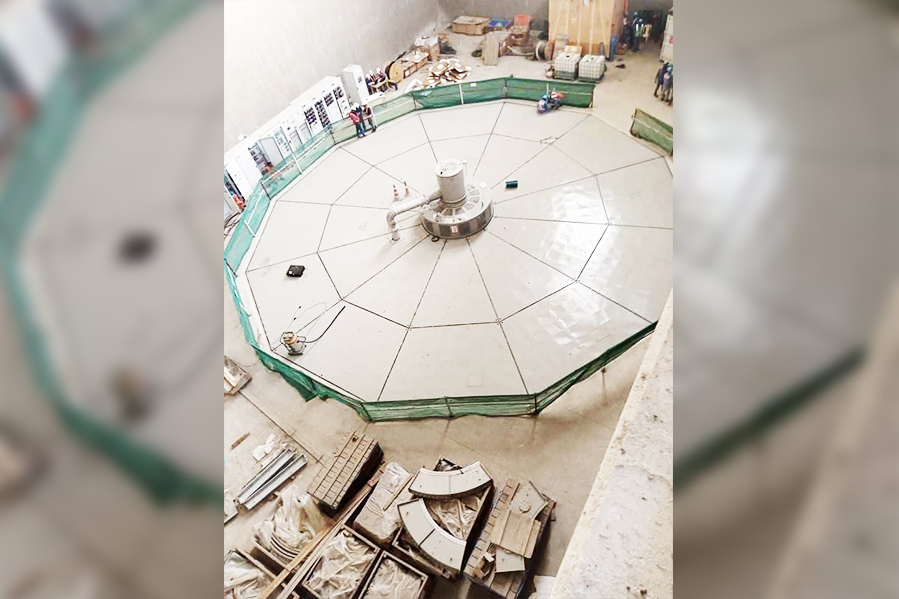
Despite the downstream countries mainly Egypt expressing its concern on its water flow Ethiopia strongly reassured that the project would not have harm on others and the country does not have intention to affect others.
To tackle the concerns, the three countries, Ethiopia, Sudan and Egypt discussed for years, while the negotiation was interrupted majorly from reasons that mainly come from Egypt.
Ethiopia has also been facilitating comprehensive engagements to address the concerns of the riparian countries since the inception of the construction of the GERD.
After discussions on UN Security Council the three countries have come to the AU-led negotiations and perhaps the negotiations between Egypt, Sudan and Ethiopia are still suspended since Ethiopia completed the second filling of the GERD.
“Ethiopia has never and will never accept any mediator and will would never agree with unfair terms that seek to maintain the hydro hegemony of Egypt and Sudan,” said Sileshi, adding, “Exerting unnecessary pressure on Ethiopia by intentionally politicizing and internationalizing the matter will not make Ethiopia accept the colonial-era treaty over the Nile River.”
Ethiopia contributes more than 86 percent of water share for Abay, while the river does not provide required economic benefit.
With some cooperation and wisdom, it was initially possible that the ambitious GERD project could become both a great development project for the Ethiopian people and a model for cooperation between Ethiopia and its neighbors. Instead, the project has become a constant cause for conflict as the various actors vie for regional hegemony.
Several senior government officials declined to give official information on the issue.
EHPEA advices gov’t to consider all contexts before penning the EPA
The Ethiopian Horticulture Producer Exporters Association (EHPEA) calls the government to be vigilant in light of joining the Economic Partnership Agreements (EPA) as government remains undecided on the matter.
It is recalled that the country’s horticulture industry registered massive success in the export market becoming the second largest hard currency earner in the agriculture sector after coffee. The major export destination being European countries, Ethiopia has been utilizing the Everything But Arms (EBA) duty free scheme initiated by EU to maintain its market in Europe.
The EBA preferential treatment which is accorded by EU provides the initiative to remove all quotas and tariffs on all products originated from the Least Developed Countries (LDCs) in African, Caribbean and Pacific (ACP) except arms.
However, EU and ACP have also agreed to put in place the EPAs which give reciprocity for all countries from both sides to open their markets. So far some countries from Africa, other LDCs, signed the EPAs to open some high percentage of their market for European countries gradually.
On the workshop called by EHPEA which was held on Tuesday December 28, the association expressed its concern by advising government to be prudent on taking to account the benefit of Ethiopia in general and the horticulture sector in particular.
“If the country inks on the EPAs at the current content of the agreement, the performance of our industry shall significantly be affected. Farms in the EU are strong and experienced besides betting different support from their governments, but on the other hand the industry in Ethiopia is immerging and running with several challenges,”  , Executive Director, said.
At the current level, the trade balance is favoring Europe except very few countries like the Netherlands, which is the major destination for Ethiopian floriculture products. The latest figure shows that Ethiopia exports about USD 550 million worth of commodities that is mainly primary goods to Europe while on the other hand the import from the stated continent is USD 1.8 billion.
Experts said that if EPAs shall be in effect the trade balance shall be widened.
“Ethiopia might not be competitive after the EPAs especially in the horticulture, wheat, meat products poultry and other agricultural products. The European governments subsidize their agricultural sector and the enabling environment which are very dynamic,” Tewodros explained by referring the early assessment that was conducted by EHPEA on the effect of EPAs.
He said that EPAs shall crumble the Ethiopian industry if it is not properly articulated.
“The agriculture sector in general and the horticulture industry in particular is the major source of hard currency, so the strong negotiation pattern is required,” the Executive Director strongly stressed.
He also added the newly coming agro processing industries shall be paralyzed because of the coming of the opening up of the market through EPAs.
He said that the free market agreement has also different impacts in the revenue for the country that leads to diminishing the investment on social facilities, which houses job mostly managed by women.
“As an association we propose that under the current context the EPAs, ought not to be inked even though some ACP countries have signed to it. We have to continue to benefit from the EBA initiative,” he said by adding alternative configuration comprising of LDCs to be implemented.
The association stated that EHPEA will back further and detailed assessment regarding EPAs potential effect and benefit.
At the workshop Mussie Mindaye, Director General of Trade Relation and Negotiation at Ministry of Trade and Regional Integration (MoTRI), said that despite Ethiopia’s export to EU increasing when EBA was launched, it is not tapping the full opportunity.
“Ethiopia has not been efficiently utilizing and taking the advantages of this preferential market access due to supply side constraints as well as non tariff barriers such as the stringent rules of origin and the high product standard among others,” Mussie elaborated.
He said that the horticulture sector stands a high chance to benefit from EBA, “However, we have to ask ourselves as a country whether we are using the full potential in this position of exporting the product.”
“When we met with EU officials we stated that the country has not properly benefited from the duty free scheme,” he said, adding, “That is why Ethiopia is reluctant to push on the EPA negotiation.”
He said that as a nation the country is insisting for the continuation at least up to the period that the country graduates from the LDCs list.
He added that the country is yet to decide when and in which terms to sign the EPAs, “we need to undertake detail assessment regarding, the benefit and effect of EPAs.”
