Tuesday, May 12, 2026
Home Blog Page 3117

Dagmawit Amare takes over as General Manager of Great Ethiopian Run

0

Dagmawit Amare has been appointed as the new General Manager of Great Ethiopian Run. Taking over from Ermias Ayele who had been the GM for the past eleven years, Dagmawit becomes the third GM in the company’s twenty-year history and the first female to lead the company.
Speaking about her appointment, Haile Gebrselassie said “this is a great opportunity for Dagi to lead the company. Dagi is a very humble person, but she is also very smart. She has a wonderful gift of empowering others to do their work well. We are lucky to have her to lead us in the next phase of our work.”
Having started working for the company seventeen years ago, Dagmawit is also the longest-serving employee at the company that celebrated the 20th edition of its flagship international 10km road race in January of this year. Over many years she has masterminded the company’s work of mobilising large numbers of participants to register for their races. As a passionate lover of Ethiopian music, she has also been instrumental in bringing live music bands to the events and two years ago worked with an Ethiopian dance group to introduce a unique dance routine as part of the participant warm-up for the international 10km.
Former General Manager Richard Nerurkar recalls how Dagmawit has also been passionate about making a success of the annual women’s run. “From her earliest years she was totally committed to seeing this race grow into what it has now become. She loves creating enjoyment for the participants. Another example of this is the annual Pasta Party which nowadays has the feel of a special Gala Dinner. But what I value most about Dagi is the way she takes care of others. For the past 17 years, she has been the glue which has kept us together as a happy and successful team,” Nerurkar said.
The same point is made by Dagim Teshome who as Operations Director has been working closely with Dagi for the past 14 years. “With Dagi, nothing she does is about herself. It’s about our races and our team. It’s about us as an organisation and about us doing something for Ethiopia.”
Ruth Duncan, who has worked as part of the Event Hospitality Team for the past ten years, said “Dagi is the perfect person to take over the driving seat at Great Ethiopian Run. Her friendly professionalism and passion for sharing Ethiopia’s running culture have been central to the way in which our races have sent out so many positive messages about Ethiopia and its welcome to the outside world.”
Dagmawit’s popularity outside the office has also been evident in tributes made by those who know her both as a person and as an event professional.
Chachi Tadesse, one of Ethiopia’s well-known singers who regularly attends races organised by Great Ethiopian Run, commented “Dagi is a wonderful person to be around always positive, totally committed and incredibly humble. I’m excited to see how she will lead the organisation and the new ideas she will bring to her work.”
Members of the AIMS Women’s Commission, an international movement for improving women’s participation in distance running worldwide, and of which Dagmawit is a founding member, have also expressed their delight at the news of Dagmawit’s appointment as General Manager. AIMS Vice President Martho Morales said “Congratulations! We are so proud of you!”

Ethiopian Gudaf Tsegaye wins 10,000m race in Portugal

0

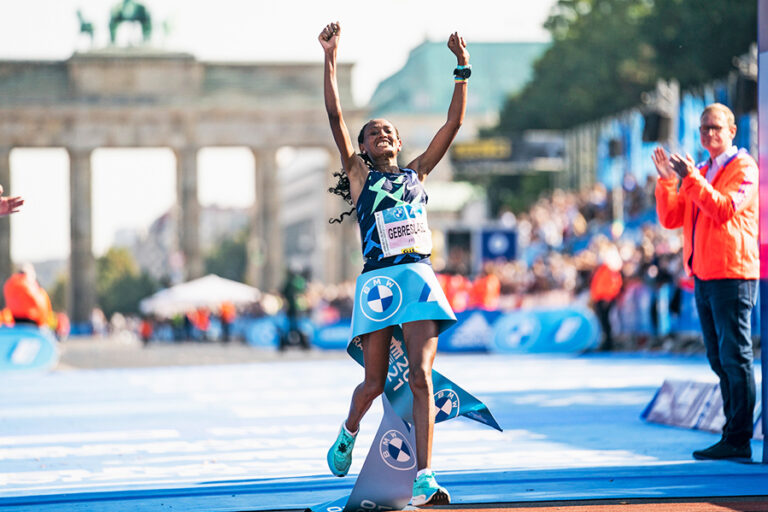
Ethiopia’s Gudaf Tsegay ran an amazing 29:39.42 10000meter debut at the Fernanda Reberio Gold Gala in Portugal. The World Indoor 1500 meter record holder (3:53.09), ran 14;55 for the first 5000 meter and then accelerated to 14:49 for the second half to win the race in 29:39.42.
Behind Gudaf finished Ethiopian-Bahrain’s Kalkidan Gezahne who returned to racing in 2018 and amazingly clocked 29:50.77. Meanwhile, Uganda’s Doreen Chesang took third place in 30:09.82.
The 24 year-old Gudaf became the first woman in history who in her 10000meter debut broke the 30 minute barrier , Gudaf’s 29:39.42 puts her in fifth place on the world all-time list.
Breaking the women’s world record for the indoor 1500 meters in February 2021 after posting a time of three minutes, 53.09 seconds and now a phenomenal finish in her debut 10000m race Gudaf is one of the highly expected prospects of Ethiopian athletes at Tokyo Olympics.

Ethiopian Lucy to lock horn against Uganda in African Cup of Nations qualifier

0

The draw for the extended 2022 Women’s African Cup of Nations brought Ethiopia to a two leg head-on clash with Uganda while African heavy weights Nigeria and Ghana set for a phenomenal qualification showdown. U-20 Ethiopian Women’s side awaits the winner of South Sudan and Rwanda in the 2022 African qualification for the U-20 World Cup final to be held in Costa Rica.
112th in the latest Coca Cola World Ranking Ethiopian Lucy faces a regional adversary Uganda which ranks 154th. The first round will see Kenya play against South Sudan as Uganda face off against Ethiopia, Eritrea against Burundi, while Djibouti will confront Rwanda.
Should the Kenyan Starlets proceed past South Sudan, they are set to face off against either Uganda or Ethiopia in the second round. The winners on aggregate will qualify to join hosts Morocco in the regional showpiece.
The first and second leg fixtures of the first round will be played between June 7 and June 15, while the second round’s first and second leg fixtures will take place between October 18 and October 29.

What it will take to overcome the pandemic

0

Although the COVID-19 pandemic has hit some communities, countries, and regions much harder than others, it also has reminded us that our fates are intertwined. There will be more pathogens with pandemic potential in the future, but whether they inflict such catastrophic costs will be entirely up to us.

As special envoys on COVID-19 for the director-general of the World Health Organization, we have witnessed firsthand the intensity of the suffering caused by the pandemic, especially in poorer communities. This profound tragedy has been evolving before our eyes and still is nowhere near its end.
In our experience, the first priority in responding to an infectious disease is to save lives and protect the health and well-being of current and future generations. At the same time, we are increasingly concerned by the tremendous social and economic damage that COVID-19 has wrought. With people everywhere struggling to preserve their livelihoods under the constant threat of the coronavirus, it has become clear that this pandemic is more than a health emergency. It has become a global whole-of-society crisis.
In this context, one of our greatest fears is that after decades of improvement, future generations’ prospects have suddenly plummeted. Some regions are experiencing a reversal of gains achieved in the past 20 years. Achievements such as higher employment, expanded essential services, and better education (particularly for girls) are at risk. So are improvements in infrastructure, water and sanitation, disease control, political stability, and governance institutions.
This loss of momentum toward the international community’s Sustainable Development Goals for 2030 will have far-reaching costs, most of which will be borne by the most vulnerable. Consider the vaccine rollout. Through extraordinary global scientific cooperation, the international community has created an Access to COVID-19 Tools Accelerator (ACT-A) to facilitate the sharing of technology, and the COVID-19 Vaccine Global Access (COVAX) facility to deliver vaccines equitably and efficiently around the world.
But while hundreds of millions of vaccine doses have been administered globally, there are deep disparities. In high-income countries, vaccine supplies are sufficient to provide for around one in four people, on average; in low-income countries, this figure drops to one in 500. At this point, it should go without saying that no one will be safe until we have made these cutting-edge technologies available to everyone. The longer we delay, the greater the risk that dangerous new variants will emerge.
SARS-CoV-2, the virus that causes COVID-19, is certainly not the last contagious pathogen that humanity will face. But it could be the last one that inflicts such exorbitant costs. Whether the next pandemic can be prevented is up to us all. Success will depend on commitments from all countries to implement the International Health Regulations, the WHO’s legal framework establishing how they should prepare for and respond to the cross-border transmission of pathogens and other health emergencies.
Beyond following through on these existing measures, world leaders should take six additional steps. First, we must dramatically scale up investment in global preparedness, so that we can spot the next potential pandemic as early as possible. There is now ample evidence of what works well, and we have gained hard-earned experience in getting the necessary systems to function as they should, everywhere. All countries should commit to sharing relevant information rapidly and ensuring its reliability.
Second, we must do more to prevent pathogens from moving to humans from animals and the environment. That means appreciating the risks of crossover transmission and adopting a “One Health” mindset that reflects awareness of biological interdependencies and our shared obligation to protect fragile ecosystems.
Third, we need to ensure that all countries can respond rapidly when the alarm bells start to ring. There is an urgent demand for more investment in local, national, and regional health systems, particularly those that currently lack the capacity for prompt detection and response.
Fourth, public officials need to demonstrate enlightened leadership by committing to, and engaging in, constructive international cooperation, without which the world will always be at risk. As WHO envoys, we are encouraged by the call from 26 heads of state and government, the president of the European Council, and WHO Director-General Tedros Adhanom Ghebreyesus for an international treaty on pandemic preparedness. This effort can provide a solid foundation for high-level coordination between governments. Ideally, it would result in a new compact designed to complement the International Health Regulations and drive a simultaneous upgrade in all national systems that need it.
Fifth, we must intensify international cooperation to develop and deliver the vaccines, diagnostics, and treatments that are necessary for achieving universal health coverage. That means building on initiatives like the ACT-A to establish a permanent forward-looking mechanism for ensuring equitable access to critical health technologies for all who need them.
Lastly, and above all, there is an urgent need to reset the response to this crisis. Everyone needs to recommit to supporting a singular and cohesive strategy that is built on equity and fairness, driven by a single-minded focus to end the pandemic as quickly as possible, and in keeping with the WHO’s mantra: solidarity, science, and solutions.
As special envoys for COVID-19, we will continue to support countries and communities as they confront this crisis. The task now is to prevent and mitigate as much of the damage as we can, which will require concerted action within and across countries to implement the right public-health policies and build capacity wherever it is falling short. Sustaining these efforts will be critical, because it will be many months even years before vaccines against current and future variants of the virus are accessible to everyone.
We urge everyone to do their part to help prevent, prepare for, and manage the next outbreak. Above all, we call on today’s leaders to muster the solidarity needed to work together for the common good. What leaders decide to do now will have implications for everyone living today and tomorrow.

This commentary is co-authored by: John Nkengasong, Director of the African Centres for Disease Control and Prevention; Mirta Roses, former WHO regional director of the Americas; and Samba Sow, Director-General of the Center for Vaccine Development in Mali.