

The financial giant Commercial Bank of Ethiopia (CBE) has adjusted its loan interest rate by at least 1.17 percent from the previous 8.63 percent, while its decision is expected to reflect on other banks’ minimum interest rate for loan provisions. This is in light of the bank undergoing major reform.
The financial sector experts said that the decision that is taken by CBE, a public financial firm, is most probability followed to minimize its cost and narrow the stipulation with the private banks, who currency are charging up to 21 percent interest.
“Meanwhile CBE is a policy bank it is in pressure in different conditions including cost and debt settlement default on some public enterprises who default billions of birr,” a banker who demands not to be named says, adding “the default of the public enterprises has forced the bank to hold some provisions.”
Abe Sano, President of CBE, told media that the interest rates adjustment is aimed at balancing the unbalanced income and expense rates of the bank.
Abe said that the income of the financial giant is growing with an average of 26 percent rate, while its expense has been growing by 39 percent during the last five years.
The borrowing rate of Commercial bank of Ethiopia is much lower that the market borrowing rate, which is an average of 14.5 percent, the president claimed.
Accordingly, the bank has made service charges adjustment to an average of 9.8 percent from the previous 8.63 percent rate, including for merchandise goods (maximum 16.5 percent), micro finance (maximum 12.5 percent), condominium house (12 percent), public enterprises (maximum 12.5 percent), corporate bond (9 percent), and coupon bond (10.5 percent), among others.
The bank also improved the loan service charges on merchandise goods that earn foreign currency from 5.5 to 9.5 percent.
A private bank president that Capital obtained their opinion about CBE’s adjustments expressed that decision would have effect on other banks’ service charge since the bank holds 61.4 percent of the total outstanding loan on the financial sector in the past financial year.
“The minimum interest rate of private banks definitely will be changed,” one of the bank presidents said, while the president argued that the effect on the maximum rate will be seen in the future because it is currently not small.
“Borrowers in Ethiopian are giving attention to secure the money than evaluate the interest rate and at the same time some medium and small banks that have huge operational cost have charged up to 21 percent for loans like long terms,” he says , adding “At the same time the central banks is criticizing private banks for contributing for the inflation and for problems for borrowers because of high interest rate due to that I would not expect that banks’ interest will show significant change on the maximum rate.”
However bankers argued that the operational cost mainly office rent and salary sky rocketing push them to balance the cost by adding up on loan and service interest rate.
Based on the annual report of National Bank of Ethiopia as of June 30, 2020 CBE has 1,825 branches with 28 percent share in the banking system in the country.
CBE adjusts loan interest rate
Unity in Diversity: Ethiopia

Ethiopia’s politics is overwhelmed by bitterness and rancor. For the last few years, many people worry about the growing ethnic pandemic of polarization. Each group feels it’s under perpetual attack and is fighting against one another, when in fact it should be fighting for one another. Each group is tearing the fabric of our society apart as well as our relationships, especially our communities.
The solution is not a new and improved theory of identity, although in time the country could use one. Instead, a practical solution would require us to begin by pivoting from philosophy to institutions. It is all well and good to debate the various theories of identity. But our leaders should also focus on building and sustaining those institutions that can concretely ground a functional civic life – one that works in practice even if it sometimes seems as though it couldn’t work in theory.
Indeed, given that the whole of human kind now constitutes a single civilization, with all people dressing almost the same across the globe, watching the same TV programs, speaking the same one language, or sharing the same common challenges and opportunities, why do we feel that a return to ethnicism offer real solutions to the unprecedented problems of our citizens? Is it because we haven’t yet grasped the degree and extent of the key problems all of us across the world face, namely climate-driven natural disasters, technological disruptions, health pandemic and the persistent and increasing inequality, these are just a few examples. Is it because we don’t know the gravity of our current state of affairs that we keep rationalizing away the absurd?
We have no answers. But we know we haven’t also learnt from history.
Take Eritrea, in those days it was unthinkable it would secede one day to become a separate and independent country until it did. And like Eritrea, the Ethiopia we know today also can fall apart. So let’s think ahead much further, planning for the complex, emerging challenges that the country might likely encounter by midcentury.
Look at the climate change case, any one of Ethiopia’s ethnic state, or even the nation state itself is simply the wrong framework to address these threats. The scale of the threats to the biosphere and all its life forms – including humanity – is in fact so great that it is difficult to grasp for even well-informed experts. Our political dysfunction in this regard looks like both a failure of individuals and a corrosion of our entire political culture and its institutions.
Yes, identity is important to all communities. Keeping our Timket, Eid, Ereecha or our Chembelala are just a few things that generate true community identity and in all sense, pride. We should not ask people to forget about those things, but we should ask people to go beyond their pride and have a candid dialogue about the future of the country and our communities. We know that change isn’t openly embraced by all, but we know our country is changing at a greater pace in today’s world. Change doesn’t happen by accident. It is a product of vision, disciplined thinking, energy, passion, and an unwavering commitment to see the challenge through. A famous politician, I now forgot the name, says ‘Individuals make history, and not the other way around. In periods where there is no leadership, society stands still. Progress occurs when courageous, skilled leaders seize the opportunity to change things for the better.” That’s why I argue we need to bring new leaders to fore during the upcoming election. We need to bring leaders who bring people together; leaders who can heal divided population; leaders who can reduce conflict and resolve difficulties. For most of us, Ethiopia is about something much bigger than what tribe you come from; and yes, it may be nearly impossible to solve our core national challenge in theory, but we can solve it in practice, as Ethiopians so often have.
How can leaders help unify people and bring everyone together?
First, let’s acknowledge that the public is tired and engulfed by despair. Many people are at the end of their rope. People are looking toward Dr. Abye Ahmed, expecting him to conduct itself in a way that overcomes personal interests and immediate political calculations. The public longs for leadership that will give it strength and hope, and most of all, give meaning to the price it paid and the sacrifices it has been asked to make for nearly a year. It longs for a leadership that will talk to the people and tell them the truth, even when the truth is hard to hear. The public wants success, but expects its leaders to be honest enough to admit to failures. These are the ABCs of rebuilding trust between society and the government – any government. The coming election, which is perhaps the most important in our lifetimes, will be about keeping Ethiopia united, and this will require strong and inclusive national institutions that can function amidst polarization, and bind individuals under a single identity: citizen of Ethiopia.
TOTALIZING TOTALITARIANISM
Totalitarianism has become a fact of life in the whole of the human world. By ‘totalitarianism’ we mean the effective domination of the human being in almost all of its worldly endeavors. This is done mostly by institutions of hyper modernity, usually at the service of bona fide psychopaths. The techno-sphere has also facilitated the whole scheme of totalitarianism. Modern informatics, for example, has severely undermined the supposed freedom of the global sheeple (human mass). In many of the ‘undeveloped’ countries (at least it used to be) where the penetration of technology is shallow, ruling elites had to resort to brute force to subjugate the sheeple. In other words, it is mostly physical ‘terror’ they have at their disposal. The industrially advanced countries, on the other hand, effectively control, indoctrinate and brainwash their populations by leveraging technology!
At the level of the individual sheeple, we now have convenient gadgets that also double as surveillance equipment. Mobile phones, lap/desk tops, TV sets, credit cards, etc., along with the Internet, are powerful tools to shadow and ultimately control the ‘will’ of the sheeple, so to speak. Even cars are now planted with microchips, to locate their whereabouts (required in many of the industrialized countries). Moreover, their control system can be ‘hijacked’ or interfered with from afar! The new Internet based corporations, such as ‘Facebook’, ‘Google’, ‘Netflix’, etc., have also become quite proficient in the surveillance business. Many of these corporations extend, rather willingly, their services to the all-powerful states, run by the usual power hungry control freaks! Today almost everything that we do using the Internet and mobile telephony end up being stored in the servers of corporations and the intelligence agencies of the powerful and not so powerful states.
At the level of organizations/institutions, the industrially advanced countries have developed finely tuned monitoring capacities. Political parties and states have become adept at rigging elections. Some countries genuinely interested in democratic elections are gradually moving away from these defective systems to systems that are literally intervention proof. It is said the recent Russian election has used ‘blockchain’ technology in the voting process. Venezuela, despite continuous condemnation by empire, has one of the best voting systems in the world, according to the former president of the United States of America, Jimmy Carter! The old schemes of flooding countries with NGOs (non governmental organizations) to do all sorts of surveillance/espionages, etc., (mostly on behalf of the intelligence agencies of empire) have become costly and cumbersome. As a result, modern informatics is replacing them. Even though ‘false flags’ have been around for a long time, technology is helping to execute some of the newer versions. For example, false flags proclaiming chemical poisoning/gas attacks are being used to justify bombardments in countries where empire has interests. Unfortunately, Syria is now on the firing lane! In today’s world, conferences, summits, etc., can be bugged rather easily. Rumor has it; the AU headquarter here in Addis is so bugged that even the small island nation of the Maldives has its listening/video devices safely tucked in all the critical places. This might not be only in jest!
Private entities like corporations, who have always been interested in business espionages, are using all kinds of modern gadgets to further their profit-driven interests. To this end, hotel rooms, business centers, corporate headquarters, etc., are routinely bugged for intelligence gathering. Who did what in a hotel room is no more a private affair. For instance, the current US president is facing one such problem arising from his liaisons with the ladies (long before he became president)! Almost all intelligence agencies of the advanced industrial countries know what an individual does at work, at home or anywhere else. All information are stored and ready to be used at the discretion of the deep state, thanks to the Internet and various modern gadgetry!
Nonetheless, this ‘1984’ (book by George Orwell) nightmare in which we find ourselves, is being challenged by the feeble, but undying spirit of ‘free’ humanity! There are some encouraging signs. In the world of information dissemination, the old institutions are being thrown out, literally, and are being replaced by alternative media. Wikileaks, The Intercept, anti-media, anti-war, etc., etc., are some such entities. In the world of finance, the new tools of crypto-currencies are threatening the old established fraud that goes by the name ‘fractional reserve banking’ (where money is created out of thin air) and its apex institutions of ‘central banks’! Non-transparency and extreme centralization, which led to the ascendancy of the ‘deep state’ is the backbone of the modern world’s financial system. Here is our definition: deep state = the military-intelligence-industrial-banking-media-complex. Interestingly, many analysts are finally coming close to our definition of the ‘deep state’ in a rather roundabout ways. See Johnstone’s and Durden’s article on page 51. Perhaps we should have pedantically developed this concept to earn a Ph. D from one of the mills instead of lamenting about our pathetic ph. d (phony doctorate), but we digressed! ‘Dropping out’, mostly from the consumer world, is another of the initiative that is trying to derail the existing suffocating and unsustainable system. This approach is expected to be one of the more effective ones in delegitimizing the prevailing totalizing totalitarianism!
“Behind the ostensible government sits enthroned an invisible government, owing no allegiance and acknowledging no responsibility to the people.” Theodore Roosevelt, 26th President of the United States (1901-1909). Good Day!
From digital to paper: Ministry orders national exams to be printed
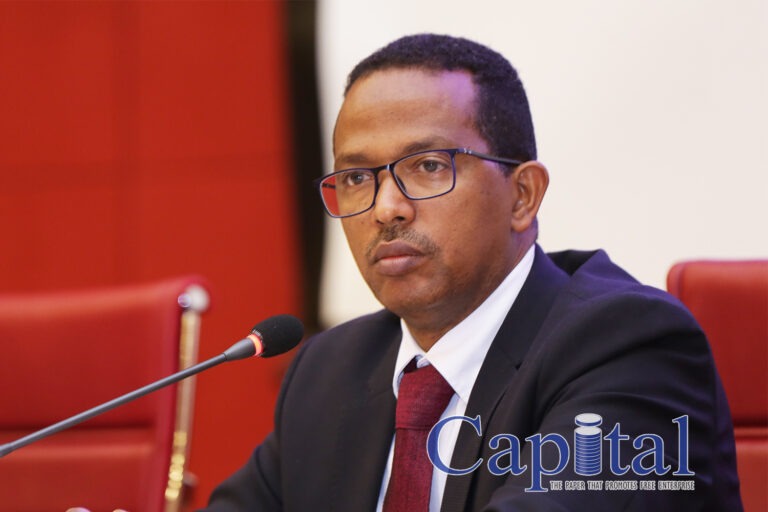
Ministry of Education has ordered Berehan ena Selam Printing Press to start printing the exam papers for the 12th grade examination starting as soon as possible.
Even if at the beginning of the year the ministry was planning to give the entrance exam digitally by tablets as result of delay on importing the equipment, the ministry has changed its plan. On Thursday February 11 2021, Getahun Mekuria, Minister of Education told the press that the ministry has decided to submit the exam on paper due to the inability of the test tablets to enter the country on time.
Accordingly, the 2019/20 National Examination will be held on March 8, 2021, he said. Examination credentials will be issued at the school from March 1 up to 3, the statement said.
Even if the ministry has assumed to give the exam within the coming 25 days as the sources close to the case told Capital, the ministry has ordered Berehan ena Selam Printing Press to get ready to print the exam papers. As the source indicates, the ministry is expecting the printers to finish the printing within the time frame.
Similarly, the government is also planning to distribute the exam and answer shits within seven days from February 28 up to March 6, 2021 to all zones in the country.
As past experiences from the ministry, preparation for the exam takes a longer period which the exam printing by itself takes about three months. However, according to the National Educational Assessment and Examination Agency director, Delamo Otoore, “It is possible to prepare the exam in one month if we use our time properly.” Furthermore, he said that there is nothing the agency is concerned about that could change the exam date since students have to be ready for university. In line with what he said, universities could start receiving fresh students starting from March- April.
It is to be recalled that the Ministry of Education has been preparing to give the 2012 Grade 12 National Examination online by giving each and every student tablets to take the exam digitally in selected schools.
As Delamo said, it would be possible to give the exam through tablets if the time was tabled on March, however because of some delay and parents’ pressure, the government is obliged to go the print route.
According to the Ministry of Education data, there are 450,000 grade 12 students that are expected to take the exam.
Previously, the government was preparing to give the exam from December 7 up to December 10, 2020. At the time students were given 45 days of class and technology guidance and registration was expected to be done online, which normally was done manually before. According to the decision of the ministry every student who has completed grade 11 and attended the first semester of the academic year was eligible to sit for the exam
It has been a turbulent year for the students amidst this pandemic from the onset of schools being closed after Prime Minister Abiy Ahmed ordered the closure all schools across the country On March 16, 2020, and on March 27, 2020. Ethiopia which has around 20 million pupils in Ethiopian schools with about 45,000 schools over the country and nearly a million in the 50 public universities and more than 250 private academic institutions, all of which represent high potential transmission sites faced uncertainty during this time of closure.
Similarly, following the conflict in Tigray region the Education Minister Getahun Mukaraba said more than 12,000 12th graders in the Tigray State will take their exams at higher education institutions in the region if the exams were to be rolled out on time to the students who were also full of uncertainty.
This uncertainty is now leveled across the board as the ministry has affirmed that the examinations will be done. Furthermore, the ministry has assured to coordinate this exam roll out in a timely fashion to transition these students.
