Friday, October 9, 2026
Home Blog Page 3200

NBE’s intermediary directive thrives

0

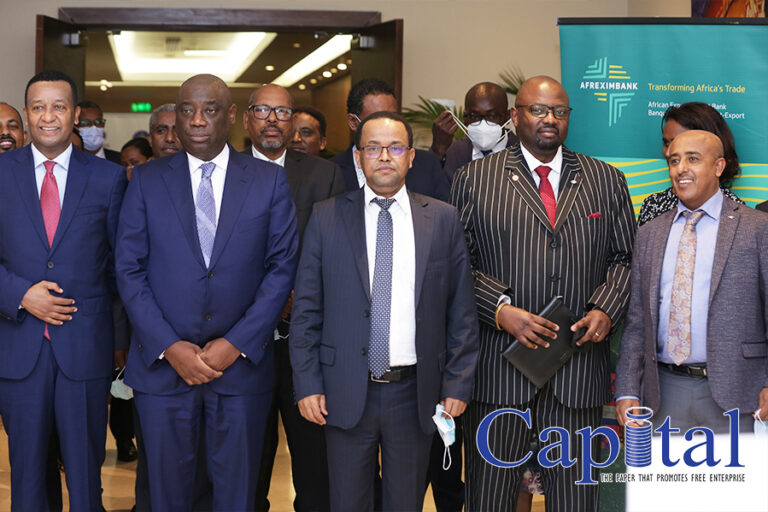
The intermediary directive of National Bank of Ethiopia (NBE) bears fruits for banks. Ethiopia announces that it expects further fund from the supranational financial institution, African Export-Import Bank (Afreximbank), which this week disclosed the allocation of half a billion dollar for all commercial banks through Afreximbank Trade Facilitation (AfTRAF) Programme. In related with the roadshow event that was held for three days starting from Wednesday September 15, Afreximbank announced that it has allocated for all commercial banks including private banks to facilitate USD 500 million to boost their activity on the international trade with their customers.
It is the first time in the history of Afreximbank, which commenced operations in 1993 and based in Cairo, to make funds available for private banks in Ethiopia.
Rene Awambeng, Global Head, Client Relations, Afreximbank, commended the tremendous effort and transformative measures, which are impacting Ethiopia’s financial sector development the macroeconomic stability of the country, the growth and the foreign exchange management, “despite the external shocks and internal challenges, including the emergence of the pandemic catastrophe, the financial services sector in Ethiopia remains quite resilient and its position to grow in the right direction with the slowdown of the pandemic.”
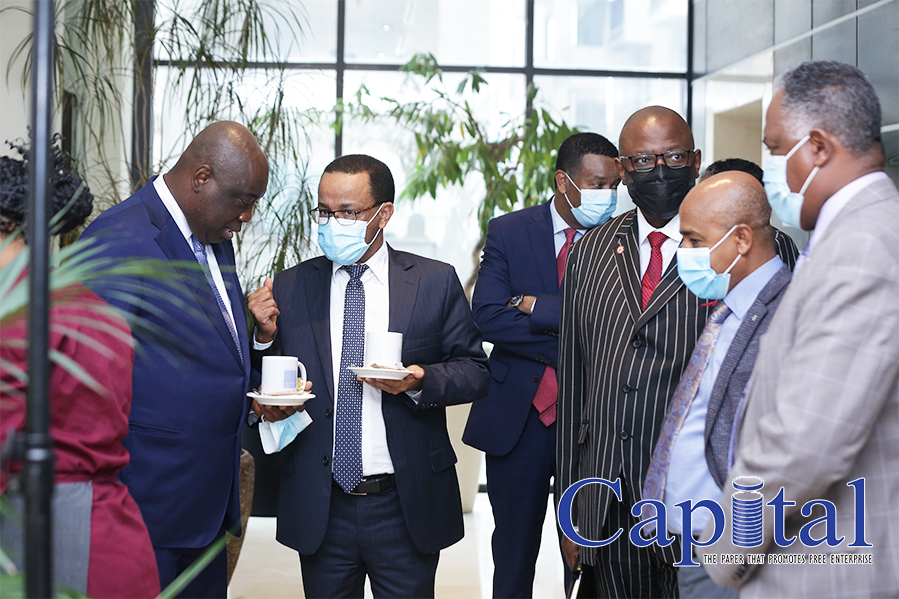
(Photo: Anteneh Aklilu)

In the past couple of years, NBE has introduced massive changes in the financial industry that would pave the way for the country on the process to join World Trade Organization (WTO) and support for doing business in the country beside direct support for commercial banks to engage on massive activities including to access finance from foreign sources as intermediary for their local customers.
Regarding the latest allocation of half a billion dollar, despite him not mentioning the name of the firm he stated that one bank has already enjoyed over 200 million dollars of this facility, “so this new facility comes to improve and increase amounts. The facility approval is expected to be complete by the end of September and in the last quarter, banks should begin enjoying the benefit of this facility that trade finance programs,” he explained.
Ethiopia is one of the founding members and the shareholder of the bank, through NBE, Commercial Bank of Ethiopia (CBE) and Ethiopian Insurance Corporation.
“However, we have not seen a significant comparison in the size of the support of the Afreximbank, to the Ethiopian economy over these last years; and this is one of the reasons, why we want to address the situation by having this road show with the financial sector and looking at intermediation with the financial sector so that we can improve the support of the bank to you as intermediaries and consequently to the small and medium-sized companies to the large corporates, and to the public sector in the Ethiopian economy,” Awambeng says, adding, “We are not here to compete with financial institutions. We are here to complement financial institutions. Our work is not principally driven by profit. Our work is driven by development and impact. We need to show a difference. If a commercial banks in Ethiopia is capable of doing a transaction. There is no need to interfere, we’re not going to come and take customer or displace that client from the Afreximbank.” he added.
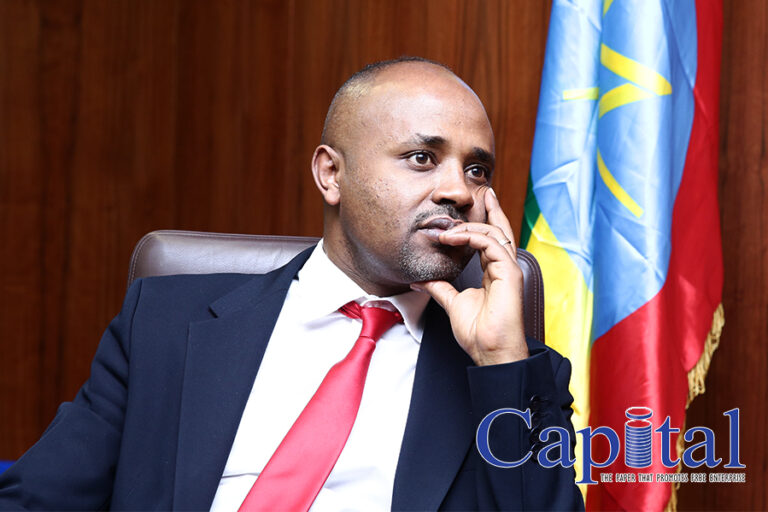
Yinager Dessie, Governor of National Bank of Ethiopia (NBE) told Capital that his government is expecting more similar facilities from the continental trade bank to support Ethiopian business.
He said that the bank has provided some support for Ethiopia but it was not that much “I have told them (the continental trade financer) to improve their facility for Ethiopian financial sector.”
Awambeng recalled that Ethiopia benefited about USD one billion from the bank mainly through the state owned bank.
It was recalled that about a year ago NBE approved a directive ‘Foreign Currency Intermediation by Banks Directives No. SBB/77/2020’ that allow local private banks to play intermediary role to access loan from foreign sources to granting credit to local borrowers in foreign currency. The current instrument facilitated by Afreximbank is part of the latest move NBE, which allows banks to improve LC settlement and payment of banks.
Yinager said that the NBE directive help banks to access such kind of funds from foreign sources that was not impossible before.
The Governor furthermore emphasized that the bank ought to open its office in Ethiopia as other international financial organizations on the aim to accelerate the benefit of the country.
Afreximbank stated that though the Bank’s Ethiopian interventions have traditionally been executed through its relationship with the country’s largest financial institution, CBE with whom it has existing facilities as well as an operating AfTRAF programme Afreximbank aims to develop strong partnerships with all commercial banks in Ethiopia, and is actively pursuing its target of signing up, and providing the AfTRAF Programme to 10 other commercial banks in Ethiopia by the end of 2021.
The Global Head has also introduced different financing instruments that Ethiopian banks shall utilize on their operation with customers.
“We also have project and asset based financing to support your growing industry. Such as the tourism sector, the medical sector the airline sector, the beverage sector, which are booming sectors in the economy,” he explained.
Awambeng said “commercial banks play an important role in facilitating and promoting trade a core ingredient of economic growth. Today’s forum serves to demonstrate the Bank’s commitment to support Ethiopia’s efforts to expand its trade capacity and establish the knowledge, infrastructure and resources by which this will be achieved.”
Under the roadshow representatives from the commercial banks received in-depth training in trade finance from Afreximbank, as part of its ambitious capacity-building exercise in the country.
According to the statement of Afreximbank the forum took place in the context of far-reaching reforms undertaken by the government of Ethiopia to open up its economy for the participation of the private sector.
It added that central to this economic liberalization, it is the work of the National Bank of Ethiopia to reform the country’s banking sector. These changes are expected to strengthen the capacity of Ethiopian institutions, including commercial banks, to accelerate the development of the Ethiopian economy through trade and investments. The reforms are also expected to increase Ethiopian trade with Africa and the rest of the world.
The continents commercial banks actually account for about 60 percent of Afreximbank financing as they are intermediaries to be able to extend support to public, private sector and local financial institutions.
There are currently 51 participating member countries in the African export-import bank group and family, and only Libya, Algeria and Somalia have not ratified the establishment agreement of the bank.
At the end of 2020, the Bank’s total assets and guarantees stood at USD 21.5 billion, and its shareholder funds amounted to USD 3.4 billion. Afreximbank disbursed more than USD 42 billion between 2016 and 2020.
Besides it’s headquarter in Cairo it has offices in Abidjan-Côte D’Ivoire, Abuja- Nigeria, Harare-Zimbabwe, Kampala-Uganda and next week it will open in Yaoundé-Cameroon for central Africa regional office.
He assured that Addis will host a representative office of Afreximbank in the next five years time.
AfTRAF Programme incorporates various products devised to increase intra-extra African trade volumes, diversify the character of this trade, and assure the confidence of trade partners in the settlement of international trade transactions for critical imports into Africa. Specifically, the programme is designed to enable and escalate trade activities and investments through, among other measures: the provision of bank-to-bank Reimbursement Undertaking facilities; issuances of promissory notes and bills of exchange aval facilities; issuances of bonds, guarantees and indemnities (BGI) facilities; and issuances of trade confirmation guarantee facilities.
The bank leaders have also introduced the MANSA, a pan-African customer due diligence repository for financial institutions, corporate entities and SMEs, developed to address the perceived risk of doing business in Africa and with Africans, for bankers to use it, which was launched by the continental bank about ten months ago. It was launched to ease banks’ engagement with global partners.
MANSA is a single source of the primary data required for Customer Due Diligence (CDD) and Know Your Customer (KYC) checks on African entities, including financial institutions, corporates and SMEs, in accordance with best practices.

Spotless posterity

0

The World Cleanup Day has been marked in Addis Ababa at all schools in the capital with with the motto ‘Neat & Tidy Schools for Posterity.’
The event was noted to help motivate students in COVID 19 prevention and work for keeping premises and environments alike clean.
Pictured here; Education Minister, Getahun Mekuria, Urban Development and Construction Minister, Ayisha Mohamed and other officials marking the day with students participating in the cleanup at Yekatit 12 Menen Preparatory School.

Insurers furious over gov’t bond stance

0

The insurance industry express their anger on the decision of the government that forces insurance firms to buy 15 percent bond from Development Bank of Ethiopia (DBE) from their total net profit. They said it seems like a command economy behavior that the government has passed a decision on private property in that manner.
Recently, the government through National Bank of Ethiopia (NBE), a financial industry regulatory body, amended existing rules and directives or introduced new monetary policies and directive to control the inflationary behavior in the market and improve the financial industry.
Similarly, the NBE Board announced that it will continue to closely monitor economic and financial developments and stands ready to utilize all available policy tools at its disposal to ensure price and financial stability consistent with its legal mandate.
Under article 4.1 of ‘investing in Development Bank Bond Directive No.SIB/54/2021/’ NBE order all insurers except the state owned Ethiopian Insurance Corporation, stating that an insurance company shall invest an amount equal to a minimum of 15 percent of its net income in DBE Bond.
Article 4.2 of the directive says an insurance or Ethiopian reinsurance company shall invest the amount stated under article 4.1 within 90 days after the close of its financial year.
The Bond shall have a maturity period of three years and shall pay a bond rate at least two percent points higher than the minimum interest rate paid on saving deposit at the time of issuance. Currently, the minimum deposit rate is seven percent that means that on this rate the DBE Bond interest rate is nine percent.
The directive that becomes effective as of September 1 stated that DBE Bond shall be paid annually.
However, the sector commentators and CEOs of insurance industry did not accept the decision that the government took. Capital learnt that the association, Association of Ethiopian Insurers, would discuss the issue and pass its statement in the near future.
One of the oldest and biggest insurers CEO told Capital that the directive may not have bold and direct effect on insurance firms compared with its outcome on shareholders.
“As per the directive of NBE the amount that would be invested Bond is the property of shareholders who may secure through annual dividend, due to that it is significantly affects our shareholders,” a senior insurance industry export and CEO elaborated.
According to another big insurance CEO, the effect on shareholders like who invest their dividend on other investment activities or for those who are using their annual profit from their share to lead their life would be much higher.
Those who have big share on the insurance company and shall get significant dividend may invest their profit on other investments that is vital for the economy, he says “but the current decision would affect their investment activity directly and by large the economy.”
Similarly those who have small share but use their dividend to lead their day to day life as a pension would fall victim to the NBE directive.
“In general it is a decision that would be seen on the command economy. The government shall not pass a decision on private property but if it happens it is a tendency of socialist mindset,” an expert on the sector said.
An insurance CEO said that the decision has disappointed shareholders, “it would be better that the government shares its view and convinces shareholders on their assembly to surrender the amount of money to invest on the Bond rather than pass such kind of decision.”
“The government may say that the government has this and that project and it needs investment like bonds which investors in the insurance industry shall invest,” the CEO added.
On the other hand, the new decision was also described as a directive that would have pressure on insurance industry expansion.
It is common that at the general assembly the board of directors and the leadership of a given insurance company tabled a proposal of capital expansion from annul profit, experts in the sector explain, “at this point of view the expansion rate shall be reduced or capital expansion payment would take more time since the volume of dividend shall contract because of DBE Bond investment that have a maturity of three years.”
Similarly under ‘investment on DBE Bonds Directive No.SBB/81/2021/ NBE introduces that commercial banks shall annually invest a minimum of 1 percent of their outstanding loan and advance in DBE Bond until the aggregated bond holding equals 10 percent of their outstanding loans and advances.
In its meeting on August 27, 2021, the Board of Directors of the National Bank of Ethiopia decided to modify the reserve requirement, the interest rate on individual banks’ lending facility, the forex surrender requirement, and the forex retention rights.
The statement announced after the meeting stated that outstanding credit to the private sector grew at 40.8% (year on year) in July, and disbursement during the month grew at about 125 percent, compared to the same period of last year.
“Such a rapid growth of credit poses significant risks to price and financial stability, in the context of a rising inflation which reached 26.4 percent (year on year) in July. Consequently, the Board has decided to raise the reserve requirement on birr and foreign currency deposit liabilities held by commercial banks to 10 percent, from the current level of five percent, effective on September 1st, 2021,” it added. Banks are given a transition period of 3 months to meet the 10 percent reserve requirement.
Regarding interest rate on banks’ individual lending facility, it says that while the purpose of the individual banks’ lending facility is to help commercial banks meet unexpected liquidity needs by borrowing from the NBE, some banks are seen repeatedly accessing the facility to finance their aggressive lending, “hence, the Board has decided to increase the interest rate on facility to 16 percent, from its current level of 13 percent to discourage overutilization of the facility for lending purposes.” According to the NBE board statement, the measures are expected to contain banks’ ability to lend aggressively, bring the growth of credits to a healthy level, and help control inflation.

Telecom privatization progresses to bidding stage

0

The telecom privatization which grabbed the attention of significant players under the Expression of Interest (EoI) stage, has moved to the bidding stage process, the Ministry of Finance (MoF) has disclosed.
The Ministry which is responsible to follow the process with Public Enterprises Holding Administration Agency had issued the EoI mid-June that closed after a month. Recently, Eyob Tekalegn, State Minister of MoF told Capital that several EoI had come, while he did not give figures.
This week, MoF has issued a request for proposal (RFP) for the partial privatization of the country’s telecoms provider, Ethio Telecom.
Bidders are required to pay a USD 20,000 to access the RFP document to be part of the bidding process.
The bid announcement stated that Ethiopia’s young population, high gross domestic product growth rate, and increased private sector investment offer valuable growth opportunities, “Further, low Tele density in Ethiopia highlights the huge untapped potential in Ethiopia’s telecommunication sector. The Ethio Telecom’s robust infrastructure coupled with its strong financial performance will offer a significant competitive advantage to any investor.”
It invited interested parties who can add value to the Company by bringing in best practices in terms of operations, infrastructure management, and next-generation technological capabilities.
The RFP is open to all interested parties and not limited to those companies who indicated their interest by submitting an EoI.
It’s to be recalled that the government decided to sale 40 percent of Ethio Telecom shares for interested foreign investors, while it would be single. Eyob said that interested investors shall come as a single buyer to get the stated share on the telecom giant, which would get in competition for the first time since the Safaricom lead consortium would commence operation in the first quarter of next year.
The investment teaser released in association with MoF’s announcement for EoI for Ethio Telecom, the century and quarter telecom monopoly, stated that the enterprise’s total equity and liabilities is over 79.8 billion birr.
The Investment Teaser ‘Project Nigat’ was conducted by Deloitte Consulting Limited, which was hired by MoF to consult on the partial privatization.
“Business valuation that includes the turnover of the company, services and their value and the total generation in the coming years is critical rather than total asset to measure the value of a company,” one of the sector actor closely following the partial privatization process told Capital.
Of the stated amount, the current assets are 38.9 billion birr and the remainder 40.9 billion birr is noncurrent asset.
The enterprise equity that was stated on the investment teaser’s balance sheet was 25.29 billion birr, while the noncurrent liabilities and current liabilities are 27.2 billion birr and 27.3 billion birr respectively.
It explained that from the balance sheet the mobile network equipment is the largest non-current asset class constituting 42 percent of property, plant and equipment as at 31 December 2020.
As per the investment teaser, Ethio Telecom has over 7,400 tower sites (700 plus sites in Addis Ababa); of which 96 percent are greenfield towers and remaining are rooftop towers with the length ranging from 2 metres to 102 metres and an average height of 36 metres, while it has 7,777 real estate properties. It has over 21,000 km of fiber network spread across Ethiopia and about 85 percent is buried.