

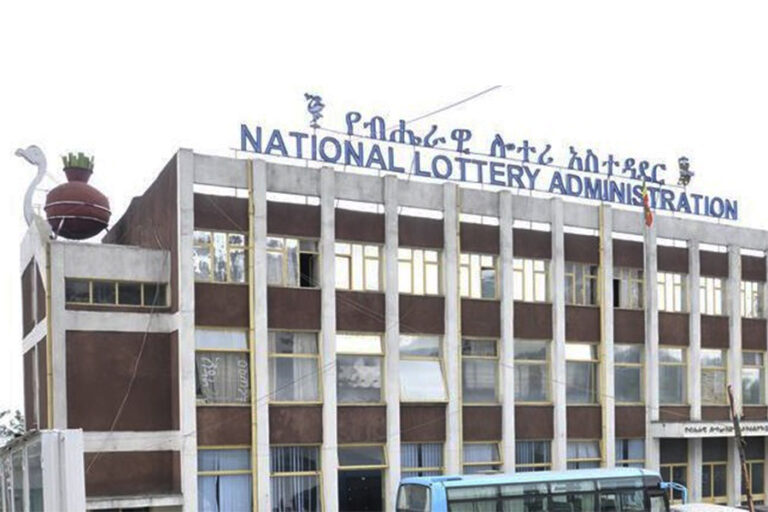
National lottery administration is said to restart giving licenses for betting companies, however, the administration has increased the license fee to 500,000 birr from the existing 400 birr while to renew the license companies are required to pay 100,000 birr which used to be 200 birr to restrain the adverse gambling effects on society. On Tuesday, September 13, 2021 authorities from the administration gave a press conference at Eliana Hotel regarding the remanded directive that governs the betting market.
For the last two years the administration had temporarily stopped issuing new licenses to betting companies, and as the director elaborates, any company which didn’t go as per the directive, the license faced revocation.
“As there has been disappointment over sports betting activities, citing its adverse impacts on the community, the new directive is needed to govern the sector with strict law and strength guide the betting market,” said Geremew Garje, director of the administration.
By strengthening the control on the market as the authority said issuing new license for new entrants in the market is opened with a permit fee which increased significantly from the 400 birr to 500,000 birr
After receiving complaints from different stakeholders and the society, the Administration established a task force and conducted a study in collaboration with the Ethiopian Management Institute, to assess the impacts of betting activities.
The new directive incorporates details on where betting companies should be opened and strengthens regulation on their daily activities. It will also require betting companies to regularly submit reports on their operations. Upon completion, the directive will be sent to the Ministry of Revenues for approval.
According to the new directive, licensed sports regulators will be required to provide 1.5 million birr bank guarantee.
According to Dessie Dejene, Director General of Licensing and Supervision at the National Lottery Administration, the Lottery Licensing Directive has been amended to include more restrictions that were not in the previous directive, as well as to ensure that the betting process is governed by strict rules and regulations.
According to the previous directive, the transfer companies have been operating without any bank guarantee. He said that a guideline has been prepared for them to guarantee.
It was also pointed out that the prize pool for sports betting lottery players has not been uniform and exorbitant fees have been paid in the past, but according to the new directive, the top prize for each ticket should not exceed one million birr.
Under the previous Sports Betting Lottery Directive No. 85/2005, anyone over the age of 18 was allowed to take part in the lottery, but due to public inquiries, only those aged 21 and over could participate in the game under the new rules, the administration said.
Dessie said there was no directive to inform the administration in advance of the sale, but that the companies should now notify the bank of their activities and submit their monthly banking report to the administration on a monthly basis.
The revised directive stipulates that sports betting sites should be located within 500 meters of religious institutions and school areas, and prohibits the establishment of betting establishments in restaurants, grocery stores and chat rooms.
The directive will compel betting companies to carry out charitable works, committing 0.5pc of their sales. According to the previous directive, all betting companies are obliged to disperse 20 percent or more from their net profits to sport institution or clubs; however none of those betting companies have been discharging their corporate social responsibilities.
The establishment proclamation of the Administration, enacted in 2007, gives it the mandate to regulate and license betting companies, while a directive was put in place five years ago with the same purpose. There are currently 42 active betting companies in Ethiopia.
Stringent directive drawn as relicensing resumes in betting industry
Ethio telecom gets a green light to start international remittance

Ethio telecom has received a green light from the National Bank of Ethiopia to start international remittance through its mobile money platform Telebirr which is gaining a large number of customers. The service is expected to start within one month.
As sources from Telecom told Capital, Ethio telecom has already got the permit to start the service from the national bank to which only receiving an official document is left.
As the sources said, Ethio telecom is working to integrate its system with its international partners which the process is under pipeline of testing.
According to the information Capital obtained, Ethio telecom was planning to start the service at the end of the year perhaps certain situations have hindered the telecom service operator.
When it starts giving the service, telebirr will enable customers to receive money from abroad. Both registered and unregistered telebirr users can receive international remittance. Customers can conveniently receive money via their mobile number from those living abroad.
Recently the CEO Firehiwot Tamru said that Ethio Telecom has made its preparations to provide international remittance services through its mobile money transfer service. Currently, there are 9.5 million and growing subscribers of telebirr with 938 million in birr being transacted through telebirr. So far, 26,442 agents have been providing telebirr services across the country with 8 banks being integrated with the platform.
It is to be recalled that, the Telecommunications CEO said that the new service, telebirr, will mark a shift for Ethiopia, where the banking system is seen as inefficient with 19 commercial banks serving a population of about 115 million. To this end, within the coming five years about 50 percent of the total Ethiopian economy or 3.5 trillion birr in transaction is expected to go through tele birr.
The west region receives 4G LTE advanced boost
On similar news, Ethio telecom launched 4G LTE Advanced mobile internet service in the West Region as part of the growth strategy plan to expand 4G LTE Advanced services in areas where there is high mobile data traffic. To this regard, on September 18, 2021, Ethio telecom launched its LTE advanced service in six towns of the west region named Gimbi, Nekem, Dembidolo, Bako, and Shambu.
The expansion made a number of cities beneficiaries with the LTE advanced now accounting to 79.
“High speed features and reliable data service of 4G LTE will enable and empower our customers to digitalized their services, increase productivity and improve their experience,” said Firehiwot Tamru, CEO of Ethio telecom.
Besides its network expansion as part of its corporate social responsibility, the telecommunications giant has donated 600,000 exercise books worth 16.5 million to 666 primary schools over the country.
Civil society network calls on western governments, private foundations to stop funding industrial agriculture in Africa
The Alliance for Food Sovereignty in Africa (AFSA) urged donors to stop funding the western led Alliance for a Green Revolution in Africa (AGRA). The move comes after AGRA failed to provide credible evidence to refute research done by AFSA that challenges the 15-year-old industrial initiative adopted by the former.
As AGRA’s Green Revolution forum opens, members of the Alliance are challenging donors to halt funding solutions that have not presented advantages to the continent, but rather focus on a healthy, sustainable and culturally appropriate food system for Africa.
“We welcome investment in agriculture on our continent,” wrote AFSA General Coordinator Million Belay in a recent co-authored article in Scientific American. “But we seek it in a form that is democratic and responsive to the people at the heart of agriculture” he added.
The alliance urged prominent organizations such as the Bill and Melinda Gates Foundation, the Rockefeller Foundation, the German, Dutch and Canadian governments and other donors to stop financing AGRA’s initiative which is believed to be driving the hunger crisis in Africa.
In a press conference organized by AFSA, general coordinator of AFSA, Million Belay highlighted the vision. “We want to be able to produce healthy and nutritious food… we want the right to food,” he said, emphasizing the integral role the African continent and its people play in the system overall.
There is a growing opposition of western-centric ways of farming in Africa in particular and in the global South in general due to its stressed value of Agro-chemicals as well as artificial fertilizers and pesticides. The promotion of high-end varieties including GMOs and others invite local African farmers to reorient their agriculture to unfamiliar mechanisms that seldom result in ecofriendly results.
Speakers during the conferences also stressed the economic and social impacts such influence could present including potential health and cultural crisis. This is also believed to undermine the rights of farmers and their benefits. Another issue raised was the lack of adequate support for Sub-Saharan African scientists to conduct their research and come up with local solutions for local problems.
An open letter initiated by 35 of AFSA’s member networks along with five allied organizations was presented and garnered 160 international organizations.
Seamless boarders: Ethiopia eyes more OSBP following success with Kenya
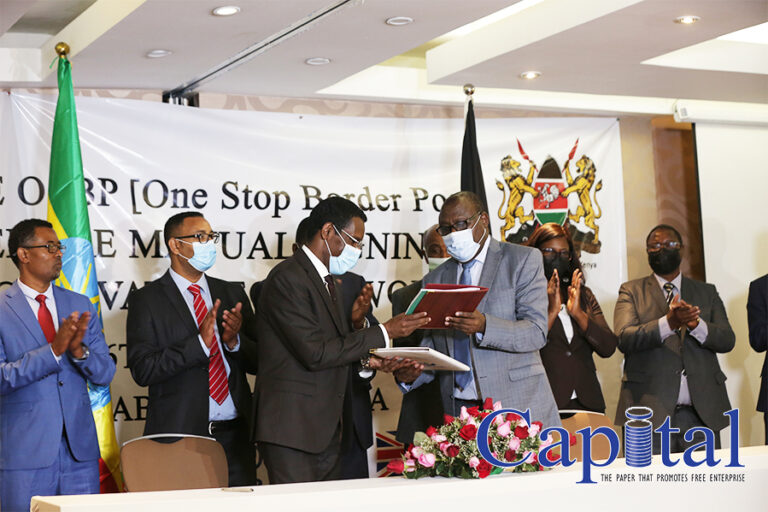
Ethiopia has expressed its keenness to see more One Stop Border Posts (OSBP) with neighboring countries soon, while Ethiopia and Kenya signed operational procedure manual to accelerate the activity of Moyale OSBP.
Debele Kabeta, Commissioner of the Ethiopian Customs Commission, said that Ethiopia has interest to expand OSBP that it established with Kenya this year.
“We are on the process to establish OSBP with Djibouti, which is the major outlet for Ethiopian cargos, on two directions via Galafi and Galafi ,” he said.
According to the Commissioner, the required facilities at Dewale of Ethio-Djibouti border have been done and that the only thing remaining is to make operational the OSBP through the operational procedure manual that Ethiopia signed with Kenya this week for Moyale OSBP.

“Regarding Galafi, the two countries have reached an agreement and Trademark East Africa (TMEA), which provided technical support on the realization of Moyale OSBP from inception, is expected to handle the facilitation of the required process,” Debele added.
Ethiopia has also targeted to establish OSBP with Eritrea through Asab, “so far Ethiopia has prepared required customs precondition to form relation ship with Eritrea and customs protocol and structure have developed and provided for Eritrean Foreign Ministry.”
“Similar relation with Somalia, South Sudan and Sudan is expected to be realized as per the government decision, while under the ten year plan the Customs Commission has set to make similar OSBP platforms shall be realized through the support of TMEA and other nongovernment organizations,” he added.
Ethiopia and Kenya through the Ethiopia Customs Commission and the Border Control and Operation Coordination Committee respectively have signed the operational procedure manual in a ceremony held in Addis Ababa on Wednesday September 15 and attended by key private and public sector players from both countries. This follows the inauguration launch on 9th December 2020 by the heads of both Governments and the subsequent commencement of One Stop Border Post (OSBP) Operations, on 8th June 2021.
Debele reminds that the two countries have historical and strong relation and at the same time the Continental Free Trade Agreement has come through which will improve the relation between neighboring countries in different relations including social and economic areas.
“The manual will make the operation at Moyale more profound which shall also expand the cooperation at the border area. Both countries have huge market and investment potential which is beneficial, due to that cooperation is crucial,” Debele told media after the signing ceremony.
“Meanwhile, we are similar people and have long relation, we have never tapped the benefit that was supposed to be attained, rather illegal activities like contraband and human trafficking were a challenge that is solved under the OSBP,” he added.
The OSBP operations manual will guide government officers of the border regulatory agencies in successful implementation of coordinated border management operations, so as to improve border crossing efficiencies, by making border clearance processes easier, faster and cheaper for traders, transporters and travelers, without compromise to the border regulatory requirements.
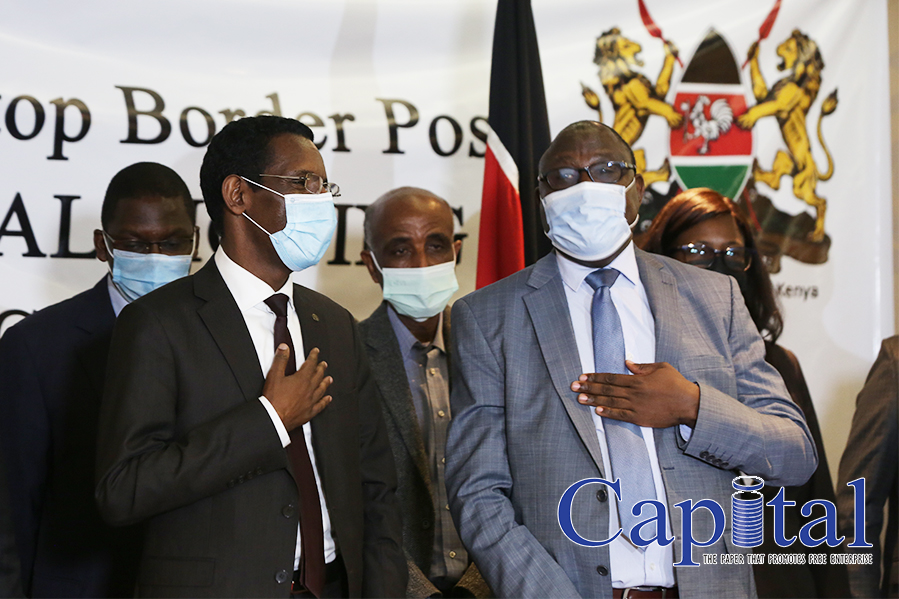
Wilson Njenga, Internal Security Secretary, who led the Kenyan delegation, said the signing of the Moyale OSBP Procedure Manual is a step towards enhanced cross-border trade and movement of persons between the two countries.
He added that the OSBP is highly dependent on the Lamu Port- South Sudan-Ethiopia-Transport (LAPSSET) Corridor Project as it will ensure growth arising from better services and improved infrastructures.
Kenya Revenue Authority (KRA) Commissioner for Customs and Border Control, Lilian Nyawanda, on her part, emphasized the need to simplify trade to ensure goods flow seamlessly and within the confines of the customs laws.
