

Ten years ago, at the height of the ‘Arab Spring’, Libya was bombarded to smithereens by the combined forces of NATO. The UN Security Council gave permission for intervention in Libya, allegedly to save civilians (humanitarian intervention). But that directive was cynically and callously stretched by the power that be (TPTB), resulting in untold destruction of lives and properties. If truth be told, the UNSC resolution was used as a pretext to dismember Libya and murder its strongman, Muammar Gaddafi. Amongst the NATO nations, France and of course the US, stand out as the main protagonists in the obliteration project. Nonetheless, behind the whole so-called humanitarian campaign, it was the imperial policy of regime change that was actually in play!
To be sure, Gaddafi was no saint, but he was neither anti-Africans nor anti-Africa! If anything, it is his attempts to consolidate Africa on a more independent trajectory that brought his demise. Since then, those who professed democracy to the Libyan sheeple (human mass) have been very quiet. In fact, they are nowhere to be seen, except perhaps nearby the Libyan oilfields. The whole notion of bringing democracy to a nation from abroad, besides being extremely condescending, is also rife with a lot of hidden agenda. For instance, France has a lot of stake in the Sahel region. French speaking West Africa uses the French backed common currency (CFA). As a result, all significant credit creation as well as currency printing, for the whole of French speaking West Africa, is done, not overseen, by France from Paris! Moreover, the uranium to power France’s numerous electricity generating nuclear reactors is increasingly coming from Niger. Gold is also mined in Mali, Burkina Faso, Cote d’Ivoire and Guinea, to say nothing about other natural resource of the CFA nations. On the other hand, the US has increased its non-stop military operations on the African continent, under the aegis US Africa Command. The US Africa Command is empire’s preferred weapon of choice to control and secure the whole of Africa’s commodity chain. Propaganda aside, it is still the old ‘resource curse’ that keeps on fueling the various conflicts on our continent!
One can say Libya is now a de facto two states, east and west. The various tribes and groupings are still angling for the control of all of Libya’s oil fields, but no clear winner has emerged so far. What is now threatening in Libya is a protracted instability that might engulf other countries of the Sahel region. Without a cohesive aspiration and attendant road map to guide the Libyan sheeple, the future of the country remains precarious, to say the least. There are lessons many African countries can and should learn from the experiences in Libya and to a lesser extent Egypt. One can observe the following from the Libyan experience; phony democratization (intent as well as enactment) can easily lead to destabilization and fragmentation. Democracy is only a tool used to bring about a desired objective, be it in the sphere of political governance, or otherwise. By and large, democracy is not an end on its own!
There need be shared objectives, not always explicitly stated (mostly assumed, not needing explications) that underlie the whole society on which the desired democracy (as a tool or as a rule) can act upon! For example all citizens, without exception, can vote to commit suicide or homicide; but because this decision is reached by legitimate democratic process doesn’t necessarily mean it is always valid and must be pursued! In all civilized collective existence, it is preferred the shared values/objectives of a society are stated clearly, first and foremost, before we can employ democracy to achieve this or that. If there is no cohesive objective to be achieved, the use of democracy might well end up fuelling utter chaos. Therefore, blind worshipping of the means (democracy as a tool and not as ‘rule of the majority’) can easily lead Africans astray. This is an important lesson we can take from the current situation both in Libya and Egypt!
The other issue is; if the propped up/imported democratization fails, what will most likely follow, particularly if the interest of TPTB is still to preserve the nation-state? The first option is outright dictatorship, camouflaged as a ‘democracy’. In this case the word ‘democracy’ is meant to express the ‘majority rule’. But this gimmick is what has been tried all over without much success. Phony democracy entailing phony elections, phony participations, phony justice, etc., etc. ultimately collapses as its shelf life is very short. Ethiopia needs to study the experiences of MENA, particularly the cases of Egypt and Libya. The two trajectories, we believe, are very instructive. With an impeccable democratization process, a nation without firmly shared values can promptly disintegrate! To reiterate, if there exists no raison d’être for a particular society/nation galvanizing the collective, the mere application of democracy, rather mechanically, will not be very useful. Unless grounded by deeply shared values, say like justice & equity, democracy as a tool can also lead to undesirable outcome. There is a very good example from recent history. Nazi Germany and Hitler were voted to power by democratic means. Does that mean what they did was justifiable? Mere obsession with processes, democratic or otherwise, without other guiding human values can be futile!
LESSONS FROM LIBYA

Coffee gurus receive recognition
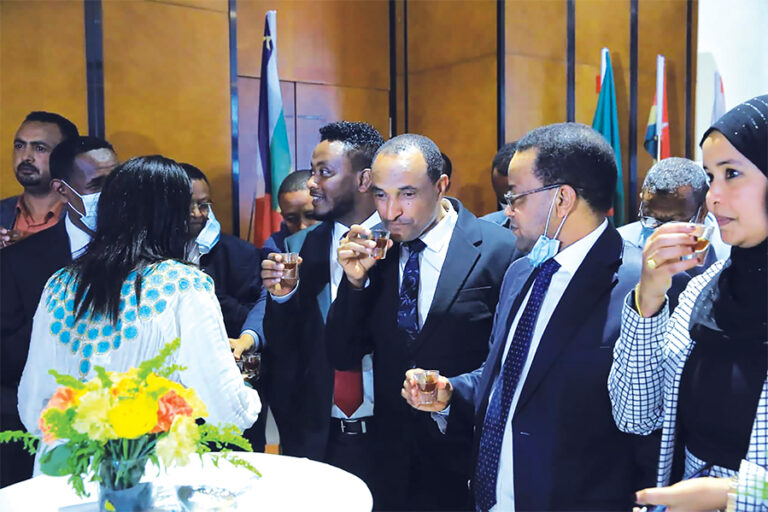
Ethiopia recognizes winners of Cup of Excellence (CoE) Ethiopia 2021. This year’s competition, which is the second, has blazed to register different records in the cupping industry similar to last year.
On the CoE Ethiopia 2021 a record number of 1,849 coffee samples were submitted from all coffee-growing areas of Ethiopia in February 2021. After three rounds of cupping, the 40 coffees with a quality score of 85+ entered the final international jury round, which was held in six different labs in the US, Japan, South Korea, Australia, China, and Norway. 30 coffees scoring 87+ became the Cup of Excellence Ethiopia 2021 winners. Out of the 30, five coffees scored 90+ and received the highest recognition in the competition, known as the Presidential Award.
For the year, Tamiru Tadesse, who competed with Sidama coffee, took the Presidential Award.
On July 7, 2021, 180 registered buyers bid online for 9 hours to buy the 30 coffees. This year’s CoE Ethiopia also set a new record with an average price of USD 32.12 per pound and with total proceeds of USD 1.96 million, which is a record for the Cup of Excellence competition globally.
The winning coffee was sold at an online auction for USD 330/ per kilogram to Saza Coffee of Tokyo, Japan. The winner Tamiru also had a second lot of coffee that took 5th place in the competition and was sold for USD 57 per kilogram to Sarutahiko Coffee Inc., which is also from Tokyo, Japan. This year’s competition also included women winners.
Coffee cupping: far left Tamiru Tadesse, Presidential Award Winner, Adugna Debela, Head of Ethiopian Coffee and Tea Authority, Yinager Dessie, Governor of National Bank of Ethiopia, and Aynalem Nigussie, State Minister of Agriculture
Ethiopia’s WTO accession plan faces delay

Ethiopia’s World Trade Organization (WTO) accession plan will take more time from the original target that was projected to end this year, Capital has learnt.
After the long delay about two years ago, Ethiopia had commenced the negotiation to be a member of the largest global trade association that would create conducive environment to access global market easily and to be more open for others.
To reinstate the process, a national committee with ten members and chaired by Mamo Mihretu, Senior Adviser to the Prime Minister and Chief Trade Negotiator, had been established mid 2019 and the Working Party that was formed in 2003 and chaired by Danish Ambassador Morten Jespersen met early 2020 after an eight-year pause.
Since the government introduced economic reform about three years ago, massive changes have occurred on economic and legal reforms that shall smoothen the way for the process of negotiation and accession of WTO. Of that the adoption and joining of New York Convention and liberalizing the telecom industry for more players shall be stated, besides massive and radical reforms in the economy structure and government policies.
Mamo said that further negotiation is expected to take place in the coming month on the accession process.
“The negotiation process has taken place as per the schedule. The September meeting is part of that,” he told Capital, but the Chief Trade Negotiator hinted that the country may not accomplish the process as per the original schedule.
When the national committee was established in June 2019 by Prime Minister Abiy Ahmed, the government had stated that it will work to join WTO by the end of 2021.
However, Capital learned that key government economic policies that are vital on the negotiation process and that which will enable the country to be one of the late comers of the 26 years old trade organization may not be restructured or changed until the time frame before the end of 2021.
Through the negotiation process that was started in 2007 and paused in 2013, one of the key areas that WTO members, mainly USA and Canada raised as a precondition was that the country to ease the restriction that imposed on the service sectors like the telecom and financial industries, which are only restricted for Ethiopians or monopoly.
However, this time around the government under the economic reform has broken the over a century telecom monopoly and allowed two more operators to invest on the sector and even introduced partial privatization on the telecom giant Ethio Telecom. Similarly, the government has opened the financial sector for Ethiopian origin with foreign citizenship to be involved on the banking and insurance business, which was not allowed in the past.
While WTO members would not be satisfied by this measure rather from the beginning, they have been insisting that foreign financial firms ought to be allowed to be part of the Ethiopian market.
This would be one of the major reasons for the delay of accession from the original plan of 2021.
“To attain the WTO accession as per the original plan we have to take some policy changes that would not be completed in these coming months,” Mamo explained.
He mentioned the reform on the financial sector as one of the policy changes that would be seen on the process of negotiation but may not be seen in tangible decision in the coming few months from the government’s side.
“We may have different type of grace period for the opening up of some sectors like the financial industry but members demand government commitment of policy changes,” national committee chair elaborated.
While he confidently stated that the process would be ended by the coming year. It was not the first time hearing the accession plan facing delay. The global pandemic, COVID 19, was also stated that it would threaten the original plan of accession.
In different occasion the government stated that the reform on the financial sector and opening up foreign actors was seen.
Experts in the global trade association said that opening up of the financial sector may not happen immediately but it would occur gradually over the years time as per the agreement between member states and Ethiopia, but countries may demand the government decision, for instance, it may say the financial aspect will be opened after this year or within this period of time.
The national committee that supports by technical committee with different expertise and sectors is comprised of: Ministry of Foreign Affairs, Revenues, Finance, Trade and Industry, National Bank of Ethiopia, Planning and Development Commission, Attorney General and Policy Study Institute.
It is to be recalled that members expressed unanimous support for the resumption of Ethiopia’s WTO membership negotiations at the 4th meeting of the Working Party on the country’s accession, held on 30 January 2020. It was the first meeting of the working party in nine years. At the time Ethiopian delegation led by Mamo said it was ready to work jointly with members to advance and, hopefully, conclude, the accession process by the end of 2021.
At the time with the meeting of Ethiopian delegation, Ambassador Jespersen said that this meeting convened after years, has been critical at least on two accounts: first, sending a clear message that the accession of Ethiopia is back; and second, Ethiopia’s engagement is decisively different from the past — it is pro-active and offensive, as the WTO accession is integral to Ethiopia’s ambitious economic reform agenda.
The Working Party reviewed the revised Factual Summary of Points Raised, which described developments in Ethiopia’s foreign trade regime.
After the January 2020 session, the next Working Party meeting was expected to take place about a year ago, while the global pandemic paused challenges for global system has forced that did not happen.
The country started work to join the WTO two decades ago, and it has been an observer at WTO since 1997. In 2002 it formally applied for accession and spent the following years, until 2006, producing its Memorandum of Foreign Trade Regime, which was distributed to members in January 2007, when negotiations began.
WTO that was established in 1995, includes 164 countries as member and it has formed agreements in trades and related issues like intellectual property as a pillar.
Finance halts new condo projects
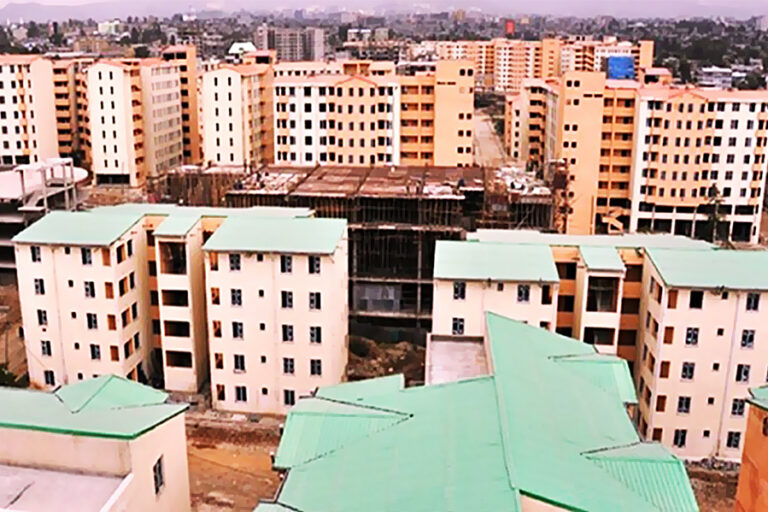
As result of financial problems, Addis Ababa Housing Development and Administration Bureau (AAHDAB) will not have any new projects of condominium housing units both on 20/80 and 40/60 schemes for the year 2014 Ethiopian calendar (2021/22).
The city administration has planned to build 1 million houses in five years until 2018, which is said to be 200,000 houses each year. Accordingly, the bureau has set its plan to start projects of 99,000 condominium housing units in both 20/80 and 40/60 schemes; nevertheless the plan seems to be failing from the start of the year due to lack of finance.
Condos were primarily started off as low-cost, subsidized residential units developed purely for the low-income section of Addis Ababa and as sources tell Capital, the bureau has asked the city administration 89 billion birr budget for the construction of condominium units in the already started budget year, 2021/22. However, the bureau is still waiting for the finance from the administration. Beside the finance set back, the agency has also asked for 512 hectares of plot of land for the projects.
As sources said projects could be started if the bureau gets both the finance and the land, however, as conditions indicates both the finance and space are not available until now thus there will be no new projects to be started this year whereas the whole focus will be completing the already started projects.
Currently, the agency has projects of 139,008 housing units which are under old projects in both 20/80 and 40/60 schemes; from this on March 6, 2019, 51,229 houses were passed to winners. Moreover 28,500 of these have shown good construction progress and 22,000 houses are transferred to residents in special way, and the rest are under construction.
In 2019/20 or 2012 E.C, the bureau had started the project of only 4,287 condominium units, which are on 7.9 percent performance as result of input shortage. According to him based on the plan, the old projects are expected to be completed until the end of the coming December, however some uncertainties including lack of finance and input could make the complication go until the end of the budget year. “We have planned in both ways,” he said.
Since 2005, Ethiopia has been implementing an ambitious government-led low- and middle-income housing program to solve an existing low-cost housing shortage and reduce poverty through housing production. The city administration constructed and transferred 300 thousand houses in the past 16 years.
Perhaps in recent times the city administration has been setting and implementing different alternative strategies to solve the housing problem of the residents including; foreign real estate developers, cooperatives, public private partnership modalities, joint venture, and other new alternatives.
Few months ago the deputy mayor, Adanech Abebe had signed an agreement with South African housing company, Wadi Al Sider Commercial Investment Liability Ltd Company to construct houses to low and middle-income residents of the city. Beside international organizations the housing bureau has also signed an agreement with Gojo Bridge Housing Trading plc to work together on the access to housing in the capital city.
Gojo Bridge Housing has introduced an alternative housing scheme in which dwellers can access a reasonable rate with the support of financial firms and volunteers, who agreed to share their plots for the construction of high rise condos.
On the Gojo’s scheme, dwellers will construct their own house on their direct involvement. Under its model Gojo has planned to construct 100,000 houses in the coming five years. Those who registered at the city administration to construct their houses via cooperatives shall access the plots of land that are available at Gojo sharing scheme.
So far 723 members have registered depositing 253 million birr in different banks planning to have 1050 housing units in the next five years in four sites.
