

Following the companies three years growth strategy plan to expand 4G LTE service in 103 cities with high data usage, Ethio telecom launched LTE Advanced mobile internet service in the central west region on August 26, 2021 on an event held in Ambo Town at Abebech Metaferia hotel.
The advancement reaches out five towns of Ambo, Sebeta, Burayu, Holeta and Woliso where high mobile data traffic has been observed.
“High speed features and reliable data service of 4G LTE will enable and empower our customers to digitalize their services as well as increase productivity and improve their overall experience,” said Frehiwot Tamru, CEO of Ethio telecom.
So far Ethio telecom has expanded its advanced LTE service in Addis Ababa and 12 regions including Southeast region, Northwest region, East East region, South South West region, East region, Central East region, North East region, North East East region, South West region, South region and North North West regions.
From the planned 103 towns at the end of the last budget year, Ethio telecom has expand its advanced network in 67 towns with in five months, including the central west region numbers of town beneficiary with the service to 72.
The company is also finalizing the expansion of 4G LTE service in line with the data growth and demand, in process of launching the service in various regions. Before the end of the year, Ethio Telecom is planning to reach out additional 106 towns with its advanced network.
The CEO highlighted that Ethio telecom has reformulate its three year plan with view to modernize services and enhance customer’s experience.
“By expanding its local and international telecom service packages, Ethio telecom will work to intensively meet its plan by strengthening telecom infrastructure, service quality, flexibility and accessibility,” said the CEO. By engaging in new business streams and shifting revenue source from traditional to value-added services and by offering more than 100 new and revamped local and international products & services, Ethio Telecom targets to generate 70 billion birr in revenue in the 2021/22 budget year.
Ethio telecom has expanded the network in the area cooperating with the Chinese firm ZTE. The operator is working to enable the country to have 5G network service by 2022.
Beside its network expansion, Ethio telecom has also registered up to 8.9 million customers with its newly launched mobile money system, Telebirr. The system which has accounted about 3 and half months and is operating certain new services payments including DSTV Ethiopia, websprix, Addis Ababa City Traffic Management Agency, ZMall and others including contributions for the Ethiopian Renaissance Dam.
Central West region receives 4G LTE advanced boost

NBE drafts vital directive to cripple illegal financial acts

National Bank of Ethiopia (NBE) drafts a directive titled “knowing your customer” (KYC) and “customer due diligences” (CDD) to tighten the activity on illegal financial acts.
The draft directive that was sent to banks to give their comments and known as ‘enhance know your customers, customers due diligences and account transfer transaction limits directive’ on its preamble stated that enhanced KYC and CDD practices are critical to ensure proper identification of customers, appropriate assessments and monitoring of transactions including assessments of related risks and prevention of money laundering, terrorism financing, and other illegal deeds.
It added that enhanced KYC/CDD procedure of banks including introducing of proper risk mitigation mechanism enables banks to better combat illegal and unauthorized transactions being operated through their infrastructure and platform in a manner that promotes shadow banking practice.
According to the draft directive banks shall put in place comprehensive and up to date KYC/ anti money laundry policy and procedure, assign independent and dedicated KYC compliance officer, establish KYC unit with appropriate staff and provide the staff training on KYC/AML procedures, risk and other similar to the area.
Banks shall assign unique customer ID to any of its depositors irrespective of deposit types and deposit holders. It stated that deposit accounts owned by a single person should be put under a single customer ID on the bank’s core banking system.
The system shall have the capability to put transfer or cash withdrawal restrictions on the customer using his ID and shall be able to control transfer or withdrawals amount and regulatory limits as per the restriction given to it.
With the objective of regulatory assessing the adequacy and comprehensiveness of its overall KYC/AML framework; i.e., systems, policies and procedures, and staff in respect of effectively mitigating changing tactics of illegal perpetrators and related emerging risks, a bank shall undertake independent assessment of the same by its compliance officers at least on biannual basis and shall make necessary amendment on the same.
Banks are also expected to be equipped with required technology to in place the directive.
Banks are expected to record and maintain comprehensive customer profile information containing all info. Under the draft directive final approval to open any deposit account shall be done at head office by the KYC unit established at a center. It stated that any account that has not been approved by KYC unit at head office shall not be in use and be considered as active account.
“A bank shall undertake bank to bank account transfer request of its customers through real time gross settlement system (RTGS). Any failure of the bank in doing so will be subject to penalty,” it said.
It also prohibited a bank to not allow cash deposit transaction to a third party account including telegraphic transfers that are done by walk in/ or no account holder customers using the bank’s system in any manner.
Multiple account to account transfers limited to five per week and the restriction shall apply on all types of deposit accounts irrespective of the channels used to access the accounts i.e., mobile, internet, ATM, POS, and electronic accounts operated through mobile money service.
On the aim to counter illegal act the directive has also imposed banks to conduct regular due diligence on the overall operation of its partner international money transfer service provider.
The sustainable water alliance, EBAW officially formed

The Ethiopian Beverage Alliance for Water (EBAW), an alliance for environmental friendly beverage industry, has officially been formed with the presence of top government officials and bottlers.
The alliance that includes all beverage bottlers starting from juice processors, soft drink, distilleries and water bottlers is a pioneer initiative to come together for collective solution and action in the face of industrial water challenges.
The statement of EBAW indicated that the overall impact of EBAW is to bring a meaningful positive change in water saving for beverage producers, community and the environment.
Seleshi Bekele, Minister of Water, Irrigation and Energy, on his speech reminded that Ethiopia has a dozen of river basins most of which have perennial rivers in their wombs with a varying level of amenability to use, “the country has limited underground water resources. These facts being irrefutable, utilization of both surface and underground water resources calls for adequate and holistic management of the scarce resource to the benefit of the nation,” the minister explained.
“The establishment of a national alliance to coordinate efforts towards fostering water efficiency in the bottled water and beverage sector will be one but a significant achievement to set an example for others to follow,” Seleshi said.
The alliance targets to create an action road map for the beverage industry to tackle water security issues over a specific period of time and move closer to international water efficiency and quality standards, drive efficiency in water use and large-scale demand side water management using own resources and knowledge.
The alliance is keen on identifying key regulatory and policy hurdles that are blocking the promotion of efficiency in water use in the sector in order to intelligently pitch them with the government in charge. Moreover, it will work collaboratively with the supply chain partners in order to improve overall efficiency of the use of water along with the entire value chain at upstream and downstream. Similarly, it will develop specific projects with governments and civil societies with a strong recourse to public private partnership models and other innovative financing for which alliance members could be interested in the engagements.
Currently, over 150 beverage companies are engaged on the manufacturing sectors. When it comes to the water issues, Ethiopia’s beverage industry is generally known to lack adequate awareness, suffer from poor collective action and is often beset with a weak regulatory framework.
P4G, Water Aid, and 2030 Water Resources Group have provided technical and financial support to realize the formation of EBAW. Ethiopian Bottled Water, Soft drink, Fruits and Vegetable Processing Industries Association and other local bottlers have taken the initiative and through this alliance are an the look to overcome previous drawbacks to future successes.
Housing under association receives boost by plot offering
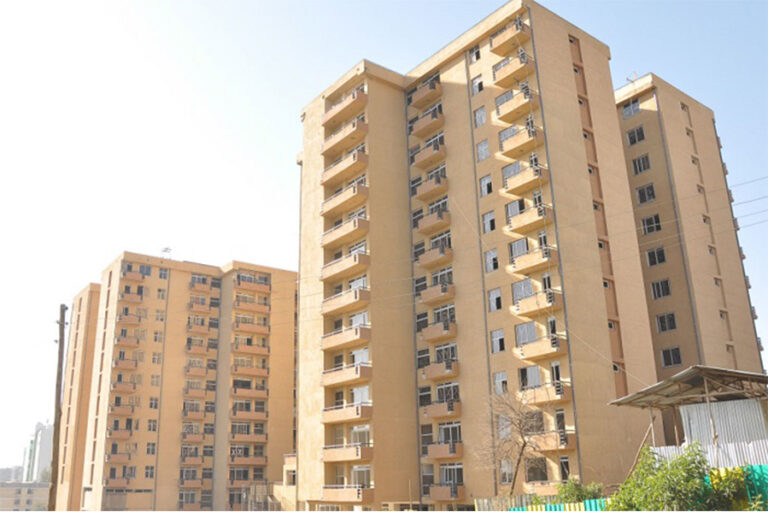
Addis Ababa Housing Development & Administration Bureau (AAHDAB) has received 52 hectare plot of land from the city administration to develop houses under associations. Compensation, replacement and budget have been noted to delay the office from starting the project.
On March 2021, the Bureau had introduced the housing scheme for people who are willing to work in partnership with other home seekers who had registered for 40/60 and 20/80 condominium schemes in 2005 E.C / 2013 G.C.
However according to Kiya Berecha, a senior Civil Engineer at AAHDAB, even if the bureau had received the lease from the city administration it is becoming difficult to start the project as certain issues are hindering the agency.
“Compensation, replacement, lack of finance and also in some areas there are people who are not volunteering to depart,” explains Kiya.
“On the project which is on its precondition will enable residents who have been saving money under the 40/60 and 20/80 condominium schemes but still have not received their homes who are willing to save 70 percent of the price of the housing units and form associations, and to this regard, so far 12,652 people have registered,” Kiya elaborated, adding that the plan is to build 20,400 houses under the scheme to which additional 8000 residents are expected to be registered.
“The bureau is working with the city administration and different stakeholders are trying to solve the problems and to secure the land. Regarding the compensation, the city administration has passed a decision to release budget which we are waiting for the payment,” Kiya explained whilst addressing the progress.
“Currently, the construction designing agency, which is under the housing bureau is engaged in the designing work, and when the designing is complete, the relevant associations will start saving in time. Overall, we are planning to start the project implementation before the completion of the newly started budget year,” Kiya further explained. However, it is clear that the Housing Development and Administration Bureau highly needs the support of the city administration.
Applicants are not allowed to form associations by themselves. Hence, it will be the Bureau which will form the associations among registered applicants. As Kiya revealed, the bureau has completed the software preparation to form the association, and perhaps forming associations will start as soon as the designing is completed.
“After we form the association, the next step will be allocating the land, infrastructure and other supports to housing associations that will build the condominium houses, in five sub-cities. A single block will be overseen by one association,” Kiya explained on the over structure.
Each unit built by the associations is expected to have similar quality based on a standard that will be set by the housing bureau. For instance, a single bedroom is expected to have a width of 60 square meters, 75 square meters for two bedrooms and 105 square meters for three bedrooms. A single housing unit, depending on its size and number of bedrooms, costs between 880,000 Birr and 1.6 million Birr. Members of the housing association cannot sell or reward the house to a third party unless the building is completed.
The City Council of Addis Ababa had passed a decision aimed at enabling registered residents awaiting for condo lots to build houses under associations. The decision came after the city administration had considered housing a problem prevailing the capital. The new initiative aims to address housing demands by registering home buyers and organizing them into associations, which will be provided with land and other infrastructures to construct 20,400 condominium housing units.
Despite registering almost a million residents of Addis Ababa during the launch of the program seven years ago, less than 20 percent were able to get houses through a lottery system. More than a 100,000 have also withdrawn the money they saved out of frustration.
