

The Global Partnership for Ethiopia (GPE) appointed Anwar Soussa as the Managing Director (MD) of the Operating Company in Ethiopia, effective 1st July 2021. He will report to the Board of the Ethiopia entity and Safaricom PLC CEO.
Anwar is currently the Managing Director of Vodacom DRC and the Chairperson of Vodacash (M-PESA) a position he has held since 2017.
He has cemented Vodacom DRC as the largest Vodacom operation outside of South Africa by driving major strides in operational performance, crossing the $500M USD in service revenue mark for the first time in 2020.
He will formulate strategies and plans to ensure delivery of quality and affordable mobile and internet connectivity enabling millions more Ethiopians to access quality telecom services.
Anwar is a Greek national who holds a bachelor’s degree in Business Administration from the American College of Greece (Deree) and a master’s degree in Marketing from Concordia University in Montreal, Canada.
GPE appoints new MD
Precise Consult publishes various studies on agriculture, health and financial sector in Ethiopia
Precise Consult, an Ethiopian management consulting firm is announced that it has completed and published various studies on Ethiopian Agriculture, Health and Finance sectors. The studies have covered key policy and regulatory barriers impeding sectoral transformations and private sector participation, lessons from other countries, and policy or regulatory recommendations.
The specific study areas are Agricultural Financing, Quality Control Systems and Regulatory Gaps in Ethiopian Agricultural Export Commodities, Access to Credit for MSEs and Credit Information System, Digitization of Government to People and People to Government Payment System & Interoperability, Medical Office Practices, as well as Digital Health.
For busy readers, policy briefs are extracted from the studies succinctly summarizing the key findings and policy recommendations primarily targeting policy makers at government, andadvocators in business associations and other civic societies. Position papers are also prepared defending our position in the study areas.
COVID 19 and New Economic Trend

One of the very few good things about the COVID 19 pandemic is when it happened. Just imagine it had it struck two decades ago, when the Internet was still at an early stage. Staying at home would have felt a lot lonelier. People are relying on the Internet to help them cope with the pandemic, but of course it is only part of the story. Shifts in work patterns, convenience factors, traffic and congestion management as well as future episodes of enforced confinement will further accelerate the existing trend toward cyberspace.
Almost everyone in America and Europe are now shops online, banks by using banking apps and pays bills electronically. Even those of us who resisted the Internet before have succumbed to it during the pandemic. Currently, Ethiopia also reportedly technologically well equipped to launch electronic transaction. This was indicated on 6 May 2020 when the Minister of Innovation and Technology, Dr. Abraham Belaya discussed the electronic transaction draft bill with human resource and technology standing committee of the House of Peoples Representatives (HPR).
With the same token, distance learning has finally taken hold. Distance learning has also become a necessity for many millions of school kids and college students around the world. Now that its potential is more obvious, it will be more accepted in the future. Here again, several schools are struggling to get their pupil engaged electronically. Alexei Bayer, a Senior Economist based in New York stressed that demand-side pressure will inevitably lead to significant supply-side improvements. No change is behaviorally more significant than teachers now thinking in a dual mode, about the physical and the digital classrooms.
Alexei Bayer noted that people who only worked at the office before the pandemic are likely to spend at least some time telecommuting after it is over. And the shift to teleconferences will be permanent, largely replacing business travel. Watching movies, theater productions and concert performances from the comfort of one’s own home is definitely on the upswing. The prospect of sitting in a confined, crowded space for a couple of hours suddenly seems so yesterday. This will have implications not just for airlines, but also for hotels, expense account restaurants, concert halls and theaters alike. The real question here is, after COVID 19, will they ever be back?
Ashutosh Sheshabalaya, CEO of SolvX, a global security services and research firm stated that all of which leads us to a new source of significant worry: Computers are also very susceptible to infections by viruses. That computer viruses infect computers and can spread around the Internet has long been known. The potential for mischief, or just mishaps, is increasing significantly in the age of the coronavirus.
According to Ashutosh Sheshabalaya, the parallels are astonishing. Like the novel virus SARS-COV-2, which invades living cells forcing them to produce copies of the virus, malignant computer programs force infected computers to do their bidding. And while we may have found protection against “old” computer viruses, the race for new, even more destructive computer viruses is always on. There have been several viruses attacking computers around the world that have been quite scary. So far, cyber security firms, which often hire those who used to create viruses themselves, have been able to deal with those viruses fairly successfully.
But viruses are becoming more sophisticated, aided by artificial intelligence and machine learning. There is a clear and always present danger that an equivalent of the current coronavirus will paralyze our computer networks and systems and force us to shelter in smaller networks – or even to leave the Internet entirely. Cybercrime has been rampant. Much of it, whether to steal people’s identity, to empty bank accounts or to lock up systems and demand ransom, operates as a for-profit business.
Holger Schmieding, Chief Economist at Berenberg Bank in London predict that an estimate puts damage from cybercrime at 6 trillion dollar by next year, up a staggering ten times from 600 billion dollar in 2017. No wonder that cybercrime has already been called a pandemic and one of the greatest challenges facing the world. Industrial spying is also a big business. Even though companies try hard to shield themselves from it, effective protection is hard to come by. The human slippage factor is very large.
Governments are trying to combat all those malicious activities but with very limited success, especially since they themselves are likely to engage in hacking, spying and cyber warfare, which involves designing and spreading malware. The United States and Israeli governments have been engaged in sabotaging Iran for years, using all kinds of sophisticated cyber weaponry. According to Holger Schmieding, some of the worst malware was allegedly designed by those countries’ secret services. Worse, national cyber warriors are believed to have deadly weapons at their disposal, ones that can disable the adversary’s power grids or damage nuclear plants. On the other hand, when it comes to identifying cyber criminals, even technologically advanced governments seem impotent, or at least they are losing the war.
To conclude, as with the coronavirus, the more crowded we become on the Internet, and the more interactions with strangers we become party to, the greater the danger of a serious infection. Potentially, this threat rises to the point when doubt could be cast on the very future of the Internet.
Ethiopians unite over GERD
By Maya Demissie
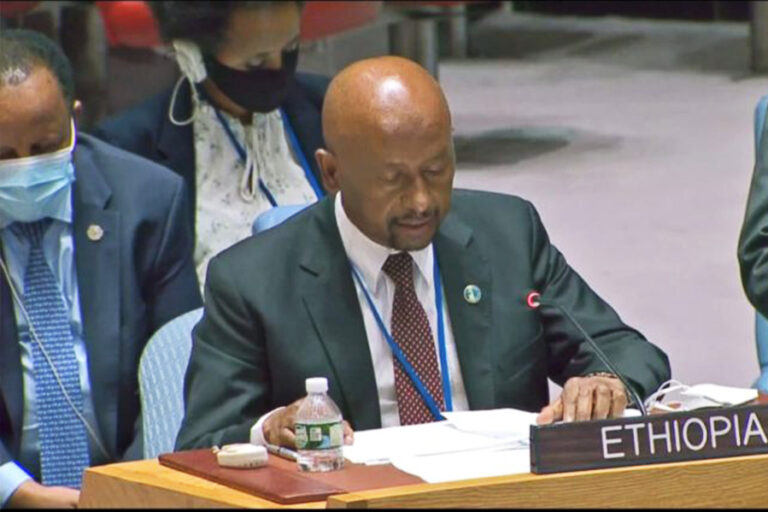
Ethiopians show their solidarity as the UN Security Council convene for an in-person briefing on an ongoing disagreement involving Egypt, Ethiopia and Sudan regarding the Grand Ethiopian Renaissance Dam. The Ethiopians unity comes in the wake of the second filling of the GERD earlier this week despite the crisis in Tigray.
An agreement on the dam can be reached, and must be reached, the United Nations emphasizes while underlining the UN’s readiness to support the countries and the African Union, in reaching an agreement that is beneficial to all sides.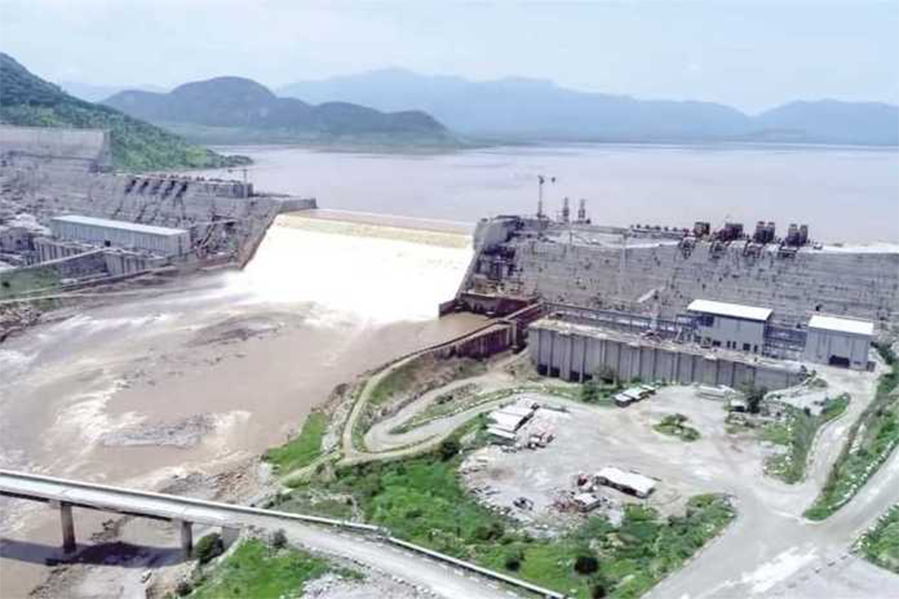
Meanwhile, tensions over the Great Ethiopian Renaissance Dam (GERD) intensify after United Nations Security Council (UNSC) meeting on Thursday, July 8.
The GERD is projected to be the largest dam in Africa when completed. Egypt and Sudan say the dam would restrict their water access and endanger their citizens, while Ethiopia argues the dam could lift millions of its own citizens out of poverty and food insecurity without affecting the downstream countries.
The ten-year conflict has endured multiple attempts at negotiations and international pressure from the United States, Saudi Arabia, and the African Union (AU), among many others.
Egypt and Sudan announced Tuesday they received notice from Ethiopia that it begun the second phase of filling the GERD reservoir.
The Egyptian Irrigation Ministry emphasized its “firm rejection of this unilateral measure,” and labeled the move “a violation of international laws and norms,” in a statement released Monday, July 5. Sudan’s Foreign Ministry described the action as a “risk and imminent threat.”
Ethiopia insists that adding water to the reservoir during the rainy season, with high risks of flooding, is a natural part of the construction process and impossible to postpone. Egyptian Irrigation Ministry spokesman Mohamed Ghanim told a local news station that the volume of water in the reservoir would depend on the rainfall in Ethiopia, and that effects on the Nile won’t be visible for at least a month.
The matter was discussed at the UNSC meeting, requested by Tunisia on Egypt and Sudan’s behalf. However, the council announced that it can only “encourage all sides to get back to negotiations,” according to France’s ambassador to the UN.
At the meeting, the UNSC members supported AU negotiation efforts and urged all parties to continue talks. Ethiopia has previously rejected international involvement in favor of AU-led mediations, and Ethiopia’s Minister of Water described UNSC involvement as “regrettable,” urging Egypt and Sudan to continue talks without outside influence.
Tunisia submitted a draft resolution urging Ethiopia to stop filling the reservoir, endorsed by Egypt and Sudan’s Foreign Ministers. The text calls on the nations involved to finalize an agreement in six months.
Egypt and Sudan have been urging Ethiopia to sign a binding deal regarding the filling and operations of the dam. Previously, Ethiopia had stated it will continue the second stage of filling with or without a deal.
Original agreements on the division of Nile control were formed on the basis of colonial-era treaties brokered by Britain. The agreement gave the equivalent of 66 percent of the river to Egypt, 22 percent to Sudan, and 0 percent to Ethiopia. 12 percent is lost to evaporation whilst Ethiopia was not consulted.
Many Ethiopians see the continent-wide record set by the GERD as a symbol of national pride.
With conflicts in Tigray, GERD is noted to act as a ‘unifying factor’ for Ethiopians in a time of crisis.
