Tuesday, October 6, 2026
Home Blog Page 3268

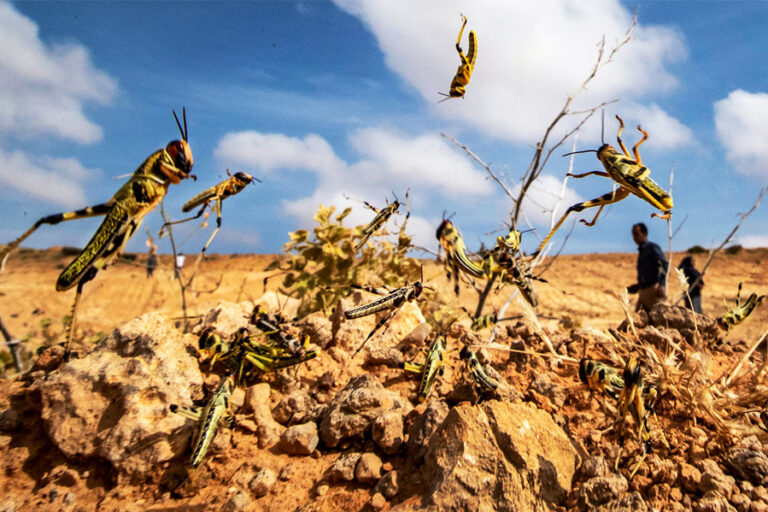
Desert locusts swarm North Eastern Ethiopia

0

By Maya Demissie

Swarms of desert locusts have arrived in North East Ethiopia, according to a report by the Food and Agriculture Organization (FAO) on Thursday, July 8, 2021.
Immature swarms of desert locusts have migrated from Somalia to areas in southern Djibouti and Eastern Ethiopia. More infestations are expected to appear in Afar along the eastern ridge of the Amhara highlands, and additional swarms have been spotted in the area near Ayasha. Some swarms may also arrive from Yemen.
The locusts have been labeled a serious threat. The FAO recommends that field operations be scaled up in northeast Ethiopia and other affected regions. “Intensive aerial control operations” will continue against these swarms in Somalia.
While migration has been limited, more swarms are expected to arrive this month to breed. Breeding levels will depend on the scale of migration, as well as the rainfall in the following months, which is projected to be higher than usual.
So far, infestations have been contained to the Horn of Africa. Iran, Pakistan, and India will be under watch during the summer.

Ethiopia’s coffee auction reaps big

0

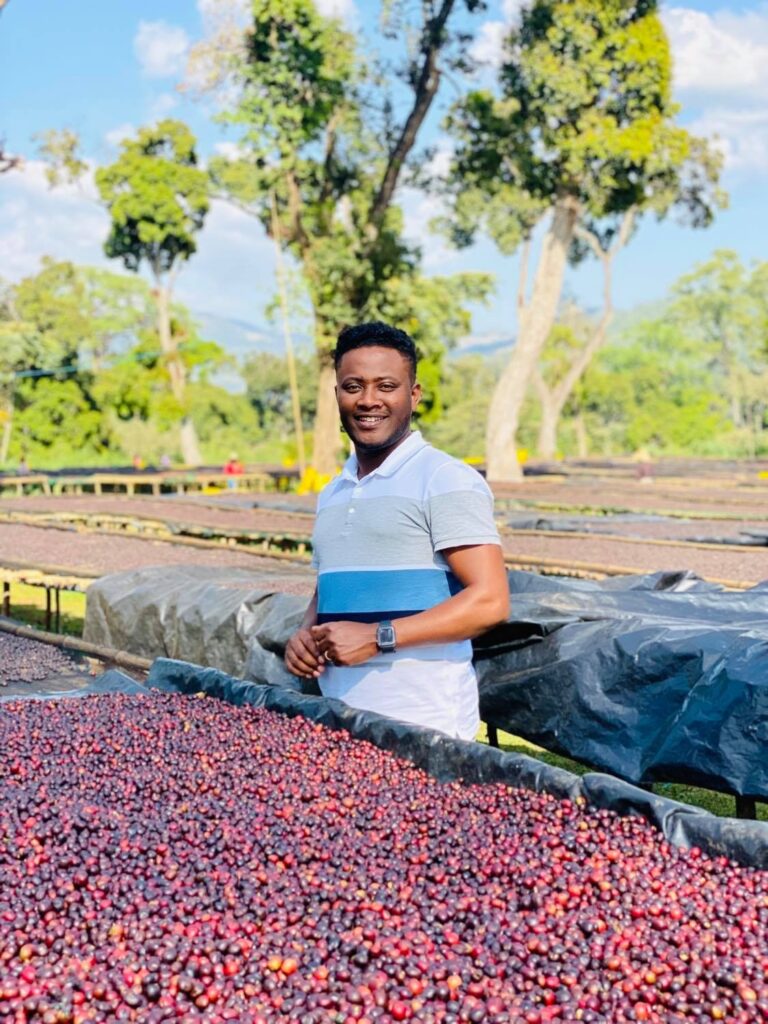
The second Cup of Excellence (CoE) 2021 of Ethiopian coffee online auction registers another new world records at the event held on Wednesday July 7.
The highly anticipated auction that gathered 188 buyers from 33 countries saw bids for over 4,000 times for more than nine hours to secure the sought-after winning coffees.
At the first CoE auction, 168 bidders from 33 countries had fought for over 5 hours to get Ethiopia’s extraordinary coffee test.
Kidist Mulugeta, CoE Coordinator and Capacity Building Manager, Feed the Future Value Chain Activity, told Capital the country’s quality coffee is now getting more attention from global buyers, “for instance we had only sent samples for 170 buyers but additional 18 buyers have been involved on the auction without testing the lots, which shows the buyers confidence on Ethiopian coffee, which is very high of course.”
Similar to last year, this year’s auction has registered other records on the global CoE auction. One of the records was that the average price offered on the auction was USD 32.12/ pound up from USD 28 that was registered on the first Ethiopian coffee auction in 2020.
On the latest auction, USD150.00/ pound was the highest bid paid that was USD 185 for last year’s event. Kidist explained that the price reduced compared with last year’s due to the higher volume being presented this year that is 18 bags in comparison to only 9 presented last year.
The buyer who paid for the highest offer came from Japan similar to last year.
According to Kidist, one of the biggest achievement for this year auction is all 30 coffee have got over USD 15/pound, “last year there was some coffees had got very high amount the rest was low, while for this year all to coffees have amassed significant value.”
The 2020 Ethiopia CoE auction broke records, with total sales of USD 1.5 topping the previous record of USD 830,245 from El Salvador in 2011. The El Salvador auction had 42 lots for sale, while the CoE Ethiopia auction included only 28.
For this year, the total proceeds value breaks another record for the second consecutive year and topped USD 1.8 million.
Bidders from countries from Asia like Japan, China, South Korea, US and Europe were involved on the auction. “This year’s unique incident is the tough competition presented by Saudi Arabia, who enabled to buy significant volumes on the session,” the coordinator explained.
Kidist, who admired the competition and the high interest of global buyers on Ethiopian coffee, said that is an indicator of how the country should fetch significant revenue if it enables to massively make available quality coffee and promote it.
The winning lots that participated on the auction are the top 30 coffees that scored above an 87 percentage by the Cup of Excellence Global Coffee Centers. Coffee by Tamiru Tadesse of Sidama was the top scoring at 90.6 percent.

Main points under the remarks made by Seleshi Bekele, Minister of Water, Irrigation and Energy of Ethiopia, at the United Nations Security Council open briefing on the issue of Grand Ethiopian Renaissance Dam (GERD)

0

Thanks Republic of South Africa (AUChair2020) and the Democratic Republic of Congo (AUChair2021) for their effective facilitation of the African Union led talks to resolve the outstanding issues and reach a mutually acceptable outcome under the auspices of the AU.
We’re dealing with a hydroelectric dam project, which is not the first of its kind in the world. We are building a reservoir to store water that will generate electricity by hitting turbines. For context, GERD reservoir is two and half times smaller than that of the Aswan Dam.
What distinguishes GERD from other projects is the extent of hope and aspiration it generated for 65 million Ethiopians that have no access to electricity. It’s also unique because the construction of the Dam is financed by the blood, tears, and sweat of ordinary Ethiopians.
The GERD is a people’s project and a humble attempt to realize our development needs. It’s the fingerprints of Ethiopia’s farmers, pastoralists, daily laborers, students, business owners, and the diaspora around the world who eke out a living in extremely difficult circumstances.
Ethiopians have best wishes and neighborly care for their compatriots in Egypt and Sudan. We have all the intention to live together in peace and cooperate for our mutual benefit. The GERD demonstrates this core principle of collective wellbeing and prosperity.
We’re here because Egypt and Sudan have expressed their opposition to the GERD. Our two neighbors have large and small dams and canals they have constructed, with absolute disregard to the right of other riparian countries and rejecting Ethiopia’s request for consultation.
Unlike Egypt and Sudan, Ethiopia has no considerable ground-water reserve. We also don’t have seawater to desalinate. Nearly 70 percent of my country’s water is in the Nile Basin. Even if we want to, even if we try, we cannot avoid utilizing the Nile River.
Ethiopia believes that an agreement is within reach, given the necessary political will and the commitment to negotiate in good faith. Understanding already reached on a number of the issues. The African Union is seized of the matter and is ably facilitating our negotiation.
The Security Council is faced with the question to determine whether or not Ethiopians have the right to utilize the Nile. On behalf of all Ethiopians, I implore our friends in this Council to answer this question: ‘Do Ethiopians have the right to drink from the Nile?
Despite the undue pressure, Ethiopia will continue to exercise maximum restraint and showcase cooperation because we are forever linked by this majestic river. Whether we like it or not, we’ll continue to drink from the same river and must learn to live together as neighbors.
Ethiopia’s longstanding commitment to the AU-led process is underpinned by a belief that Africans have the wisdom, the technical expertise, and more importantly, the agency to address their challenges. The phased-approach proposed by AU Chair could help us break the quagmire.
The filling process is pure physics. Once the dam concrete reaches a certain height, the water either flows through the bottom outlets or overflows the concrete. This year the Dam will store water until it reaches the 13.5 billion cubic meters as indicated in the filling schedule.
The Nile belongs to all the half billion people in the 11 riparian countries. The water is enough for all of us. Ethiopia generates 77 billion meter cube of water per year. It is only fair that we impound a small fraction of the annual inflow for its hydroelectric Dam.
We urge our Egyptian and Sudanese neighbors to understand that a resolution to the Nile issue won’t come from the Security Council; it can only come from good faith negotiations under the auspices of the AU with due care for the wellbeing and development of each other.

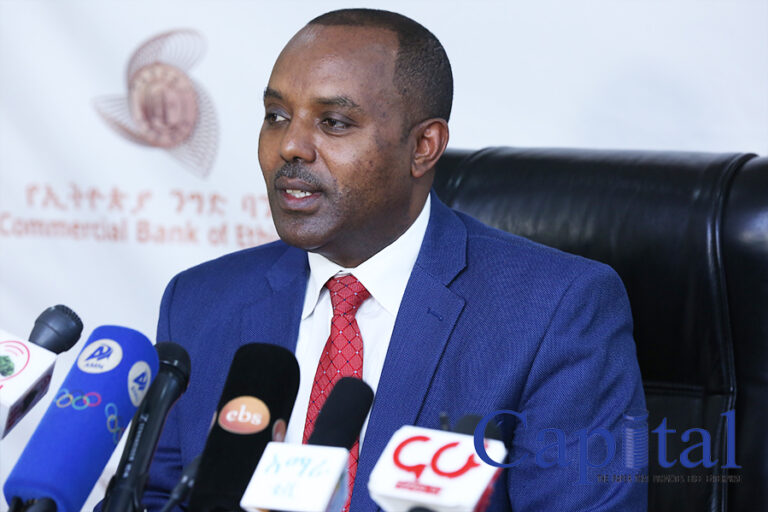
CBE marks historical profit recordings

Commercial bank of Ethiopia has earned more than 20.3 billion birr in net profit during the just concluded fiscal year of 2020/21, marking new records for the bank’s history. The bank has also collected over 140 billion birr in deposits, bringing the total deposit to 735 billion birr.
In the completed fiscal year, the bank has provided 107 billion birr in loans and bonds to various investment projects and businesses. On similar reporting, 60 billion birr has been recovered from various loans.
The bank has generated more than 2.86 billion dollar from various sources during the budget year in an effort to boost the country’s foreign exchange earnings.
According to Abe Sano, president of the bank, the total assets of commercial bank has reached 20.99 billion birr. He said that the Commercial Bank of Ethiopia (CBE) has performed better in all budgets during the just ended budget year.
“CBE has made great strides in delivering quality and technologically supported services to its customers,” said the president. According to the statement, the number of branches has reached 1700 with 31.4 million customers being severed across the country.
The number of ATM card users has reached more than 6.7 million, and similarly more than 3,091 ATM machines and more than 4,350 post terminals have been set up across the country.
Abe added that efforts to provide customers with banking services without having to go to branches have now become very effective.
The Commercial Bank of Ethiopia (CBE) is contributing to the world’s efforts to modernize the country’s payment system, he said. The Bank’s digital banking growth has grown significantly, with over 529 billion birr being transferred through digital banking during the fiscal year.
Deposit growing significantly, customer account, digital transaction growth, significant strengthened liquidity, review in structure and maintained profitability are listed as successes while loan collection, FCY generation and COVID-19 were listed as challenges that the bank had faced during the fiscal year.