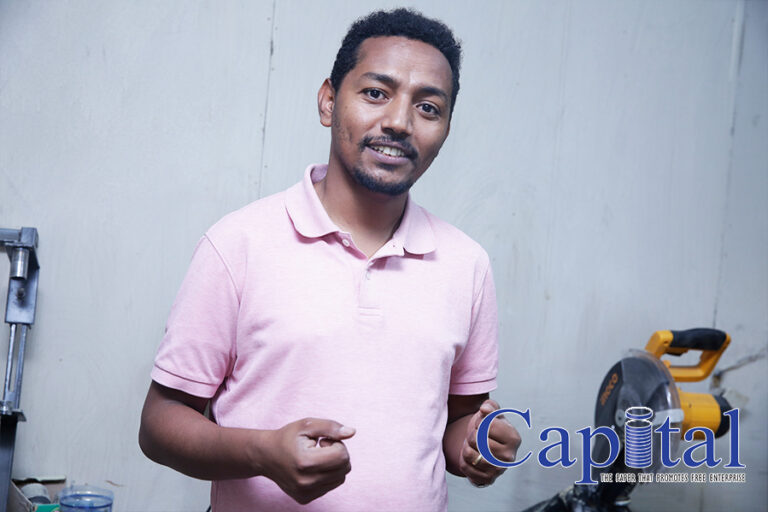
Ministry of Trade and Industry has taken the lead to support investors in Tigray region to reopen their investment and continue their contribution in the region. During the three-week war that began in the Tigray regional state, several factories were severely damaged and looted.
On Friday December 25, officials from the ministry and different stakeholders held discussions with different representatives of investors from the Tigray region.
The ministry has set up an eight members task force from different stake-holders to re-launch industries that have been shut down. The ministry is also committed to finding solutions to companies that are concerned about ports, customs degradation foreign exchange problems financial supply and inability to enter into contracts with their customers
“The first mandate of the task force is to identify information of damage and destroy to re operate industries,” said Yohannes Dinkayehu, state minister of Trade and Industry. He explained that the ministry of Trade and Industry will send its expertise directly to the location of the factories to conduct field study and find a solution to support the factories.
As Yohannes Dinkayehu said, government will support the factories in the region to quickly get out of trouble.
Some of the factories outside Mekelle reported that they had been damaged but some said they were unable to comment on the damage due to the lack of security and communication in the area.
As most of the investors indicated during the so-called operation, most of their investments has been damaged, their employees have been scattered and due to the communication problem in the area some of the investor still have no information about their investments.
Among those burned and robbed are; Zenit Gebs Eseht, Semayata Ceramics, Ajj milk processor, savanna leather and Almed textile are some.
According to Gebreegzi Tshaye, owner of Zenit Gebs eshet, Zenit has set up a modern factory in shire town in addition to Akaki and Gelan birr. His factory was demolished by a heavy machine, destroying property worth of 92 million. Also, another victim of the war is the Semayata ceramics factory which was established five years ago with capital of 500 million birr as result of the war the factory was completely destroyed.
The government has solved the problem in the region and has vowed to restore the region to its full potential.
Along with the law enforcement work, it has set up committees in each sector to work for the restoration of the country therefore, discussions are underway to get employees in the region to work.
The manufacturing industry has a significant role to play in the country’s economic growth, job creation and other social and political issues.
According to the Ministry information, there are more than 90 large industries and about 1000 of small and medium enterprises, which has created job opportunities for 300,000 peoples in the region.
Ministry of Trade and Industry provides support to Tigray Investors
ARRESTING CORRUPTION
Late modernity is characterized by blinding greed. As a result, it is facing mounting public pressure against its multifarious abuses. Systemically structured (undeserved) privileges, facilitated by the reigning neoliberal order obtain all over the world, in every nook and cranny. In other words, from large-scale parasitic activities that unashamedly leverage political power, (grand corruption) to the tiniest operations lubricated by bribes (petty corruption), un-tempered avarice dominates life in the twilight of the prevailing world system. Expected or not, the limit to all such injustices is being reached in one form or another all across planet earth. The increasing wrath of the global sheeple (human mass) is now obvious. Oligarchs are on the run and their handlers are scared. From the notorious Russian oligarchs, to the capitalists of Red China, tumult is becoming the order of the day. The recent crackdown on the princelings and their minions in Saudi Arabia is a continuation of this global uprising!
Thanks to the administration of President Putin, the Russian oligarchs are now cut to size, to the displeasure of global dominant interests, mostly located in the core countries of the West. It would be recalled that after the demise of the USSR, the newly created Russian mafia took over the country’s wealth, literally. Mines of all kinds were paper transferred to accomplished thieves with the help of western banksters. Without the gradual arrest of such gross embezzlements taking place in the Russian economy, extreme violence would have been the result. In the last five years, the Xi administration in China has managed to indict over a million and half individuals operating within the system. The reaction of dominant interests in the west to this initiatives is/was, as expected; Xi is becoming a dictator, akin to Mao. President Putin is considered, at least in the eyes of the deep state, as devil incarnate! Don’t forget, oligarchs all over the world share the same philosophy of blind greed, and want to operate in ways that can only benefit them, whatever the consequences to people and other life forms.
Unfortunately, aspiring oligarchs are also fledging in countries of the periphery, supported by global entrenched interests and compromised/captured states. In this regard, the current African reality is abysmal, not excluding the so-called developmentalist states! Even in poor Ethiopia, situations seem to get out of hand. It is time to round up the ‘princelings’ (privileged parasites) that were created during the last two decades, along with their handlers (degenerate high officials of party/government). Not to worry, we also have our own splendid ‘five star’ hotel in ‘kilinto’ eagerly waiting to accommodate them!
What is happening in Saudi Arabia might well be a last ditch effort to save the monarchy. One should recall that Egypt, Libya and Iran were once (not very long ago) ruled by monarchs. These kingdoms were not able to adapt to the changing world and had to be replaced by more participatory governance structures. The current oligarchs of the oil kingdoms, almost without exception, start with plenty of stolen capital. After their corrupt acquisition of the sheeple’s wealth, they go on acquiring legit businesses (all over the world) to clean up their loot. Just ask how these oligarchs started out and the reply is flimsy just as their so-called businesses. There is always a ‘black hole’ at the center of their empire! Alas, there is a remedy to all such shortcomings, so long as there is money. World known propagandists (public relation firms) are employed to portray these goons as if they were business geniuses or exemplary philanthropists, whose charitable works, (it is purported) can easily outshine that of Mother Theresa’s! The mainstream media (MSM) is another powerful tool that helps propagate the lies. Besides buying stakes in the media businesses, to influence or even shut them up, oligarchs also get full support of core countries governments (OECD, rich countries). After all, where does all the stolen money ultimately end up? Once the sheeple is thoroughly brainwashed about the ‘noble nature’ of these characters, they promptly engage in ‘rent seeking’ activities, which of course are their real forte! In these schemas, the captured states, led by their top honchos, always bowing to the moneyed, gladly facilitate whatever the criminal oligarchs fancy, legal or otherwise! What is sad but not surprising is; even after the thorough cleaning up of their ill-gotten money, the majority of oligarchs still fail to create or run good honest businesses. A glimpse of the financial statements of their companies tells a whole lot about their business ineptitude.
When probity and integrity in the semi-periphery/periphery tend to gain ground, entrenched global interests spin such positive moves as a sign of power consolidation, dictatorship, etc., on the part of existing political leadership. Levelheaded analysis, based on reality is thrown out as backward looking. For example, the assumption that ‘debt is wealth’ permeates the whole neoliberal order, which of course is a farce! Many of the global oligarchs, we are told, are wealthy and have net worth in the billions of dollars. Forget about asking how they earned their supposed wealth! Even without bothering with such pointed questions, the majority of them have massive debts. At the same time, the values of their assets (almost always) come very short of their debts. To rectify this, their assets are valued astronomically by the reigning global institutions; banks, rating agencies, business media, etc. The valuation of oligarchs’ wealth today is at best a joke. It is like valuing a ten year old ‘Toyota Corolla’ at ten million birr. And based on this false valuation banks avail more bank credit to oligarchs. Ludicrous! If truth be told, plenty of the oligarchs in the world have negative net worth! This whole scheme is supported and encouraged by the reigning global banksters. Like it or not, it is such fabrications that encourage oligarchs to engage in criminal activities. The whole idea is to project wealth as if it is the only thing that matters in the universe. The culture/general disposition of a society that is methodically influenced by the narrow-minded global oligarchs, is neither healthy (to individuals) nor harmonious to collective existence!
Unless the utterly corrupt princelings/oligarchs of ME & A (Middle East Africa) are cut to size, the increasingly angry/restive youth of the various countries will cut them to pieces! It helps to remember that about 50% of Saudi’s population (and most of Africa) is under 25 years of age. Here is the current royal decree from Saudi Arabia: ‘The homeland will not exist unless corruption is uprooted and the corrupt are held accountable’ and another statement from one of the most powerful person on earth: “I have great confidence in King Salman and the Crown Prince of Saudi Arabia, they know exactly what they are doing. Some of those they are harshly treating have been ‘milking’ their country for years!” President Donald Trump. Good Day!
Dashen Bank’s dash towards top flight performance
Massive Earning Per Share recorded
Dashen Bank, one of the two top profitable private financial firms in the country, achieves massive earnings per share (EPS) in the past financial year. The profit after tax has also advanced by half compared with the preceding period.
Shareholders have agreed to expand the capital to 5.5 billion birr this finance year.
In the operational evaluation for 2019/20 and the general assembly that was held at Mechare Meda, the bank leadership announced that the performance of Dashen for the past financial year was very massive and impressive.
Neway Beyene, Chairperson of the Board of Directors of Dashen, highlighted that although the financial year that ended in June had been scorched with the unforeseen pandemic of COVID 19 as a major challenge for the global economy, the bank’s performance remained sound. 
“Reflecting on the previous year’s performance, the bank remained resilient despite an otherwise difficult operating environment,” Asfaw Alemu, President of Dashen says on his report, “The review of our financial position reveals positive performance in terms of key performance metrics.”
The bank’s total assets in the stated period that ended on June 30, 2020 has expanded by 21.4 percent over last year position and climbed to 68.3 billion birr.
Dashen’s annual reported indicated that the deposit mobilization has been boosted by one fifth or by 8.8 billion birr in the 2019/20 financial year. As of June 30 the total deposit mobilization stood at 53.5 billion birr, which is one of the highest amounts in the industry regarding deposit mobilization.
From the total deposit, the interest-free banking (IFB) sector, which Dashen introduced and one of the leading in the sector, has taken 4.4 percent share or 2.4 billion birr.
In the reported year the banks had opened a full-fledged IFB branch in Adama that aims to maximize the promising IFB sector.
In the reported year the outstanding loans and advances stood at 42.6 billion birr, which makes it one of the unique performances not only for the bank but in the sector as a whole.
A year ago the total loans and advances were accounted at over 32 billion birr, while in the year ended June 30 the fresh loans and advances disbursement accounted 17.4 billion birr.
From the total loans and advances domestic trade and services, manufacturing, export and real estate have taken 11 billion, 10 billion and 5.1 billion and 5 billion birr respectively. 
The loans and advances for domestic trade and services and manufacturing registered massive increment compared with the preceding year. The manufacturing sector loans and advance has increased by more than 3.5 billion birr, while domestic trade and services increment is over 2.6 billion birr for the year.
In the IFB financing, 542 million birr has also been disbursed for the year only.
According to the annual performance indicator, Dashen’s total capital increased by over 21 percent and surpassed over 8.3 billion birr.
“The capital increment, in turn, has enabled the bank to increase its capacity to lend to a single borrower and maintain a buffer to absorb shocks,” the bank president said on his annual report addressing.
From the total equity, the share capital has a stand of 3.5 billion birr that was 2.7 billion birr a year ago.
For the year, the total revenue has expanded by over 30 percent compared with the 2018/19 financial year. The report shows that in the 2019/20 financial year the total revenue stood at close to 7.3 billion birr from 5.6 billion birr of a year ago. The interest income has taken the lion share as usual and reached at 5.8 billion birr that was 4.3 billion birr a year ago. It is then followed by 1.5 billion birr of fee and commission income.
In relation to the expansion of operation and deposit mobilization, the bank expense has also increased by more than 27 percent in the reported year and reached 5.5 billion birr.
The annual report indicated that the interest expense for the year reached at about 2.5 billion birr from over 1.9 billion birr in 2018/19 financial year, while employee benefits expense surge by almost half a billion birr and stood at 1.9 billion birr and followed by other operating expenses of over a billion birr.
In the year the bank profit before tax has reached close to 1.8 billion birr that increased by 40 percent from 1.3 billion birr of 2018/19.
Similarly, the profit after tax has registered a massive increment like other operations in the bank operation for the financial year that ended on June 30.
The report indicated that the bank profit has been boosted by more than half from the 2018/19 financial year and reached at 1.53 billion birr from over a billion birr of the preceding year.
The EPS for the year has also reached almost half of a share value, which is the highest for the industry. The ERS for the year has increased to 49 percent per share value that surged by over 20 percent from 40.8 percent of the 2018/19 performance.
At the general assembly held on Thursday, December 24, shareholders have agreed to expand the bank capital to 5.5 billion birr from the current 3.5 billion birr.
Lion International Bank roars remarkable results
Lion International bank exerted great efforts to boost its deposit in the fiscal year 2019/20, and as a result has the deposit balance has significantly grown by 9.7 billion birr or 59.4 percent from the preceding year similar period and reached 26.1 billion birr as of June 30, 2020. The growth was practically attributed to the rise in savings deposits, which went up by 8.6 billion birr (70.5 percent).
Furthermore, the bank’s total number of account holders reached 1.2 million as of the 30th of June, 2020, which grew by 369 thousand 0r 46 percent as compared to the recorded number last year.
In matters of credit management, the bank has continued to play a key intermediary role in the Ethiopian economy through mobilizing resources to different economic sectors.
Accordingly, the total net outstanding loans and advances of the bank markedly rose to 19.1 billion birr, which is an expansion of 7.5 billion birr (64.2 percent) during the ended fiscal year.
In the fiscal year 2019/20, the bank earned a total income of 3.1 billion birr, which increased by 892.2 million birr or 40.2 percent from the preceding year’s performance of 2.2 billion birr.
The total expense spent during the fiscal year 2019/20 posted 2.3 billion birr which soared by 807.1 million or 53 percent from 1.5 billion birr incurred a year earlier.
LIB completed the 2019/20 fiscal year with a remarkable achievement registering a gross profit after provision, deprecation, and before tax of birr 780.6 million, exceeding the last year’s same period performance by birr 85.1 million or 12.2 percent.
In the year under review, the bank had maintained a strong standing measured by key performance indicators. Return on assets ROA expressed as the ratio of profit after tax to the average asset of LIB stood at 2.5 percent during the ended fiscal year while the return on equality ROE articulated as the of profit after tax to average stakeholders’ equity was 25.6 percent. This profitability ratio, in this perspective, shows that the bank has continued to be capable enough to convert every invested resource into return.
Total assets of the bank have continued to expand considerably in the ended fiscal year. The bank has accumulated total assets of 31.8 billion birr exhibiting an increment of 55.9 percent (Birr 11.4 billion), over the beginning of the year balance of 20.4 billion. The expansion in the assets of the bank was attributed to growth in major components such as outstanding loans and advances, cash and bank balance, NBE bills and fixed assets.
On matters of capacity growth, the bank’s total capital and reserve rose to birr 3.5 billion, reflecting a 36 percent growth from last year same period. Similarly, the paid-up capital increased to 2.2 billion birr, which showed an increase of 621.1 million birr (40 percent) year-on-year. On the other hand, the number of shareholders reached 11,348 as of June 30, 2020.
As part of sustainable growth endeavors, the bank has been expanding its tangible assets by purchasing and constructing its buildings. The assets range from ongoing construction in Mekelle to procurement of a semi-finished building in Addis Ababa. Furthermore, as part of the effort to increase its accessibility and expand its service outreaches, the bank has opened thirty-three new branches in different parts of the country during the fiscal year under review.