

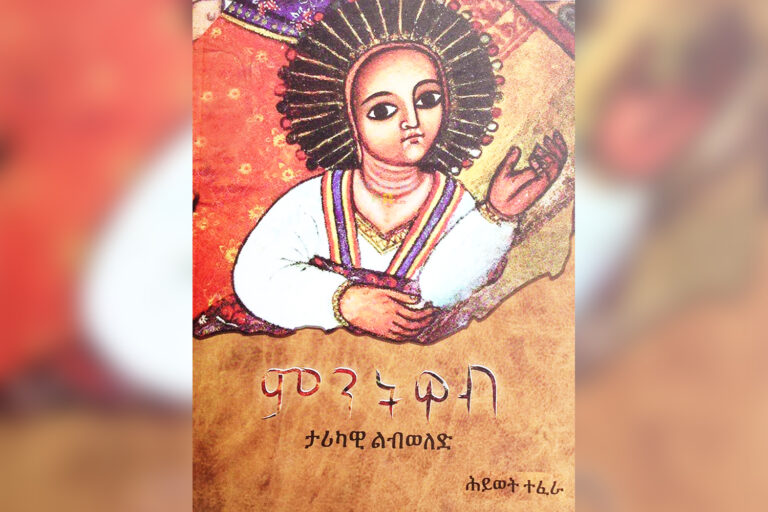
On 25 October 2020 ‘HoHE chapter’ webcasted a discussion on Hiwot Teffera’s “Mentwab” with the presence of the author and showcasing Meseret Abeje and Solomon Teshome PhD as discussants and Desalegn Seyoum as a moderator. Hiwot’s book ‘Mentwab’ published in 2020 as the third publication from her series of writings since her autobiographical note of the 2012’s “Tower in the Sky”. Containing seventeen chapters, the genre of the book “Mentwab” can be categorized as historical novel. As usual, the book amassed admiration for the thriving excellence of the author-Hiwot Teffera. Her audacity was premised on to authoring on women causes with paying all the price of researching from the grass root level in Gondar. To one’s surprise she made several trip to know the dialect, uncover the legend of Mentwab from elders.
Historically, Mentwab (lived between 1706-June 27, 1773)was Queen a native of Quara and the wife of Emperor Bäkafa (r.1721-1730), dominated Gondarine court politics in the reigns of her son Aşé Iyasu II (r.1730-1755) and her grandson King Iyoas (r.1755-1769) . Historical accounts showed us Mentwab managed to build a church and a palace at Qusquam erstwhile in 1725. For the commentator Meseret, Menetwab’s determination to build both palace and church is attributable for her equivocal passion for both religion and politics as well. The palace and the church were located southwest of the city at the foot of Mount Hogg. To her credit, Etegé Mentwab appointed her relatives to important positions that led to the emergence of a political faction named Quaräňoč that struggled against the Wällo Oromo faction of Wubit, the mother of Iyoas. Throughout her tenure as an Empress Mentewab constructed a long U-shaped castle which, completed the major complex of buildings in Gondar. Donald Levine in his ‘Wax and Gold’ underscored that Empress Mentwab Interest in architecture was revived by Bakafa. Mantwab’s castle is noted for bas-reliefs of the Ethiopian Cross, while her other castle at nearby Qusquam is decorated with sculptures depicting saints and animals as well.
Coming back to Hiwot’s book, she was inspired to expose the rare success of women in a palace. The seasoned author- Abera Lema commented Hiwot’s historical novel as a continuum of Paulos Gnogno’s ‘Yetangut Mister’ ( a book on the mother of ‘Emperor Tewordors’). Ever since, no meaningful effort was made to expose women in palace through historical novel. Perhaps, the book demonstrated Inequality, patriarchy, monarchy and what a real life could be imagined in the 18th century imperial palace of Gondar.
For the commentator- Meseret, the Book- Mentwab exceptionally began the narrative from climax of the love affair between Wolete and Tilaye other than the usual tedious chorological narration of History. Appreciably, Mentwab was humane to engage in rare love affair with all her commitment to confirm moral obligation. By virtue of her coronation as an Empress, Wolete will be renamed as “Menteweab’ at later stages of the story. Mentewab’s struggle for recognition has succeeded against the political culture in which Kingship mythology dictates the dynastic claim other than a real decent. Admirably, the author claims that as she tried to fill the gap early childhood of Mentwab through narratives of historical fiction.
Interestingly, Meseret remarked that the story of Abraha was inserted as a side narrative with commendable lesson for the today’s Ethiopia. Initially Abraha came to attend church school and easily cross married in ‘Waldeba’ all the way his career launched to enter castle palaces of Gondar. Though Abraham’s origin was from the then –Tigre province, his identity was not a trivial issue neither for his uninterrupted mobility nor entering the politics of Gondar. Sociologically speaking, it is an exception than a rule for traditional society to determine one’s eventual status through achievement and merit than ascription. One can detect the polarization through identity based politics in the contemporary society as it is became gradual reality from scratch than ever before three centuries.
In his folklore informed commentary, Solomon Teshome exclaims that what was observed during the stories of Mentewab was the discourses between barbarism and civilization, Tewahdo and Kebat theologies, localism and inclusivity, Quaregnoch and Gondarine, peace and massacre, mother and son, stable monarchy and succession rivalry, humane deviance and rigid conformity to social norms . In its entirety, it can be summed as politics in Imperial Gondar was plagued by parochial political culture whose legacy succeeded to this day as a ‘neo parochial political culture’.
In sum, the narrative of Mentewab conveys a lesson for the contemporary Ethiopia to value achievement over ascription, merit over loyalty, humanity over unfounded rigidity. Also, the past is owed with celebratory folklore and locally initiated feminist cause for Architecture and political settlement. I wish for the reader of this piece a good week but urging not to forget the food for thought drawn from Hiwot’s ‘Mentewab’.
A thrilling narrative of Hiwot Teffera’s ‘Mentwab’
Debt and Humanity
The dictionary meaning of debt is an obligation that requires one party, the debtor, to pay money or other agreed-upon value to another party, the creditor. Debt is a deferred payment, or series of payments, which differentiates it from an immediate purchase. It is true that consumer debt is the life-blood of the global economy. All modern nation-states are built on deficit spending. Debt has come to be the central issue of international politics. But nobody seems to know exactly what it is, or how to think about it.
Explaining debt’s power over humans, David Graeber, an anthropologist and activist based in London and New York in his book entitled “Debt: The First 5,000 Years” argued that the very fact that we don’t know what debt is, the very flexibility of the concept, is the basis of its power. If history shows anything, it is that there is no better way to justify relations founded on violence, to make such relations seem moral, than by reframing them in the language of debt. Above all, because it immediately makes it seem like it’s the victim who’s doing something wrong.
Mafiosi understand this. So do the commanders of conquering armies. For thousands of years, violent men have been able to tell their victims that those victims owe them something. If nothing else, they “owe them their lives” for not simply killing them. Nowadays, for example, military aggression is defined as a crime against humanity. International courts, when they are brought to bear, usually demand aggressors pay compensation. Germany had to pay massive reparations after World War I, and Iraq is still paying Kuwait for Saddam Hussein’s invasion in 1990.
Arguments about debt have been going on for at least 5,000 years. David Graeber stated that for most of human history, at least, the history of states and empires, most human beings have been told that they were debtors. For thousands of years, the struggle between rich and poor has largely taken the form of conflicts between creditors and debtors. The arguments were about the rights and wrongs of interest payments, debt peonage, amnesty, repossession, restitution, the sequestering of sheep, the seizing of vineyards and the selling of debtors’ children into slavery.
David Graeber further noted that by the same token, for the last 5,000 years, with remarkable regularity, popular insurrections have begun the same way: with the ritual destruction of the debt records – tablets, papyri, ledgers, whatever form they might have taken in any particular time and place. If one looks at the history of debt, then, what one discovers first of all is profound moral confusion. Its most obvious manifestation is that most everywhere, one finds the majority of human beings believe simultaneously that, first, paying back money one has borrowed is a simple matter of morality, and second, anyone in the habit of lending money is evil.
According to David Graeber, the Catholic Church had always forbidden the practice of lending money at interest. However, these rules often fell into disuse. This caused the Church hierarchy to authorize preaching campaigns, sending mendicant friars to travel from town to town warning usurers that unless they repented and made full restitution of all interest extracted from their victims, they would surely go to Hell. These sermons, many of which have survived, are full of horror stories of God’s judgment on unrepentant lenders.
Thomas Fricke, a correspondent for the Financial Times Deutschland stressed that they are stories of rich men struck down by madness or terrible diseases, haunted by deathbed nightmares of the snakes or demons who would soon rend or eat their flesh. In the 12th century, when such campaigns reached their heights, more direct sanctions began to be employed. The Papacy issued instructions to local parishes that all known usurers were to be excommunicated. They were not to be allowed to receive the sacraments, and under no conditions could their bodies be buried on hallowed ground.
According to Thomas Fricke, looking over the expanse of world literature, it is almost impossible to find one sympathetic representation of a moneylender, or certainly, a professional moneylender, which means by definition one who charges interest. Many people are not sure there is another profession with such a consistently bad image. It’s especially remarkable when one considers that unlike executioners, usurers often rank among the richest and most powerful people in their communities. Yet the very name, “usurer,” evokes images of loan-sharks, blood-money, pounds of flesh, the selling of souls.
And behind them all is the Devil, often represented as himself a kind of usurer, an evil accountant with his books and ledgers. Or alternately, as the figure looming just behind the usurer, biding his time until he can repossess the soul of a villain who, by his very occupation, has clearly made a compact with Hell.
Regarding debt and other religions, David Graeber noted that other religious traditions have different perspectives. In Medieval Hindu law codes, not only were interest-bearing loans permissible. But it was often emphasized that a debtor who did not pay would be reborn as a slave in the household of his creditor, or in later codes, reborn as his horse or ox. The central question then becomes this: What precisely does it mean to say that our sense of morality and of justice is reduced to the language of a business deal? What does it mean when we reduce moral obligations to debts?
In dealing the issue of money and morality, the crucial factor is money’s capacity to turn morality into a matter of impersonal arithmetic, and by doing so, to justify things that would otherwise seem outrageous or obscene. If you end up having to abandon your home and wandering in other provinces, if your daughter ends up in a mining camp working as a prostitute, well, that’s unfortunate but it’s only incidental to the creditor. Is that really the world we want to live in?
DHL unveils its digital road freight platform Saloodo! in Ethiopia
DHL Global Forwarding, the leading international provider of air, ocean and road freight services has launched its digital road freight platform Saloodo! to shippers and transport providers in Ethiopia. This free-to-use service marks the first time an international digital road freight platform is made available in Ethiopia connecting shippers to freight carriers that can meet their road transportation needs.
“Streamlining logistics both in infrastructure and through digital platforms like Saloodo! will bolster local, regional and international integration,” noted Tobias Maier, CEO of Saloodo! Middle East and Africa.
“Although the pandemic has caused significant slowdown in growth in the region, we are optimistic that Saloodo! will help bring logistics aspirations back on track and particularly benefit Ethiopia given its road map to boost logistics infrastructure. It will allow shippers to easily identify trusted freight carriers, help carriers manage fleets and optimise capacity, and provide real-time visibility all around for greater transparency and growth in the market.”
Saloodo! is the first digital logistics platform available in Ethiopia and the region that offers a single, simple and reliable interface for shippers and transport providers to best optimise cost, routes, cargo and transit times. Backed by DHL’s global and regional footprint and expertise, all contractual relationships on the platform are organised via the existing local DHL entity, providing trust and peace of mind to carriers and shippers alike.
The renewAfrica Initiative presented to EVP Timmermans
The renewAfrica Initiative was presented to Frans Timmermans, the European Commission’s Executive Vice-President for the European Green Deal. By the end of the meeting, which saw the participation of CEOs and high-level representatives of 18 of the most important international companies and organisations active in the renewable energy sector, EVP Timmermans appreciated that the Initiative is in line with the green ambitions of the European Commission and welcomed the work of renewAfrica so far as a positive contribution to the EU’s Comprehensive Strategy with Africa.
The renewAfrica Initiative has been structured to implement PPPs, so to create a level playing field for European industry and investors. In this regard, the Initiative will contribute to add value to existing European financial instruments, so to mobilise the scale of public and private capital necessary to the creation of a pipeline of sustainable and bankable renewable energy projects in Africa. renewAfrica stems from the need of an EU-led programme that should offer end-to-end support along the entire project cycle, assist with high-level policy dialogue, provide technical assistance to national governments, and offer financial de-risking and capacity building measures. For the programme to be fully effective, it should avoid limitations in terms of the supported technology, geographical area and size of the project, thus mobilising private capital and unlocking bankable renewable energy projects across Africa. renewAfrica’s task forces have elaborated a proposal, identifying possible pilot countries, outlining a set of technical assistance services, and elaborating a financial package to cover the major investments risks. The Initiative has now reached the point where it can contribute to the EU green diplomacy objectives in Africa.
