

Elections are an important mechanism in democratic and peace processes. Their purpose is to provide citizens with an opportunity to choose freely their political leaders and allocate power peacefully.
Tomorrow Ethiopians will head to the polling stations to cast their ballot. This is the first step towards democracy.
However, the side-shows in a majority of African countries’ electoral processes costs the continent big in terms of development, especially economic development, for at the end of the day when elections have come and gone, people want to live better lives. The dog-eat-dog scenarios we have been witnessing in most countries make us wonder whether the people are still major stakeholders in the governing process, or it is those who want power who matter most.
Why also waste the voters’ time and the countries’ meagre resources, if all that we are going to hear from the losers is that the poll was rigged?
This well-choreographed sing-song of “We are robbed” has become all too familiar in many African countries’ to the extent that we really wonder whether the cry-babies have the people’s interests at heart.
Multi-party democracy has turned into a nightmare for the continent as we witness how burdensome it is with each general election, and how costly and an outright embarrassment for the continent.
Somewhere between fighting for independence, governing and ushering in multi-party democracy, there seems to have been an unwritten rule that another contestant party must not win an election, and every political party that contests has the right to romp to victory!
If they lose, it can never be their fault, but rigging and a host of other nefarious accusations levelled against another political party and the electoral bodies.
However, Africa’s political parties cannot repetitively do the same thing, and expect different results. As long as they have that tunnel vision, they will continue to live with the notion that elections are rigged and not won – credibly, freely and fairly too.
We do not discount challenges that can affect some electoral processes, but for once, we beg all political parties that contest not to hold the people to ransom, for elections are a process not an end in themselves.
In a democracy, the people make choices freely. After casting the ballots, they expect their lives to move on as the winning party fulfils the promises it made during the campaign period. So too the losers. They should join hands with the winner and see how best the programmes set out produce the desired results for the nation.
The people are bigger than all these individuals, and their welfare in environments so full of challenges is of paramount importance. These are some of the fundamentals political parties in Africa forget completely, as winning becomes so central.
We have belaboured the point because we have witnessed elections in a number of African countries go violent in the last few decades.
Africa has to rethink how it handles its electoral processes. The over one billion people on the continent need to be fed; they need well-paying jobs; water and sanitation; health care facilities; modernisation of both urban and rural areas, and more. These can never be realised when politics is deemed a zero-sum game!
All actors involved in the electoral process should refrain from unlawful acts. Peaceful, democratic and credible elections are fundamental necessities that Ethiopia and its people cannot do without in the fulfillment of their aspiration for true democracy.
Others forces from outside and inside should also refrain from hindering the election. We should try to exercise our rights. It is a start and there may be many mistakes and for sure there will be flaws. Let us learn from our flaws and mistakes. This might be a start to democracy.
Waging peace through election
Ethiopia decides
The National Electoral Board of Ethiopia has said there is no fear of security in the first schedule of the sixth general election which will be held tomorrow Monday June 21, 2021.
The board vow to hold fair, credible, and free election however there is still widespread apprehension among the public, given the jarring electoral violence in the country which has been witnessed in the past.
General elections were supposed to be held in Ethiopia on the 29th of August 2020 but were delayed, supposedly due to the pandemic. In May the house of people’s representatives had voted to postpone the election to 2021.
After six years of power the house of representative has opened the door to the National Electoral Board of Ethiopia to take over the stage for the preparation of the six general elections, which both Federal and regional council elections will be held at the same time all over the country.
In late December 2020, the National Electoral Board of Ethiopia had stated that the sixth general elections would take place on 5 June 2021, however just a month ago after discussing with political parties, the election board had announced a new date for the long-waited election to be haled on Monday June 21, 2021. The new delay was needed because of logistical woes related to tasks like training electoral staff and printing and distributing ballot papers.
The logistical challenges have been a great factor in this election which have caused delays alongside other factors such as staff shortages. Places where voter registration has not started, due to security concerns, locations where voter registration has begun and been terminated, areas where complaints have been lodged during the voter registration process or where the board has decided to investigate a significant irregularity in the voter registration process, are some of the hurdles that NEBE has had to endure to provide a credible election.
Throughout the year the election board which is led by former politician Birtukan Mideksa has experienced lots of blocks. Beside the pandemic, the board has been tensioned by the national security and instability. Through the year several parts of the country have been undergoing instability, including the conflict in Tigray region.
The election is roofed by various insecurity and logistic distresses, error in the ballot papers threatened the twice delayed national poll officials but amidst all these, the government still speculate that, this will be the most credible vote in Ethiopian history.
According to Soliana Shimes, communication advisor of NEBE, the board has expressed no fear of security on the voting date. “As we have excluded the conflict areas from the first schedule of the election, there is no fear of security and the board is not concerned on the first scheduled election,” explained the advisor.
With currently almost 15 percent of constituencies unable to participate in the June 21 elections due to insecurity and other challenges, 40 constituencies were said elections cannot take place due to security reasons and voters’ registration irregularities.
According to the election board there are 673 constituencies all over the country. The 6th general election will be held at all of the constituencies in Addis Ababa, Diredewa, Gambela region and Sidama region.
Where it is not safe are in parts of western and southern Oromia, which are racked by armed insurgency. Fierce fighting in these places, as well as in the neighboring region of Benishangul-Gumuz, and Amhara Region has stopped the voting process scheduled but the delay to voting also applies to the Somali and Harari regions, which have been beset by legal disputes as well as mishaps such as misprinted ballot papers. The referendum in Southwest Ethiopia was also scheduled to take place on June 21 with the general election, but due to security concerns, some constituencies will not be able to cast their ballots so the election will be held on September 6, 2021.
On security matters, the Ethiopian Security authorities say a reliable security arrangement has been made for a peaceful election in the country. Federal and regional security authorities had an evaluative discussion regarding the security situation in the country.
Director of National Intelligence and Security Services, Temesgen Tiruneh, said that the security apparatus at different levels have made preparations needed to ensure that the sixth general election is peaceful.
The security authorities do seem to have a positive assessment this time around. In a statement issued after the discussion on Monday, authorities encouraged Ethiopians to go out in large numbers and vote on June 21.
Also, Ethiopian Human Rights Commission has also urged law enforcement agencies to act impartially during the election, to respect and uphold the rights of citizens, and to ensure accountability in the event of violations. Similarly, the commission has conducted consultations on the election process starting from June 2 to June 5, 2021 with law enforcement in all constituencies being held with intermediaries from Adama, Jimma, Bahir Dar, Hawassa, Gambella, Assosa and Semera police and judiciary.
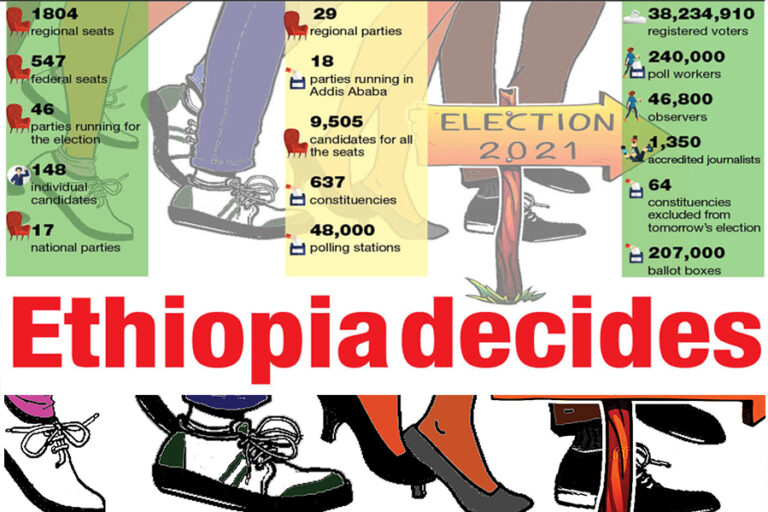
For the 547 federal seats and for the 1804 seats in the 10 regional councils including Sidama region according to the election board there are about 46 parties running to power.
According to the board a total of 9,505 candidates from the 46 parties and also 148 individual candidates has registered and run for the race all over the country.
From these 46 parties 17 of them are national parties while the rest 29 are regional parties, meanwhile 18 parties are running to get the vote in the capital, Addis Ababa.
Through the past year the board has been preparing for the election and 48,000 polling stations has been established under 637 constituencies over the country. 38,234,910 voters are said to have been registered throughout the registration period. As the board has been facing problems which also has been affecting the voter’s registration the number doesn’t include voters in Hareri region and some parts of Somali region.
Since January 2019 in an effort to reform NEBE the house of people representatives enacted a new proclamation that reduce the management. To this end, 240,000 poll workers will monitor the voting process while over 46,800 accredited observers and 1350 journalists are accredited to be involved in the election process, that is, those who have passed the accreditation process of the National Electoral Board of Ethiopia.
Beside the security issues due to errors on ballot papers the board has stated that there are problems with 54 constituencies which were found to be in need of re-printing of ballot papers. Among these constituencies, the number of polling stations that have problems with voting is now 27. Accordingly, voting in these 27 State and House of Representatives constituencies will be held on September 6, 2021.
The board mentioned that some of the errors were human made and some done intentionally and some happened in the process work related errors. “The board has taken administrative measures on its employees which is up to prohibition from work for those who are responsible for the error in the ballot papers by mishandling data due to their neglect,” said Birtukan Mideksa, chairwomen of the board on press briefing given on Thursday, June 10, 2021.
The board announced that these constituencies affected by ballot paper defections will take place on September 6, 2021 alongside with the 40 constituencies. Likewise, the second round of election will be held on September 6, 2021, and a total of 64 constituencies will hold their election on the second round election while the expected voters in those areas are still able to cast ballots before a new parliamentary session begins in early October.
NBE amends bank executives’ directive

The National Bank of Ethiopia (NBE), replaces the ‘requirement for persons with significant influence in a bank’ directive within two years’ time to empower information technology (IT) professionals to serve in the financial industry at senior level without banking sector experience.
The directive no. SBB/79/2021 that comes to effect as of June 15 by amending the 2019 directive adds a paragraph on ‘fit and proper criteria’ of article 5 sub article 1.3 (a) (ii) for senior executive officers a sub article.
The 2019 SBB/70/2019 directive article 5 sub article 1.3 (a) (ii) stated that senior executive officer, who is a deputy for the president or CEO, should have a minimum of 10 years’ experience in banking, of which at least four years should be experience as department manager. This is also not touched on the newly amended directive signed into effect by Yinager Dessie, Governor of NBE.
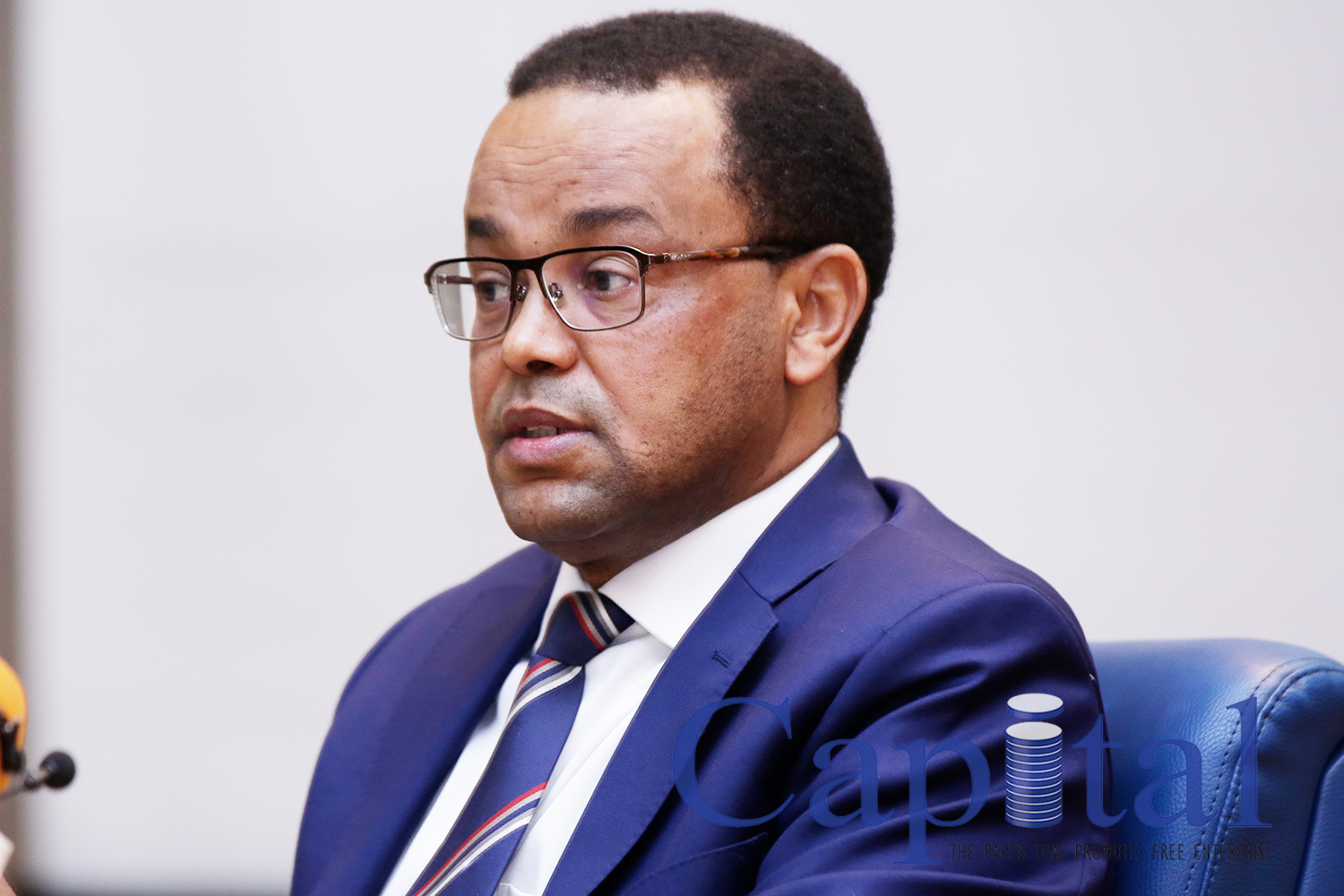
Meanwhile it added that IT professional without banking industry experience can take the post in a financial industry in technology sector. The directive states “however if the position is on IT or related fields, experience in IT related fields which may not necessarily be banking related shall also be considered as relevant experience.”
“Nevertheless, such person shall take a minimum of 5 days training on core banking business functions including credit, saving, international banking and other core functions once she/he assumes the position of senior executive officer and certificate of training shall be filed to the NBE accordingly,” the directive added.
In this regard experts in the industry reminded the recent development seen at the state financial giant Commercial Bank of Ethiopia (CBE) that assigned Amare Assefa as Information Systems Vice President without banking experience.
Amare, with education background of electrical, electronics, and communication engineering from Addis Ababa University had served as Chief Operating Officers at Ethio Telecom before he went to CBE.
Financial industry experts told Capital that the NBE move is a right decision since the financial industry is very dynamic particularly on the digital age “specific sector needs relative background rather than tight criteria.”
It was recalled that the 2019 directive that replaced the 2012 SBB/54/2012 directive came up with major changes particularly on years of services for the CEO and deputy posts.
The 2012 directive mentioned 10 years’ and 8 years’ experience for the CEO and deputies respectively, while has increased to 12 years’ and 10 years respectively by the SBB/70/2019 directive.
The SBB/70/2019 directive has also added that a senior executive officer, if directly reporting to the board of directors (mainly chief internal auditor and chief risk and or compliance officer) shall have a minimum of 8 years experience in banking, of which, at a minimum 3 years shall be in managerial position.
$1.43 bln debt paid in the first 9 months of the fiscal year

Over $362 mln is interest, commission
A total of close to USD 1.43 billion debt has been recorded as service for external creditors in the first three quarters of the fiscal year, while from the stated amount, one fourth which is over USD 300 million is interest and commission fees.
In the stated period as an eligible country of Debt Service Suspension Initiative (DSSI), the country gets a suspension of USD 199.4 million external debt service payment.
The latest Debt Management Directorate of Ministry of Finance (MoF) indicated that during the period up to March 31, of the fiscal year the total external public sector debt service that is interest and charges was USD 1.429 billion.
Out the total debt service during the last nine months, July 1, 2020 to March 31, 2021, USD 180.59 million is paid by the government while the remaining USD 1.25 billion was paid by state owned enterprises (SOE’s).
Compared with the settlement during the first six months of the current fiscal year in the third quarter only additional USD 438 million debts has been serviced for external creditors. In the six months period of July 1 to December 31, 2020 USD 991 million was service that expanded to more than USD 1.4 billion in total during nine months of the fiscal year.
From the total debt service amount USD 708.3 million and USD 540.4 million was settled by government guaranteed and non-government guaranteed SOEs, while the balance USD 180 million debt service by the government.
Of the total USD 1.43 billion debts service, USD 362.5 million or quarter of the total debt service is interest and commission. The major share of interest and commission service or USD 173 million went for government guaranteed debt and followed by central government of USD 109.3 million.
“The country is one of the eligible countries for the G20 DSSI and has signed MOU with Paris Club secretariat on the DSSI related to the Paris Club Countries; currently we are not making any external debt service payment for our bilateral creditors of central governments as per the G20 DSSI,” the MoF bulletin released late this week states.
During the period (May 1 ,2020 – March 31 ,2021) as an eligible country of DSSI initiative, has suspended the external debt service payment of central government to its bilateral creditors amounted to USD 199.44 million.
The DSSI is aligned with the effect of the COVID-19 that the World Bank and the International Monetary Fund initiated G20 countries to support poorest countries by debt suspension to mitigate the effect of the global pandemic.
In all, 73 countries are eligible for a temporary suspension of debt-service payments owed to their official bilateral creditors.
The DSSI is helping countries concentrate their resources on fighting the pandemic and safeguarding the lives and livelihoods of millions of the most vulnerable people.
According to MoF, nine months government debt assessment, total public sector debt that are external plus domestic stock stood at USD 53.9 billion, compared to revised June 30, 2020, debt stock which was USD 55.1billion.
It explained that the total public debt in terms of USD declined; as a result of decline in domestic debt in terms of USD due to relatively higher rate of depreciation of birr against USD, while in terms of birr the total domestic debt increases compared to June 30, 2020.
Out of the total public sector debt outstanding USD 31.2 billion which is about 58 percent is owned by central government the remaining USD 22.7 million (42 percent) is owed by SOE’s.
As at March 31, 2021 total public sector external debt amounted to USD 29.36 billion compared to June 30,2020 USD 28.9 billion.
“The increment in external total public debt compared to June 30,2020 can be partly explained by exchange rate variation of USD, a relatively higher depreciation of USD specially against (special drawing rights) SDR and euro,” the bulletin argued.
Out of the total over USD 29 billion external debt, 65 percent is owned by central government while the remaining 36 percent is owned by SOEs with and without the government guarantee.
The central government external debt amount is USD 19.1 billion birr and USD 3.48 billion is for non-government guarantee SOEs that are Ethiopian Airlines and Ethio Telecom.
The total public domestic debt as at March 31, 2021 amounted to USD 24.5 billion compared to June 30, 2020 USD 26.3 billion (Domestic Debt in terms of USD declined as a result of a relatively higher rate of depreciation of ETB against USD) while in terms of birr, during the period, total domestic debt increases to over a trillion-birr compared to 919 billion birr of June 30, 2020.
Out of the total domestic debt the share of central government is about 49 percent while the 51 percent is that for SOE’s.
During the nine months over USD one billion total external public debts have been disbursed.
During the period, net issuance of T-Bills with different maturity was about 45.98 billion birr, while the net issuance of direct advance was 22.5 billion birr.
Similarly, the net borrowing of SOE’s from domestic source is about 28.35 billion birr.
