

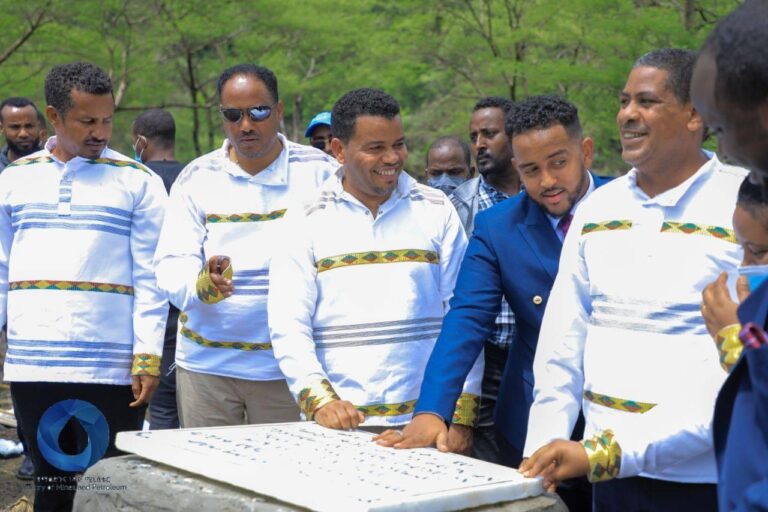
A foundation stone for the establishment of the Sun Mining Coal factory the first coal factory in Ethiopia has been laid out at Gibe Ibare Kebele in Abeshge Woreda of Gurage Zone, Southern Nations, Nationalities and People’s Region on June 14, 2021 by Takele Uma, Minister of Mines and Petroleum and the Head of Southern Region, Ristu Yirdaw amongst other government officials.
Sun Mining trading is a sister company of Sunshine Investment Group. The proposed coal production plant will have an annual production capacity of 800,000 tons of washed coal.
Sun Mining had officially received the 23.3 hectare land permit from the Gurage zone for factory construction.
“Although our country is rich in minerals and natural resources, it has not been able to make the most of this potential. Coal is one of these potential natural resources,” stated Takele.
On the contrary, the country spends up to 200 million dollars annually importing coal for use in cement production and energy generation.
Recognizing this, at the invitation of the Minister of Mines and Petroleum, Sun Mining conducted a full feasibility study including washability study sending samples to South Africa for improved quality of the coal and installation of the coal washing plant in the Gurage zone. As a result, Sun Mining is currently working on factory design.
According to the company, the total investment cost of the project is over 600 million birr, of which up to 190 million birr will be spent on the purchase of machinery for the factory.
The factory is said to be made in line with the latest technology so that the environment is not polluted.
According to the project study, the construction of the factory will take a total of 11 months and will be completed on time. Following the completion, when the factory is operational, it will supply the products to the cement factories, which is expected to save up to 67.5 million dollar and will create jobs for a total of 500 local residents and more than 1,500 organized associations.
Laying foundation for coal mining in Ethiopia
First vegetable seeds grown in BASF’s new production facility in Ethiopia
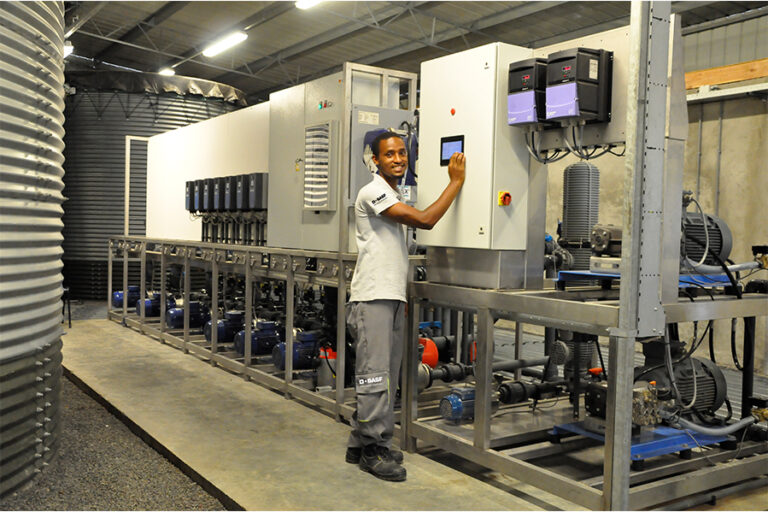
The first seeds produced at BASF’s new state-of-the-art production facility in Ethiopia enter the global vegetable seed market. Located in Amhara region, the facility offers ideal year-round production conditions for sweet pepper, tomato and cucumber. It is BASF’s first high-tech greenhouse complex in Africa.
“We invested around €8 million into this new facility. It will provide us with extra supply reliability and flexibility to serve our customers worldwide,” said Vicente Navarro, Senior Vice President of BASF’s vegetable seeds business. “Sustainable food production is very important to us and we want to do our part. That is why we are very proud of this new facility: It makes us a frontrunner in terms of establishing the first sustainable high-tech seed production site in Ethiopia with fully automated processes for climate control including humidity, heating and irrigation.”
The premises cover a surface of 15 hectares: two hectares are occupied by
state-of the-art greenhouses while the rest is used for open field seed production facilities and infrastructure. Currently, around 60 permanent employees are working at the new site. In addition, BASF also provides employment to more than 100 seasonal workers. Most of the employees were recruited from the surrounding areas and trained in-house.
“We are thrilled to have the first high-tech seed production site in Ethiopia built in the highest sustainability standards and with commitment to the society needs. This investment will not only enable BASF to serve better our customers, but it also reinforces our objective of growing Africa and contributing to the upliftment of the continent’, said Juliana Hosken Wernek, Head of Market Area Africa.
The site fulfills BASF health, safety and environmental standards and goes beyond Ethiopia’s common sustainability requirements. To reduce its carbon footprint, mainly renewable energy sources are used to generate electricity. The greenhouses are heated with solar panels. Furthermore, the facility has its own wastewater treatment plant and all the waste it produces can be recycled on site.
In addition, BASF is engaged in numerous social responsibility initiatives in the vicinity of the site. “I am very proud to see that apart from delivering seeds to Ethiopian smallholder farmers, we are also involved in projects for reforestation and soil erosion control in the area,” stressed Ben Depraetere, Managing Director Nunhems Ethiopia PLC and Country Head of BASF’s vegetable seed business in Ethiopia. “We want the local community to benefit. That is why, for example, we also supply the community around our site with safe drinking water, have invested in building new road infrastructure and established a fund to create job projects for unemployed young people from the surrounding area.”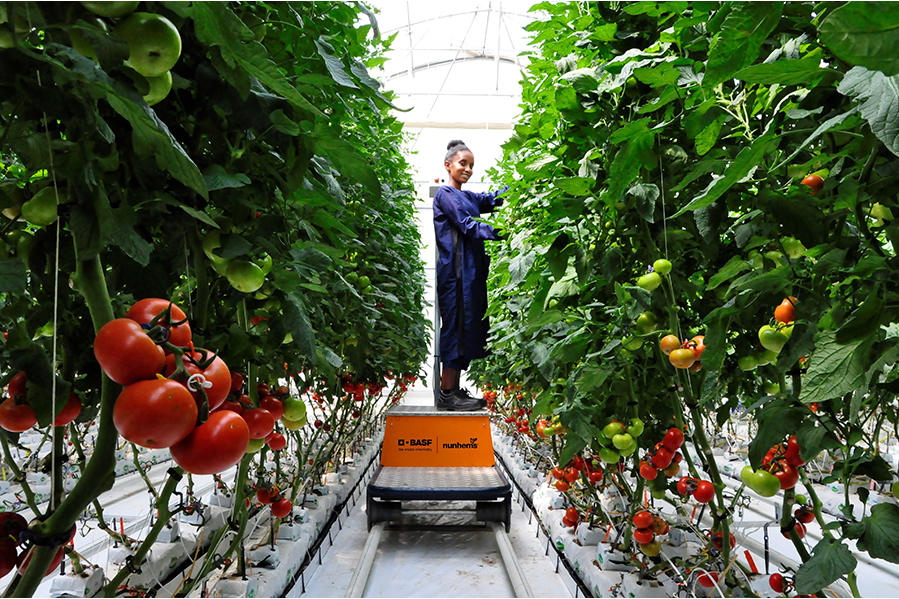
BASF SE is a German multinational chemical company and the largest chemical producer in the world. The company operates in six segments, including chemicals, plastics, performance products, functional solutions, agricultural solutions, and oil and gas.
The BASF Group comprises subsidiaries and joint ventures in more than 80 countries and operates six integrated production sites and 390 other production sites in Europe, Asia, Australia, the Americas and Africa. Its headquarters is located in Ludwigshafen, Germany. BASF has customers in over 190 countries and supplies products to a wide variety of industries.
At the end of 2019, the company employed 117,628 people. In 2019, BASF posted sales of €59.3 billion. The company is currently expanding its international activities with a particular focus on Asia.
Study suggests Exhibition Centre, Millennium Hall to resume their previous operation
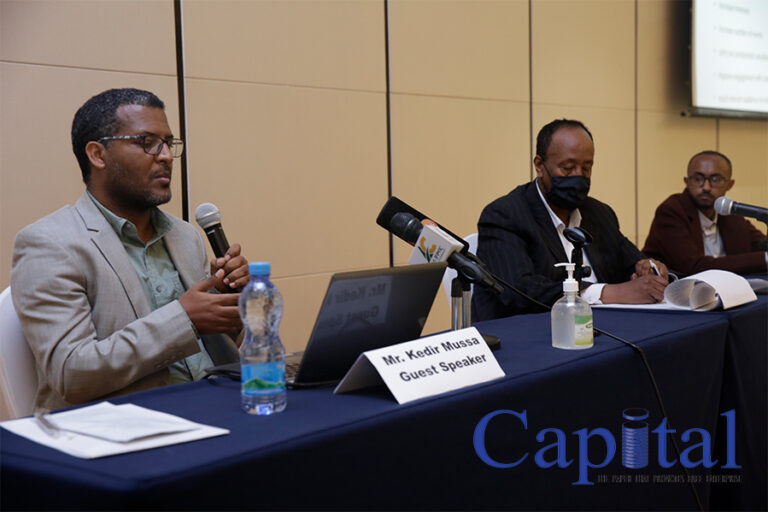
The opening up of Addis Ababa Exhibition Centre and Millennium Hall is recommended as soon as possible to return back the MICE (Meetings, Incentives, Conventions and Exhibitions) industry.
A study commissioned by the Addis Ababa Chamber of Commerce and Sectoral Association ‘on the impact of COVID 19 in the networking and event organizing industry’ shows that the MICE industry, which is a segment of the tourism industry that has been getting recognition as a sub-sector relevant for the development of tourism, has been significantly hampered by the global pandemic rather than any economic sector.
The study conducted by TopClass Consult indicated that like other countries, the pandemic in Ethiopia affected every industry, and the MICE industry is among those that was hit hard. “Under the conditions of harsh travel restrictions and closed borders, the Ethiopian MICE industry faced a sharp reduction of demand,” the study revealed.
It added that Ethiopian Airlines, hotels, car rental companies and other tourism-related businesses have experienced significant losses.
Because of the travel restrictions effected across the globe and public gathering restrictions imposed in the case of Ethiopia, many events were canceled and millions in revenue were lost that led to more than 50 percent decrease in revenue compared to pre-COVID 19 activities that also hampered the industry with cash shortage to settle their liabilities and invoices.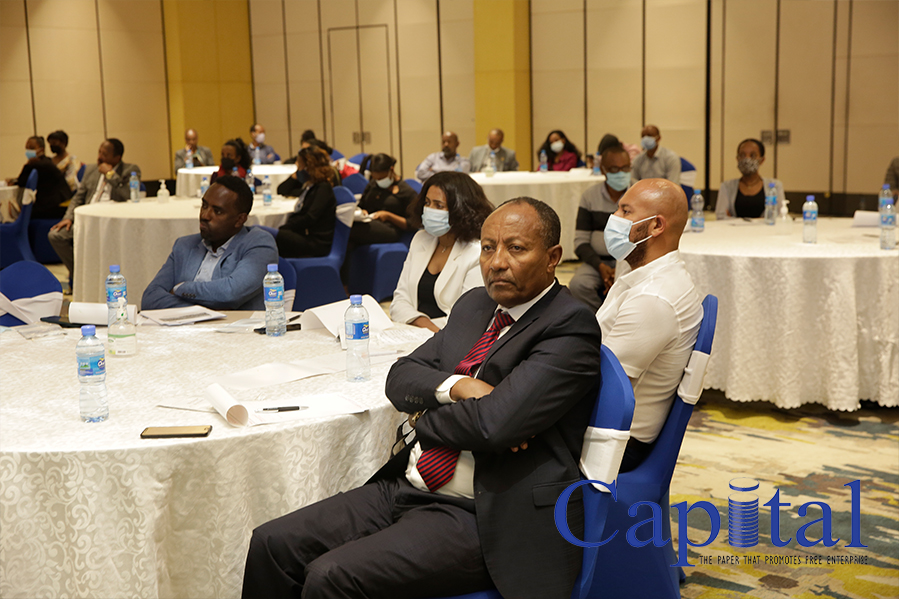
The study stated that networking and event organizing companies had adopted strategies to mitigate the challenge, while the government provided support through tax exemptions.
“The hit is so hard to the MICE industry and with travel and public gathering restrictions are yet to be relax, the COVID 19 impacts are so substantial and difficult to overcome in short period of time,” the report added.
It recommended that different initiatives are supposed to be applied to bring back the sector to normalcy.
“Addis Ababa Exhibition Center and operationalize of the Millennium Hall should resume their operation as soon as possible,” the report added.
Kedir Mussa, one of the presenters of the findings of the study, told Capital that the two facilities are the major centers for events in the city but they were inactive for over a year because they are assigned to help fight the pandemic as one being a treatment center and the other used for mobilizing resources.
“The virus will not stop in the foreseeable future and due to that the government should shift the current activities to health centers and return the MICE facilities back to their normal service on the aim to boost the economic benefit from the industry,” he explained.
He added that it is difficult to put value estimation in relation with the effect of COVID 19 because of lack of access to the required data.
According to the study, the networking and event organizing companies are very concerned of the COVID 19 outbreak and its impact on their business, since travel restrictions made most of the in person meetings cancelled.
Companies in the MICE industry are also highly impacted and are struggling financially or forced to completely close their business.
Companies with strong financial source, such as the Great Ethiopia Run, are impacted financially but are able to endure the storm.
The study also revealed that the outbreak of COVID 19 in March 2020 followed by the lock down announcement by the government forced the MICE industry to cancel 5 to 20 booked events on average which led to decrease in sales and loss of more than 5 million birr of revenue.
As a result of COVID-19, the Networking and Event Organizing companies have experienced 50 percent decrease in revenue for 2020 compared to 2019. They also faced 50 percent to 75 percent decrease in profits in 2020 and few even incurred loss, according to the study.
The study indicated that international arrivals, which may have different forms like leisure and holiday, business or conference in Ethiopia have been growing steadily with little ups and downs over the past four prior-COVID years.
As of March 2020, international arrivals decreased by 35.5 percent year-on-year to 118,950 mainly due to decreased or cancelled flights that follow the outbreak of COVID 19.
In 2019 the tourism sector contributed 9 percent for GDP, while 812,000 tourists visited Ethiopia and provided 2.2 million jobs, or 8.3 percent total employment.
Before the pandemic hit, the Ministry of Tourism and Culture expected this to increase even further and predicted it to be 2.5 million arrivals per year by 2020.
The MICE industry is highly reliant and contributes to the leisure and hospitality sectors.
In its recommendation the study applaud the opening up of the networking and event organizing sector with companies to use prevention methods of the spread of COVID 19, “trade fairs and exhibitions should strictly follow the COVID19 preventive protocol.”
Serving the community
Corporate social responsibility (CSR) is not going to solve the world’s problems. Meanwhile in the modern world the concept catch economic players and replaces companies’ commercials or advertisement by investment on social contribution. That said, CSR is a way for companies to benefit themselves while also benefiting society.
Globally institutions carry-out what is commonly known as CSR through the provision of various benefits to surrounding communities and the public. They seem to understand providing such benefits and promoting those efforts to the larger public is as good as advertising their products and services since it increases their acceptance in the public eye.
Companies, particularly in other countries, carry out CSR through the provision of various benefits to the surrounding communities and the public in general. This culture is also adopted by local companies where efforts are being made to responsibly dedicate their resources to the community. It has become common to observe schools, roads, and water pipeline built by local as well as international companies.
Though not as one expects, institutions in Ethiopia are also performing social functions, but with a number of problems. Companies are not seen employing strategic or long term plans. Instead, they rely on short term plan leading to investments in inappropriate projects. Practitioners also have little know-how on how to conduct CSR functions.
Even though the growing private sector in Ethiopia is now understanding the concept and playing big role to improve the living standard of the general public in different approaches particularly in direct and indirect donation and support. However their role does not get adequate recognition due to several reasons including lack of communication and know how.
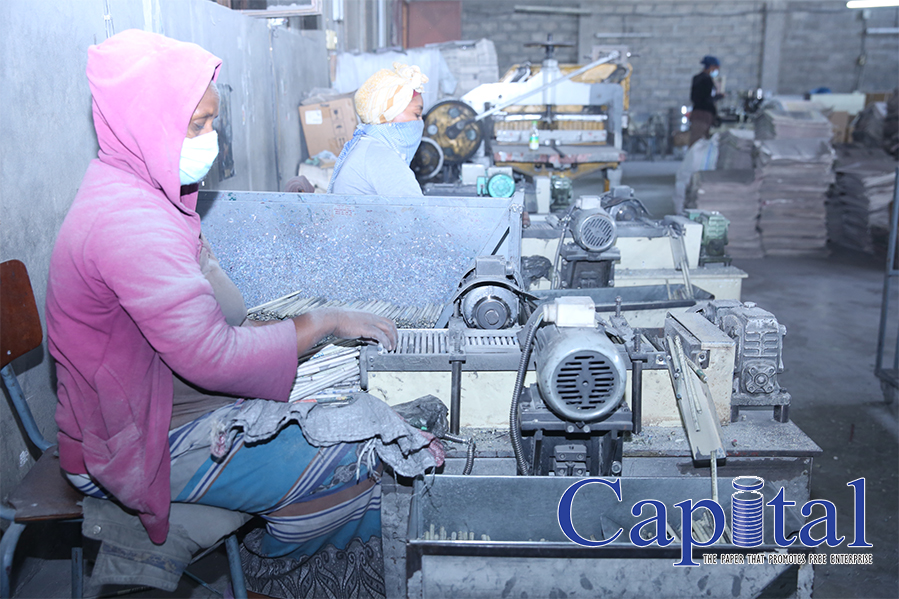
One of them is Sisay Shekour, an investor engaged in different businesses including an industry Apex plc, a pioneer and the only environmentally friendly pencil factory in Ethiopia.
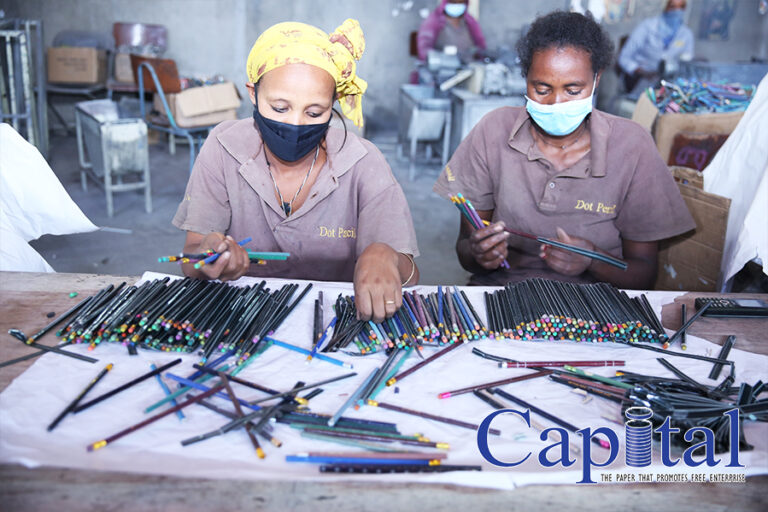
However Sisay’s environmentally friendly pencil factory, Dot Pencil, creates significant job opportunity mainly for women, his company role did not get the required attention. Capital talked to Sisay about his factory and its other activities in the area, Gelan, 28km south east of Addis Ababa in Oromia region. Excerpts;
Capital: Let us start from the factory?
Sisay: The company that started as a climate friendly manufacturing industry about 17 years ago at Gelan, an industry town. As far as my knowledge we are the only pencil factory in the country. Currently from the total of 180 employees, 97 percent are women.
Capital: Your company is stated as environmentally friendly, what does it mean?
Sisay: Our pencil factory is also a pioneer by introducing unique pencil product that is well accepted by customers. What it makes environmentally friendly is that we are not using forest products for our production; rather our major input is waste papers and used newspapers than using the traditional stick to make pencil. On this scheme youths in different part of the country are collecting used papers and wastes that they supply for us for recycling on the pencil production process. Really we are very satisfied for our contribution to keep environment and not contributing for deforestation. Besides that it has also created several jobs for others, who collect the papers and sell to our factory.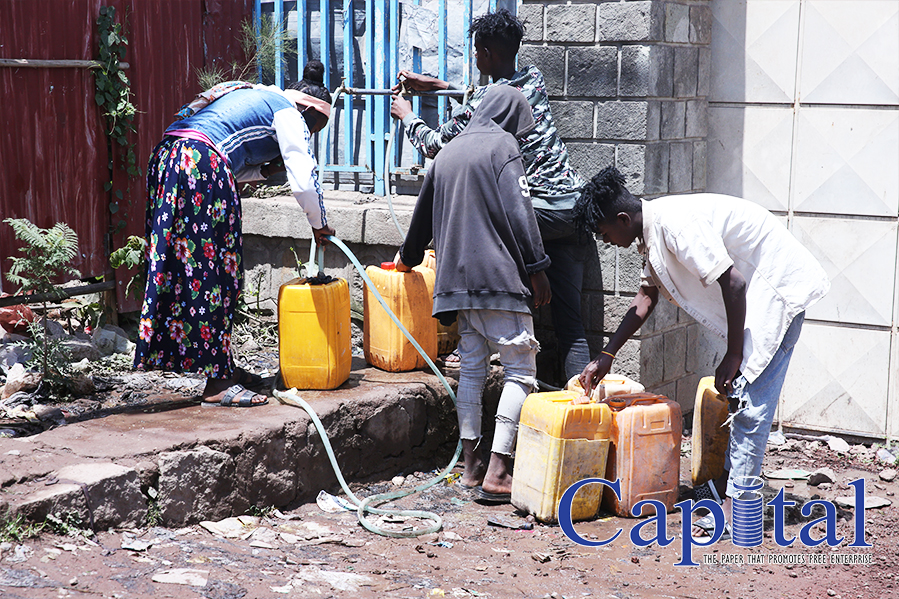
Capital: During our visit to the industry town of Gelan we have learnt that you are involved on CSR, can you explain it?
Sisay: Currently Gelan is one of the major industry hubs in the country. When we started our factory about two decades ago we are one of the two or three private businesses in the area and the town was also very small. When we commence activities we learnt that there are some social challenges like lack of jobs for women and they go very far to fetch water from a pond. Other wise to get safe tap water they have to go back to Akaki or go up to Bishoftu town, which is very far and need extra expense that is unaffordable for the society. So we decided to share their burden by providing job for women and supplying clean water for the society for free.
Capital: When and how do you start the water supply and how does it operate?
Sisay: We drilled 207 meter deep water well that produces 3 liter per second by hiring an Indian contractor. It started 17 years ago and the water production capacity is the same through all these period. We are pumping the water throughout the day, while it is very expensive due to the power interruption which is frequent and that forced us to use diesel generator to continue the supply without interruption. For this service we have different costs like the expense for regular maintenance and permanent employees to look after for the service all the time.
Capital: Who use the water and how?
Sisay: It is available at the gate of the factory, which is located on the main road from Addis Ababa to Bishoftu. So without interruption anyone can fetch water 24 hours a day. Residents, hotels and other businesses or any institution or others who want to get the water can fetch from the facility. Even farmers from the surrounding rural area come with their donkey cart to access the safe water. For instance youths are fetching the water to sell it to businesses around the town. It means that it has become a source of income for the community in the town besides drink.
Capital: Why do you do this and what is your principle for CSR?
Sisay: I feel that I have to share my opportunity for others who need it. I myself have been contributing several supports in different locations and in different social projects. For instance I was engaged in different social works like school development in Gurage zone and other areas, providing different regular support for different communities, constructing different social service centers and this will continue. Creating jobs for young women or sharing their burden by providing water nearby may not big contribution but it creates a satisfaction for me and it is also my responsibility as part of the society.
Capital: Do you get recognition for these initiatives?
Sisay: The biggest recognition we get and that we are satisfied is the feedback of the community, who are really a family of the factory. Secondly as a pioneer we have become a lesson for other industries to engage on CSR in the area. While we received different recognition certificate from the local government and the town and zonal administrations have good feedback for our activity.
Capital: Regarding CSR what is your future plan?
Sisay: There are rural communities in the surroundings of Gelan town that are fetching water from our facility. Now we have a plan to work tirelessly to drill more wells in that surrounding and make it easy for our community in the rural area to access the safe drinking water. We also have different initiative in different forms for the specific area and other places.
