

The 14th edition of Art Dubai recognized as the Middle East’s leading art fair for showcasing local, regional, and international artists is attracting art lovers in the UAE with an in-person fair ended on Saturday.
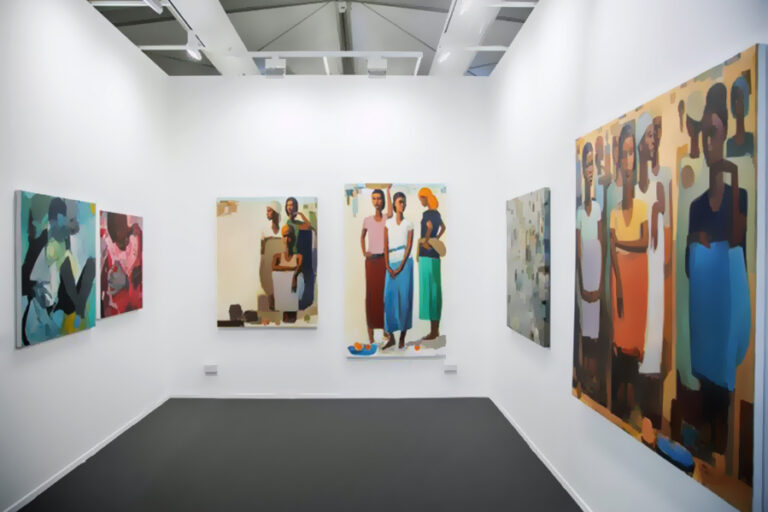
Among the participating galleries is Addis Fine Art gallery, which has set up a booth at the event for the fourth year.
The art hub, which is based in London and Addis Ababa, is exhibiting a group show of four artists from across Ethiopia Tadesse Mesfin, Addis Gezehagn, Tsedaye Makonnen and Tizta Berhanu.
Each of the artists is showcasing new works that explore and document humanity’s adaptability and resilient responses to moments of upheaval.
Gallery co-founder Rakeb Sile said that Art Dubai is one of her favorites.
“It’s the only fair where we get to see galleries from pretty much the global south. It’s a really diverse encounter. Other fairs that we do are not necessarily that diverse,” she said.
She believes that putting Ethiopian artists in “that conversation is also important, because it teaches us things that we wouldn’t have necessarily found out just by doing a Western fair.”
Sile launched Addis Fine Art gallery with Mesai Haileleul as a “passion project.”
“It was like, ‘we know this is amazing; why doesn’t the rest of the world know about any of these artists?’” she said.
Haileleul elaborated on his partner’s words, saying that the art scene in Addis Ababa has “incredible talent.”
“Obviously a lot of people might not be familiar with it. We do not have a lot of galleries there that function and work like Addis Fine Art gallery because it is very difficult,” he said.
“For that reason, artists do not get the representation they badly need. But it’s not for lack of talent. We are there to change that; we are there to help with that.”
(Arab News)
Addis Fine Art gallery showcases Ethiopian work at Art Dubai 2021
ELIMINATING NTDs
Neglected tropical diseases (NTDs) are a diverse group of tropical infections which are common in low-income populations in developing regions of Africa, Asia, and the Americas. They are caused by a variety of pathogens such as viruses, bacteria, protozoa and parasitic worms (helminths). “Neglected”, is often the term used because they generally afflict the world’s poor and historically have not received as much attention as other diseases, such as the big three infectious diseases (HIV/AIDS, tuberculosis, and malaria), which generally receive greater treatment and research funding.
Changing this narrative however is The END (Ending Neglected Diseases) Fund which is a private philanthropic initiative aimed at controlling and eliminating NTDs that debilitate, blind, disfigure, and cause early death to over 1.5 billion of the world’s poorest people.
One of the leaders spearheading this initiative is Sam Mayer who is the Vice President, Public Affairs at the END Fund. He is responsible for the organization’s global external engagement, including advocacy and communications that advance the neglected tropical disease (NTD) platform and attract additional resources and attention to the NTD sector.
Sam leads the END Fund’s efforts to mobilize a growing ecosystem of NTD champions across governments, the pharmaceutical industry, and a coalition of other cultural, private sector, and community-based organizations.
Previously, Sam was Executive Director, International Programs at the M∙A∙C AIDS Fund where he oversaw a grant portfolio that supported 130 HIV/AIDS service organizations across 50 countries. There, he devised public private partnerships and strategic health programs that reached over 26 million people affected by or at risk of HIV/AIDS.
Prior to that, Sam led global fundraising efforts for a leading sport-for-development organization, Grassroot Soccer.
He was also previously Chief Operating Officer for Millennium Promise, and Global Operations Manager at the Clinton Health Access Initiative where he helped establish the organization’s health financing division.
Sam currently serves on the board of the National Jazz Museum in Harlem. He holds a Master’s degree in Development Economics from the University of London’s School of Oriental and African Studies, and a BA in Economics from the University of Strathclyde in his native Scotland. Sam lives in New York with his wife and two children, and enjoys competing in triathlons and marathons. Capital got hold of Sam for detailed insights of the END Funds programs. Excerpts;

Capital: How was the END Fund founded, and what is its primary mission?
Sam Mayer: In 2006, the Legatum Foundation, a founding investor of the END Fund, funded NTD programs in Rwanda and Burundi. Over the span of four years, they supported the treatment of more than eight million people for diseases like intestinal worms, schistosomiasis, and lymphatic filariasis at a small cost. Their intervention demonstrated the feasibility of quickly scaling up NTD programs to a national level. It helped generate the evidence and enthusiasm for creating the END Fund as a philanthropic platform to engage others in ending neglected diseases. Since our founding in 2012, the END Fund has continued to work to ensure that people at risk of neglected tropical diseases in over 30 countries can live healthy and prosperous lives. NTDs are a group of parasitic, bacterial, and viral infections that affect 1 in 5 people globally, leaving them trapped in a cycle of poverty, sickness and suffering. They include diseases such as intestinal worms, schistosomiasis (bilharzia) and trachoma amongst others.
Capital: Describe the new innovative initiatives that The END Fund is deploying to accelerate progress towards elimination of intestinal worms in order to ensure promotion of better health.
Sam Mayer: In support of particularly progressive policy environments, the END Fund supports its government partners by leveraging the power of collaborative philanthropy to build cross-sector partnerships, deepen expertise, and promote a more strategic approach for NTD investment in endemic countries. We work towards elimination of NTDs and health promotion by supporting mass drug administration (MDA) campaigns and advances in health system strengthening through vehicles like our Deworming Innovation Fund. This initiative was established to accelerate progress towards the elimination of schistosomiasis and intestinal worms in Ethiopia, Rwanda, Kenya, and Zimbabwe. Progress is achieved through investing in innovative approaches to treatment, prevention, and financial sustainability. The END Fund increases reach to expanded at-risk populations through generous donations from pharmaceutical companies. We believe in this model of philanthropy because it directly supports host governments and communities who take the lead role in planning, implementing, and assessing local drug delivery strategy with community drug distributors driving strong social mobilisation and service delivery. We recently commissioned a study by the Economist Intelligence Unit to measure the high social and economic returns of investments in NTD treatment and control. The study revealed that $3.2 billion in productivity gains can be achieved from the elimination of soil-transmitted helminths and schistosomiasis in Ethiopia.
Capital: What are the current statistics of people affected by intestinal worms across the world and in the countries where the END Fund operates? What is the END Fund’s strategic plan to bring these numbers down?
Sam Mayer: Intestinal worms affect more than 1.5 billion people, and 40% of the global burden is found in Africa. The END Fund currently works in more than 25 countries, with the highest NTD burden being in the Democratic Republic of Congo, Nigeria, and Ethiopia. Our strategic framework until 2030 is aligned with the World Health Organization (WHO) 2030 NTD Roadmap that seeks to ensure that 90% of people suffering from an NTD receive treatment. The END Fund has supported the delivery of over 140 million treatments annually for the last five years, and we are committed to growing the scale at which we support service delivery over the coming decade, ensuring that hundreds of millions more can live lives free from the burden of NTDs.
Capital: Can you give us an insight on the progress of the “Reaching the Last Mile Fund (RLMF)” since its initiation?
Sam Mayer: The Reaching the Last Mile Fund (RLMF) is a ten-year, multi-donor fund dedicated to the elimination of river blindness and lymphatic filariasis. The RLMF is initiated by His Highness Sheikh Mohamed bin Zayed Al Nahyan, the Crown Prince of Abu Dhabi, in collaboration with the Bill & Melinda Gates Foundation with additional support from a diverse group of philanthropic, corporate and government funders. Since 2018, RLMF has distributed more than 28 million treatments, trained over 435,000 health care workers, and conducted more than 900 surgeries.
Capital: The END Fund has been committed to ending neglected tropical diseases around the globe. How is it raising local and global awareness about these neglected diseases?
Sam Mayer: Despite the well documented effects of NTDs on economic productivity and on the health and wellbeing of communities, these diseases have struggled to garner sufficient political prioritization and remain largely under-addressed. The END Fund engages in both local and global advocacy on behalf of the NTD community by explicitly advocating for public and private funding to tackle these preventable diseases. Our local advocacy includes engaging with governments and NGO implementing partners to assess country needs and coordinate effective program delivery. We complement this by forging strategic partnerships with credible, committed, and effective NTD champions to elevate the NTD platform and reinforce the benefits of effective interventions. For example, in 2019 we partnered with Nigerian national footballer, William Troost-Ekong, to deliver a multimedia public service announcement with support from the Nigerian Federal Ministry of Health that leveraged the timing of Nigeria’s progress in the Africa Cup of Nations and effectively improved knowledge and attitudes towards NTD programs ahead of government-led mass drug administration programs. More recently, in partnership with the Global First Ladies Alliance, we created a program to recruit local champions, including African First Ladies that can advocate for country-led programs through resource mobilization, political support, and garnering public demand for NTD programs. The END Fund’s communications and storytelling initiatives center and elevate the voices and needs of impacted communities. With national voices at the forefront, we can support targeted dissemination strategies to educate audiences, inspiring and mobilizing the communities that we serve.
COVID 19 and the global economy

The United Nations World Economic Situation and Prospects (WESP) mid-2020 report, released recently reveals that against the backdrop of a devastating pandemic, the global economy contract sharply by 3.2 per cent last year. The global economy is expected to lose nearly $8.5 trillion in output over the next two years due to the COVID-19 pandemic, wiping out nearly all gains of the previous four years. The sharp economic contraction, which marks the sharpest contraction since the Great Depression in the 1930s, comes on top of anaemic economic forecasts of only 2.1 percent at the start of the year.
According to the report, GDP growth in developed economies plunged to -5.0% in 2020 and a modest, 3.4% growth, barely enough to make up for the lost output, is expected in 2021. World trade contracted by nearly 15 per cent in 2020 amid sharply reduced global demand and disruptions in global supply chains.
In 2020, nearly 90 per cent of the world economy has been under some form of lockdown, disrupting supply chains, depressing consumer demand and putting millions out of work. The developed economies are contracted by 5.0 per cent in 2020, while the output of developing countries will shrink by 0.7 per cent.
More than any business school corporate case study ever could, the Covid-19 pandemic has made crystal clear how economically and socially interconnected our world has become. This pandemic has revealed how globalization, with its unparalleled levels of human interaction and mobility, has facilitated the rapid spread of this highly contagious disease. Faced with a global health disaster, governments around the world are doing their utmost to save human lives and not thinking about the future of globalization as an existential priority.
Given the above factual explanation, Joseph Vann, Chair of the Strategic Initiatives Department at the George C. Marshall European Center for Security Studies recently said “for years to come, business schools around the world will likely be citing the 2020 Covid-19 Coronavirus crisis as one of the best all time examples of a Black Swan event. For the global economy, it will likely cause a complete re-evaluation of our collective attitudes towards globalization”.
But while mega efforts are underway to manage the health challenge and the economic challenge, it is not too early for other policy makers to begin examining why globalization did not work out the way its advocates either wished or thought it would. This examination should yield some very clear answers.
Joseph Vann, Director of the Program in Countering Transnational Organized Crime Programme at the George Marshall European Center for Security Studies stated that the substantial freeing of market forces during the post-Cold War era directly improved the wellbeing of people around the world. The freedom to trade practically at will and exploit market economies, happily seduced nations into a new and complex system of economic interdependence.
Market exchanges and specialization clearly demonstrated greater efficiencies in the ability to satisfy the needs for goods and services, and this created a thriving international marketplace. Manufacturers around the world grew bigger by using ever deeper supply chains and taking advantage of a global division of labor. All of which was good given no disturbances to the status quo.
Joseph Vann further noted that simultaneously, we witnessed voluntary de-industrialization in Western countries and the transfer of industrial production to emerging economies. As a result, and because of conscious policy decisions, China quickly became one of the world’s leading manufacturing powerhouses. In the search for markets with the lowest costs of production, the total stock of foreign direct investment into China in the last two decades rose from $193 billion to $1.6 trillion in 2018.
Valbona Zeneli noted that beyond partial de-industrialization, especially prominent and subsequently politically treacherous, in the United States and UK, the concept of “just in time” delivery proved an efficient economic alternative to the costs of maintaining inventories. Before we realized it, the concept of just in time manufacturing was born. Advanced economies, using their IT technologies and data driven know how, created the perfect logistics architecture. Managing the global supply chain and its distribution networks, so the underlying promise, could be handled with the ease of a mouse click.
According to Valbona Zeneli, all of this brilliance in getting products to market seemed to have overlooked the single point of failure that could ultimately disrupt the global economy, the growing deficiency in the global diversity of suppliers. The Covid-19 pandemic has demonstrated the lack of diversity in existing global networks. Supply chains have failed. Orders are backlogged. The lack of options with regard to suppliers are now vulnerabilities and have become painfully visible. It was not just the promise, but the firm assumption of “just in time” practices that had us mislead ourselves into reducing stocks and accepting too little redundancy in production capability and capacity to meet demand.
In a crisis situation, production bottlenecks can cost human lives. To give but one example, the lack of critical medical supplies is preventing the fight against Covid-19. By some estimates, more than 50% of the medical masks are made in China. The backlog in production and delivery has cost the world dearly. China is also the largest exporter of chemical ingredients used in antibiotics and other drugs. Medical companies and hospitals having grown dependent on China working its just in time planning magic are now struggling.
Michael Zurn, Director of Research on Transnational Conflicts and International Institutions at the Social Science Research Center in Berlin argued that for all the good and the efficiency it created, globalization was never meant to absolve national policy makers of the requirement to maintain economic sovereignty. Nations and their government leaders have a moral duty to maintain economic sovereignty by ensuring that their economies are resilient to the inherent traps of globalization.
Michael Zurn noted that failing on that account is not a failure of globalization, but a profound miscalculation and form of over-optimism at the national level. This also makes plain why de-globalization efforts would bring more disadvantages than wins.
According to Valbona Zeneli, the key lesson learned from the current crisis is this: The maintenance of sufficient economic room of maneuver in case something does not work perfectly should be the core goal of globalization. In fact, this kind of foresight is what the art of management is all about.
Ministry of Agriculture eyes to triple dairy production
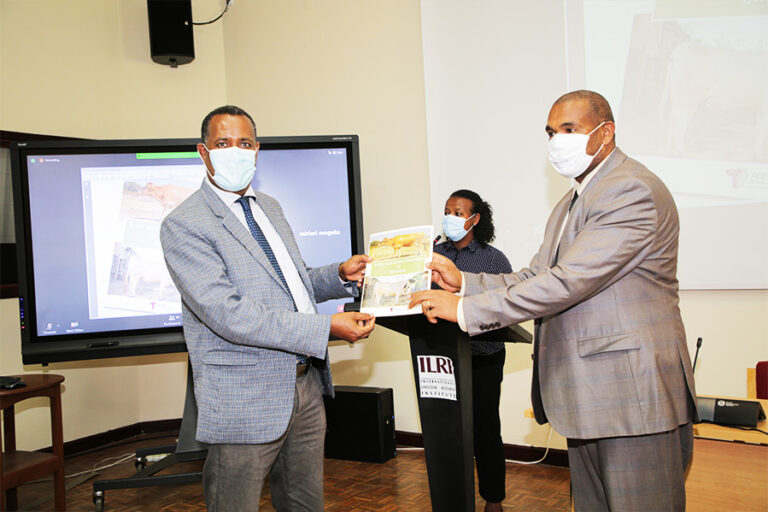
Ministry of Agriculture targets to triple the dairy production in the coming decade to 10.4 billion liters, while access to improved genetics in the sector has acquired prior attention in the strategic plan.
On similar developments, the first dairy animal parade was held early this week which was organized by the International Livestock Research Institute (ILRI) and the National Animal Genetic Improvement Institute (NAGII).
During the parade held on Tuesday March 30, it was disclosed that the farmer-feedback systems which assist farmers to improve their productivity was piloted successfully.
The information of ILRI indicated that milk production in developing countries, including Ethiopia, is dominated by smallholder dairy farmers, each keeping 1-3 dairy cows. Majority of these farmers are not currently extracting optimum benefits, because herd and cow production, and productivity levels remain low.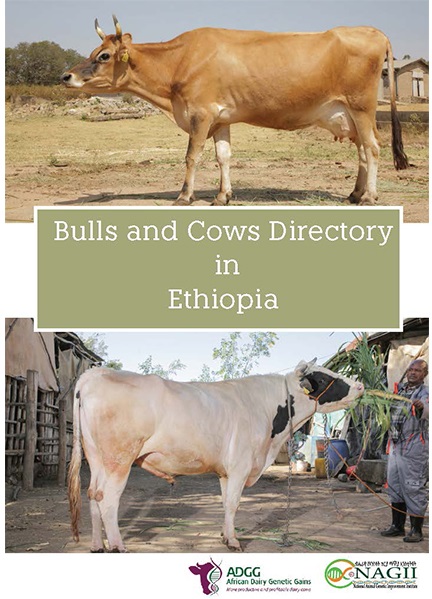
It explained that in Ethiopia, African Dairy Genetic Gains (ADGG), farmer and country-focused ILRI-led project, is jointly working with NAGII, and other domestic and international partners. To this end, the program objectives are to establish performance recording and sampling systems in Ethiopia and Tanzania. The information and samples will be used to develop systems to select crossbred bulls and cows of superior genetic merit for artificial insemination (AI) and natural mating; pilot farmer-feedback systems that assist farmers to improve their productivity; and establish public-private, non-government organizations, and producer partnerships necessary for funding and scaling the on-going ADGG program into a regional platform.
Under the pilot program that took five years, the very best males were selected to provide semen for AI through national and regional AI centers in Ethiopia. “This way, the genetic variability among and within cattle breeds in Ethiopia are being efficiently exploited, while at the same time a population of resilient yet productive dairy genetics is slowly being built,” the ILRI document explained.
The project routinely captures herd performance records of individual animals, their production environment and genomic information. The data generated is used to identify appropriate dairy genetics, including crossbred bulls of superior genetic merit for increased milk production, fertility, longevity, and resilience. ADGG is operating in 98 districts in Amhara, Oromia, SNNP, Sidama, and Tigray, regions, and Addis Ababa.
Elite animals have been certified and promoted to AI centers, the top 3 locally adapted crossbred bulls were transferred to AI center for wider national use.
Asrat Tera, Director General of NAGII, said that the new initiative has its own roll to reduce the demand for foreign currency for the import of semen.
MoA has targeted to expand the market oriented milk product and productivity for the growing demand in the country.
Fikiru Regessa, State Minister of Agriculture, reminded that the country is endowed with large population of cattle but the product and productivity of milk is low in terms of fulfilling the existing demand, “It needs to be linked with improved genetics, animal health, feed, and husbandry practices.”
He told media that the ministry projects to boost the milk development to 10.4 billion liters by 2030 from the current four billon liter.
Fikiru, who is also a molecular biologist and a genetically engineering scientist by profession, said that to attain the goal MoA is working with NAGII in collaboration with international partners to expand and improve animals in the sector, from the current poor level.
He said that from the targeted milk production, the cattle sector will take the major share, while camel and goat milk is the other product.
In Ethiopia’s livestock sector, improving the genetics has been conducted for many years for breeding purposes. For the last seven decades, the country had imported semen for breeding with local animals for better output. However, there was some initiative for the assessment of required and actual data was not properly registered regarding the production of milk, health and breeding value at the farmers’ level.
Under the current program, it has been covered on selected sites alongside an organized database for the identification of best performing animals.
According to experts, the program has achieved ‘identifying the expected results.’
The ADGG program supports Ethiopia’s national dairy recording center to operate a digital data capture platform that has enabled more than 70,000 dairy herds and 110,000 animals to be registered and their pedigree and performance data recorded.
Genomic information is captured on a sub-set of the animals and all records are appropriately analyzed to generate breeding values that are used to rank animals.
Currently, about 3 million of the total cattle population is included on improved animals in Ethiopia, while the total number is 61 million. “We select the top performing bulls to provide semen for AI through national and regional AI centers in Ethiopia and circulated to the farmers. It replaces the cost of foreign currency allocated for the import of improved bulls,” Fikru said.
“This way, the genetic variability among and within cattle breeds in Ethiopia are being efficiently exploited, while at the same time a population of resilient yet productive dairy genetics is slowly being built,” the ADGG document explained.
“It will also scale up the scheme since farmers would get information about the current initiative,” the State Minister said.
Improved cows give about 15 liters of milk per day, while local cows’ average milk production is 1.5 liter per day.
“We have to focus on production based husbandry practices than increasing the number of animals,” Fikru explains, “the ten year strategic plan has also given main attention to the expansion of improved animals coverage.”
The 14 AI centers will manage the plan with different breeds. According to Fikru, synchronization and scaling up will be the next mission and facilities and infrastructures requiring empowerment have got attention by MoA to fill the growing demand.
He added that the private sector as investor and public private partnership will also be part of the initiative. “Currently, the involvement of the private sector in related with improved animals’ development is concentrated in urban areas but that is supposed to be expanded and grown, thus the government will have different initiatives to attract the private sector,” he expounded.
In the aspect of giving attention for improved breeds, the government is further looking for feeds for the animal as per the demanded level.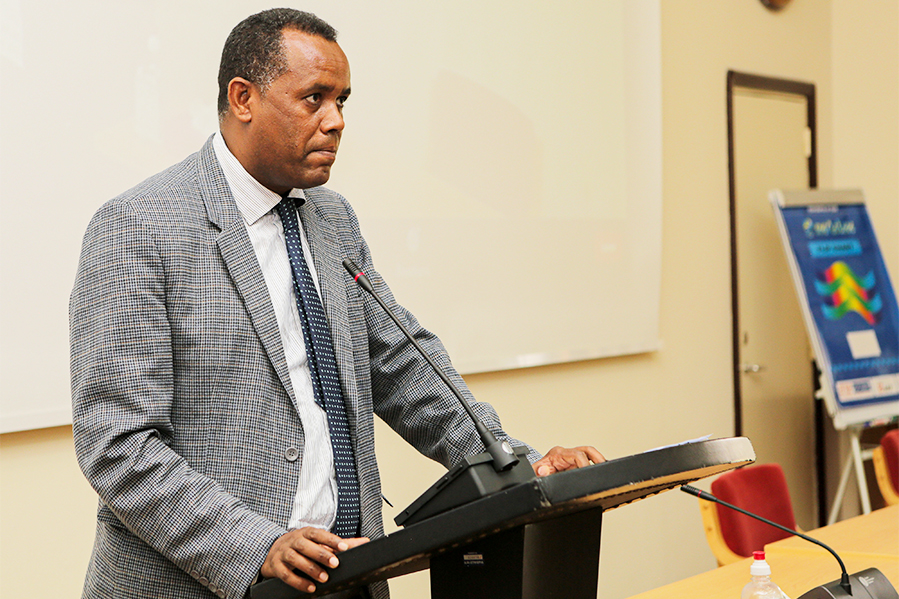
“Currently, the feeding center like open grazing land have deteriorated thus farmers are now alert and prefer to focus on quality than quantity of cattle which boosts the demand for improved animals,” the State Minister said.
Presently, there are four animal feed sources; open grazing land, which is highly reduced because of urbanization, crop agriculture mixed that dominate the mid and highland areas, whilst the third source is improved animal feeds and multipurpose trees that shall accommodate as alternative at densely populated areas. Fourthly, industry wastes are also an alternative which have been used in commercial farming.
“Improving the sector would not have any positive result without giving focus to the feeding system thus animal feeding has got proper attention, however, there are certain challenges,” Fikru stated amplifying the commitment of his ministry.
The dry season irrigation based harvest from mainly the wheat production that includes the low land will expand the feed security for not only the sector in general but also for pastoralists.
The first Ethiopian dairy bulls and cows’ directory that was stated as a milestone for the sector was also launched at the same event. In addition, the dairy animals’ catalogue application was also introduced.
